Model Governance and Evaluation Pipelines: The MLOps Stack Enterprises Are Adopting in 2026
How enterprises build governed MLOps in 2026: evaluation gates, model registries, drift detection, policy-as-code, and safe rollout patterns for auditable AI.
Why Model Governance Became an Engineering Discipline
Five years ago, model governance was a policy slide deck. A committee voted, someone filed a form, and the model shipped whenever it passed a single review. In 2026 that approach fails almost immediately, because the number of models in production has exploded.
Most enterprises I work with now run dozens of machine learning models and generative AI agents in production simultaneously. The old "review once, ship forever" mindset cannot track versions, measure degradation, or prove compliance across that scale. Governance stopped being a compliance exercise and became a continuous engineering problem.
Regulation pushed this forward. The EU AI Act's obligations hit their full effect around August 2026, and frameworks like the NIST AI RMF and ISO 42001 gave organizations a concrete way to structure their controls. What these standards share is a demand for evidence: reproducible runs, traceable lineage, documented evaluation, and continuous oversight.
So model governance in 2026 means reproducibility, traceability, continuous evaluation, and rollout control. It means any model can be rebuilt from a known recipe. It means every artifact has a clear origin. It means performance is measured after deployment, not just before. And it means a bad model never reaches all users at once.
The teams that ship governed models do not treat evaluation as a final sign-off. They build evaluation gates into the delivery pipeline itself. That single shift is the difference between governance as theater and governance as engineering.
The Model Evaluation Pipeline — From Offline Benchmarks to Production Gates
The evaluation pipeline enforces decision gates before deployment. Evaluation is not one event. It is a pipeline with stages, and each stage ends in a decision gate. If a model fails a gate, it does not move forward until the failure is understood and resolved.
The first stage is offline evaluation, before anything reaches infrastructure near real users. You split data into training, validation, and holdout sets. You measure domain-specific metrics: precision and recall for classifiers, RMSE for regressions, recall@k for retrieval systems. This stage catches the obvious problems cheaply.
The second stage is the pre-deployment gate. Here you run fairness checks, adversarial inputs, and performance verification against business thresholds. In many teams this is where a human reviewer signs off alongside the automated checks. The model also gets a spot in a model registry, with its lineage, metrics, and approval state recorded.
The third stage is rollout. You expose the model to limited, controlled traffic through shadow or canary patterns before broad release. This is evaluation with real users but bounded risk.
The fourth stage is production monitoring. Continuous metrics, drift detection, and business impact measurement now run forever, not once.
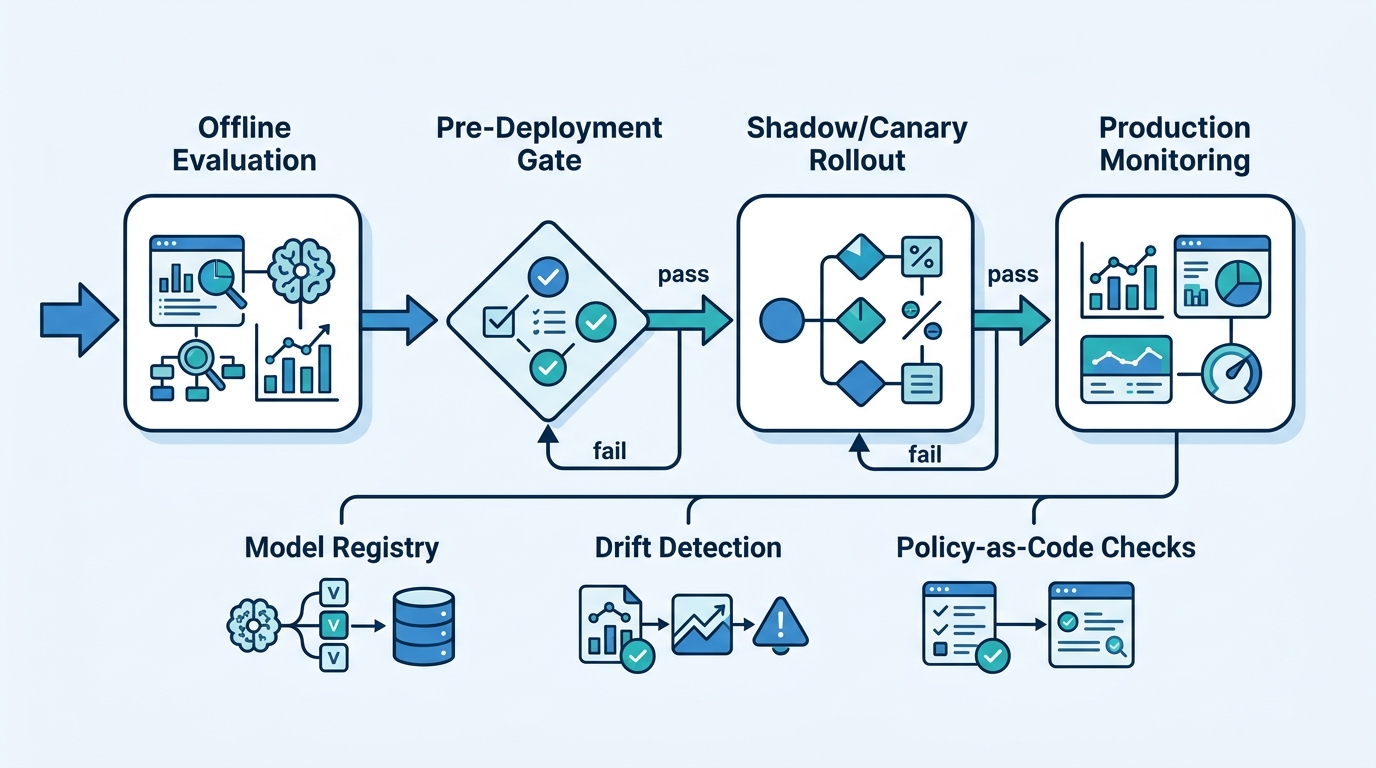
What matters is that every gate has explicit exit criteria. A gate without a defined threshold is not a gate; it is a formality. In practice, teams document things like "minimum 0.95 precision on the validation quarterly slice" and "no more than 2% increase in p95 latency" so that pass and fail are unambiguous, reviewable decisions, not vibes. If you do not know whether a number is a pass or a fail, you have not actually defined a gate.
Key insight — A decision gate with a written threshold turns "is this ready?" from a discussion into a measurement. That measurability is what makes governance auditable and repeatable.
Why LLMs Broke the Evaluation Playbook
Classic machine learning evaluation assumes a ground truth. You know the correct answer, and you score predictions against it. Large language models broke that assumption.
LLM outputs are non-deterministic. Ask the same model the same question twice, and you can get two different answers. There is often no single correct answer to score against, especially for open-ended generation, summarization, or reasoning.
So evaluation changed. LLM evaluation requires LLM judges and human feedback to reach reliable signals. Teams use LLM judges, where a strong model scores another model's output. They use reference-free metrics that evaluate a response without a gold answer. They sample human preferences to measure quality that machines cannot judge reliably. They track hallucinations and prompt drift, problems that barely existed in classic ML.
A concrete LLM judge checklist looks like: does the answer stay grounded in the provided context, does it contradict prior turns, is it fluent, and does it satisfy the user's actual request? Each item gets a score, and the aggregate becomes the gate metric.
Cost and latency also became first-class evaluation dimensions. A model that is accurate but too slow or too expensive is not production-ready. Evaluation in 2026 weighs accuracy, safety, latency, and cost together, not accuracy alone.
The Model Registry as the System of Record
Every governed model needs a home. That home is a model registry, and in 2026 it is the single system of record for model lifecycle.
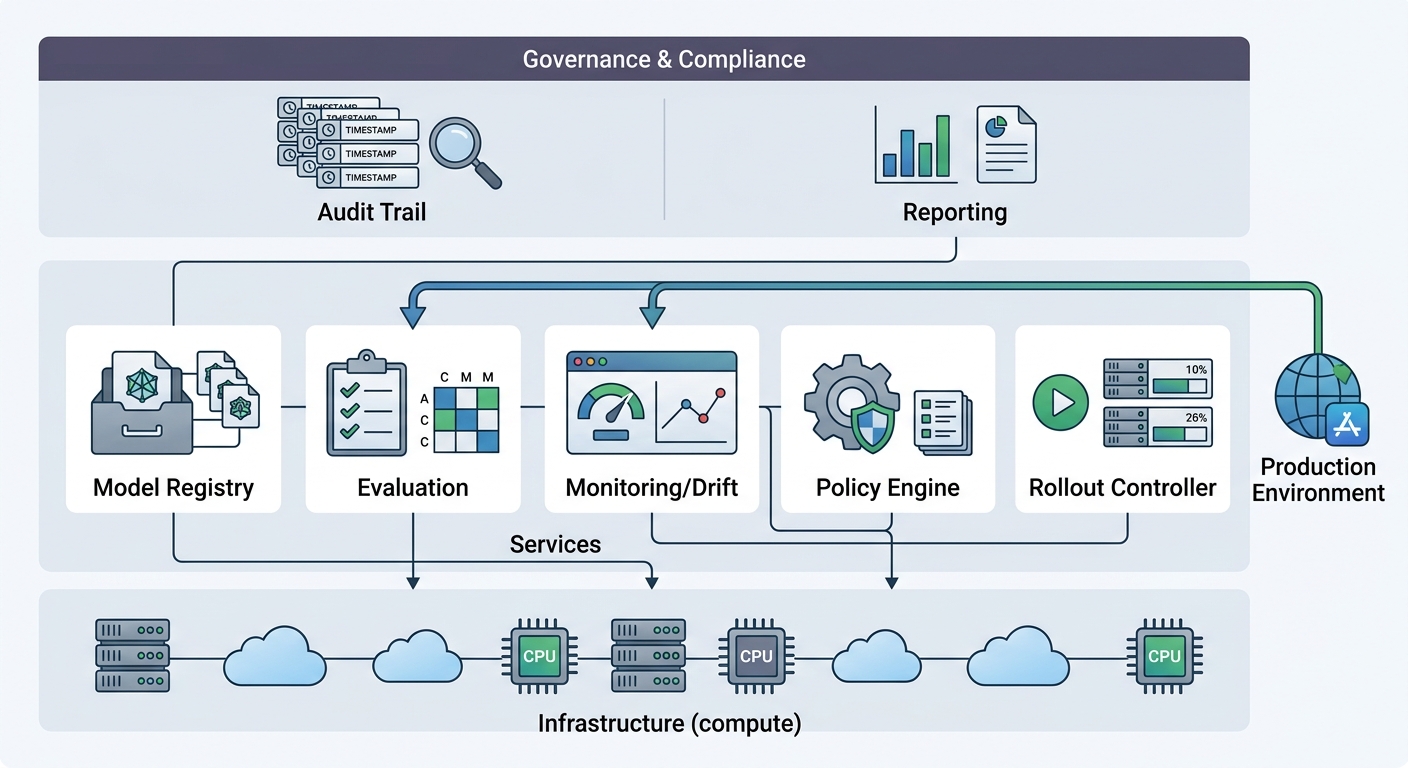
A model registry stores versions and lineage for audit. It stores versions, so you always know which model is current. It stores lineage — the data, code, and configuration that produced the model. It stores performance metrics, including drift indicators over time. And it stores the approval state: drafted, in review, approved, deprecated, revoked.
Approval flow matters. A registry that anyone can write to and promote from is not governance. Real teams enforce that only approved, reviewed versions move from staging to production, and every promotion is recorded with who did it and when.
This registry is also the evidence layer. When an auditor or compliance officer asks "which model decided this, on what data, and did you review it?", the registry is where the answer lives. It turns governance from a narrative into pullable, queryable facts.
Drift Detection — Catching Degradation Before It Costs Money
Models decay. The distribution of real-world data shifts, user behavior changes, and the relationship between inputs and outputs changes with it. If you do not watch for it, accuracy slides silently until someone notices in a support ticket.
Drift detection triggers automated retraining when inputs or behavior shift. It separates the kinds of change. Data drift is a change in the input distribution. Concept drift is a change in the relationship between input and the target. Prediction drift is a change in the model's own output distribution. Each signals a different problem and a different response.
For LLMs, prompt drift matters too. Users change how they phrase requests, and the model's behavior shifts in response. Monitoring tracks output distributions, token costs, latency, hallucination rates, and safety.
The practical challenge is thresholds. Set them too tight and alert fatigue sets in; nobody reads the noise. Set them too loose and real degradation slips through. The approach that works is starting with conservative statistical tests, then tuning thresholds against actual incident history over a few months. A common starting point is flagging when a distribution metric moves beyond three standard deviations from the reference window, then tightening or loosening from real data.
The cost framing is straightforward. A degradation you catch through drift detection triggers a retrain, a fallback, or a rollback before it affects users broadly. A degradation you only find through an incident is more expensive by an order of magnitude, in lost revenue, support load, and trust. Model monitoring measures accuracy, drift, and business impact to make that catch possible. Drift detection is the cheapest form of risk insurance an ML team can buy.
The most mature teams tie drift alerts to automatic actions. A drift alert opens a ticket, re-runs evaluation, and can trigger a retraining pipeline or roll back to the last good version. The loop closes from detection to correction without a human babysitting every step.
Policy-as-Code and Automated Governance Gates
Compliance checklists are easy to skip and hard to prove. Policy-as-code encodes fairness and privacy controls as executable checks that run inside the pipeline.
Fairness becomes a bias test that fails the build when a protected group's error rate drifts. Data lineage becomes an automated verification that every training dataset has a documented origin. Privacy becomes a check that personal data is redacted before a model sees it. Risk controls become gates that block deployment when thresholds are not met.
The benefit is that compliance becomes continuous. Every commit, every promotion, every deploy runs the checks. There is no quarterly audit where someone reconstructs what happened; the audit trail is built as you go, from the start.
This matters most under the EU AI Act and ISO 42001, which expect documented controls and evidence. Policy-as-code produces that evidence mechanically and consistently, rather than relying on memory and goodwill.
Safe Rollout — Shadow, Canary, and A/B in ML
Even a well-evaluated model can surprise you with real users. Safe rollout patterns limit the blast radius and give you production-grade evaluation.
Shadow deployment evaluates new models without user impact. It runs a new model alongside the production model but serves none of the real traffic. You compare outputs behind the scenes, measure quality, and decide whether the new model is worth promoting. There is zero user impact, which makes it the safest starting pattern.
Canary release slowly ramps traffic to the new model, say 1% then 5% then 25%. Automated monitoring watches for performance or error regressions and rolls back instantly if something breaks. Canary balances real-world validation with controlled risk.
A/B testing runs two versions in production for a defined period and measures business outcomes — conversion, engagement, or revenue — to pick a winner. This is the most statistically rigorous but also the slowest and most involved pattern.
The decision rule is simple. If you need zero risk and a quick quality read, use shadow. If you are confident but want an automatic safety net, use canary. If you need to prove business impact, use A/B. Match the pattern to the stakes of the decision the model drives.
Governance KPIs Enterprises Actually Track
Governance needs a dashboard, and the numbers leaders care about are specific. The most useful KPIs I see in mature teams are:
- Gate pass rate — the fraction of models that pass each evaluation gate on the first attempt. A dropping pass rate signals upstream quality problems.
- Time to approve — how long a model sits between submission and approval. Slow approvals mean governance is a bottleneck.
- Drift events — how many drift alerts fired and how many led to action. This proves monitoring is doing something.
- Retrain frequency — how often models are refreshed, ideally tied to drift triggers rather than a fixed calendar.
- Production incidents — how many live errors traced back to model failure. This is the number that connects governance to real cost.
Each KPI ties back to a business outcome. Faster approvals and higher pass rates shorten time-to-value. Fewer incidents reduce downtime and support cost. Drift-driven retraining keeps models healthy without wasting compute.
Where to Start — A Bottom-Up Adoption Path
Full model governance can feel overwhelming, which is why teams fail by trying to do everything at once. The pattern that works is bottom-up and incremental.
Start with a model registry and a single evaluation gate. Get one model through the full loop: versioned, lineage-tracked, evaluated, and promoted through a real gate. Prove it works on one model before scaling it to fifty.
Add monitoring and drift detection next, so you can see degradation after deployment and close the loop. Then add canary or shadow rollout for new versions. Add policy-as-code last, once the pipeline mechanics are stable and you can bolt encoded controls onto a working process.
Keep the stack provider-agnostic where you can. Cloud-native tooling is convenient, but heavy lock-in on one vendor makes it harder to govern models that run across providers and complicates multi-cloud compliance. A composable stack, built on open standards and portable artifacts, scales with you and survives vendor changes.
Governance is not a one-time project. It is a discipline that compounds. The teams that invest in evaluation gates, a real registry, drift detection, and encoded policy get not just compliance, but models they can trust at scale. That trust is the real competitive advantage in 2026.
If you are building or maturing your MLOps stack for governance, subscribe to Algorithmine for ongoing, practical coverage of model evaluation, registries, monitoring, and the rest of the production ML toolchain.
Expert Q&A
Q: My team uses many open-source and cloud model tools. Do I need one platform, or can I assemble a governance stack that still gives auditors what they want? A: You do not need a single monolithic platform. What matters is a shared system of record — a model registry that every tool writes to — plus a consistent set of evaluation gates and a retained audit trail. A composable stack built on open standards is often more flexible and less risky than betting on one vendor. Auditors care about evidence and consistency, not about which tool produced it. Just make sure lineage, metrics, and approval state land in one queryable place, or the "system of record" claim falls apart.
Q: What is the most common mistake teams make when they first add drift detection? A: They set thresholds without history, then drown in alerts or miss real degradation. My advice is to start conservative — a common starting point is flagging when a distribution metric moves beyond three standard deviations from the reference window — then tune against actual incident history over a few months. Better yet, wire drift alerts to automatic actions from day one: open a ticket, re-run evaluation, and let the pipeline decide between retraining and rollback. The goal is a closed loop, not a pile of notifications.
Q: How is evaluating an LLM-based agent different from evaluating a traditional classifier I already monitor? A: Fundamentally. A classifier has a ground truth you can score against; an agent's output is open-ended, non-deterministic, and often has no single correct answer. So you need LLM judges, reference-free metrics, and human preference sampling on top of classic accuracy checks. You also track hallucinations, prompt drift, latency, and cost as first-class metrics. Many teams find they need a separate evaluation layer for generative systems, layered over the same registry and gate mechanics they already use.
Q: When is human review still mandatory even with automated gates? A: Automated gates handle the repeatable, deterministic checks: thresholds, fairness tests, lineage verification, and drift. Human review is mandatory in high-stakes or regulated decisions — hiring, credit, healthcare, and anything with significant individual impact — where a model's outcome needs reasoned judgment and accountability, and where regulators expect a documented human sign-off. The pragmatic rule is: automate the mechanical checks, but keep a human in the loop for consequential and ambiguous outcomes, and record that review in the registry.
Q: How do I prove to leadership that model governance is worth the investment? A: Tie governance to business outcomes rather than fear. Track the KPIs that connect to money: gate pass rate and time-to-approve (speed to value), drift events and actions taken (prevention), and production incidents traced to model failure (real cost). Show that drift-driven retraining keeps models healthy without wasted compute, and that fewer incidents cut downtime and support load. Once governance reduces a measurable incident or shortens a delivery cycle, the ROI argument writes itself.