Building a Repeatable ML Experiment Framework: From Ad-Hoc Notebooks to Reproducible Pipelines
Every data scientist knows the feeling. Three months ago you trained a model that hit a great score.
Every data scientist knows the feeling. Three months ago you trained a model that hit a great score. Now a teammate asks how you did it. You open the notebook in shame. Cell order is scrambled. The dataset was overwritten. The library versions are lost. Your result is gone.
This is the notebook trap. It is common, and it is fixable. In this guide we build a repeatable ML experiment framework. It moves you from ad-hoc notebooks to reproducible pipelines. You will get concrete stages, real tool names, and decision rules.
The Notebook Trap: Why Ad-Hoc ML Breaks Down
Jupyter notebooks are excellent for exploration. They show charts inline. They let you change one cell and rerun quickly. But notebooks hide state. Variables persist between cells. Anyone can execute cells out of order. The final output often depends on invisible global state.
This creates three problems. First, non-determinism: the same notebook can give different results depending on how cells run. Second, lost context: nobody recorded which dataset, code version, or environment produced the number. Third, manual labor: teams retype metrics into spreadsheets, then misplace them.
Ad-hoc notebooks are fine for testing an idea. They are not a system for learning seriously. A repeatable framework turns one-off runs into comparable, auditable experiments.
What "Reproducible" Actually Means in ML
Reproducibility means another person can recreate your exact result. In machine learning, four things must be fixed to achieve it.
Code. Every script that processed data, trained the model, or evaluated it must be under version control.
Data. The raw and processed datasets must be snapshotted. A tool like DVC (Data Version Control) links dataset snapshots to code commits. DVC is an open-source tool that versions large files, like datasets, alongside code.
Model. The trained model artifact itself needs a version and a registry. A model registry is a central place that stores versioned, signed model artifacts for production.
Environment. Libraries, Python version, and drivers change results. Containerization with Docker or pinned Conda environments captures the exact runtime.
There is an honest caveat. Seed management helps but is not magic. A seed fixes the random-number sequence used in training. Yet GPU operations are not always deterministic. You should report results across multiple seeds, not tuned to one perfect seed.
The 5-Stage Repeatable Experiment Framework
This framework moves you from notebook chaos to structured pipelines. Each stage builds on the last. You can adopt stages one at a time.
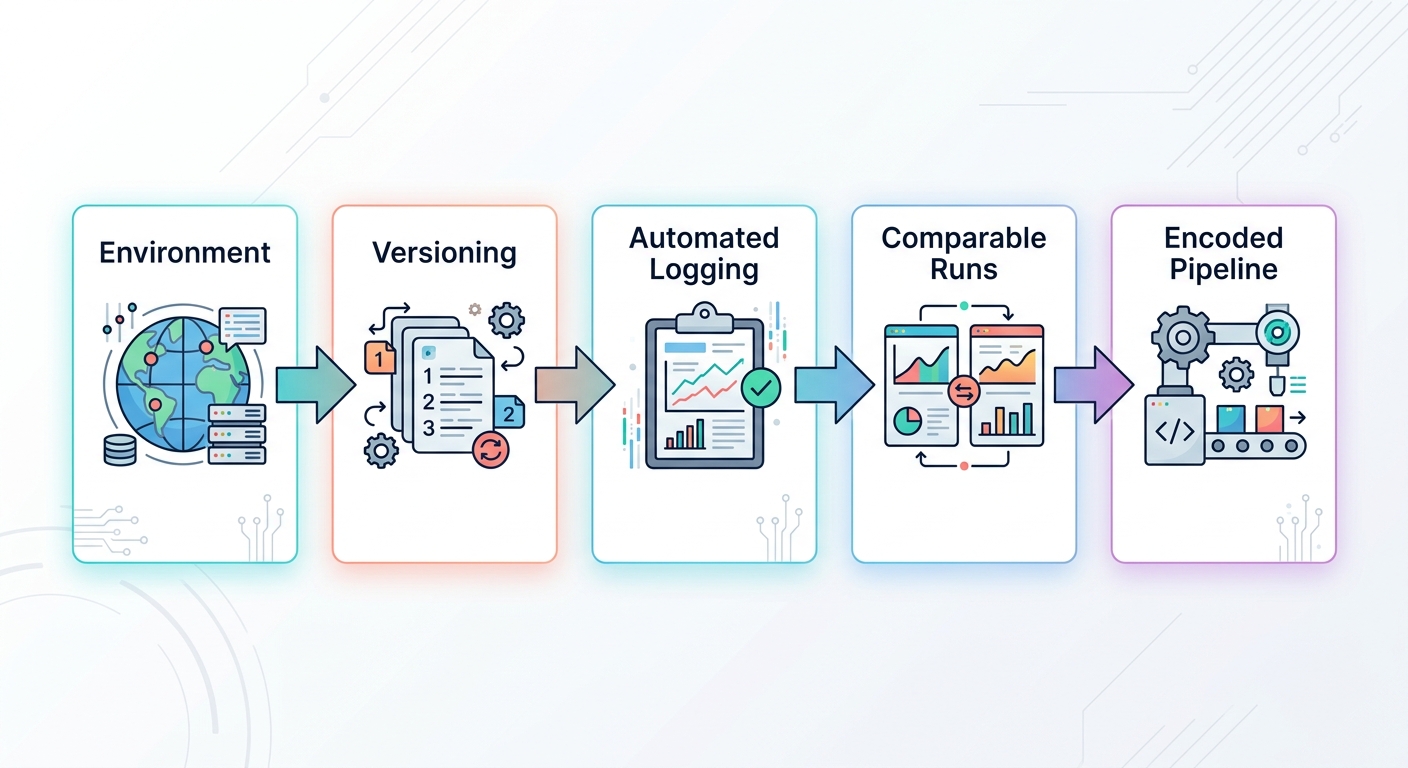
Stage 1 — Standardize the Environment
Start with the runtime. Define your dependencies as code. Use a requirements.txt, a Conda environment file, or a Docker image. Docker is a tool that packages software and its dependencies into a container that runs anywhere.
Pin exact versions. Do not use ranges like pandas>=1.0. An unpinned library can change behavior silently. When a result works, the reproducible environment must be re-creatable from a single command.
Stage 2 — Version Everything: Code, Data, Models
Put your code in git. Git is the standard version-control system for source code. Then version your machine learning datasets with DVC or a similar tool. Link each dataset snapshot to the code that used it.
The model artifact lives in a model registry. Popular options include the one bundled with MLflow. MLflow is an open-source platform for managing the machine learning lifecycle, including tracking and model registry. Store the model version alongside its training metadata.
Stage 3 — Automate Experiment Logging
Stop recording metrics by hand. An experiment tracking framework records parameters, metrics, and artifacts for every run automatically. MLflow and Weights & Biases are two common choices.
Each run gets a unique ID. That ID links to the code commit, data version, hyperparameters, and evaluation metrics. Later you can query this history like a database. Automation removes typos and lost spreadsheets.
Stage 4 — Make Runs Comparable
Comparability requires fixed seeds and clear baselines. Fix the seed for random operations. Run each configuration multiple times and report the mean and variance. Always compare against a baseline model, not just against previous attempts.
Use the tracking framework to compare runs side by side. Sort by metric, filter by parameter, and export the winning configuration. This turns experimentation into a rational search, not a lucky guess.
Stage 5 — Encode the Pipeline
Finally, move the winning logic out of notebooks. Refactor into versioned scripts. Break work into stages: prepare data, train, evaluate. For automation, wire these stages into a pipeline orchestrator such as Airflow or Prefect.
An ML pipeline is a sequence of steps that transform raw data into a deployed model automatically. This is the handoff point to MLOps. MLOps is the practice of applying DevOps principles—automation, monitoring, versioning—to machine learning.
Choosing Your Tooling: A Lightweight Decision Framework
Tool choice can feel overwhelming. Use these questions to decide.
Do you need a centralized tracking platform? If you work alone on small experiments, MLflow's local tracking may be enough. For teams, Weights & Biases or ClearML give richer dashboards and collaboration.
Do you work with very large datasets? Then invest in DVC or LakeFS for data versioning. LakeFS is a tool that brings git-like branching and versioning to data lakes.
Is compliance a concern? A managed registry and audit logs matter. Cloud platforms such as AWS SageMaker, Azure ML, and Google Vertex AI bundle these features.
When do notebooks still win? Keep them for exploration and communication. Move to versioned pipelines once an approach becomes serious. Do not treat notebooks as your production system.
A Baseline Reproducibility Checklist
Use this list before you call any experiment done.
- Dependencies are pinned to exact versions.
- Code is committed to git with a clear hash.
- Dataset snapshot is recorded and linked to that commit.
- Environment is re-creatable from one command.
- Every run has a unique ID in the tracker.
- Parameters, metrics, and artifacts are logged automatically.
- Random seed is fixed and reported.
- Results are reported across multiple seeds.
- Winning model is registered with a version.
- Config is stored as code, not typed by hand.
Common Pitfalls and How to Avoid Them
Pitfall 1: Tuning the seed. Picking the seed that gives the best score is academic dishonesty. Use several seeds and report the range.
Pitfall 2: Silent data drift. The data pipeline changes upstream, but nobody notices. Add data validation gates that check incoming data against expected schema.
Pitfall 3: Partial versioning. Versioning code but not data still breaks reproducibility. Version all four pillars together.
Pitfall 4: Manual tracking. Hand-written metric logs breed errors. Automate with a tracking framework.
Pitfall 5: Docs as an afterthought. Document dataset sources and model behavior. Model cards and datasheets build trust and satisfy compliance.
From Framework to Habit — and the Algorithmine CTA
A framework only works if you use it daily. Start with one stage this week. Pin dependencies. Version your code and data. Log your next run automatically. Add a stage each sprint. In a month the process becomes habit.
Reproducible experiments are the difference between guesswork and genuine engineering. They make your work trustworthy, shareable, and auditable.
The best ML teams do not rely on memory. They rely on systems. A repeatable experiment framework is the system that turns one-off results into durable knowledge.
If you want more practical guides like this, subscribe to the Algorithmine portal. We cover machine learning engineering, MLOps, and AI research every day. Join us and build systems that actually scale.
Frequently Asked Questions
What is ML experiment tracking? It is a system that records parameters, metrics, and artifacts for each training run. This makes experiments comparable and auditable.
Can I keep using Jupyter notebooks? Yes, for exploration. Move to versioned scripts and pipelines once an idea becomes serious.
Why is my model not reproducible even with a fixed seed? GPU nondeterminism, data ordering, and library versions can still cause drift. Report results across seeds.
Do I need a commercial tracking platform? Not always. Open-source MLflow and DVC cover many teams well.
What is the fastest first step? Pin your dependencies, version your code and data, and log every run automatically.