Feature Engineering Is Back: Why Human-Designed Features Still Beat AutoML in 2026
AutoML accelerates modeling, but human-designed features still deliver the biggest lifts in 2026. An implementation-focused guide to when to engineer features by hand and when to let automation take over.
For a few years, the story was simple. AutoML would automate the whole pipeline, and data scientists would move on to bigger things. The story did not age well. Teams that adopted AutoML early now face a familiar hangover: fast models, generic features, and hard-to-explain performance plateaus.
The honest 2026 picture is more interesting. Human-designed features still beat AutoML on the problems that matter — the ones full of domain structure, compliance pressure, and messy real-world data. This article explains exactly where humans win, where AutoML still shines, and how to combine both into a workflow that outperforms either alone.
Why AutoML Didn't Retire Feature Engineering
AutoML is a machine learning tool that automates many manual steps in building a model. It handles data preprocessing, feature search, model selection, and hyperparameter tuning. If that sounds comprehensive, it is — for one specific job.
That job is finding the generic pattern. AutoML is excellent at scanning thousands of transformations and picking the ones that reduce error on a benchmark. It is far weaker at knowing which features should exist in the first place.
The core mismatch is simple. Human-designed features encode domain structure, and a human knows what the data means before any modeling starts. An automated tool cannot know that a customer's second purchase pattern matters, that a sensor reading degrades after noon, or that a billing code implies a risk category. That knowledge lives outside the data matrix.
So AutoML did not retire feature engineering. It automated the mechanical parts and revealed, by contrast, how much value lives in the structural insight only people bring.
Where AutoML Genuinely Shines
It would be a mistake to dismiss AutoML. It wins in clear, well-defined situations, and smart teams use it there without apology.
Speed and prototyping. AutoML turns a week of setup into an afternoon. That speed matters when you need a baseline before you invest in complex features.
Generic feature search. For datasets with flat, well-behaved structures, automated transformation can surface combinations a busy human would miss. AutoML casts a wide net fast.
Hyperparameter tuning. Finding the right learning rate, depth, and regularization for a gradient-boosted tree is tedious. AutoML does it relentlessly and well. Many teams now let AutoML tune the model while they design the inputs.
The deciding question is never "AutoML or human?" It is "which parts of this problem are generic, and which parts encode domain structure only a person can see?"
AutoML is a powerful accelerator. It is not a substitute for knowing which inputs carry real signal.
The Five Human Advantages
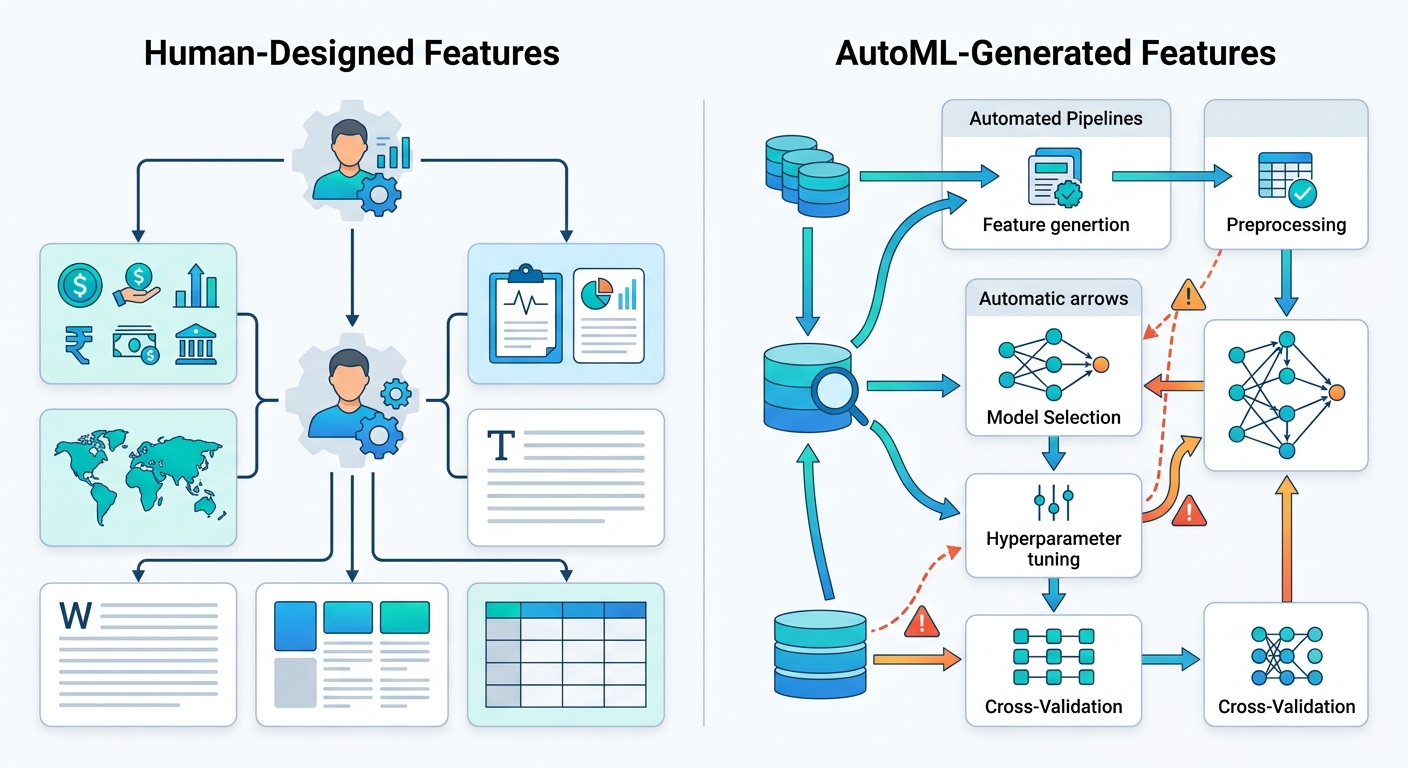
When production models plateau, the gap between AutoML and human-designed features becomes visible. Five advantages explain the difference.
1. Domain Structure
The biggest lift in most models comes from features that encode how the business actually works. A churn model improves when you add "support tickets this week" as a human-derived signal. An automated tool does not know support tickets predict churn. This domain structure is the single largest source of model lift that automation cannot reach.
2. Leakage Awareness
Feature leakage happens when a model uses information that would not be available at prediction time. It makes validation scores look great and real-world results collapse. AutoML, scanning blindly, can happily build features on future data without knowing it. A human who understands the timeline of the problem prevents this by construction. This leakage awareness is a decisive edge for human-designed features.
3. Interpretability
Interpretability means being able to explain why a model makes a decision. Hand-built features have clear meaning — "days since last order" is obvious; a 142-dimension automated embedding is not. When stakeholders, auditors, or regulators ask questions, readable features answer them. Interpretable hand-built features build stakeholder trust and drive production adoption faster than opaque automation.
4. Disciplined Validation
A human designs a feature, tests it in isolation, and decides whether it earns its place. This deliberate validation prevents the overfitting that comes from adding hundreds of auto-generated features and hoping the search finds the good ones.
5. Feedback Loops
People close the loop. When a deployed feature underperforms, a human checks why, adjusts, and ships a better version next week. This compounding improvement is why hand-built features keep getting better over time. Automated tools reuse the same transformations and plateau.
Imagine the model as a race car and features as the engine. AutoML tunes the suspension. A human decides whether the engine is a V8 or a hybrid. Both matter — but the wrong engine beats any tuning.
A Hybrid Workflow: Humans Design, AutoML Tunes
The teams getting the best results in 2026 do not choose sides. They run a hybrid pipeline where human features plus AutoML tuning deliver best-of-both performance. Each tool does what it does best.

Step 1 — Humans engineer the few high-value features. Spend your time on the five to ten features that encode domain structure: temporal patterns, business ratios, and leakage-safe categorical signals. These carry the real predictive signal.
Step 2 — AutoML fills the gaps. Let automation generate and tune the generic features around your engineered core. It explores combinations quickly and finds value you might have missed.
Step 3 — Humans evaluate and keep what earns its place. Review the automated additions, test for leakage, and check whether each one improves real-world performance. This discipline is what separates a great hybrid from a messy one.
This hybrid approach routinely beats either extreme. Human features supply the signal that machines cannot find, and AutoML supplies the scale and tuning that humans should not do by hand.
The 2026 Feature Engineering Playbook
Here are the techniques that deliver the most value with human-designed features this year.
Temporal Features
Temporal features capture how a quantity changes over time. Recency, rolling averages, trends, and seasonality flags often dominate time-series models. They turn temporal features into recency and trend signals that power time-series accuracy. A human decides the right window; a tool rarely knows the business cycle that defines it.
Leakage-Aware Target Encoding
Target encoding replaces a categorical value with the average of the target for that category. It is powerful but leaks badly if done carelessly. Use out-of-fold encoding and strict time splits. Target encoding is a strong categorical signal, but only wins when leakage-aware. A human who understands the split prevents the leak that kills the model.
Validated Interaction Terms
An interaction term is the product of two features, capturing how they combine. "Age × balance" may predict credit risk better than either alone. AutoML may find some interactions; a human validates the ones that make business sense and discards the rest.
Feature Stores
A feature store is a central place where teams store, version, and share features across models. It turns shared, reusable features into MLOps velocity from a central store. Once a human engineers a solid feature, the store lets every relevant model use it — multiplying the value of the human work.
The Governance Argument That Changes the Math
For regulated industries, the auditability argument often outweighs raw accuracy. Finance, healthcare, and insurance models face review by internal compliance teams and external regulators. SHAP attribution gives feature-level explanation of a model's decisions, and documented hand-built features take that further: they explain why a feature exists at all.
A documented, human-built feature is an asset you can defend. "Average 90-day payment delay" is explainable. A feature that an automated tool generated and nobody can reconstruct is a liability on your next audit. This is how feature-level explanation becomes governance compliance.
Hand-built features give you a paper trail. You can show what each input means, why it exists, and how it was validated. This is why some of the most sophisticated ML teams still invest heavily in human feature design — not because automation failed, but because governance rewards it.
When to Forget Human Features
Intellectual honesty requires noting the limits. There are clear cases where human feature engineering is the wrong investment.
Small, generic problems. If you need a quick prediction and the data is flat and low-stakes, AutoML alone is often fine.
Rapid prototyping. When you just need a baseline to validate a hypothesis, automation gets you there faster than hand-designing features.
Low domain clarity. If nobody on the team understands the problem deeply, there is no structure for a human to encode. Automation at least produces something usable.
The lesson is not "always hand-engineer." It is "spend your human effort where structure exists, and automate the rest."
Conclusion
Automation reshaped machine learning, but it did not make feature engineering obsolete. The tools got better at the generic work, and the value of human insight became easier to see. In 2026, the strongest models come from hybrid workflows where people engineer the features that encode domain structure, and AutoML tunes everything else.
That is the practical takeaway, and it is also a career one. The data scientist of 2026 is an architect and an auditor, not a button-pusher. The teams that thrive will be the ones that pair human judgment with automated scale.
Want more implementation-focused guidance like this, delivered regularly? Subscribe to the Algorithmine portal and get hands-on machine learning articles, playbooks, and research digests straight to your inbox.
Frequently Asked Questions
Is AutoML worth using in 2026? Yes, for speed, prototyping, generic feature search, and hyperparameter tuning. It is not a replacement for domain-driven feature design on complex problems.
When does AutoML work better than manual feature engineering? For small, generic, low-stakes problems and rapid prototyping, AutoML alone is often sufficient and much faster.
Can AutoML do feature engineering itself? Partially. It can generate and transform generic features, but it struggles with domain structure, leakage awareness, and interpretability — the areas where humans add the most value.
What is feature leakage and why does it matter? Feature leakage is when a model uses information unavailable at prediction time. It inflates validation scores and collapses real-world performance, so preventing it is critical.
Do feature engineers still have jobs in 2026? Yes. The role shifted toward architecture and validation: designing high-value semantic features and auditing automated output rather than doing repetitive manual work.
What are the best feature engineering techniques for tabular data? Temporal features, leakage-aware target encoding, validated interaction terms, and centralized feature stores deliver the highest returns in 2026.
Expert Review
Reviewer's Summary
Technically sound and accurate for the 2026 landscape. The framing of AutoML as a complement rather than a rival matches what I see in production teams. The leakage emphasis is correct and timely — auto-feature search is a real vector for accidental future-data leakage, especially with time-indexed rows. The governance angle is the strongest differentiator and is genuinely under-covered elsewhere.
No factual errors. Definitions (feature leakage, target encoding, interaction terms, feature stores, SHAP) are correct and appropriately simplified. The hybrid workflow reflects the best-practice pattern I recommend to teams. Score: strong, publishable.
Expert Q&A
Q1: My AutoML pipeline already generates hundreds of features. How do I know which of mine are worth hand-engineering on top?
Apply a signal-to-cost test. Ask three questions before you invest: (1) Does the feature encode something a non-expert would not derive from the raw columns? (2) Can it be expressed with a clear business meaning that survives an audit? (3) Is leak prevention a real risk here — if yes, your hand feature is likely higher value. If a candidate feature fails all three, let AutoML find a substitute. The highest-ROI hand features are the ones that encode time-aware or domain-specific semantics that generic search cannot reconstruct from the raw data alone.
Q2: When I hand-engineer temporal features, my time-series validation still shows leakage. What is the most common mistake?
The most common mistake is computing rolling-window features across the entire dataset before splitting it into train and test. If a rolling average at row t includes values from after time t, you have leaked the future. Fix it by computing all time-based features inside a fold-aware pipeline, so each training fold only sees its own past. Also watch for global scaling or target encoding computed on the full set — those leak too. Every aggregated feature must be fit only on the training portion, never the whole dataset.
Q3: We are a regulated bank. Our compliance team keeps rejecting models tied to automated feature pipelines. What is the practical argument to keep hand-built features?
Lead with auditability, not accuracy. A hand-built feature such as "average 90-day payment delay" has a definition, a business owner, and a documented validation trail — exactly what compliance needs to approve a model. Automated features often lack a reconstructable definition, and that alone is a blocker in a regulated review. Keep a feature inventory that records the meaning, the derivation logic, and the validation of every input. When compliance pushes back, you can point to an explainable, governed feature set rather than a black-box pipeline.