Automated Machine Learning in 2026: How AutoML Platforms Are Democratizing Model Development
For years, building a machine learning model meant assembling a team of specialists. AutoML platforms automate the end-to-end pipeline — data cleaning, feature engineering, model selection, deployment — letting teams without PhD researchers produce production-grade models in hours.
Meta description: In 2026, AutoML platforms let teams build production-ready models without a PhD. This guide compares top tools, explains the pipeline, and shows where AutoML still needs human judgment.
What Is AutoML and Why Does It Matter in 2026?
For years, building a machine learning model meant assembling a team of specialists. You needed data engineers to prepare the pipeline, data scientists to select algorithms and tune hyperparameters, and ML engineers to deploy the resulting model to production. Each step required deep expertise and weeks of iteration. That bottleneck kept AI out of reach for most organizations.
Automated Machine Learning — AutoML — changes that calculation. AutoML platforms automate the end-to-end pipeline: data cleaning, feature engineering, algorithm selection, hyperparameter tuning, model evaluation, and deployment. The result is that teams without a roster of PhD researchers can now produce production-grade models in hours instead of weeks.
The market reflects this urgency. The global AutoML market is estimated at $3.43 billion in 2026 (estimated; industry sources report a range of $3.4B–$6.9B), growing at a compound annual growth rate of approximately 46.5% (estimated). Organizations across healthcare, financial services, manufacturing, and retail are adopting AutoML to accelerate analytics initiatives and reduce their dependence on scarce data science talent.
But the 2026 reality is more nuanced than "AutoML replaces data scientists." The technology works best as an augmentation layer — handling the mechanical repetition of model exploration while human experts focus on problem framing, business context, and edge case reasoning. Understanding this distinction is critical for anyone evaluating AutoML today.
The AutoML Pipeline — What Gets Automated
To appreciate what AutoML delivers, it helps to understand what it automates. The typical ML development pipeline involves at least six distinct stages, each of which has traditionally required human judgment and significant time:
- Data preprocessing — handling missing values, encoding categoricals, normalizing scales. AutoML automates these transformations with sensible defaults.
- Feature engineering — creating new input variables from raw data, such as interaction terms, aggregations, or time-based lags. This is historically one of the most time-intensive steps; modern AutoML platforms generate hundreds of candidate features automatically.
- Algorithm selection — choosing which model families to try (tree-based, linear, neural, ensemble). AutoML systems evaluate dozens of candidates in parallel.
- Hyperparameter optimization — tuning the settings that control how models learn. AutoML uses Bayesian search, random search, or evolutionary algorithms to find strong configurations efficiently.
- Model evaluation and ranking — comparing candidate models on validation data using multiple metrics. AutoML produces leaderboards with transparency into model behavior.
- Deployment — packaging the winning model for serving predictions in production. Many platforms offer one-click deployment to managed endpoints.
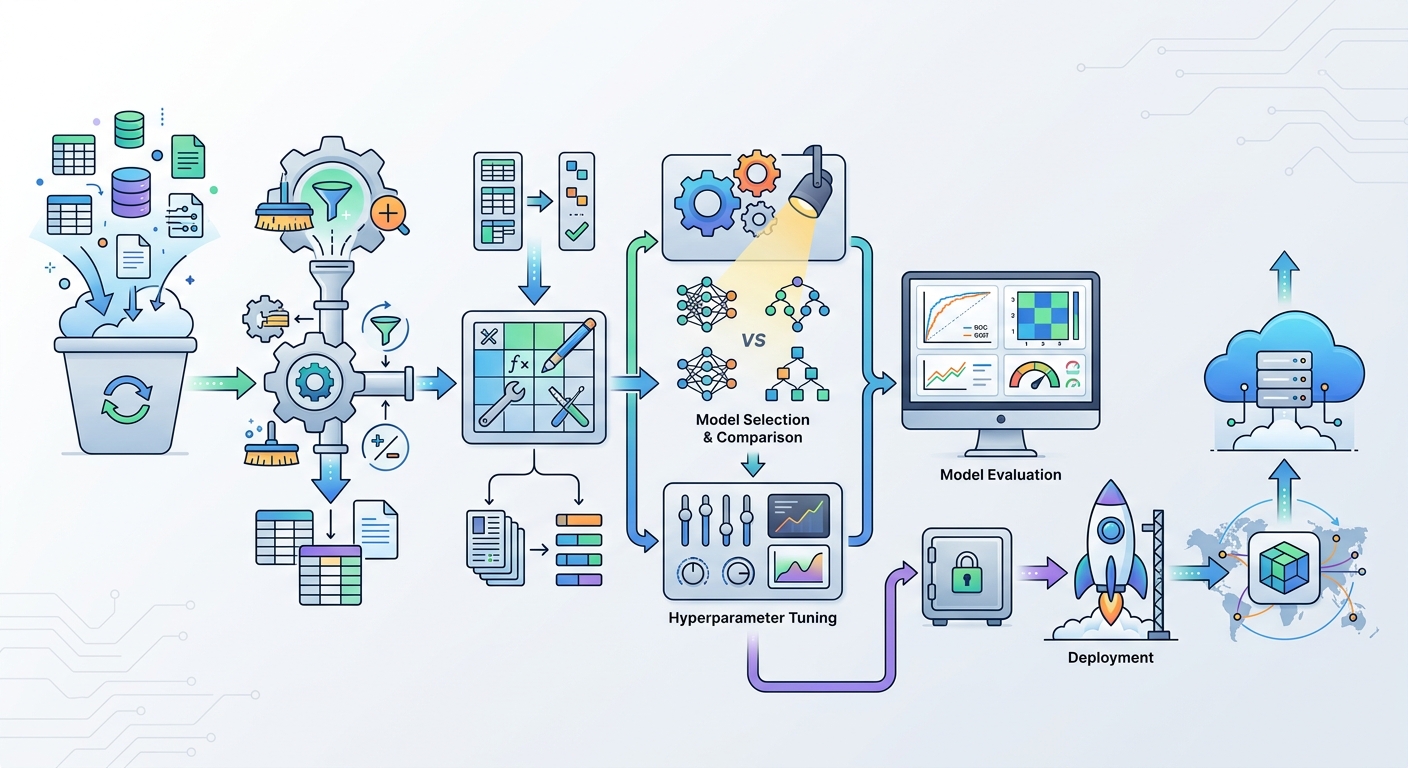
Understanding this pipeline matters because it clarifies where human oversight is still essential. AutoML automates the execution of model search. It does not automate the definition of the problem, the interpretation of results, or the business judgment about whether a model is fit for deployment.
The Top AutoML Platforms in 2026 — Feature Comparison
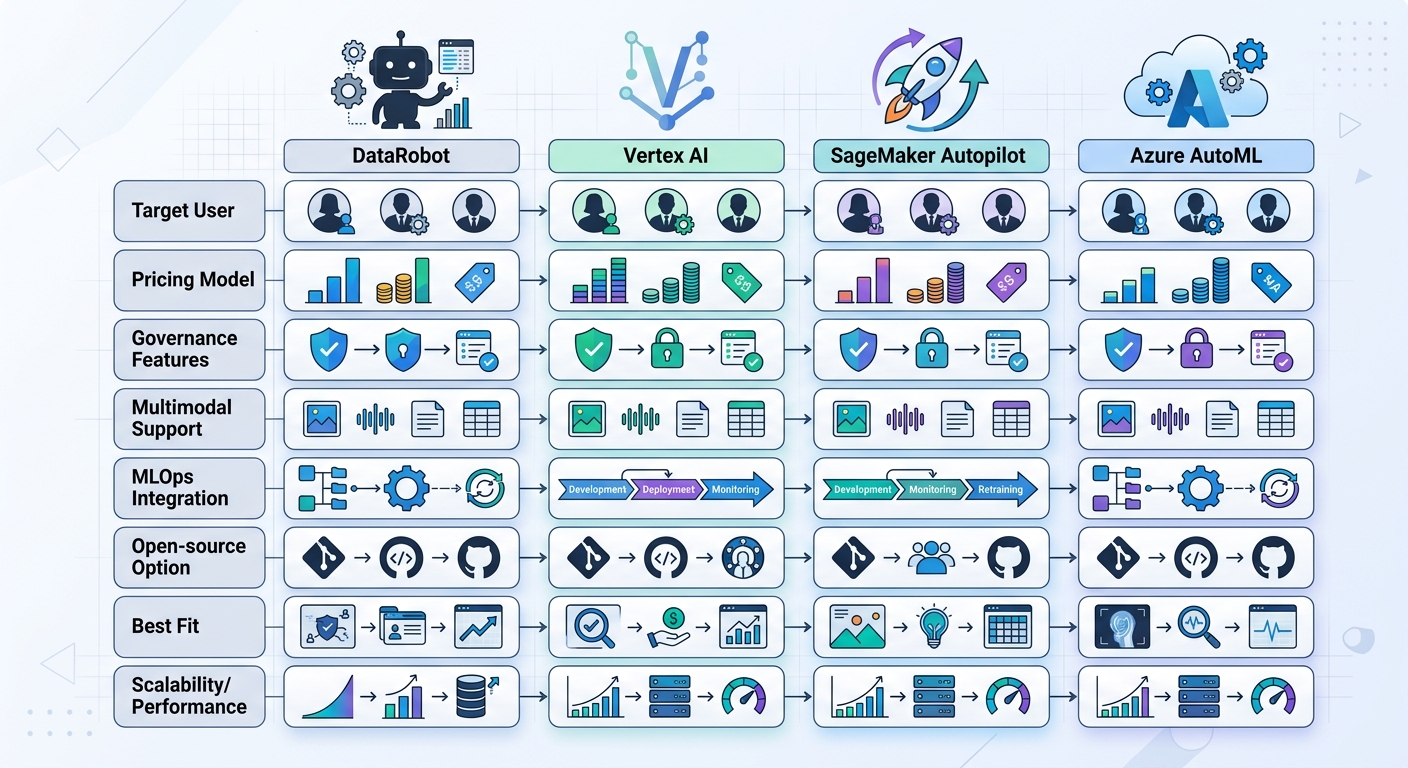
The AutoML platform landscape in 2026 is dominated by four major enterprise players, each with distinct strengths. Choosing among them requires matching their capabilities to your team's profile.
DataRobot
DataRobot is widely considered the benchmark enterprise AutoML platform. It was recognized as a Leader in the 2026 Gartner Magic Quadrant for Data Science and Machine Learning Platforms (estimated; confirmed by DataRobot's published Gartner positioning). DataRobot organizes its offering around three pillars: AutoML for Enterprise, AI Workbench (a developer and MLOps layer), and an Agentic AI Suite introduced in 2025–2026.
DataRobot provides enterprise governance and explainability through automated feature engineering, model selection across hundreds of algorithms, built-in validation and drift detection, and SHAP-based explainability layers. For regulated industries — healthcare, finance, insurance — DataRobot's governance and audit trail capabilities are the most comprehensive in the market. It supports cloud, hybrid, on-premise, and air-gapped deployments.
The primary tradeoff is cost. DataRobot targets enterprise buyers, with pricing typically starting around $150,000 annually (estimated based on widely reported enterprise pricing; exact contracts are custom). It is the right choice for organizations that need comprehensive governance, compliance documentation, and a single vendor for the full ML lifecycle.
Google Vertex AI (AutoML)
Google Vertex AI provides AutoML capabilities integrated into the Google Cloud ecosystem. As of mid-2026, Vertex AI features were reorganized under the Gemini Enterprise Agent Platform's "Models" sub-menu (estimated; consistent with Google cloud platform updates), but the AutoML functionality — covering structured data, images, text, and video — remains intact.
Vertex AI integrates Google Cloud ecosystem services seamlessly. It offers integration with BigQuery for data storage, TensorFlow for custom modeling, and Vertex AI Model Garden for accessing pre-trained models. The UI is approachable for non-technical users, and Google claims strong accuracy for vision and NLP AutoML tasks. Pre-trained APIs for Vision, Natural Language, and Translation provide a fast path to baseline predictions without any custom model training.
The limitations are vendor lock-in and cost at scale. Google's consumption-based pricing ($1–10 per training job, with costs scaling quickly for large projects) and the managed environment limit customization for advanced use cases. For GCP-native teams needing a fast path from data to deployed model, Vertex AI is a strong choice.
Amazon SageMaker Autopilot
Amazon SageMaker Autopilot is part of the broader Amazon SageMaker AI platform, renamed from the classic SageMaker service in late 2024 (confirmed via AWS documentation). SageMaker Autopilot automates the entire ML workflow — from data preprocessing through model deployment — with a distinctive emphasis on transparency: every AutoML job generates transparent editable notebooks showing exactly what transformations and algorithms were attempted.
SageMaker Autopilot is best for AWS-native teams with technically skilled data scientists on staff. It supports classification, regression, and time series forecasting. SageMaker Canvas provides a no-code interface for business analysts, while the full Autopilot experience offers the granular control that technical users expect. Time series forecasting is a particular strength, with automatic handling of lag features, rolling windows, and seasonal patterns.
Like Vertex AI, SageMaker Autopilot uses consumption-based pricing that can escalate at scale. Production deployment often requires additional configuration for endpoint management. For organizations with existing AWS infrastructure, it represents a cost-efficient entry point into AutoML.
Microsoft Azure AutoML
Azure AutoML is the AutoML layer within Azure Machine Learning, Microsoft's platform for building, deploying, and managing ML models. Azure AutoML enables MLOps for Microsoft enterprise teams through deep integration with the Microsoft ecosystem — particularly Power BI for visualization, Azure Synapse for data warehousing, and Dynamics 365 for operational data.
Azure AutoML targets Microsoft-standardized enterprises and regulated industries. Its strength is the combination of a no-code UI for business users and SDK-level control for technical teams. MLOps capabilities — model versioning, automated retraining pipelines, role-based access — are mature and well-integrated. Azure's enterprise security certifications make it a preferred choice for organizations with stringent compliance requirements.
The main limitation is that optimization for non-Microsoft environments is weaker. For organizations not already invested in Azure services, the integration benefits diminish significantly.
Open-Source AutoML — FLAML, AutoGluon, MLJAR, and H2O
Not every team needs enterprise-grade governance and support contracts. A mature ecosystem of open-source AutoML libraries offers powerful alternatives for Python-fluent teams.
FLAML (Microsoft) optimizes hyperparameters with focal search, making it particularly efficient for finding strong model configurations with minimal compute. It handles classification, regression, and time series tasks and is designed to integrate easily into existing Python workflows.
AutoGluon (Amazon) builds stacked ensemble models automatically — combining multiple models to boost predictive performance. It handles tabular, text, and image data and is widely praised for achieving strong accuracy with minimal configuration. For teams that want high performance without spending weeks on model selection, AutoGluon is a compelling option.
MLJAR provides a human-friendly AutoML interface with three search modes — Fast (quick baseline), Medium (balanced exploration), and Optuna (deep optimization) — letting users choose their preferred tradeoff between speed and model quality. It also generates feature importance reports and explanatory visualizations.
H2O AutoML uses distributed in-memory processing to scale to enterprise data volumes. AutoML inherits training data bias if datasets reflect historical discrimination, and H2O's open-source version is free — the enterprise Driverless AI product adds governance and explainability features.
How AutoML Democratizes ML Development
AutoML platforms democratize machine learning access for non-specialists. The core promise of AutoML is access. Before these platforms existed, building a machine learning model required a rare combination of statistical knowledge, software engineering skill, and domain expertise. AutoML decouples these requirements.
No-Code Model Building
The most significant democratization is the no-code AutoML interface. Business analysts, product managers, and operations teams can now upload a dataset, specify a target variable, and receive a ranked list of candidate models — all through a visual interface. The technical complexity is abstracted away.
This matters because the people closest to the business problem are often the ones best positioned to frame it correctly. A customer success manager who understands churn drivers can now build a churn prediction model directly, rather than waiting weeks for a data science team's backlog to clear.
Speed and Cost Reduction
AutoML accelerates model deployment from weeks to hours. A model development cycle that traditionally takes four to eight weeks can often be reduced to a few hours with AutoML. This speed benefit is particularly valuable in fast-moving industries where competitive advantage depends on rapid experimentation.
The cost implications are equally significant. Data science talent is expensive and scarce. AutoML reduces data scientist time on routine tasks, enabling them to focus on architectural decisions, novel problems, and business-facing interpretation. The result is a better return on data science investment.
Bridging Technical and Business Teams
AutoML creates a shared vocabulary between technical and non-technical stakeholders. Model leaderboards, feature importance rankings, and evaluation metrics can be reviewed collaboratively without requiring everyone to read Python code. This transparency reduces miscommunication and accelerates alignment on model priorities.
The democratization effect is real but bounded — AutoML makes model building accessible, but it does not make data science as a discipline disappear. The organizations that benefit most are those that combine AutoML accessibility with strong data literacy programs.
AutoML for Time Series and Forecasting
Time series forecasting is one of the most practical AutoML use cases in enterprise settings. Demand forecasting, resource planning, predictive maintenance, and financial projections all depend on accurate temporal predictions.
Modern AutoML platforms handle time series natively. They automatically create lag features, encode seasonal patterns, and handle missing values in temporal data. DataRobot, SageMaker Autopilot, Azure AutoML, and FLAML all include dedicated time series capabilities. The key requirement — often overlooked — is that the data must be split temporally rather than randomly. AutoML platforms that ignore this requirement will produce overly optimistic validation scores.
The Rise of Agent-Based AutoML
Agent-based AutoML goes beyond single-stage automation in 2026. Rather than automating individual pipeline stages, agent-based AutoML autonomously manages the entire lifecycle.
An agent-based system can interpret a task description in natural language, inspect the provided dataset, generate Python code for preprocessing and modeling, run experiments, debug errors when they occur, propose new feature engineering ideas, and iteratively improve model performance — all without human intervention at each step.
DataRobot's Agentic AI Suite and the integration of Google Gemini with Vertex AI represent early implementations of this paradigm. The practical implications are significant: complex end-to-end workflows that previously required a team of specialists can now be initiated with a single prompt.
Agent-based AutoML autonomously writes and debugs Python code, but the current generation still requires human oversight. Agents can introduce subtle errors in problem framing or miss domain-specific constraints that a human expert would catch. The trajectory, however, is clear: increasingly autonomous ML development is arriving.
AutoML and Multimodal Data — Text, Images, Video
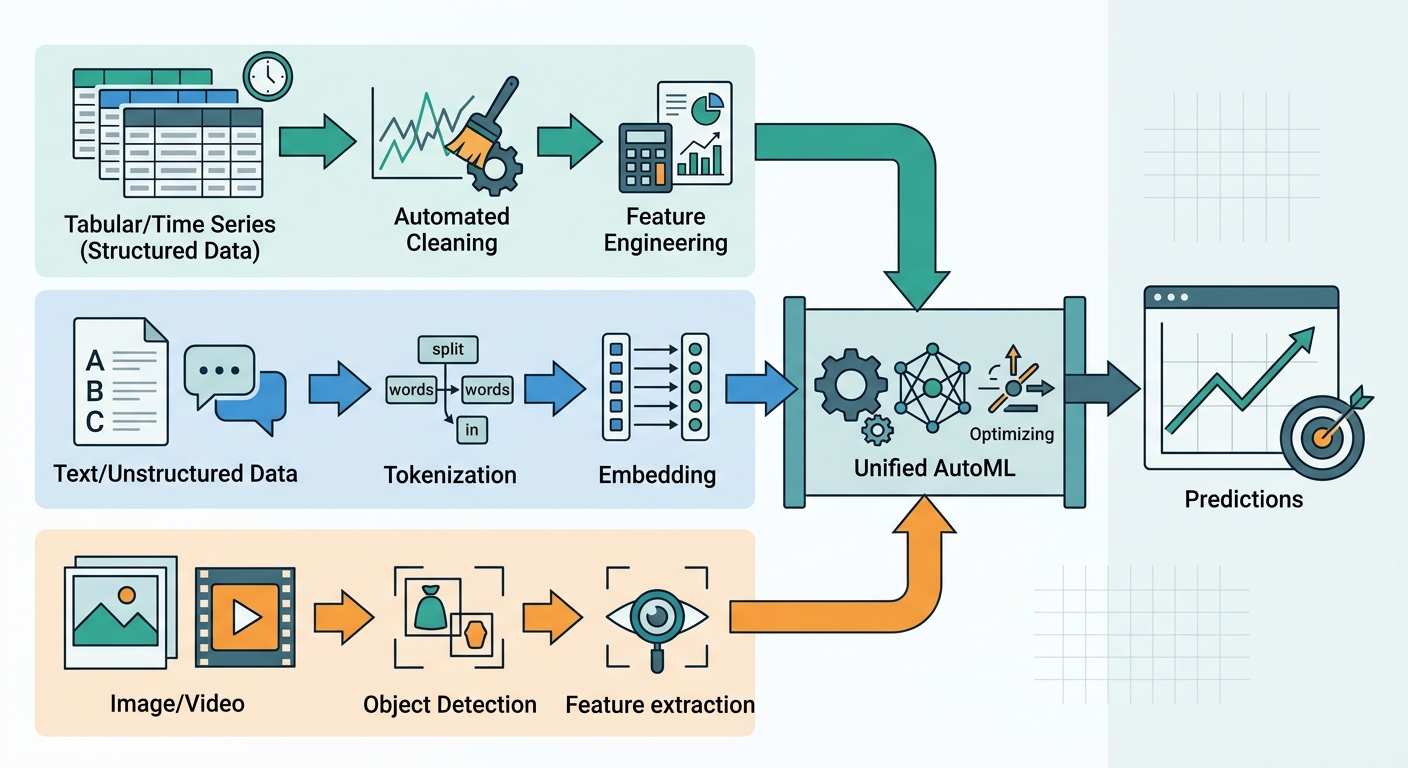
AutoML handles multimodal data — text, images, time series — in 2026. Leading platforms support text, images, and video alongside traditional structured datasets.
This multimodal capability matters because real-world business problems rarely involve only numbers in rows and columns. A manufacturing quality control system needs to analyze images of products on a production line. A customer service team may want to classify the sentiment of support tickets. A logistics company may want to combine structured delivery data with text from customer notes and images from warehouse inspections.
Google Vertex AI Vision AutoML and Azure Computer Vision AutoML are the strongest options for image classification and object detection pipelines. AutoGluon handles multimodal inputs natively for tabular-plus-text use cases. The common limitation across all platforms is that multimodal AutoML still requires more technical oversight than pure tabular AutoML — defining the right preprocessing pipeline and interpreting model behavior across data types demands expertise.
Critical Limitations — Bias, Interpretability, and Governance
AutoML inherits training data bias and poses real risks that responsible teams must address directly. The most important of these are model interpretability, algorithmic bias, and governance gaps.
The Black Box Problem
AutoML produces black-box models lacking interpretability. AutoML systems can produce highly accurate models while remaining largely opaque about how predictions are made. This is not unique to AutoML — it affects machine learning generally — but AutoML's automated search process can compound the problem by selecting complex ensemble models that are even harder to interpret than single algorithms.
In regulated industries where model decisions must be explained — healthcare diagnostics, loan approvals, insurance underwriting — this opacity is a serious constraint. "The model achieved 94% accuracy" is not sufficient documentation for a compliance audit.
Leading platforms are addressing this through built-in interpretability tools. SHAP values, permutation importance, and LIME are increasingly standard features. DataRobot provides the most comprehensive explainability layer among enterprise platforms. But interpretability tooling varies significantly across platforms, and the quality of explanations matters — a SHAP summary that just prints numbers without context is not actionable.
Bias and Fairness
AutoML can amplify training data bias, leading to discriminatory outcomes. AutoML systems inherit the biases present in their training data. If the data used to build a model reflects historical discrimination — in hiring, lending, policing, or healthcare — the AutoML system will learn and potentially amplify those patterns.
This is not a hypothetical concern. There are documented cases of AutoML-deployed models exhibiting discriminatory behavior in high-stakes applications. The challenge is that standard AutoML optimizes for accuracy metrics like AUC or F1 score. These metrics do not capture fairness. A model that achieves 91% accuracy but systematically under-predicts creditworthiness for a protected demographic group passes the standard AutoML evaluation but fails the fairness test.
Responsible AutoML deployment requires deliberate bias auditing before production. Most platforms provide fairness metrics — demographic parity, equalized odds, disparate impact ratios — but they must be explicitly requested and reviewed. Organizations should establish fairness thresholds as part of their model governance process.
Data quality is the foundation — AutoML cannot compensate for incomplete, outdated, or biased training data. Garbage in, garbage out applies with full force to automated pipelines.
Governance and Audit Trails
Enterprise AutoML deployments require more than a single data scientist's judgment. Organizations need audit trails that document which data was used, which model was selected, who approved deployment, and how the model's behavior changes over time.
DataRobot, Azure AutoML, and Databricks offer the most mature governance capabilities — model versioning, role-based access, approval workflows, and drift detection. Open-source tools require additional tooling for governance that commercial platforms include by default.
Navigating Regulatory Requirements — EU AI Act and Beyond
EU AI Act requires transparency for high-risk AI systems in 2026. The EU AI Act, now in effect for high-risk applications, requires transparency and explainability for AI systems used in consequential decisions. Deploying AutoML in regulated industries within the EU — or for EU-based customers — imposes specific documentation requirements.
Organizations must maintain records of the data used to train models, the feature engineering steps applied, the model selection rationale, and the validation results. Model cards and datasheets are increasingly standard artifacts for compliance documentation.
DataRobot and Azure AutoML offer pre-configured EU AI Act compliance templates that automate parts of this documentation burden. Databricks provides governance tooling that supports regulatory audit requirements. Organizations using open-source AutoML tools should build compliance documentation into their MLOps process explicitly — it will not happen automatically.
AutoML vs Traditional ML — When to Choose Which
AutoML automates model selection — but not all problems are equal. AutoML is not always the right tool. Understanding when to use automated approaches versus traditional manual model development is itself a critical skill.
Choose AutoML when:
- Rapid prototyping is needed to validate whether ML is appropriate for a problem
- The team lacks deep ML expertise but has strong domain knowledge
- The data is well-structured tabular data with a clear prediction target
- Time-to-value matters more than marginal accuracy improvements over baseline models
- The use case is a standard ML problem type (classification, regression, forecasting) with abundant training data
Choose traditional ML when:
- The problem requires a novel or highly specialized model architecture
- Domain expertise is critical for feature engineering and cannot be captured by automated search
- Model decisions must be fully interpretable by design, not through post-hoc explanation
- The input data is complex and multimodal in ways that exceed current AutoML capabilities
- A senior data scientist is available to invest the time for custom optimization
The hybrid approach combines both. Many organizations use AutoML to establish a strong baseline quickly, then refine the AutoML-generated model with custom feature engineering, algorithm tweaks, or ensemble modifications. This workflow captures the speed of AutoML while preserving the quality gains possible through expert intervention.
The ROI of AutoML for Enterprise Teams
Organizations deploying AutoML report consistent improvements in time-to-model and analyst productivity.
Time-to-baseline-model is the most commonly cited metric. Standard use cases — churn prediction, demand forecasting, anomaly detection — that previously required four to eight weeks from brief to deployed model can now be completed in hours. This speed amplification enables more experimentation and faster iteration cycles.
Analyst empowerment is a secondary but significant benefit. When domain experts can build and maintain their own models, data science teams spend less time on routine requests and more time on complex, high-value problems. The net effect is a more efficient allocation of scarce data science talent.
Cost-per-model decreases for routine use cases. While enterprise AutoML platforms carry significant licensing costs, the reduction in data scientist time allocated to routine modeling often delivers a positive ROI for organizations with enough model development volume.
Best Practices for Deploying AutoML in Production
Building a model in AutoML is the beginning, not the end, of the ML development process. Production deployment requires disciplined practices that many teams discover through experience.
Start with data quality. AutoML cannot compensate for missing values, measurement errors, or unrepresentative samples. Invest in data validation and cleaning before uploading to any AutoML platform.
Define business metrics, not just model metrics. Accuracy and AUC are model-centric. A model that maximizes AUC may not maximize business outcomes. Define the business metric — reduced churn rate, improved forecast accuracy, lower false positive rate — and evaluate AutoML candidates against it.
Split data temporally for time series. Random train/test splits create look-ahead bias in temporal data. Always use chronological splits for forecasting problems.
Validate on holdout data before deployment. Leaderboard scores from AutoML's internal validation are optimistic estimates. Always hold out a final validation set that mimics production conditions.
Monitor for data drift. The most common silent failure mode in production AutoML is distribution shift — when the data the model receives in production differs from the data it was trained on. Deploy monitoring that tracks input data distributions and model output distributions over time. Many platforms offer automated drift detection; use it.
Document everything for compliance. Model cards, feature importance reports, validation results, and approval records are essential artifacts. Build documentation into the deployment process, not as an afterthought.
Retrain systematically. AutoML models trained on historical data will eventually become stale. Establish automated retraining pipelines that rebuild models on fresh data on a regular schedule.
The Future of AutoML — Trends to Watch
AutoML is still early in its evolution. Several trajectories will shape the technology over the next one to three years.
Agentic AutoML (AutoML 3.0) is the defining trend. Autonomous agents that manage the full ML lifecycle — from problem understanding through deployment and monitoring — represent a qualitative shift in what automated ML can accomplish. Early implementations exist, but the next generation will be significantly more capable.
Domain-specific AutoML will emerge for healthcare, finance, and manufacturing verticals. These specialized versions will encode domain knowledge, regulatory constraints, and industry-specific best practices as default settings, reducing the configuration burden for practitioners in those fields.
LLM-native AutoML integrates large language models as orchestrators and feature extractors. LLMs can interpret task descriptions, generate code, explain model behavior, and summarize findings — turning AutoML from a model selection tool into a more comprehensive ML assistant.
AutoML for edge deployment is maturing. Compressed AutoML models optimized for on-device inference enable real-time predictions in settings without cloud connectivity — manufacturing equipment, autonomous vehicles, medical devices.
Regulatory-driven standardization will force broader adoption of governance frameworks. As AI regulations solidify globally, the governance capabilities built into enterprise AutoML platforms will shift from differentiators to requirements.
Expert Q&A
Q: Does AutoML replace data scientists?
A: No. AutoML automates repetitive tasks — model selection, hyperparameter tuning, feature engineering — that previously consumed the bulk of a data scientist's time on routine problems. This frees experienced practitioners to focus on higher-value work: framing problems correctly, applying domain knowledge, designing custom architectures for novel use cases, and interpreting results for business stakeholders. The organizations that treat AutoML as a replacement for data science expertise tend to struggle. Those that treat it as a productivity multiplier for their existing team tend to see the best outcomes.
Q: Which AutoML platform is best for a small team on a limited budget?
A: FLAML and AutoGluon are free and open-source with strong performance on tabular data. Google Vertex AI and Azure AutoML offer free tiers with limited training hours. DataRobot's enterprise pricing targets large organizations with compliance requirements, so it is rarely the right choice for small teams. The key is to match the platform's maturity to your team's technical sophistication. Open-source tools require more manual configuration; managed platforms handle more complexity automatically but at higher cost.
Q: How does AutoML handle biased data?
A: Most platforms provide bias detection tools — fairness metrics, disparate impact analysis — but they do not automatically fix biased data. A model that achieves high accuracy on a biased dataset will learn the bias and reproduce it in predictions. Responsible AutoML use requires deliberate bias auditing as a separate step from model selection, using dedicated fairness tools. In high-stakes domains like hiring, lending, and healthcare, this auditing process should be treated as mandatory, not optional.
Q: Can AutoML be used for real-time production predictions?
A: Yes. All major enterprise platforms support one-click deployment to production endpoints with auto-scaling. Open-source tools like AutoGluon and FLAML support model export to standard formats — ONNX, PMML, or native formats — for integration with production serving infrastructure. The key requirement is a monitoring strategy: AutoML models that go into production without drift detection will silently degrade when input data distributions shift.
Q: What is the biggest risk of AutoML in enterprise?
A: Silent failure due to data drift is the most common and most damaging risk. AutoML models trained on static datasets will eventually become miscalibrated when the real-world process they model changes. A customer churn model trained on 2024 behavior will become less accurate as customer behavior evolves in 2025 and 2026. Without continuous monitoring and retraining pipelines, organizations can end up making decisions based on systematically outdated predictions without realizing it.