Mastering In-Context Learning: How to Get More from Every LLM Query
In-context learning (ICL) is the engine beneath modern LLM prompting. Drop a few examples into a conversation, and the model adapts its output instantly.
In-context learning (ICL) is the engine beneath modern LLM prompting. Drop a few examples into a conversation, and the model adapts its output instantly. No gradients. No retraining. Just better results.
If you are building on LLMs in 2026, mastering ICL is not optional. It determines whether your application delivers reliable, on-brand responses or inconsistent ones that require constant post-processing.
This guide covers what ICL is, why it works, and how to use it at an expert level.
What Is In-Context Learning?
In-context learning is a capability where a language model adapts its behavior based on examples embedded in the input context. The model reads the examples, identifies patterns, and applies those patterns to generate a response. Crucially, no model weights are modified during this process.
The concept was demonstrated at scale by the GPT-3 paper (Brown et al., 2020). Researchers showed that a 175-billion-parameter model could learn new tasks from just a handful of examples provided in plain text. This was surprising. Previous models required explicit fine-tuning on task-specific datasets.
ICL works through the model's attention mechanism. When you provide examples before your query, the model's self-attention layers compare your query against each example token. This comparison draws on the model's pre-trained knowledge to identify relevant patterns. The output adapts accordingly.
In 2026, ICL is the standard way developers customize model behavior. Fine-tuning still has a role for permanent capability shifts, but for most product use cases, ICL delivers faster iteration and lower operational overhead.
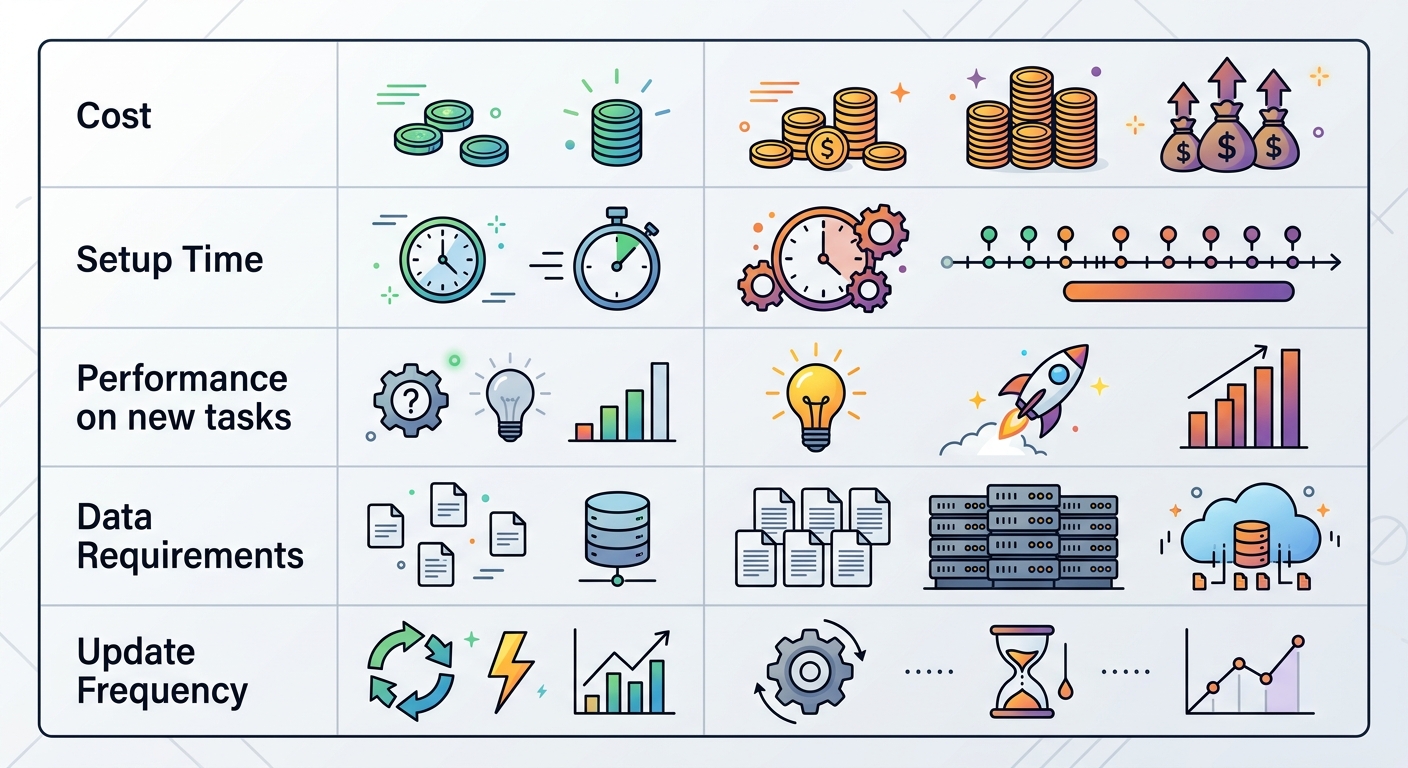
Key distinction: Fine-tuning modifies model weights permanently. ICL modifies behavior temporarily through context. Change the context, and the behavior changes. No infrastructure rebuild required.
Why In-Context Learning Outperforms Basic Prompting
Zero-shot prompting provides a single instruction with no examples. The model relies entirely on its pre-trained knowledge and its ability to interpret the instruction. For well-known tasks, this works adequately. For nuanced or domain-specific tasks, zero-shot outputs can be inconsistent.
Few-shot prompting adds k examples before the query. These examples demonstrate the task structure, expected output format, and domain conventions. The model uses these demonstrations as calibration signals. It infers what "correct" looks like for this specific task, rather than guessing from pre-training alone.
The difference in practice is significant. Even a single well-chosen example can cut error rates substantially on classification and extraction tasks. Adding two or three diverse examples typically improves accuracy further, with diminishing returns beyond five to seven examples.
Why do demonstrations work so well? They reduce ambiguity. A natural language instruction can be interpreted in multiple ways. Examples constrain the interpretation by showing the intended mapping from input to output. This is especially valuable for tasks where the correct output is underspecified by the instruction alone.
Format examples teach structure. If you need JSON output, show the model what valid JSON looks like. If you need a specific tone, show a sample response that matches your brand voice. The model follows the pattern.
Diversity examples teach breadth. Real-world inputs vary. A set of diverse examples teaches the model that the task applies across different input distributions, not just the most common cases.
Research finding — Brown et al. (2020) reported that GPT-3's performance on the BIG-Bench benchmark improved substantially when shifting from zero-shot to few-shot prompting with examples. The magnitude of improvement varies by task type, with structured output tasks showing the largest gains.
Edge-case examples teach boundaries. If your task has known pitfalls or special conditions, include examples that illustrate those conditions explicitly.
The Three Core Types of In-Context Learning
Understanding the three primary ICL types helps you choose the right approach for each task.
Few-Shot (k-Shot) Prompting
Few-shot prompting embeds k labeled examples directly in the context before the query. The value of k depends on task complexity and token budget.
Few-shot is most effective for format-dependent tasks. Classification labeling, entity extraction, structured output generation, and style imitation all benefit from concrete examples. When the task involves mapping an input to a specific output format that is difficult to describe in words alone, few-shot is usually the right choice.
The trade-off is token cost. Each example consumes context tokens. For models with per-token pricing, adding five examples per query adds cost on every call. In high-volume applications, this compounds quickly.
A practical constraint: with larger context windows now available (128K tokens in many 2026 models), the temptation is to add many examples. Resist this. Noisy or redundant examples reduce model focus and can introduce contradictions.
Zero-Shot Prompting
Zero-shot prompting uses no examples. The model operates on a pure instruction combined with its pre-trained knowledge. This approach is fastest and cheapest, but it requires the task to be well-defined and within the model's existing capability range.
Zero-shot works well for straightforward tasks the model knows natively. Summarization of news articles, translation between common language pairs, and general-purpose question answering are all strong zero-shot candidates.
The limitation emerges with ambiguous tasks. If the correct output is underspecified by the instruction, zero-shot responses may vary in ways that are unacceptable for production systems. For example, instructing "summarize this document" leaves many format and detail-level choices undefined. Adding one example clarifies those choices.
Chain-of-Thought Prompting
Chain-of-thought (CoT) prompting adds intermediate reasoning steps to the examples. Rather than showing input → output, the examples show input → reasoning → output. This explicit reasoning path helps the model replicate multi-step logic in its response.
CoT is most valuable for complex reasoning tasks. Multi-step math problems, multi-hop question answering, code debugging with trace reasoning, and multi-step planning all benefit from reasoning demonstrations.
The trade-off is example quality. A poorly reasoned example propagates incorrect logic. Building a good CoT example set requires you to work through the reasoning yourself first, which doubles the authoring effort.
Key principle — Hybrids are valid and often optimal. A prompt that combines a clear zero-shot instruction, one format example, and a chain-of-thought reasoning demonstration frequently outperforms any single approach used in isolation.
Choosing the Right Type
Use k-shot for format-dependent tasks where structure matters more than reasoning. Use zero-shot for simple, well-known tasks where the instruction is unambiguous. Use CoT for multi-step reasoning tasks where showing your work matters. For complex production pipelines, combine techniques in a single prompt.
Crafting High-Quality Demonstrations
The difference between a mediocre few-shot prompt and an excellent one is demonstration quality. Here are the principles that govern quality.
Quality Outweighs Quantity
Three excellent examples outperform ten mediocre ones. Every example in your context consumes tokens and demands the model's attention. Redundant or low-quality examples dilute the signal. Before adding an example, ask whether it teaches something the existing examples do not.
Maintain Label Consistency
If your task involves classification, use a consistent label set throughout all examples. Do not label one example as "Positive" and another as "Good." The model will pick up on the label variation and become uncertain about which vocabulary to use.
Label inconsistency is a common cause of output instability in production ICL systems. Audit your example labels before deploying.
Cover the Input Distribution
Your examples should represent the full range of inputs the model will encounter. Include easy cases, hard cases, and known edge cases. If 10% of your production queries fall into a specific edge case, at least one of your examples should illustrate that case.
Failure to cover the distribution is the leading cause of ICL degradation in production. Users encounter inputs that do not resemble any demonstration, and the model produces generic or incorrect outputs.
Include Negative Examples
Positive examples show what correct output looks like. Negative examples show what incorrect output looks like. For style and tone tasks, negative examples are particularly powerful. They teach the model which patterns to avoid.
Mind the Ordering
Models can exhibit position bias. Some models weight earlier examples more heavily (primacy effect). Others weight later examples more (recency effect). Rotate the order of your examples across test queries to check whether output quality varies with position.
If position affects output quality, consider including multiple example orderings in your evaluation or using a fixed rotational scheme in production.
Respect the Token Budget
Context windows are large, but not infinite. Every token consumed by demonstrations is a token not available for the query or response. Monitor cumulative token counts. Prune low-value examples that do not add new signal.
A useful heuristic: if removing an example would not change the model's output, that example is redundant. Remove it.
Match Output Format Exactly
If you need JSON output, your examples must show valid, complete JSON. If you need a specific sentence structure, your examples should use that structure. The model follows the format of its demonstrations more precisely than the wording of its instructions.
Keep Examples Self-Contained
Each example should make sense in isolation. Do not rely on information from previous examples to interpret the current one. The model processes each example independently through its attention mechanism, and cross-example dependencies can confuse the calibration.
Build better prompts with the Algorithmine prompt engineering guide. It covers demonstration design, token budgeting, and evaluation frameworks for production ICL systems.
Advanced In-Context Learning Techniques
Once you have mastered the basics, these advanced techniques unlock further improvements.
Retrieval-Augmented ICL
Fixed few-shot examples are static. Retrieval-augmented ICL (RA-ICL) dynamically fetches the most relevant examples from a task-specific corpus at query time. Given an incoming query, a vector embedding model identifies the k examples most similar to the current input. Those examples are injected into the context.
The advantage is relevance. Fixed examples may not match the current query's distribution. Retrieval ensures each query gets calibrated examples drawn from a relevant distribution. This is particularly valuable for question-answering systems and document understanding pipelines.
Implementation requires a vector store (such as a FAISS index or a managed vector database) and an embedding model. The retrieval step adds latency, so evaluate whether the quality gain justifies the speed cost for your use case.
Self-Consistency
Self-consistency (Wang et al., 2022) is a decoding strategy that improves CoT reliability. Rather than generating a single reasoning path, the model samples multiple reasoning paths with temperature greater than zero. Each path produces a potentially different final answer. The most common answer across paths is selected as the final output.
Self-consistency dramatically improves accuracy on math and logical reasoning tasks. The improvement comes from reducing the impact of any single erroneous reasoning step. When multiple independent reasoning paths converge on the same answer, confidence in that answer increases.
The trade-off is cost. Generating multiple samples multiplies the per-query token count. For high-stakes outputs where accuracy matters more than speed, self-consistency is worth the cost.
Dynamic Few-Shot Selection
Static few-shot prompts use the same examples for every query. Dynamic few-shot selection classifies the incoming query into a sub-type, then selects only the examples most relevant to that sub-type.
For example, a customer support chatbot might have different example sets for billing queries, technical issues, and account management. A query classification step routes the input to the appropriate example set before generating the response.
This approach reduces token cost (smaller example sets per query) while improving relevance (each query sees only applicable examples). It requires a query classifier and a curated example bank, but the infrastructure investment pays off in production at scale.
Meta-Prompting for Example Generation
You do not always have existing examples for a new task. Meta-prompting uses the LLM itself to generate an initial example set. A meta-prompt describes the task and asks the model to produce k input-output pairs that illustrate correct task performance. These generated examples are then manually validated before deployment.
This bootstrapping approach accelerates the initial development of new ICL pipelines. The model's generated examples are often surprisingly good, especially for tasks within its pre-training distribution. Human validation remains essential — generated examples can contain subtle errors that would propagate into production outputs.
Calibration via System Prompt
Place a calibration sentence in the system prompt to anchor the model's response style before demonstrations appear. Phrases like "Answer concisely and accurately" or "Provide step-by-step reasoning before giving your answer" set an expectation that carries through the examples that follow.
This anchoring effect is subtle but consistent. System-level instructions prime the model's interpretation of subsequent examples. Use this mechanism to establish tone, format, and reasoning expectations before the few-shot examples appear.
Ensemble ICL
For critical outputs where reliability is paramount, ensemble ICL runs the same query with multiple different prompt variants (different example sets). Responses are aggregated through majority voting or a learned weighting scheme.
This approach is expensive — n variants produce n times the token cost. It is appropriate only for high-stakes decisions where the cost of error exceeds the cost of additional compute.
Common In-Context Learning Failure Modes
Even well-designed ICL pipelines fail. Here is how to diagnose and fix the most common failure modes.
Conflicting Demonstrations
If two examples show contradictory output formats, the model produces mixed or erratic outputs. For example, one example shows comma-separated values and another shows JSON. The model may alternate between formats or produce a hybrid.
Fix: Audit all examples for consistency before deployment. Use a linter or automated format check on example outputs.
Label Bias
An imbalanced demonstration set biases the model's predictions. If 90% of your classification examples are labeled "Positive," the model learns to favor that class even on neutral or negative inputs.
Fix: Balance demonstration sets to reflect the expected true distribution. If the true distribution is imbalanced, include a note in the instruction ("Most reviews are positive") to compensate.
Position Bias
The model may overweight examples at the start (primacy) or end (recency) of the context. This causes output quality to vary based on example order.
Fix: Rotate example order across queries. Track whether output quality correlates with example position. If it does, fix the order or use multiple rotation schemes and aggregate results.
Token Limit Saturation
Too many examples crowd out the actual query, or cause the context to truncate mid-example. Truncated examples are worse than no examples — they show partial patterns that confuse the model.
Fix: Monitor cumulative token counts including examples, query, system prompt, and expected response. Reserve at least 30% of the context window for the response. Prune low-value examples.
Noisy or Incorrect Examples
Errors in demonstration outputs teach the model incorrect patterns. If even one example is wrong, it can bias a subset of production outputs.
Fix: Validate all demonstrations manually. For high-volume pipelines, add automated checks that verify example output quality before deployment.
Domain Mismatch
Examples drawn from a different distribution than actual queries produce irrelevant calibration. A classification model trained on news articles will underperform on social media inputs.
Fix: Periodically audit the distribution of production queries. Refresh example sets when the production distribution shifts.
Over-Reliance on Examples
For simple tasks, heavy few-shot prompting is slower and more expensive than zero-shot with a clear instruction. Adding examples to a task that does not need them wastes tokens and can introduce unnecessary constraints.
Fix: Start with zero-shot. Add examples only when zero-shot output quality is unacceptable. This keeps pipelines lean and cost-efficient.
Measuring In-Context Learning Effectiveness
Improving ICL requires measurement. Without metrics, you cannot know whether a change to your examples helps or hurts.
Task-Specific Metrics
Define accuracy metrics for your specific task. For classification, use precision, recall, and F1. For extraction, use entity-level F1. For generation quality, consider human evaluation or an LLM-as-judge approach where a second model evaluates outputs.
Establish a baseline with your initial prompt. Every change should be measured against this baseline. Small sample sizes produce noisy metrics — aim for at least 100 test cases before drawing conclusions.
Consistency Scoring
For tasks where the correct output is deterministic, run the same query multiple times and track how often the output matches. Consistency scoring reveals whether ICL produces stable results across repeated calls.
Inconsistent outputs indicate calibration problems. The model is not reliably learning from its demonstrations. Consistency issues are often caused by conflicting examples, noisy labels, or position bias.
Calibration Curves
Plot a calibration curve showing predicted confidence versus actual accuracy. Well-calibrated models are confident when they are correct and uncertain when they are wrong. A miscalibrated model (overconfident on errors, underconfident on correct answers) may need better demonstrations or a different prompting approach.
A/B Testing Prompt Variants
Test different example sets, different example counts, and different prompting strategies in production. Route a percentage of traffic to each variant and compare output quality metrics over time.
A/B testing catches issues that offline evaluation misses. Real-world query distributions differ from test sets, and production behavior can diverge from lab behavior.
Cost-Per-Query Tracking
Track tokens consumed per query including examples, query, and response. Calculate cost per query at your model's pricing. Monitor for drift — adding examples increases cost, and a change in the production query distribution can alter the average example count required for acceptable quality.
The Future of In-Context Learning
ICL is evolving rapidly. Several trends will reshape how practitioners use it in 2026 and beyond.
Extended context windows (128K tokens and beyond) enable richer demonstration sets. Practitioners can include full documents as examples rather than truncated snippets. This reduces the context truncation problems that plague long-document extraction tasks.
Multimodal ICL is emerging. Models that accept both image and text inputs can use visual demonstrations alongside text examples. A diagram as a demonstration can communicate structure more precisely than text alone.
Test-time compute scaling may reduce ICL dependency. As models gain more reasoning capacity through increased compute at inference time, some tasks currently handled by few-shot demonstrations may become reliable with zero-shot prompting. However, ICL and test-time compute are complementary, not competitive — both improve output quality through different mechanisms.
Retrieval-augmented everything pipelines are becoming standard. Static prompts are giving way to dynamic systems that fetch relevant context, relevant examples, and relevant domain knowledge at query time. This shift requires more infrastructure but produces more robust systems.
The core principle remains constant: in-context learning lets you shape model behavior without touching model weights. Master this, and you can adapt any LLM to your use case faster than any fine-tuning pipeline allows.
Summary
In-context learning is the most practical tool for customizing LLM behavior in production. It requires no model retraining, no infrastructure rebuilds, and no machine learning team. Just better examples.
The techniques in this guide — from basic few-shot through retrieval-augmented and self-consistency — give you a full spectrum of tools. Start with simple few-shot prompting. Add chain-of-thought for reasoning tasks. Measure everything. Graduate to dynamic retrieval and ensemble techniques when reliability requirements demand it.
The model is only as good as the context you give it. Give it better context, and it gives you better answers.