Gradient Boosting vs Random Forests in 2026: When to Choose Which Algorithm
Two algorithms dominate tabular data competitions in 2026. Random Forest and Gradient Boosting both build ensembles of decision trees. That is where the similarity ends.
What Makes Gradient Boosting and Random Forest Different
Two algorithms dominate tabular data competitions in 2026. Random Forest and Gradient Boosting both build ensembles of decision trees. That is where the similarity ends.
Random Forest trains each tree independently and in parallel. Every tree sees a random bootstrap sample of the data. At each split, only a random subset of features is considered. The final prediction is a majority vote (classification) or average (regression) across all trees.
Random Forest reduces variance through bagging and feature randomness. Each tree in the ensemble learns from a different data sample and different feature subset, making the overall prediction robust to individual tree errors.
Gradient Boosting reduces bias by iteratively focusing on remaining mistakes. Each new tree is trained specifically to correct the errors that all previous trees combined still make. This sequential error correction allows GBM to model increasingly subtle patterns.
Gradient Boosting takes the opposite approach. Trees are added sequentially. Each new tree corrects the errors made by all previous trees combined. This is called sequential error correction.
Why architecture matters — Random Forest reduces variance by averaging diverse, independent predictions. Gradient Boosting reduces bias by iteratively focusing on remaining mistakes. The implications for accuracy, speed, and tuning effort are profound.
In practice, we find that Random Forest gives reliable results with minimal setup. Gradient Boosting can reach higher accuracy but demands more attention.
When Random Forest Is the Right Choice
Random Forest is the stronger choice in several common scenarios.
You need a solid baseline quickly. With default parameters, Random Forest often achieves 85–95% of its potential accuracy. Gradient Boosting with defaults can significantly underperform its capability. If time is limited, RF wins.
Your data contains noise or outliers. Bagging — training each tree on a different data sample — smooths out the effect of noisy observations. Random feature selection at each split further decorrelates trees. Gradient Boosting, by contrast, can amplify errors when data labels are noisy.
Random Forest provides interpretable feature importance scores. Gini importance and permutation importance metrics identify which features drive predictions across the ensemble. This matters when stakeholders need to understand model behavior.
Computational resources are constrained. Random Forest trees train independently. This means training parallelizes perfectly across CPU cores. With n_jobs=-1 in scikit-learn, a 500-tree forest trains nearly 500 times faster than it would sequentially.
You want to avoid overfitting with less rigorous validation. Because each tree sees only a fraction of the data and never the full picture, Random Forest naturally resists overfitting. Gradient Boosting requires careful validation setup to avoid fitting to noise.
When to default to Random Forest — If your dataset has fewer than 10,000 rows, or if labels may contain noise, or if you need results within the hour, start with Random Forest. You can always graduate to Gradient Boosting if accuracy falls short.
When Gradient Boosting Delivers Better Results
Gradient Boosting earns its reputation when accuracy is the non-negotiable priority.
Maximum predictive accuracy is required. On structured tabular data, Gradient Boosting implementations like XGBoost, LightGBM, and CatBoost consistently rank at the top of leaderboards. The typical gap over Random Forest is 2–5% accuracy. In high-stakes applications — fraud detection, medical diagnosis, conversion prediction — that margin matters.
The data is clean and well-preprocessed. Gradient Boosting is sensitive to noise. When your dataset has been carefully cleaned and validated, GBM's iterative refinement extracts patterns that Random Forest cannot.
Complex non-linear interactions exist. Because each GBM tree focuses on what previous trees missed, the ensemble models subtle feature interactions that independently-trained trees miss.
Gradient Boosting achieves higher peak accuracy with careful tuning. The tuning investment is substantial, but when maximized, GBM consistently outperforms RF on clean tabular data.
The dataset is imbalanced. Gradient Boosting can concentrate on misclassified minority-class samples. Random Forest treats all samples equally unless you explicitly set class_weight.
Time for tuning is available. Gradient Boosting has more hyperparameters to optimize. Learning rate, tree depth, subsample ratio, and regularization all interact. When you can invest that tuning effort, GBM pays off.
XGBoost vs LightGBM vs CatBoost in 2026 — Which GBM Implementation to Choose
Three implementations dominate Gradient Boosting in 2026.
XGBoost remains the mature, production-safe choice. It offers L1 and L2 regularization, handles missing values natively, and works well across medium-sized datasets. Use XGBoost when you need a reliable baseline with fine-grained control.
LightGBM is the fastest option for large and high-dimensional data. Its histogram-based algorithm buckets continuous features into discrete bins, dramatically reducing computation. LightGBM grows trees leaf-wise for faster convergence — it expands the leaf node that provides the largest loss reduction, rather than building all levels evenly. For datasets with hundreds of thousands of rows, LightGBM trains 5–10x faster than XGBoost.
CatBoost leads on datasets rich in categorical features. Its ordered boosting scheme prevents target leakage when computing target statistics for categorical variables. No manual one-hot encoding is needed. CatBoost handles categorical features natively without encoding through its permutation-driven ordered target statistics. CatBoost often produces the best results with the least tuning effort when categorical features dominate.
Decision shortcut — Choose XGBoost for general-purpose use. Choose LightGBM for large data speed. Choose CatBoost when your dataset has more than 30% categorical features by cardinality.
The Accuracy Trade-Off: What the Benchmarks Actually Show
Honest accuracy expectations matter.
Stacking combines RF and GBM predictions for superior performance — using both algorithms as base learners and a meta-learner on top is a proven technique that typically adds 1–2% lift over either algorithm alone.
Gradient Boosting typically outperforms Random Forest by 2–5% on clean tabular classification tasks. This gap widens on tasks with complex feature interactions and narrows — or inverts — when data is noisy.
Random Forest with default settings can match a Gradient Boosting model that has been poorly tuned. Conversely, a well-tuned GBM consistently beats an RF baseline.
The tuning math — A Random Forest achieves ~90% of peak accuracy in 5 minutes of setup. A Gradient Boosting model might require 2–4 hours of tuning to reach its peak. The question is whether that 2–5% accuracy difference has business value.
Stacking both algorithms — using their predictions as input features for a meta-learner — frequently outperforms either algorithm alone. We regularly see 1–2% additional lift from stacking in production systems.
How to Actually Tune Each Algorithm
Practical tuning ranges for both methods.
Random Forest Key Parameters
- n_estimators: Start with 200 trees. Accuracy typically plateaus between 100–500. More trees increase training time linearly but rarely improve predictions beyond 500.
- max_depth: Limit to 10–20 to prevent individual trees from overfitting. Set to
Noneonly if you are certain the data is clean. - min_samples_leaf: Set to 5 or more. This smooths predictions by ensuring each leaf represents a meaningful sample.
- max_features: For classification, use
sqrt(n_features). For regression, tryn_features / 3. This decorrelates trees.
Gradient Boosting Key Parameters
- n_estimators + learning_rate: These trade off against each other. A learning rate of 0.1 with 100 trees is roughly equivalent to 0.01 learning rate with 1,000 trees. Lower rate needs more trees but often generalizes better.
- max_depth: GBM trees are typically shallower than RF trees. Use 3–8. Deep trees increase overfitting risk.
- subsample: Sample 80% of rows for each tree. This reduces variance and speeds up training.
- Regularization (XGBoost): Set
alpha(L1) andlambda(L2) to values between 1 and 10 to penalize complex trees.
Always use cross-validation to evaluate changes. Time-series data demands time-series splits. Classification tasks benefit from stratified k-fold to preserve class ratios.
Combining Both — When Stacking Wins
Random Forest and Gradient Boosting are not mutually exclusive.
In a stacking approach, both algorithms serve as base learners. Their predictions on a validation set become input features for a simple meta-model (often logistic regression). This meta-model learns when to trust RF versus GBM.
Random Forest contributes diversity to stacking. Because it builds trees independently, RF tends to model different patterns than the sequentially-trained GBM. This diversity is exactly what stacking exploits.
Blending — a simpler variant — uses a fixed holdout set to generate base predictions instead of cross-validation. It is less robust to leakage but easier to implement.
When to stack — Use stacking when both RF and GBM individually perform well on your task but in different ways. If one algorithm clearly dominates, stacking adds complexity without proportional benefit.
Decision Framework
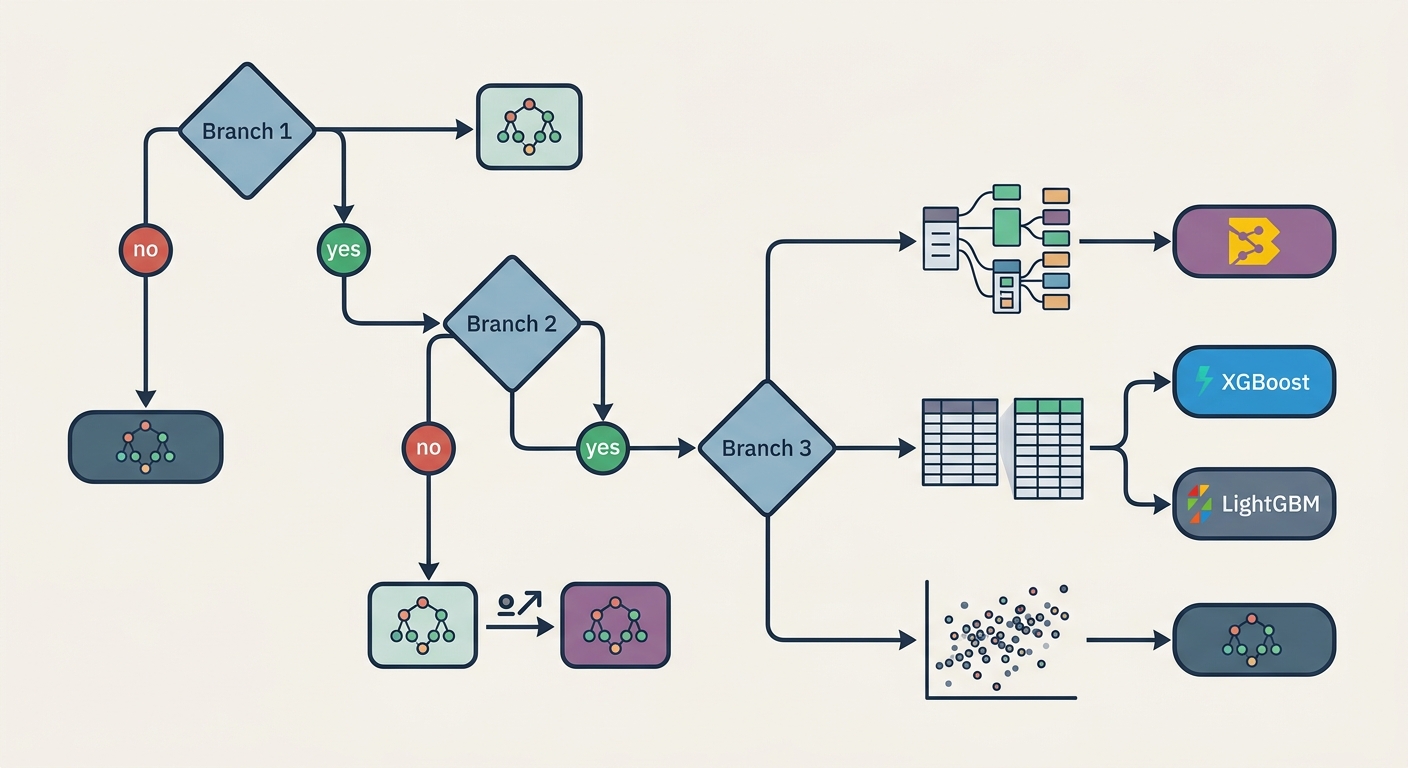
Use this checklist to choose between Random Forest and Gradient Boosting:
- Is maximum accuracy the absolute priority? → Gradient Boosting
- Do you have time to tune hyperparameters carefully? → Gradient Boosting
- Is your data noisy or prone to outliers? → Random Forest
- Do you need results quickly with minimal setup? → Random Forest
- Are there many categorical features? → CatBoost
- Is the dataset very large with high dimensionality? → LightGBM
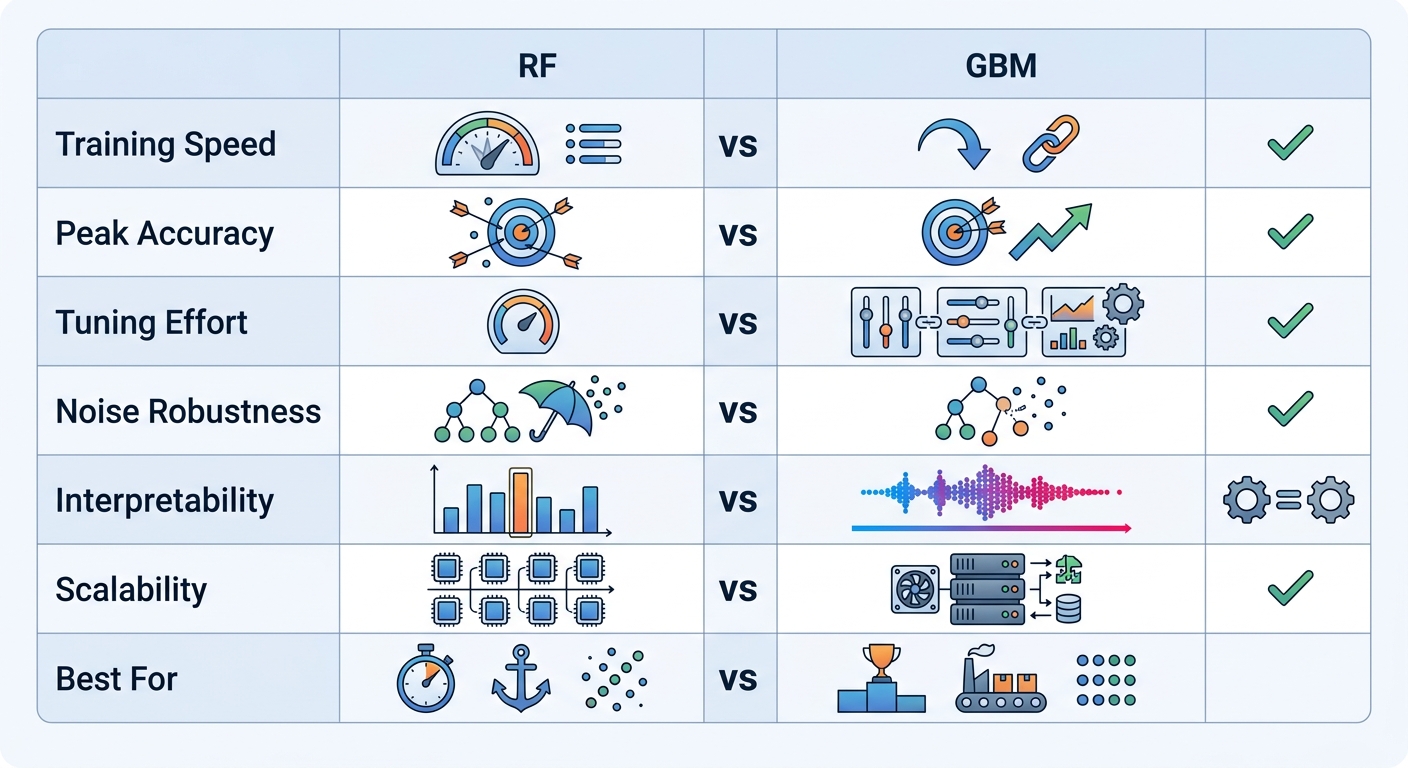
Below is a quick-reference comparison across the key dimensions:
Frequently Asked Questions
When should I choose Random Forest over Gradient Boosting?
Choose Random Forest when you need reliable results fast, when your data is noisy, or when interpretability matters alongside accuracy. It is also the better choice if computational resources are limited or hyperparameter tuning time is short.
Is Gradient Boosting always more accurate than Random Forest?
No. Gradient Boosting typically achieves 2–5% higher accuracy on clean tabular data, but on noisy datasets the gap narrows or reverses. A well-tuned Random Forest can match a default Gradient Boosting model.
Which gradient boosting implementation is best for large datasets?
LightGBM is the fastest for large and high-dimensional datasets due to its histogram-based algorithm and leaf-wise tree growth. CatBoost is the top choice when categorical features are prominent.
How many trees should a Random Forest have?
Start with 200 trees. Accuracy typically plateaus between 100–500 trees. Beyond 500, additional trees rarely improve accuracy but increase computation time linearly.
Can I combine Random Forest and Gradient Boosting in one project?
Yes. Stacking or blending both algorithms as base learners often outperforms using either alone. Use their predictions as features for a simple meta-learner.
Choosing between Gradient Boosting and Random Forest in 2026 comes down to understanding your specific constraints: time, data quality, accuracy requirements, and tuning capacity. Random Forest gives you a fast, robust baseline. Gradient Boosting pushes that baseline higher — if you invest the effort. Know what you have before you decide what you need.
To stay current with practical machine learning guides like this one, subscribe to the Algorithmine portal — hands-on articles for working data scientists delivered weekly.
Expert Q&A
Q: I've heard that LightGBM's leaf-wise growth can overfit more easily than XGBoost's level-wise growth. Is this something to worry about in practice?
A: Yes, this is a legitimate concern. LightGBM's leaf-wise growth always expands the leaf with the largest loss reduction, which can produce deeper, more complex trees on small datasets. In practice, overfitting risk from leaf-wise growth is manageable if you set num_leaves conservatively — typically between 20 and 100 depending on your data size. XGBoost's level-wise approach builds balanced trees that are more structurally regular, which can be advantageous when model interpretability matters. For large datasets (100K+ rows), leaf-wise overfitting is rarely an issue. For small datasets, consider XGBoost or apply stronger regularization in LightGBM.
Q: My dataset has about 40% categorical features by cardinality. Is CatBoost always the right choice here, or can I still use XGBoost with one-hot encoding?
A: CatBoost is strongly preferred at this cardinality level, but you have options. XGBoost with proper one-hot or target encoding can work, but CatBoost's ordered target statistics handle categorical features without manual preprocessing and without the target leakage risk that comes with naive target encoding. The 30% threshold in the article is a guideline — at 40% categorical features, you'll likely see a meaningful accuracy gap favoring CatBoost. The exception is when categories have very high cardinality (hundreds or thousands of levels); in that case, LightGBM's native categorical handling or XGBoost with target encoding may be more memory-efficient than CatBoost's full categorical approach.
Q: In the stacking section, you mention using predictions on a validation set as features for a meta-learner. How do I avoid data leakage during this process?
A: This is the critical implementation detail that makes or breaks stacking. The correct approach uses k-fold cross-validation on your training data to generate out-of-fold predictions for each base learner. These out-of-fold predictions become the training features for the meta-learner, and they're generated without the meta-learner ever seeing the corresponding training labels. The key rules: (1) Never generate base predictions on the same data used to train those base models; (2) Use a separate holdout set or a separate k-fold run to generate predictions for the test set; (3) Ensure the meta-learner's training data comes from the same distribution as its test-time input. A common mistake is generating base predictions on the full training set after fitting — this leaks information and inflates validation metrics.
Q: You recommend 200 trees as a starting point for Random Forest, but Kaggle competitions often use 1,000+. What's the practical guidance here?
A: The right number depends on your goal. For production models where inference latency matters, fewer trees are better. For accuracy maximization in competitions, more trees help because RF's averaging naturally benefits from ensemble diversity. In practice, we find that accuracy improvements beyond 300 trees are marginal — typically less than 0.5% for most tabular datasets. The exception is when features are noisy; larger forests provide more averaging and stability. For most real-world ML projects, 200–500 trees is the practical sweet spot. If you're in a competition setting and compute is not a constraint, 1,000+ trees is reasonable.
Q: When you say Random Forest is "robust to outliers," does that mean I can skip data cleaning entirely?
A: No — and this is a common misinterpretation. Random Forest is more robust to outliers than Gradient Boosting in the sense that individual outlier observations get averaged out across trees during bagging. However, outliers can still distort the splits that trees learn, particularly for continuous features. If an outlier sits in a leaf with many clean observations, it may have limited impact. But if outliers define the split conditions themselves, the tree structure becomes suboptimal. Robustness to outliers is relative — it does not replace proper data cleaning, particularly handling of label noise and extreme values in the target variable.
Image URLs
| # | Alt | URL |
|---|---|---|
| 1 | Algorithm decision flowchart: gradient boosting vs random forest choice criteria | /api/images/97089006c1eb4314af014326148abcf4 |
| 2 | Comparison table: Random Forest vs Gradient Boosting across 7 dimensions | /api/images/c319f71b609e49b5b80475b544084f83 |
Total: 2 images uploaded