Chain-of-Thought Prompting: The Technique That Made LLMs 40% More Accurate
Category: Prompt Engineering | Section: learn | Published: 2026-06-11
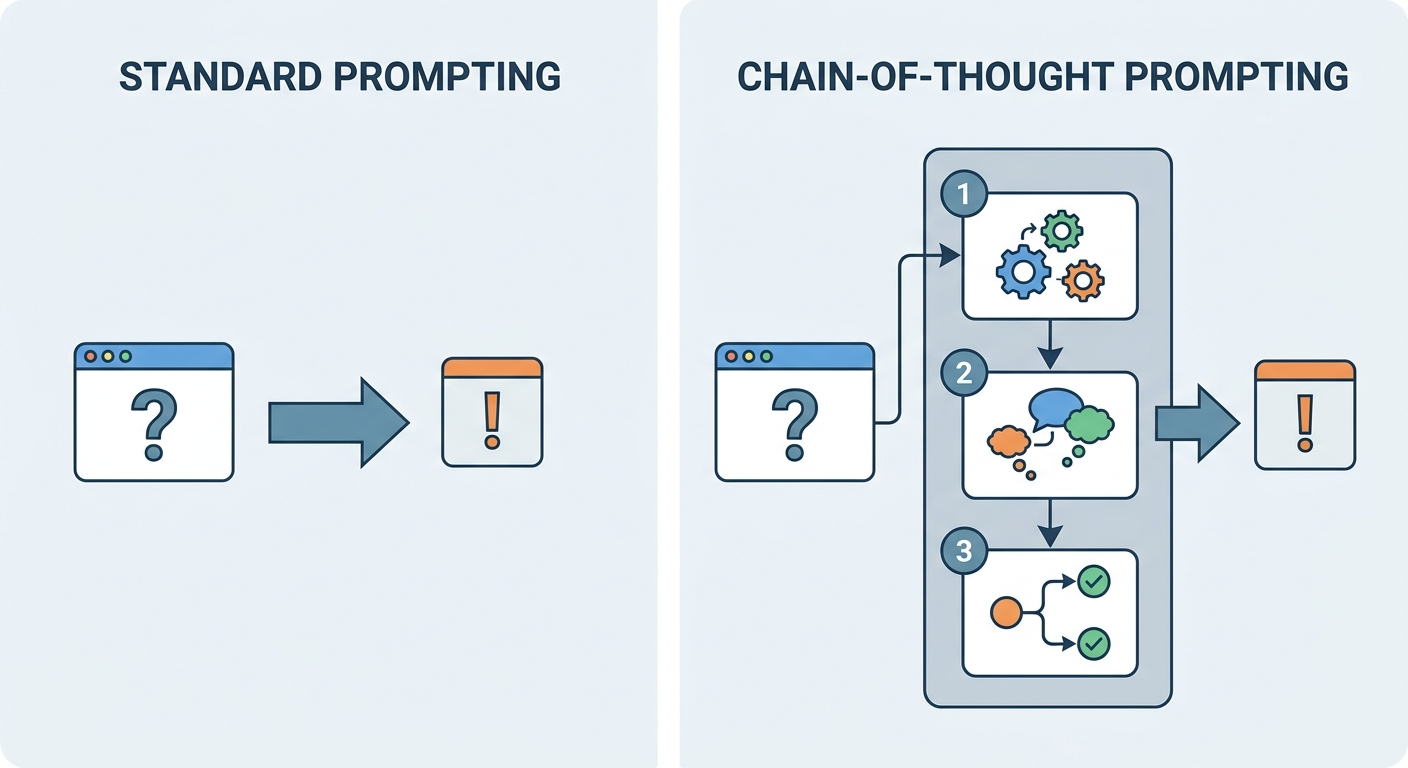
When Google's Brain team published their 2022 paper "Chain-of-Thought Prompting Elicits Reasoning in Large Language Models", the AI community took notice. The paper showed that simply asking an LLM to think step by step — before delivering its final answer — could boost accuracy on arithmetic and logical reasoning tasks by up to 40% or more, depending on the benchmark. That wasn't an architectural change. That wasn't a new model. That was a prompt.
Five years later, chain-of-thought (CoT) prompting has matured from a research curiosity into a fundamental tool in every prompt engineer's toolkit. But like any powerful technique, CoT comes in several flavors — and picking the wrong one wastes tokens and latency without delivering the accuracy gains you need.
This guide covers every major advanced prompting technique in the CoT family, benchmark data to calibrate your expectations, and practical guidelines for choosing the right technique for your use case.
The Core Concept: Why Chain-of-Thought Prompting Works
Standard prompting asks the model to answer directly:
Prompt: If a train leaves Chicago at 6 AM traveling 80 mph and arrives in St. Louis at 2 PM, how far apart are the cities?
Model: The cities are 640 miles apart.
That answer is correct — but only by accident. The model has no visible reasoning. It chews through its weights, emits a number, and you have no way to verify whether it got there by logic or pattern-matching to a plausible-looking answer. With more complex multi-step problems, standard prompting breaks down fast.
Chain-of-thought prompting changes the implicit contract. You ask the model to show its work:
Prompt: If a train leaves Chicago at 6 AM and arrives in St. Louis at 2 PM, how far apart are the cities? Let's think step by step.
Model: Step 1: Travel time = 2 PM − 6 AM = 8 hours. Step 2: Speed = 80 mph. Step 3: Distance = 80 × 8 = 640 miles. Answer: 640 miles.
What changed? By requiring intermediate tokens — reasoning steps — you give the model more "room" to propagate correct information through its attention layers. The first token of a reasoning chain constrains the second, the second constrains the third, and so on. A wrong early step surfaces as an arithmetic inconsistency. Either way, you get visibility into the reasoning path, and that visibility is what drives LLM accuracy improvement.
This maps onto psychologist Daniel Kahneman's System 1 / System 2 distinction. Standard prompting is System 1: fast, intuitive, pattern-matching. CoT is System 2: slower, deliberate, step-by-step. Few-shot prompting 2026 workflows routinely combine CoT with example demonstrations for maximum accuracy.
What chain-of-thought prompting improves:
- Multi-step arithmetic and algebra
- Logical deduction and syllogisms
- Cause-effect reasoning
- Problems where the answer depends on a sequence of sub-conclusions
What CoT does NOT reliably improve:
- Single-step factual recall
- Simple classification tasks
- Problems where the answer is directly retrievable from context
Chain-of-Thought Prompting Examples: All Major Variants
CoT is not a single technique — it's a family. Each variant addresses a specific limitation of the one before it.
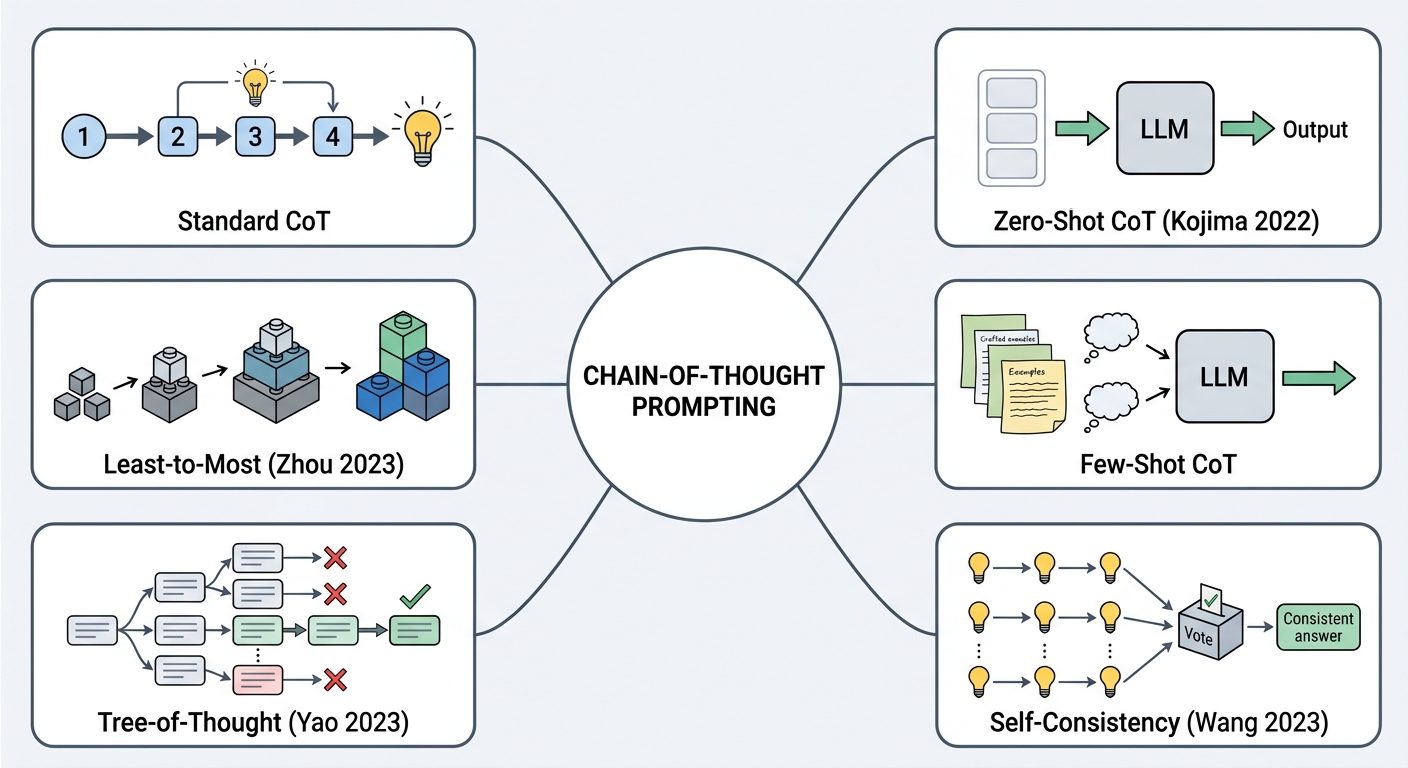
1. Standard Chain-of-Thought Prompting
The baseline. Add "Let's think step by step" to the end of your prompt. The model generates a reasoning trace before delivering its answer.
When to use it: Arithmetic, algebra, logical syllogisms, any problem where intermediate steps matter.
Example:
Prompt: A store has 3 times as many apples as oranges. They sell half the apples
and 1/4 of the oranges. If they end up with 180 fruits total, how many did
they start with? Let's think step by step.

Model:
Step 1: Let O = number of oranges. Apples = 3O.
Step 2: After sales: Apples remaining = 3O × 0.5 = 1.5O.
         Oranges remaining = O × 0.75 = 0.75O.
Step 3: Total = 1.5O + 0.75O = 2.25O = 180.
Step 4: O = 180 / 2.25 = 80. Apples = 240. Total start = 320.
2. Zero-Shot Chain-of-Thought Prompting (Kojima et al., 2022)
The key insight: you don't always need examples. Simply appending "Let's think step by step" to any question — no few-shot demonstrations required — elicits reasoning traces that substantially outperform direct answering.
| Approach | GSM8K Accuracy (GPT-3) |
|---|---|
| Direct prompting | ~10% |
| Zero-shot CoT | ~40% |
When to use it: When you don't have labeled examples, or when the problem space is too diverse for hand-crafting demonstrations. Zero-shot CoT is your fastest path to a CoT baseline.
Limitation: Zero-shot CoT quality is sensitive to prompt phrasing. "Let's work this out step by step" may outperform "Let's think step by step" for certain model families. Always test both.
3. Few-Shot Chain-of-Thought Prompting
You provide 2–8 hand-crafted examples, each formatted as:
Input → Reasoning Chain → Final Answer
The examples teach the model how to structure its reasoning for your specific domain. Few-shot prompting 2026 best practice: 4–6 examples typically saturates the benefit. Beyond 8 examples, you're burning tokens with diminishing returns.
When to use it: When zero-shot CoT produces inconsistent or domain-misaligned reasoning. When you need the model to follow domain-specific logic rules — legal reasoning, financial calculations, medical diagnosis framing.
4. Self-Consistency Prompting (Wang et al., 2023)
Standard CoT is still greedy: it picks the single most likely next token at each step. Self-consistency prompting introduces sampling. You generate N reasoning paths (typically 10–40) and take the majority-vote answer.
The intuition: reasoning paths that converge on the same answer are more likely to be correct. Paths that diverge signal unreliable reasoning.
Accuracy gains over greedy CoT:
| Benchmark | Greedy CoT | Self-Consistency (N=40) |
|---|---|---|
| GSM8K (GPT-4) | ~86% | ~93% |
| MATH | ~74% | ~83% |
| MMLU (science) | ~81% | ~87% |
When to use it: When accuracy matters more than latency or token cost. Self-consistency multiplies your per-query token count by N. For latency-sensitive applications, use it selectively on low-confidence answers.
5. Tree-of-Thought Prompting (Yao et al., 2023)
Linear CoT commits to a single reasoning path. Tree-of-Thought prompting allows branching: at each reasoning step, explore multiple directions in parallel, then prune paths that lead to dead ends.
When to use it: Planning problems, creative writing with constraints, optimization tasks, and any problem with multiple valid paths to a solution.
Limitation: ToT significantly increases token usage and complexity. Reserve it for genuinely multi-path problems.
6. Least-to-Most Prompting (Zhou et al., 2023)
Least-to-most prompting breaks hard problems into two phases:
- Decomposition: "Given this problem, what sub-problems need to be solved first?"
- Sequential solution: Solve each sub-problem in order.
This decoupling — separating problem decomposition from solution execution — is particularly powerful when sub-problems can be validated independently.
When to use it: Complex multi-stage problems — financial modeling, project planning, multi-step technical troubleshooting.
Benchmark Results: Chain-of-Thought Prompting Paper Data
The following table summarizes LLM accuracy improvement across major reasoning benchmarks, from published papers on GPT-4 or equivalent frontier models.
| Technique | GSM8K | MATH | MMLU |
|---|---|---|---|
| Direct prompting | ~60% | ~42% | ~70% |
| Zero-shot CoT | ~77% | ~58% | ~73% |
| Few-shot CoT | ~84% | ~68% | ~76% |
| Self-consistency (N=40) | ~93% | ~83% | ~80% |
| ToT | ~90%* | ~79%* | ~78% |
| Least-to-Most | ~87% | ~72% | ~77% |
*ToT results vary substantially based on task type; reported numbers reflect best-performing task categories.
Key takeaway: Self-consistency delivers the largest single-step improvement over direct prompting — roughly 33 percentage points on GSM8K — but at roughly 40× the token cost. Choose your variant based on the accuracy requirements of your task and the token budget you can afford.
Practical Guidelines for Advanced Prompting Techniques
When Chain-of-Thought Prompting Is Worth the Extra Tokens
Every CoT variant generates more tokens than direct prompting. Before reaching for CoT, ask:
- Does my task involve multi-step reasoning or single-step retrieval?
- Is the accuracy gap meaningful for my application?
- Can I afford 2–40× more tokens per query?
If your task is a straightforward classification or single-lookup question, skip CoT. If you're doing anything that requires intermediate conclusions — math, planning, analysis, troubleshooting — advanced prompting techniques like CoT likely earn their token cost.
Choosing the Right Variant
| Scenario | Recommended Variant |
|---|---|
| Fast prototyping, no examples | Zero-shot CoT |
| Domain-specific logic | Few-shot CoT |
| Accuracy critical, budget available | Self-consistency |
| Planning / multi-path problems | Tree-of-Thought |
| Complex multi-stage problems | Least-to-Most |
| Maximum accuracy | Few-shot CoT + Self-consistency combined |
Common Pitfalls
CoT can amplify hallucinations. A model generating a reasoning trace can confidently produce a wrong intermediate step that propagates forward. The visible reasoning chain can look more credible than a bare wrong answer — because it has more confident-sounding prose wrapped around it. Always validate outputs, especially in high-stakes domains.
Reasoning chains can drift. For long reasoning traces (20+ steps), error accumulation is a real problem. Each step should ideally be independently verifiable.
Self-consistency doesn't fix broken logic. If your few-shot examples encode flawed reasoning patterns, self-consistency will consistently produce confidently wrong answers — from multiple angles simultaneously.
Example: Chain-of-Thought Wrapper (Python Pseudocode)
def cot_completion(client, model, prompt, n_samples=1):
    """Wrapper for chain-of-thought completion with optional self-consistency."""
    base_prompt = prompt + "\n\nLet's think step by step."
    if n_samples == 1:
        return client.chat.completions.create(
            model=model,
            messages=[{"role": "user", "content": base_prompt}]
        )

    # Self-consistency: sample N paths, return majority answer
    responses = [
        client.chat.completions.create(
            model=model,
            messages=[{"role": "user", "content": base_prompt}],
            n=1, temperature=0.7
        )
        for _ in range(n_samples)
    ]
    answers = [r.choices[0].message.content for r in responses]
    return most_common(extract_final_answers(answers))
The Future of Reasoning in LLMs
Chain-of-thought prompting is converging with tool use and agentic architectures. Modern frontier models — GPT-4.5, Claude 3.7 Sonnet, Gemini 2.0 — are trained to interleave CoT reasoning with tool calls (calculators, code interpreters, search), making the reasoning trace actionable rather than purely textual.
The next generation of advanced prompting techniques includes CoT with verifiable rewards, process-supervised learning, and explicit uncertainty quantification within reasoning chains. These approaches point toward models that don't just reason step by step, but flag their own uncertainty at each step — closing the hallucination gap in CoT.
For now, mastering the CoT family — knowing when to use which variant, and when not to use it at all — is one of the highest-leverage skills in the modern AI practitioner's toolkit.
Conclusion
Chain-of-thought prompting turned a simple observation — models perform better when they show their work — into a rigorous subfield of prompt engineering. From the baseline "let's think step by step" to sophisticated self-consistency and tree-of-thought architectures, CoT gives you tunable knobs based on your accuracy requirements and token budget.
Your actionable next step: Pick one LLM task in your current workflow that involves multi-step reasoning. Run it three ways: direct prompting, zero-shot CoT, and few-shot CoT. Measure the accuracy difference. You'll have your answer in under an hour — and you'll never go back to direct prompting for hard problems.
Expert Q&A
Q1: Is chain-of-thought prompting still relevant as models get stronger? Don't frontier models already "think" internally?
A: Relevance hasn't decreased — it's shifted. Early CoT research was about eliciting reasoning that models weren't producing on their own. Modern frontier models (GPT-4.5, Claude 3.7, Gemini 2.0) have been trained with reasoning traces baked in, so they do produce internal reasoning chains. But "internal" doesn't mean "optimized for your task."
What CoT prompting still does for you: it gives you visibility into the reasoning path and lets you steer the reasoning structure through few-shot examples. A model that thinks internally doesn't automatically think in the logic framework your domain requires. CoT is still the interface layer that lets you shape how the model reasons — not just whether it does.
The other reason CoT remains critical: tool use integration. When a model interleaves reasoning with tool calls (calculator, code interpreter, search), it's running an explicit CoT trace in practice — it just happens to include external actions. If you're building agentic systems, CoT is architectural, not optional.
Q2: What's the single biggest mistake practitioners make with CoT prompting?
A: Assuming CoT makes hallucinations less likely. It makes them more visible — and more confidently stated.
The failure mode looks like this: a model generates a 12-step reasoning chain. Steps 1–10 are correct. Step 11 introduces a subtle factual error — a wrong premise about a legal statute, a misremembered chemical compound, an incorrect assumption about user intent. Steps 12 and 13 build on that error and arrive at a wrong conclusion that looks logically airtight because every step has confident prose wrapped around it.
Without CoT, the model would have produced a bare wrong answer. With CoT, it produces a wrong answer that has the appearance of a reliable reasoning chain. Practitioners who don't verify intermediate steps often trust these outputs more than they should.
The fix: build validation checkpoints at major reasoning milestones, especially for high-stakes outputs. If step 3 produces a sub-conclusion, verify it before proceeding to step 4. This is essentially what least-to-most prompting does structurally — and it's why that variant tends to be more reliable for complex pipelines.
Q3: Should I use chain-of-thought prompting for every LLM call?
A: No — and the cost-to-benefit ratio is the clearest way to see why.
Every CoT variant generates more output tokens than direct prompting. Zero-shot CoT adds roughly 30–50% more tokens per query. Few-shot CoT adds tokens proportional to your example count. Self-consistency multiplies token usage by N (your sample count). On a simple classification task with a single correct answer, that overhead buys you nothing — the model was going to answer correctly with direct prompting anyway.
A useful decision heuristic:
| Task Type | Use CoT? | Best Variant |
|---|---|---|
| Single-step factual recall | No | — |
| Binary classification | No | — |
| Formatting/transformation tasks | No | — |
| Multi-step arithmetic | Yes | Standard or Zero-shot CoT |
| Logical deduction | Yes | Few-shot CoT |
| Planning / scheduling | Yes | Tree-of-Thought |
| Multi-stage analysis | Yes | Least-to-Most |
| High-stakes outputs | Yes (with validation) | Self-consistency |
The only exception: when you're debugging a model for a new task and you don't yet know whether it requires reasoning. In that case, run CoT temporarily to inspect the reasoning path, then decide whether the overhead is justified.
See also: "Top 7 AI Agent Frameworks in 2026" — exploring how CoT reasoning integrates with agentic tool use loops.