Agentic RAG: How Autonomous Retrieval Systems Are Replacing Keyword Search in Enterprise
Your enterprise knowledge base holds answers. Your employees cannot find them.
This is the silent productivity killer. Workers spend an average of 3.6 hours daily searching for information. They type queries into search bars built for 1990s web pages. They skim long documents hoping to land on the right paragraph. They give up and ask a colleague who might also not know.
The problem is not a lack of information. It is the retrieval layer sitting between questions and answers.
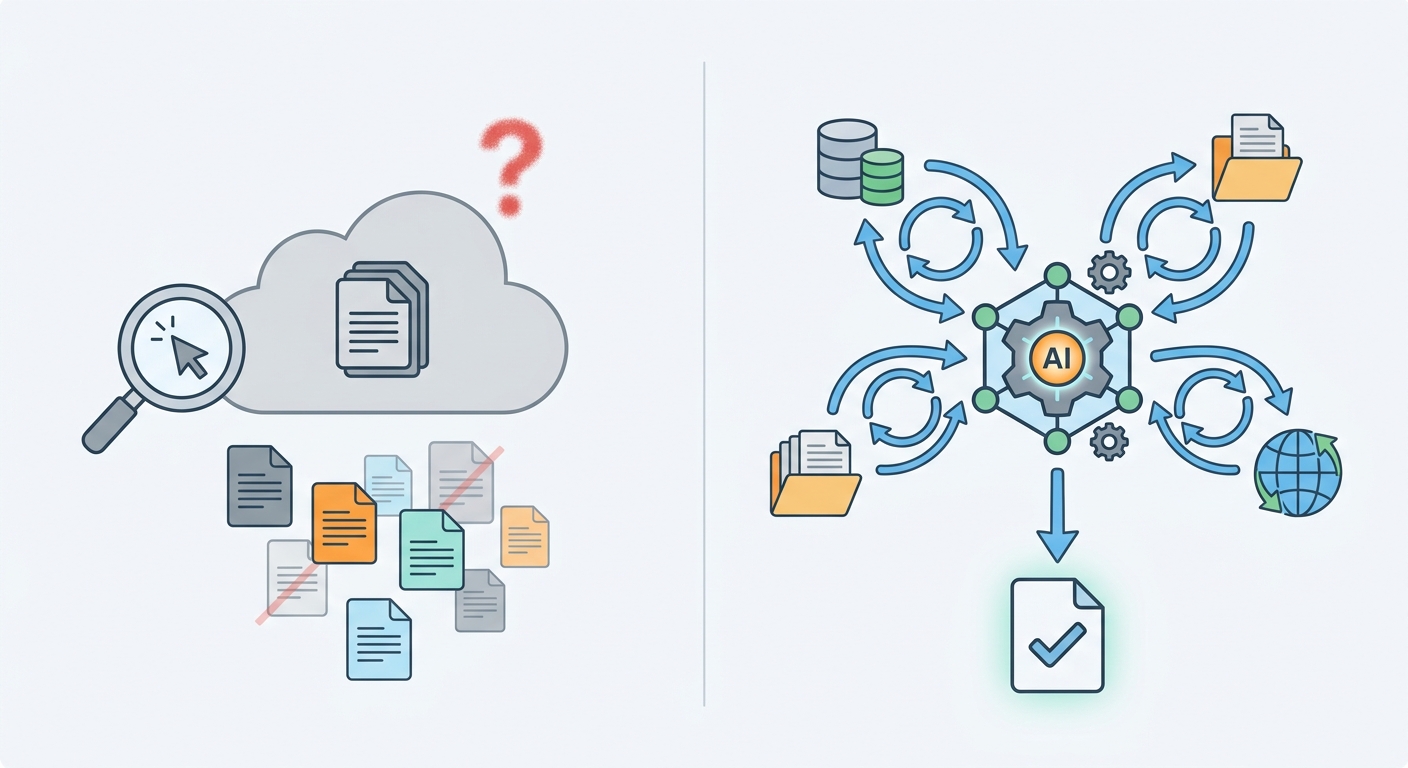
Keyword search matches words, not intent. It returns documents containing your terms. It cannot infer what you actually need. It cannot chain across multiple sources. It cannot know that "Q3 performance" means different things to finance and operations teams.
Traditional retrieval-augmented generation improved things. RAG systems retrieve relevant context before generating answers. This reduced hallucinations. It grounded responses in real data. But most RAG systems still operate as one-shot processes. A query comes in. Documents are retrieved. A response is generated. Done.
Enterprise questions rarely fit that mold.
What Is Agentic RAG?
Agentic RAG introduces autonomous AI agents into the retrieval pipeline. These agents do not just fetch documents. They plan. They reason. They iterate. They decide which sources to query, when to refine a search, and when to validate an answer against additional data.
IBM describes it as transforming the RAG pipeline from a linear workflow into a dynamic, intelligent problem-solving system.
Traditional RAG follows a fixed path. Agentic RAG treats each query as a unique problem requiring strategy. The agent breaks down complex questions into sub-tasks. It retrieves iteratively, building toward a complete answer. It uses tools beyond vector databases, such as calculation engines, code interpreters, or specialized APIs. It validates its own outputs before presenting them.
The distinction matters. A healthcare system asking "what are the protocol changes for pediatric dosing this quarter?" requires understanding which protocols, which departments, which regulatory updates apply. A traditional RAG system might return protocol documents. An agentic RAG system identifies the relevant protocols, cross-references regulatory databases, validates against current clinical guidelines, and synthesizes a context-specific answer.
How the Pipeline Works
The agentic RAG pipeline operates in distinct phases.
Goal Breakdown. The AI agent receives a query and decomposes it into targeted retrieval objectives. A question about quarter-end compliance involves identifying applicable regulations, locating internal policies, and mapping them to current operations.
Dynamic Retrieval. Rather than one retrieval pass, the agent queries multiple sources in sequence or parallel. Initial results inform subsequent searches. If early results are insufficient, the agent adjusts query strategy. This mirrors how a skilled researcher refines searches based on what they learn.
Tool Augmentation. The agent calls external tools as needed. It might run a calculation to verify financial figures. It could invoke a code interpreter to transform data format. It might query a structured database alongside a vector store. The retrieval layer expands beyond any single system.
Reasoning and Validation. Before generating a response, the agent evaluates whether retrieved context actually supports the answer. It checks for contradictions. It flags low-confidence claims. It requests additional sources when initial context leaves gaps.
Synthesis and Response. The agent synthesizes validated context into a coherent answer. It provides citations. It explains its reasoning path. The result is traceable, auditable, and grounded.
Weaviate notes that this iterative approach allows agents to handle complex, multi-step queries that would defeat a traditional RAG system.
Enterprise Benefits
Agentic RAG delivers measurable improvements across several dimensions.
Reduced Hallucinations. By validating retrieved information against multiple sources, agentic RAG significantly lowers the risk of generating incorrect claims. Each step leaves an audit trail. Answers are traceable to specific sources.
Cross-Source Synthesis. Enterprise knowledge rarely lives in one place. It spans wikis, databases, document management systems, and third-party tools. Agentic RAG breaks down these silos. The agent traverses multiple sources and synthesizes findings into unified responses.
Adaptive Learning. Agentic systems learn from interactions. They refine retrieval strategies based on what works. They improve over time without manual reconfiguration. This adaptability is crucial in fast-moving industries where knowledge bases shift constantly.
Governance and Auditability. Regulated industries demand transparency. Agentic RAG systems log decision steps, maintain source-level citations, and provide explainability. Compliance teams can trace any answer back to its authoritative sources.
Decision Speed. When employees find answers faster, decisions accelerate. A manager preparing a board report should not spend hours reconstructing metrics from fragmented systems. Agentic RAG synthesizes that information in seconds.
"By orchestrating knowledge more efficiently and providing synthesized, contextualized information, agentic RAG helps employees get what they need faster, speeding up decision-making processes." — Enterprise AI Research
Where Enterprises Are Using It
Several high-value workflows are already benefiting.
Intelligent Virtual Assistants. Internal help desks and employee support chatbots require accurate, context-aware responses. Agentic RAG enables these systems to handle nuanced queries across benefits, IT support, and HR policy without frequent escalations to human agents.
SOP and Policy Intelligence. Frontline workers need step-by-step guidance grounded in current procedures. Agentic RAG retrieves official documentation, interprets applicability based on context, and delivers traceable references. Onboarding time decreases. Policy compliance improves.
Compliance and Regulatory Support. In financial services and healthcare, interpretation of complex regulations varies widely. Agentic RAG standardizes policy interpretation by grounding responses in current regulatory text. This reduces compliance risk and audit findings.
Manager Decision Support. Executives synthesize information from multiple departments for strategic decisions. Agentic RAG pulls from finance, operations, sales, and market intelligence. It contextualizes data against historical patterns. The result is faster, better-informed decisions.
Frontline Workforce Automation. Field service teams access real-time SOP guidance, scheduling information, and compliance checks through mobile interfaces. Agentic RAG delivers context-specific answers without requiring workers to navigate multiple systems.
Trade-offs to Consider
Agentic RAG is not free of challenges.
Compute and Cost. Iterative retrieval and reasoning loops consume more resources than single-pass systems. Each additional validation step adds latency and infrastructure expense. Organizations must weigh whether the accuracy gains justify the cost for each use case.
Latency. Multiple retrieval passes take time. A complex compliance query might require five to ten seconds to complete. This is acceptable for high-value decisions but problematic for real-time customer-facing interactions requiring sub-second responses.
Complexity. Agentic systems introduce orchestration complexity. Prompt engineering, tool configuration, and validation logic require specialized expertise. Teams need AI engineering capabilities to implement and maintain these systems effectively.
The consensus among practitioners: agentic RAG suits high-value, complex workflows best. Routine queries that traditional search handles adequately do not benefit from the added sophistication.
The Path Forward
Enterprise search is undergoing a fundamental shift. The era of keyword matching and one-shot retrieval is ending. Autonomous agents capable of reasoning across fragmented knowledge are taking its place.
The organizations adopting agentic RAG now will define the next standard for enterprise knowledge management. Those that wait will spend years compensating for outdated retrieval infrastructure with human effort.
The question is no longer whether autonomous retrieval will replace keyword search. It is how quickly your industry will make the transition.