Agent Orchestration Frameworks in 2026: A Vendor-Noise-Free Comparison
A vendor-noise-free comparison of LangGraph, CrewAI, AutoGen, Semantic Kernel, and custom orchestration for production AI agents, with a reusable evaluation checklist.
Agent orchestration frameworks are the backbone of production AI agents in 2026, yet most teams pick one by popularity rather than fit. The choice between LangGraph, CrewAI, AutoGen, Semantic Kernel, and custom orchestration is an architecture decision, not a marketing contest. Get it wrong and you inherit state chaos, tool sprawl, and debugging misery.
This guide gives you a vendor-noise-free comparison and a reusable evaluation checklist. You will learn what agent orchestration really means, how the main frameworks differ on architecture and state, and when to build your own.
Agent orchestration is the coordination of execution order, state, tool calls, and handoffs across one or more agents and tools. The decision shapes reliability, cost, and team velocity. Here is a clear way to make it.
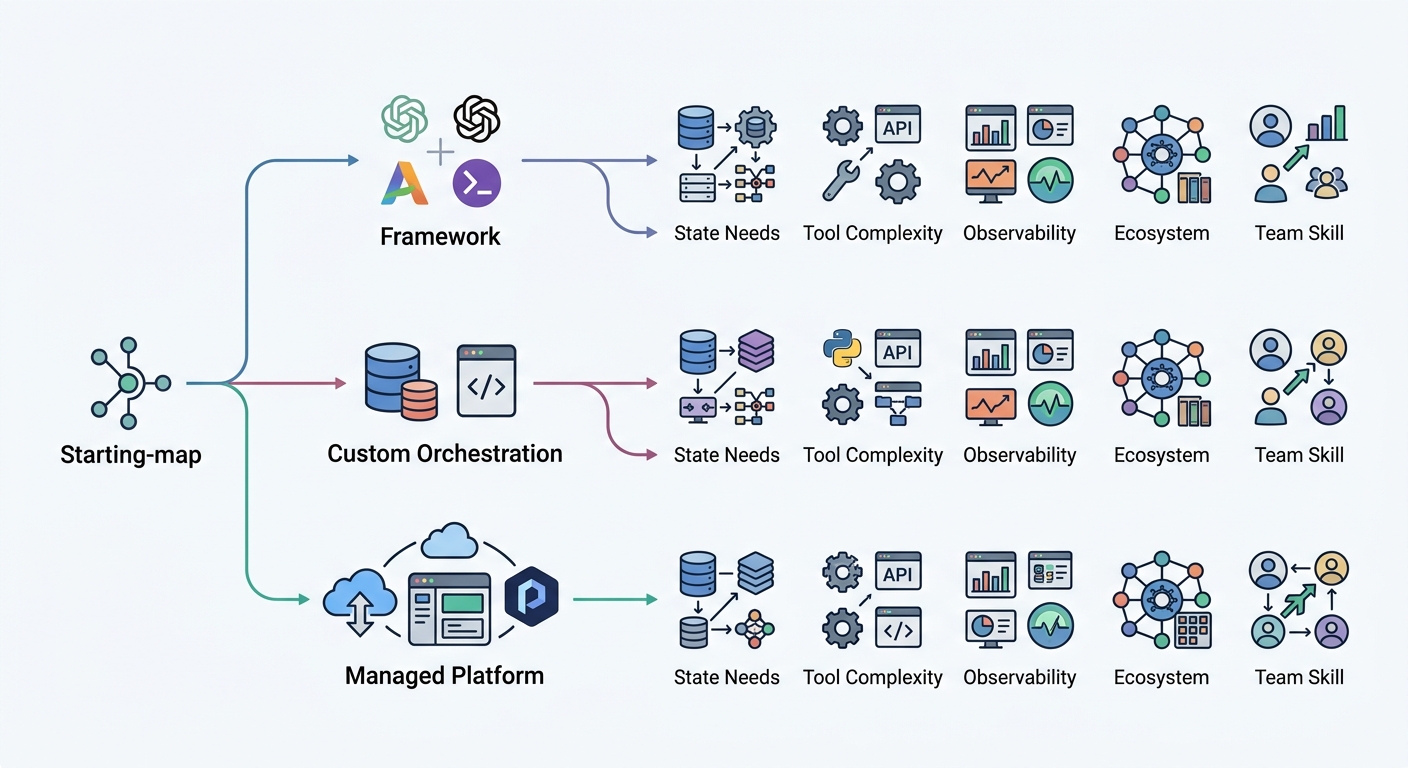
What Agent Orchestration Actually Means
Let's define the core term before comparing tools. Agent orchestration is the discipline of coordinating execution order, state, tool calls, and handoffs across one or more agents and tools. It is the "how" that turns a model into a dependable system.
The Anatomy of an Agent Run
A single agent run usually follows the same loop. The model plans a step. It calls a tool, such as an API or database. It observes the result. Then it decides the next action. That cycle repeats until a task completes or the agent stops.
A tool is an external function or service an agent can invoke, like a search API or a CRM update. Each step produces and consumes state. State is the accumulated data that persists across steps in a run.
Failure handling is where orchestration earns its keep. A retry policy decides what happens after a failed tool call. A timeout stops a runaway loop. Without these, an agent hangs or burns tokens.
When You Cross into Orchestration Territory
Not every AI feature needs orchestration. A single prompt that answers one question is not orchestration. If the task fits in one prompt, add a framework and you add complexity for nothing.
You cross into orchestration territory when several conditions appear. The task involves multiple steps. State must survive between steps. The agent calls several tools. Runs are long and can fail. Or you need observability and audit trails.
Sensing these triggers early prevents over-engineering. It also prevents the opposite mistake: hand-rolling chaos when a structured approach would help.
The Main Frameworks at a Glance
Four generalized frameworks dominate the conversation. We characterize their general capability areas without pinning exact versions or undocumented features. Check current docs before you commit.
Related reading: for a deeper look at how to design the instructions these agents run on, see our guide to prompt engineering for agentic AI.
LangGraph — Graphs and State Machines
LangGraph centers on a graph model. You define nodes and edges that describe a state machine. Each node does work. Edges decide the next node. This model makes flows explicit and controllable.
Its strength is durability and resumability. Checkpointing saves the state of a run so it can resume after a crash. For long workflows, that matters. A run that survives restarts is far easier to operate.
LangGraph suits deterministic, controllable, long-running flows. If you need clear control flow, this model is a strong fit. The tradeoff is that explicit graphs demand more upfront design.
CrewAI — Role-Based Crews
CrewAI organizes agents as a crew. You define agents with roles and tasks. A lead agent coordinates specialists to complete a goal. It is an intuitive way to model a team of helpers.
The abstraction is simple: agent, role, task, and process. This lowers the barrier for teams new to multi-agent work. It also offers workflow features for orchestrating steps.
CrewAI works well when you think in terms of roles and handoffs. The cost is that the abstraction can hide lower-level details when you need fine control.
AutoGen — Event-Driven Conversations
AutoGen, built by Microsoft, models agents that converse. Agents exchange messages and react to events. This event-driven design suits open-ended collaboration.
It is strong for research, analysis, and negotiation-style tasks where agents refine output through dialogue. Group chats let multiple agents contribute. The conversation model has been folded into Microsoft's broader Agent Framework.
AutoGen suits exploratory tasks where the path is not fixed. For rigid business processes, the free-form conversation model can be less predictable.
Semantic Kernel — The Microsoft-Native Option
Semantic Kernel is Microsoft's framework with strong support for C#/.NET and Python. It centers on a planner and plugins. Plugins are reusable skill-and-function packages an agent can call.
Its appeal is enterprise fit. Teams already on the Microsoft stack find it natural. It integrates with Azure services and follows patterns .NET developers know.
Semantic Kernel is a strong choice when ecosystem alignment matters more than orchestrator novelty. For teams outside .NET, other options may feel lighter.
What to Compare: The Five Decision Dimensions
Vendor marketing compares features. You should compare dimensions that explain real operational cost. Here are the five that matter most.
For related guidance on shipping reliable AI, see how to build a multi-agent RAG production pipeline.
Architecture Model
Ask how the framework expresses flow. Is it a graph, a crew, a conversation, or a planner? Match the model to your problem. Deterministic processes favor graphs and pipelines. Exploratory research favors conversation and role-based designs.
State Management and Durability
Where does state live? Can a run survive a crash and resume? Durability is the ability to preserve a run's progress across restarts. Checkpointing and exactly-once semantics matter for long or critical tasks.
Ask a hard question: if the server restarts mid-run, what happens? The answer separates demo-grade tools from production-ready ones.
Tool Calling and Permissions
How do agents call tools? Modern frameworks use schema-driven function calling — the model receives a JSON description of available functions and returns a structured call. Look for tool registration, allow and deny lists, and clear error surfacing.
Standards matter. MCP (Model Context Protocol) is an open standard that standardizes how agents access tools and data. MCP compatibility reduces vendor lock-in. Check whether a framework follows it.
Multi-Agent Patterns
Which patterns does a framework express naturally? Supervisor, hierarchy, and sequential pipelines are common. Some frameworks make one pattern trivial and others painful. Match the framework to the pattern you actually need.
Observability and Evaluation
Can you see what your agent does? Look for tracing, streaming, and logging. Observability is the ability to inspect and understand system behavior from its outputs. Evaluation hooks let you test agent quality. Integrations with tools like Langfuse or LangSmith reduce setup work.
Multi-Agent Patterns That Actually Matter
Here is the truth about multi-agent systems. Most teams do not need many agents. One well-designed agent beats three poorly coordinated ones. Use these patterns deliberately.
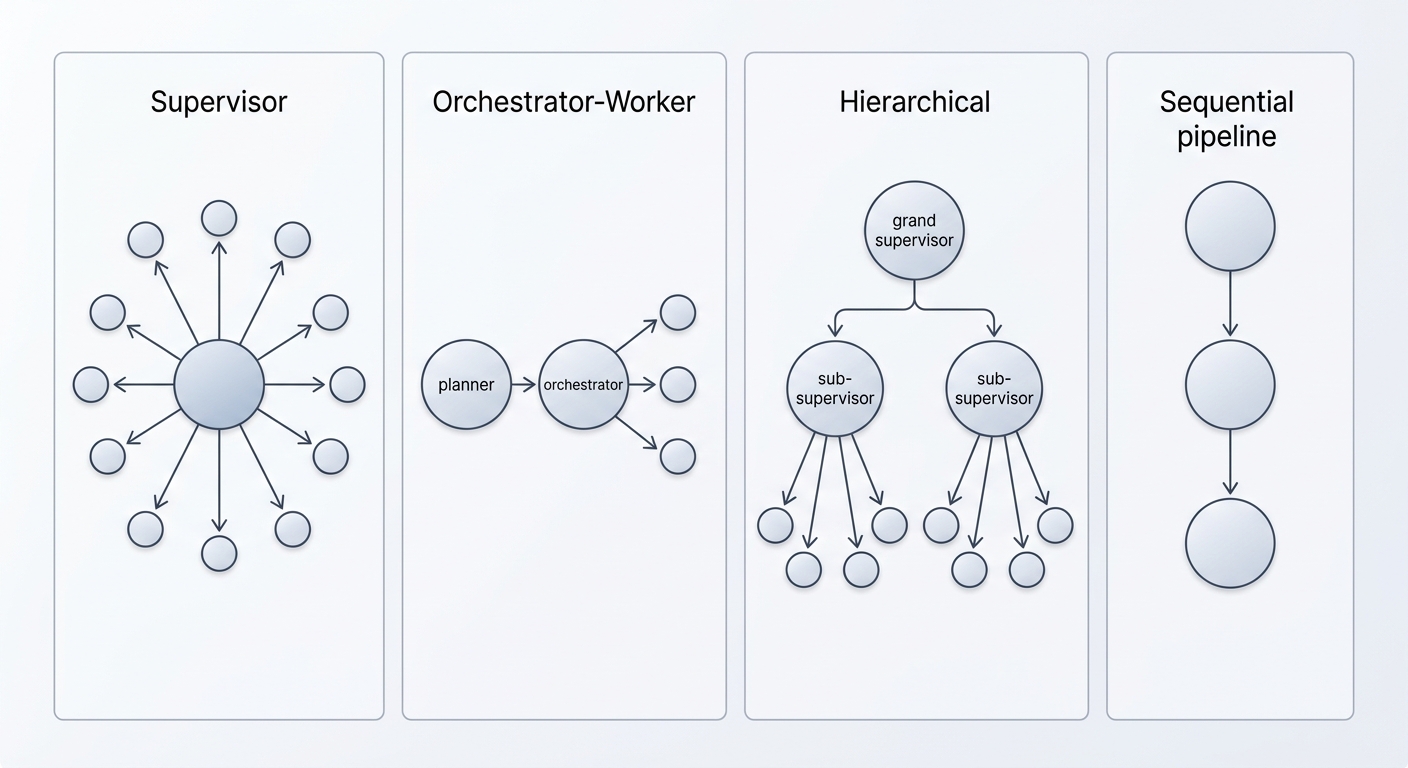
Supervisor / Orchestrator-Worker
A supervisor is a central agent that delegates subtasks to specialized workers. It decides which worker handles what. This pattern works when work divides cleanly across domains.
The benefit is focused specialists. Each worker does one job well. The cost is the supervisor's decisions on every step, which adds latency and a single point of failure.
Hierarchical and Sequential
Hierarchical patterns nest supervisors over supervisors. This suits very large domains that need tiered routing. It adds management layers, so use it only when scale demands it.
Sequential patterns chain steps in order, A then B then C. They are the most deterministic and easiest to test. For stable business processes, sequential beats cleverness.
When Multi-Agent Is Overkill
Ask whether one agent can finish the task. If it can, do not add more. Every extra agent adds latency, cost, and failure modes. Multi-agent systems shine for genuinely parallel or specialized work, not for simple requests.
Framework vs. Build Your Own
The loudest marketing tells you to adopt a framework. The strongest engineering often goes the other way. Let's weigh both honestly.
For a related take on the human side of running agents at scale, see our piece on the AI accountability wave and agent liability.
The Case for Custom Orchestration
Build your own when your team owns the stack and your state already lives in your application database. Custom orchestration means plain code coordinates the loop, with your systems as the source of truth.
Custom code shines when tool surfaces are simple and stable. You get full control over retries, logging, and compliance. You avoid learning a framework and chasing its releases.
The catch is that you must build everything: state, retries, observability, and tool routing. That is real engineering work. Skip it unless the payoff is clear.
The Hidden Cost of Frameworks
Frameworks are not free. There is a learning curve. There is version churn as releases change behavior. There is lock-in that makes leaving harder. Abstraction leakage happens when the framework's simplifications surface as bugs you must understand.
Frameworks also add an indirection layer. Debugging goes through the framework's machinery, not just your code. Budget for this in adoption time.
A Middle Path: Framework + Your State
Many production teams take a middle path. Use a framework for orchestration logic. Store state and checkpoints in your own durable store. Keep tool contracts in your codebase. This gives you structure without surrendering control.
This approach limits lock-in. If the framework changes, your state and tools survive. It is a pragmatic hedge that many mature teams adopt.
A Practical Evaluation Checklist
Use this checklist to compare any option against your actual requirements. Requirements first, frameworks second.
- Map the task to a pattern. Supervisor, sequential, or single agent? Match before you shop.
- List required state and durability. Does the run need to survive restarts and resume?
- Count your tools and permission needs. How many tools? Who may call what?
- Decide ecosystem and language fit. Does it fit your stack, such as .NET or Python?
- Define observability requirements. What must you trace, log, and evaluate?
- Prototype a thin end-to-end slice. Build the smallest real flow first.
- Measure latency and cost. A realistic run tells you more than a demo.
- Stress-test retries and recovery. Kill the process mid-run and check the outcome.
- Review release and governance cadence. Is the project active and stable?
Score candidates against your checklist, not against their marketing. The right framework is the one that meets your requirements with the least ceremony.
FAQ
What is the difference between LangGraph, CrewAI, and AutoGen? LangGraph uses a graph-based state machine with durable checkpoints. CrewAI models role-based multi-agent crews. AutoGen enables event-driven multi-agent conversation. Each suits a different architecture model.
Should I use a framework or build my own agent orchestration? Start with your requirements. Use a framework when it matches your architecture and saves real work. Build your own when state and tools already live in your systems and control matters more than convenience.
What is agent state management and why does it matter? State management tracks data across an agent run's steps. It matters because long runs can fail or restart. Durability and checkpointing let a run resume, which is critical for reliability.
What is MCP (Model Context Protocol) and do I need it? MCP is an open standard that standardizes how agents access tools and data. It reduces vendor lock-in for tool access. You need it when you want portability across frameworks and tools.
Which multi-agent pattern should I use? Use sequential for stable processes. Use supervisor or orchestrator-worker for parallel specialized work. Use hierarchical only at real scale. When in doubt, use one agent.
How do I make agent orchestration production-ready? Add observability, tracing, and evaluation. Define retries and timeouts. Test failure recovery. Store state durably. Treat orchestration as infrastructure worth the same rigor as your backend.
Conclusion
The framework decision is an architecture decision. Start with the task, the state, the tools, and your team's strengths. Then pick the tool that fits with the least ceremony.
Whether you choose LangGraph, CrewAI, AutoGen, Semantic Kernel, or your own code, the principles are the same. Control your state. Govern your tools. See what your agents do. Test before you trust.
Subscribe to the Algorithmine portal for practical engineering guidance on building and shipping AI systems. Requirements first, frameworks second — that method saves you from the noise.
Section summary: We defined agent orchestration, compared the four main frameworks on architecture and state, identified the five decision dimensions, covered the multi-agent patterns that matter, weighed framework vs. custom, and ended with a reusable evaluation checklist.