Vision-Language Models in Manufacturing: A 2026 Enterprise Implementation Guide
Vision-Language Models are transitioning from pilot programs to production deployments in 2026. This guide covers where VLMs deliver the most value in manufacturing — quality control, predictive maintenance, and robotics — and provides a 24-week implementation roadmap for enterprise teams.
Meta Description: Enterprise-grade guide to deploying vision-language models (VLMs) in industrial manufacturing. Covers quality control, predictive maintenance, robotics, architecture decisions, and a 2026 implementation roadmap for B2B decision-makers.
Slug: vision-language-models-vlm-industrial-production-2026
Introduction: The Multimodal Shift Arriving on the Factory Floor
In 2025, the global Vision-Language Model market was valued at approximately $4.8 billion. By 2034, analysts project it will reach between $38.6 billion and $98.7 billion — a compound annual growth rate that places VLMs among the fastest-expanding segments in enterprise AI. Within that trajectory, manufacturing stands out as the single fastest-growing vertical, with end-user adoption expanding at a CAGR of 29.6%.
These are not abstract projections. They reflect a concrete shift happening in factories, warehouses, and production facilities right now. Vision-Language Models — AI systems that simultaneously process images, video, and natural language — are moving out of the research lab and into production pipelines. They are inspecting parts, writing maintenance tickets, commanding robots, and generating compliance documentation. And 2026 is shaping up to be the year many manufacturers move from pilot programs to full-scale deployment.
What makes VLMs fundamentally different from the computer vision systems that preceded them is the combination of visual perception with semantic reasoning. Traditional inspection cameras detect defects by matching pixel patterns against known templates. VLMs see a scratch on a connector pin and generate a plain-language description — scratched surface near connector pin, approximately 2mm — that integrates directly into a quality record, a maintenance work order, or an ERP system. The machine doesn't just detect; it understands, explains, and connects what it sees to the operational context that humans work in every day.
Key Stat: Manufacturers report that VLM-based inspection systems reduce defect escape rates by 15–40% compared to traditional rule-based inspection, according to published case studies from electronics and automotive assembly deployments. (Sources: PatSnap Eureka VLM Manufacturing Report 2025; Roboflow Industrial VLM Case Studies)
This guide is for enterprise decision-makers — operations directors, automation engineers, plant managers, and CTOs — who need to evaluate, plan, and execute VLM deployment in manufacturing environments. It covers what VLMs are, where they deliver the most value today, the architecture decisions that determine success or failure, and a phased roadmap for moving from initial pilot to production scale.
What Are Vision-Language Models?
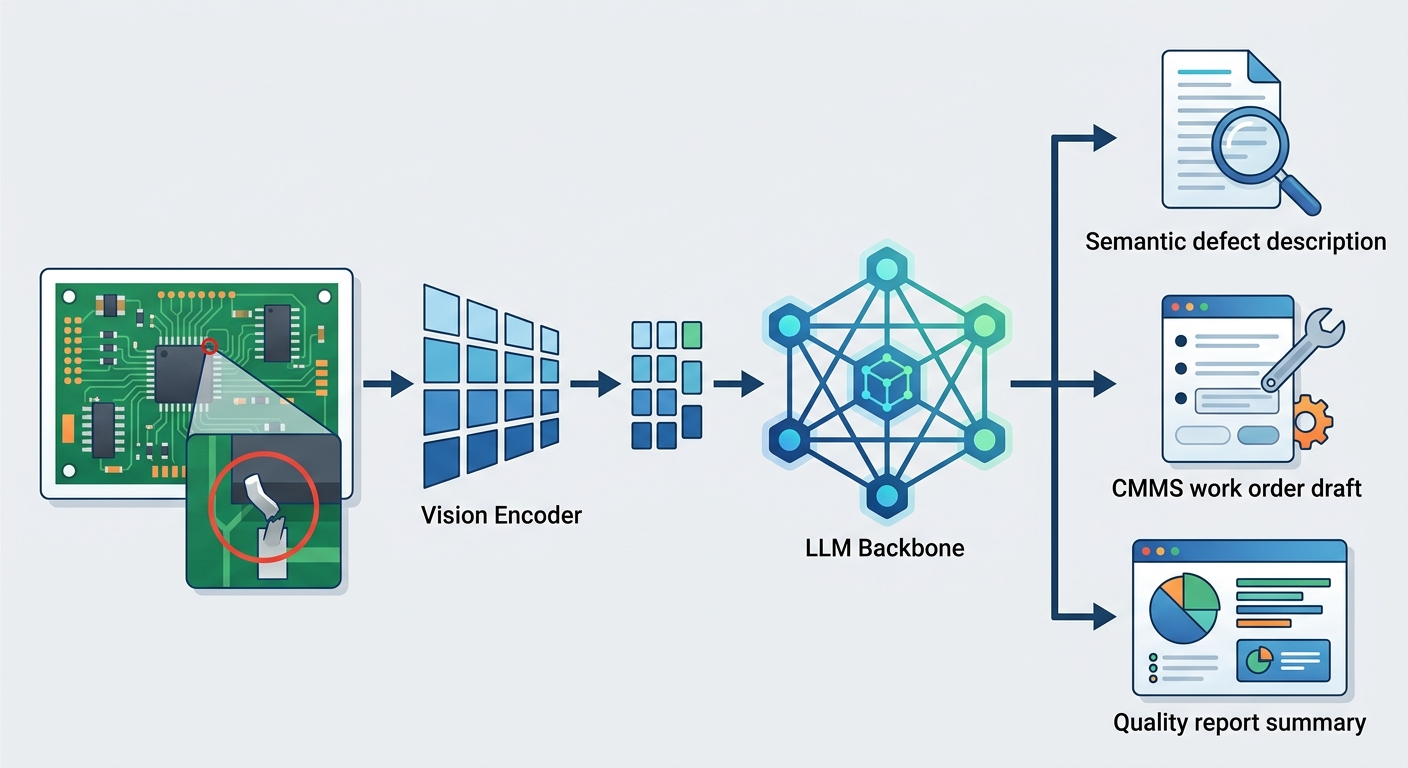
A Vision-Language Model (VLM) is a multimodal AI system that processes visual inputs (images, video frames) and textual inputs (queries, instructions, metadata) within a single unified architecture. The typical structure combines a vision encoder — often a modified vision transformer (ViT) or convolutional backbone — with a large language model (LLM) core. The encoder transforms pixel data into a representation space that the LLM can reason over, enabling the system to answer questions about images, describe what it sees, follow complex visual instructions, and generate text outputs grounded in visual evidence.
This architecture produces a fundamentally different capability profile compared to traditional computer vision. A conventional CNN-based inspection system receives an image and outputs a classification label or bounding box coordinates. It excels at tasks that resemble its training distribution — a defect it has seen before, a class it was explicitly taught. A VLM, by contrast, can interpret a visual input it has never encountered and produce a semantically meaningful response: describing the anomaly in natural language, assessing its operational significance, and connecting it to relevant documentation.
Core capabilities relevant to manufacturing include:
- Visual question answering (VQA): Asking "Is this solder joint acceptable?" or "What is the severity of this surface defect?" with image-contextualized answers.
- Zero-shot and few-shot classification: Generalizing to novel defect categories without retraining, using only a textual description of the new class.
- Semantic defect description: Generating detailed natural-language descriptions of anomalies detected in production imagery.
- Instruction following: Executing complex, multi-step visual tasks described in natural language — for example, "Inspect the five components on the left side of the board for missing resistors."
The practical implication is that VLMs close the gap between what a vision system can detect and what a human inspector can understand and communicate. They bring the reasoning layer that transforms raw visual data into operational knowledge.
Production Use Cases: Where VLMs Deliver Value Today
The most mature VLM deployments in manufacturing cluster around three areas: quality control, predictive maintenance, and robotic manipulation. These are not future-state concepts — they are active deployments with measurable outcomes.
Quality Control and Visual Inspection
Quality inspection is the highest-value near-term application for VLMs in manufacturing. The core problem is this: traditional rule-based and CNN-based inspection systems are brittle when confronted with defect types they haven't been explicitly trained to recognize. In high-mix production environments — short runs of many product variants, frequent changeovers, custom orders — new defect modes appear faster than inspection systems can be retrained.
VLMs address this through zero-shot generalization. A VLM trained on broad visual and textual data can assess a novel anomaly using only a language description of what constitutes acceptable quality. When a VLM inspects a PCB and encounters a component misalignment it has never seen in training, it can still evaluate it semantically: misaligned capacitor, lead not centered in pad, risk of intermittent connection. This capability dramatically expands the coverage of an inspection system without requiring exhaustive defect libraries.
Beyond detection, VLMs transform inspection into a self-documenting process. Rather than a human engineer reviewing images and manually logging findings, a VLM generates a structured quality record in real time:
Inspection Result: Solder defect — insufficient solder on pin 3, Q2 transistor. Severity: moderate. Recommended action: rework before assembly.
This output integrates directly into MES event queues, ERP quality modules, or digital thread platforms without manual transcription. The result is faster closed-loop feedback, higher inspector throughput, and a complete audit trail generated at machine speed.
Use cases span industries: electronics manufacturers use VLMs for solder joint and component placement inspection on SMT lines; automotive OEMs apply them to weld quality validation and paint defect detection; pharmaceutical producers deploy them for 100% visual inspection of vials, syringes, and tablets under GMP conditions.
Predictive Maintenance
Traditional predictive maintenance systems ingest sensor data — vibration, temperature, pressure, current draw — and generate numerical health scores or threshold-based alerts. While useful, these outputs often lack the contextual depth needed for accurate diagnosis. An alert saying bearing temperature 12% above baseline tells a technician that something is wrong but provides no insight into cause, severity, or recommended action.
VLMs extend predictive maintenance by fusing visual evidence with the full corpus of maintenance knowledge available in an organization: OEM service manuals, historical work orders, technical bulletins, and SOPs. When a VLM analyzes a vibration sensor anomaly alongside an image of the bearing housing, it can generate a diagnostic narrative:
Diagnostic: Elevated temperature in output bearing (Bearing 7, Line 3, Pump Station A). Cross-referenced with work order history (WO-2024-1187, WO-2025-0342) and OEM service bulletin SB-2024-044. Consistent with raceway wear pattern. Recommend inspection within 48 hours; parts likely required: bearing raceway, lip seal.
This level of diagnostic richness goes beyond what any numerical model reliably produces. The VLM connects visual evidence to institutional knowledge that would otherwise require a senior technician to retrieve and interpret.
Equally significant is automatic work order generation. The VLM output above contains sufficient specificity — component, location, probable cause, recommended action — to draft a maintenance ticket for a CMMS or EAM system. This closes the loop between detection and response without requiring an engineer to manually translate observations into structured records.
Industrial Robotics and Human-Machine Collaboration
Vision-Language-Action (VLA) models represent the next frontier in factory robotics. Unlike conventional pick-and-place systems that execute pre-programmed motion paths, VLA-equipped robots accept natural language instructions grounded in visual context. A technician can say "Pick up the blue component beside the red bin and place it in the inspection tray" — and the robot processes both the verbal instruction and the visual scene to execute the task without retraining.
This capability matters most in two scenarios: high-mix assembly environments where product variants change frequently, and warehouse and logistics operations where unpredictable object arrangements challenge fixed programming. In both cases, VLMs enable robots to adapt to variation without mechanical retooling or code changes.
For collaborative robots (cobots), VLMs serve as an interface layer that makes automation accessible to non-technical operators. Rather than configuring waypoints and velocity parameters through a pendant, a floor operator describes what needs to happen in plain language. The VLM translates that instruction into robot motion, applies necessary safety constraints, and executes. This dramatically lowers the barrier to automation in labor-constrained manufacturing environments.
Architecture Decisions: Edge vs. Cloud Deployment
The infrastructure decision for VLM deployment is not a binary choice — it is a spectrum, and getting it right determines whether the system performs reliably in production or becomes a source of latency and operational risk.
Edge Deployment
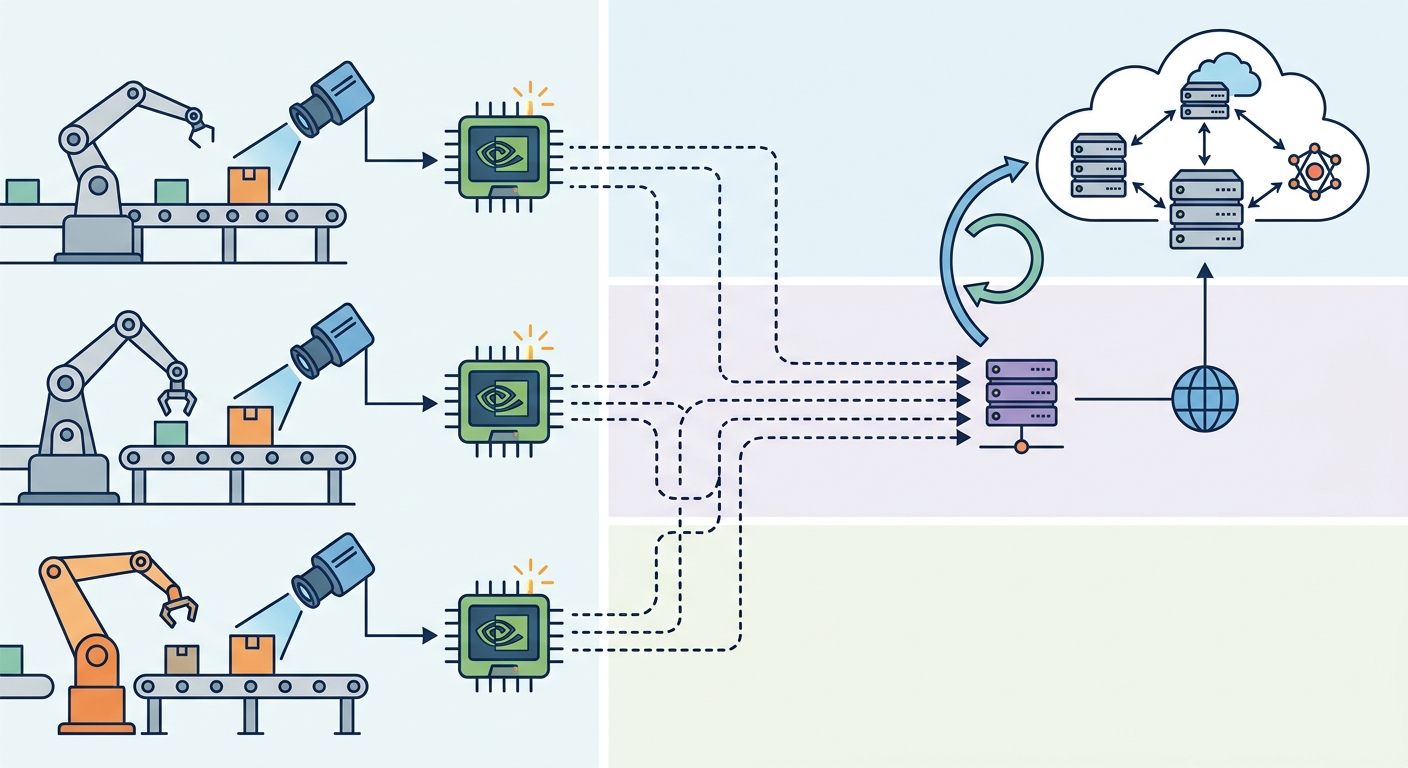
Running VLMs at the edge — on industrial PCs, dedicated inference hardware, or embedded modules at the point of inspection — offers three decisive advantages for manufacturing environments.
Latency. Industrial inspection and robotic control require response times measured in milliseconds. A quality checkpoint on a high-speed packaging line may need to evaluate a product in under 50 milliseconds. Cloud-hosted VLMs introduce network round-trip latency that makes real-time inspection impractical at scale. Edge inference eliminates this penalty.
Data sovereignty and operational security. Manufacturing environments operate under strict OT network isolation requirements. Sending inspection imagery to a third-party cloud API may conflict with data governance policies, customer contractual requirements, or regulatory frameworks such as ITAR or GDPR. Edge deployment keeps all visual data within the plant network.
Reliability. A production line that depends on cloud connectivity is vulnerable to bandwidth fluctuations and service outages. Edge inference is independent of external network conditions, ensuring consistent performance across shifts and facility locations.
Effective edge VLM deployment requires model optimization. Full-precision VLMs demand hardware that is prohibitively expensive for edge economics. Quantization — reducing numerical precision from FP32 to INT8 or INT4 — shrinks model size by 60–75% with acceptable accuracy trade-offs for most industrial inspection tasks. Hardware platforms purpose-built for edge AI inference include NVIDIA Jetson (Orin series), Intel NPU-accelerated platforms, and dedicated AI accelerators from Ambarella and Qualcomm.
Cloud Deployment
Cloud-hosted VLMs offer the advantage of access to the most capable foundation models — GPT-4o, Gemini 2.0, Claude Sonnet — without the burden of managing inference infrastructure. For non-real-time workloads, this is often the right choice: analytics dashboards, retrospective quality studies, document processing, and long-horizon predictive models where a few seconds of latency is acceptable.
Cloud deployment also simplifies model updates. A new foundation model version becomes available without a firmware update cycle on edge devices.
The Hybrid Pattern
The most robust production architectures combine edge and cloud strategically. Edge inference handles time-critical inspection and control loops. Cloud inference handles complex reasoning tasks — root cause analysis, cross-fleet analytics, model retraining pipelines — where latency is acceptable. A middleware layer routes requests based on latency budgets and data classification.
Integration Points
Regardless of deployment topology, VLM outputs must connect to existing industrial systems. The practical integration layer typically includes:
- OPC-UA for communication with PLCs and SCADA systems
- MQTT for publish-subscribe event streaming to MES and data historians
- REST APIs for synchronous integration with ERP, CMMS, and quality management systems
- gRPC for high-throughput, low-latency streaming from inspection cameras to inference engines
Implementation Insight: Expect integration effort to represent 30–50% of total project time in a typical VLM deployment. This is not a software problem alone — it requires collaboration between data science teams, OT engineers, and IT integration specialists.
Implementation Roadmap: From Pilot to Production in 24 Weeks
Organizations that achieve successful VLM deployment share a common pattern: they approach it as an engineering program, not a procurement exercise. The following roadmap reflects the most consistent timeline from organizations that have moved VLM pilots into production.
Phase 1 — Pilot (Weeks 1–8)
The pilot phase is scoped narrowly: one production line, one use case, one shift. The objective is not to prove business value yet — it is to validate technical feasibility with real production data.
| Weeks | Activities | Key Outputs |
|---|---|---|
| 1–2 | Use case selection and scoping | Defined success criteria, selected production line |
| 2–4 | Data collection and labeling | Representative defect image library |
| 3–6 | Model selection and fine-tuning | Baseline performance metrics |
| 6–8 | Shadow mode operation | VLM output vs. human decision comparison |
Week 1–2: Use case selection and scoping. Choose a use case with sufficient volume and defect diversity to generate meaningful signal. Quality inspection on a mixed-model line is the most common starting point. Define the success criteria before collecting any data.
Week 2–4: Data collection and labeling. VLMs require images. A representative library of defect imagery — including the full spectrum of known defect types, plus representative samples of good parts — is the essential foundation. This phase often exposes gaps: organizations frequently discover they have limited historical imagery, inconsistent labeling, or poor image quality from existing cameras.
Week 3–6: Model selection and fine-tuning. Evaluate one or two foundation models against your specific imagery. Fine-tune on proprietary defect data to improve domain accuracy. Document baseline performance metrics — detection accuracy, false positive rate, inference latency — before any optimization.
Week 6–8: Shadow mode operation. Deploy the VLM in parallel with existing inspection systems. The VLM observes and generates output; human inspectors make the actual disposition decision. Compare VLM outputs against human decisions to identify failure modes.
Phase 2 — Validation (Weeks 9–16)
Shadow mode results inform whether the system is ready to move to active advisory mode and eventual production.
Week 9–12: Accuracy benchmarking and gap analysis. Quantify detection accuracy, false reject rate, and missed defect rate against the existing system. Identify categories of errors the VLM makes that humans do not — these are the most important to understand before trusting the system.
Week 11–14: Integration testing. Connect VLM outputs to MES, CMMS, or ERP systems. Validate data formats, ensure audit trail completeness, and test failure modes — what happens when the VLM is unavailable? Does the system fail gracefully or halt production?
Week 13–16: Regulatory and validation documentation. In regulated industries — pharmaceutical, medical device, aerospace — this phase includes writing validation protocols, IQ/OQ/PQ documentation, and establishing change control procedures. Plan for this explicitly; it cannot be retrofitted after production deployment.
Phase 3 — Production Scale (Weeks 17–24+)
Week 17–20: Controlled production rollout. Begin with a single line or cell during the least busy shift. Define explicit escalation protocols: what happens when VLM confidence is low? Who reviews borderline cases? Establish a feedback loop where human override decisions are captured and fed back into model improvement.
Week 20–24: Performance monitoring and model drift detection. VLMs can experience performance degradation when production variation shifts the visual distribution of parts (new materials, different suppliers, seasonal changes). Implement continuous monitoring with alerting on key metrics: detection rate, false positive rate, and output latency.
Ongoing: ROI measurement. Track the KPIs defined in Phase 1. Common metrics include defect escape rate (parts shipped with defects), false reject rate (good parts rejected), inspector throughput (parts per hour per person), and unplanned downtime attributable to inspection-related holds.
Vendor and Technology Landscape
Selecting a VLM platform is a consequential decision that shapes integration complexity, cost structure, and long-term flexibility. The options fall into three categories.
Cloud API Services
OpenAI's GPT-4o with vision, Google Gemini 2.0, and Anthropic's Claude with vision offer state-of-the-art multimodal capability through cloud APIs. They require no inference infrastructure, support the most capable models available, and price on a per-query basis. The trade-offs are data privacy (inspection imagery leaves the facility), latency (network round-trip), and cost at scale (millions of inferences per day add up).
For organizations with moderate inspection volumes and acceptable data governance frameworks, cloud APIs are the fastest path to a working system.
Open-Weight Models
Qwen2-VL, InternVL3, and LLaVA offer fine-tunable, on-premise deployable VLMs under permissive licenses. These models can be run entirely within the plant network, fine-tuned on proprietary defect datasets, and integrated without external dependencies. They require more ML ops investment — model serving infrastructure, fine-tuning pipelines, monitoring — but offer superior data control and lower long-term per-inference cost at scale.
Qwen2-VL has demonstrated competitive performance on industrial visual reasoning tasks at 7B–72B parameter scales. InternVL3-78B offers strong document and diagram understanding relevant to manufacturing documentation automation.
Industrial-Specialized Platforms
Roboflow provides an end-to-end computer vision platform that includes VLM-capable workflows with industrial inspection tools, dataset management, and deployment infrastructure. AQ-ROSE's AQ-VLM is specifically trained on manufacturing defect imagery and offers a domain-adapted foundation for quality inspection applications.
Selection Criteria: The factors that matter most for manufacturing VLM selection — latency under real production constraints, accuracy on domain-specific imagery (not just general benchmark performance), licensing terms for commercial deployment, and the maturity of the enterprise support and validation documentation ecosystem.
Challenges and How to Address Them
Transparent acknowledgment of VLM limitations is essential for responsible deployment — and for building the credibility that earns decision-maker trust.
Precision-Critical Inspection Tasks
For tasks requiring micron-level measurement repeatability — solder paste deposit volume, machined surface flatness — traditional machine vision systems with pixel-accurate measurement capabilities still outperform VLMs. VLMs reason about visual semantics; they are not optimized for sub-pixel metrology. The practical resolution: use a hybrid architecture where CNN-based systems handle quantitative measurement and VLMs handle semantic classification and anomaly interpretation.
Latency at Scale
Even quantized VLMs introduce latency that challenges high-throughput production lines. A single inspection station operating at 60 parts per minute has a budget of under 1 second per part. Complex VLM inference can exceed this. Mitigation strategies include model distillation (training a smaller student model on the larger teacher's outputs), hardware acceleration investments, and careful routing that reserves VLMs for cases where their semantic capability is needed, while faster CNNs handle routine clearance.
Training Data Scarcity
The most common barrier to deployment is insufficient representative training data. Manufacturing defects are, by definition, rare events — a line running at 99.5% yield produces defect imagery at a very low rate. Strategies to address this include synthetic defect generation (physically plausible defects rendered onto images of good parts), active learning pipelines that selectively label the most informative new examples, and transfer learning from related industrial domains.
Legacy System Integration
Manufacturing facilities run a mix of equipment from different eras, often with incompatible communication protocols and limited API exposure. Integrating VLM outputs into MES event queues, CMMS work order systems, and ERP quality modules requires middleware development that should be scoped explicitly in project planning. OT engineers must be involved from day one — this is not an IT-only initiative.
Model Interpretability for Audit
In regulated industries, every inspection decision must be attributable and explainable. VLMs generate natural-language outputs but do not natively produce structured confidence scores, decision rationale, or audit-compatible metadata. Production deployments should implement a structured output layer: JSON-formatted responses with confidence scores, contributing visual regions, and decision rationale that maps to audit requirements.
Conclusion
Vision-Language Models represent a genuine paradigm shift in industrial AI — not because they detect defects faster or more accurately in every case, but because they close the semantic gap between what a machine sees and what a human can understand and act upon. A traditional inspection system flags an anomaly. A VLM explains it, contextualizes it against maintenance history, and drafts the work order to address it.
The market and technology have both reached a maturity threshold where production deployment is no longer speculative. Organizations that completed VLM pilots in 2025 are now scaling those systems. The window for early-mover advantage in specific industry verticals — electronics assembly, automotive body-in-white, pharmaceutical packaging — is still open but narrowing.
The implementation path is well-understood: start narrow (one line, one use case), validate rigorously against existing systems, integrate deliberately into MES and CMMS, and expand only after measurable KPIs confirm performance. The architecture decision — edge, cloud, or hybrid — must be driven by latency requirements and data governance constraints, not by which option is simpler to set up.
For enterprise decision-makers evaluating VLM investment in 2026, the core question is no longer whether VLMs will be relevant to manufacturing. The question is whether your organization will deploy them systematically and first — or follow competitors who did.
Article 2 | Topic: Vision-Language Models in Production: VLMs for Industrial Applications 2026 | Section: research | Category: 4 (Computer Vision) | Published: 2026-06-26