Test-Time Compute Scaling: How Thinking Time Is Replacing Training Compute
For years, the AI industry operated on a simple premise: more training compute yields smarter models. Scale parameters, scale data, scale energy — and accuracy climbs.
For years, the AI industry operated on a simple premise: more training compute yields smarter models. Scale parameters, scale data, scale energy — and accuracy climbs. That logic produced GPT-2, GPT-3, GPT-4, and a generation of frontier models. It remains the dominant mental model inside most engineering teams.
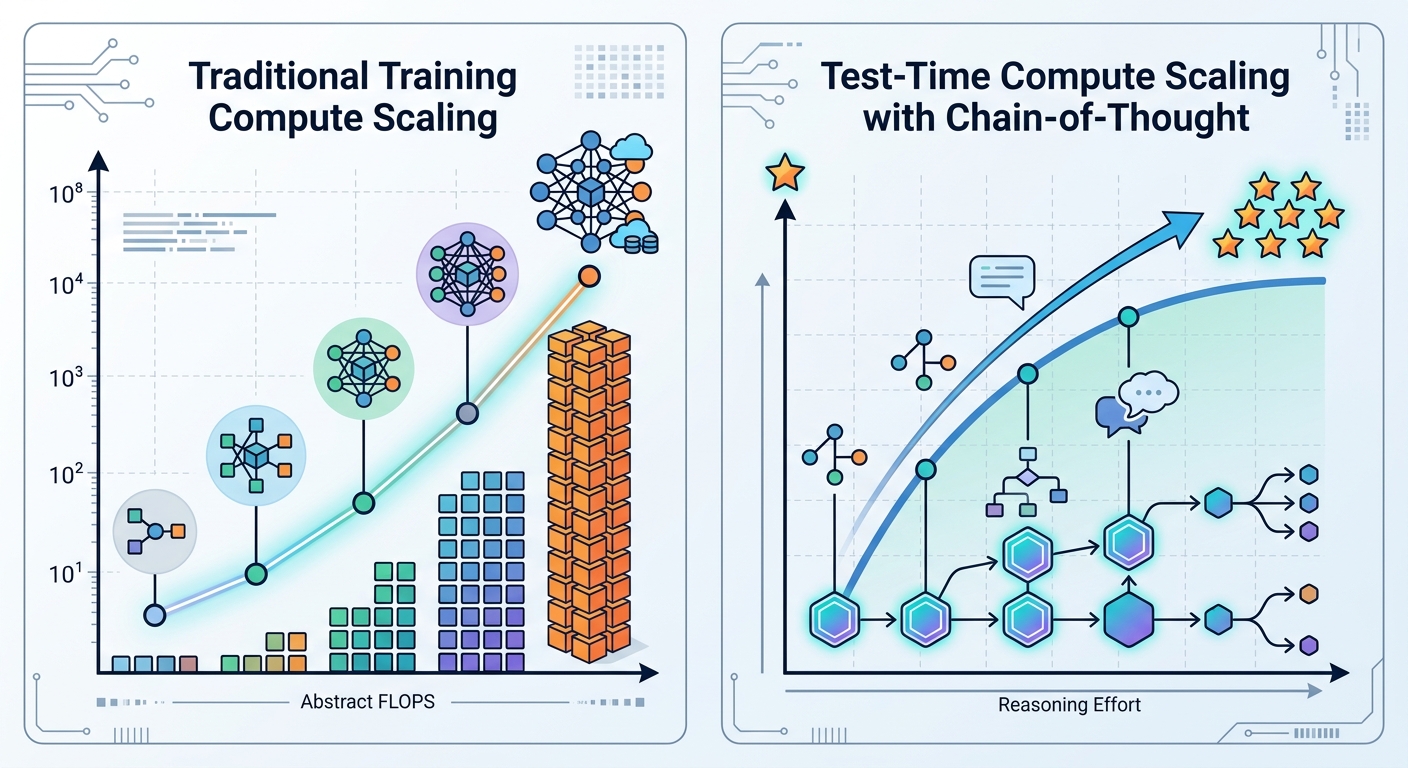
But in 2024 and 2025, a competing paradigm emerged from research labs and into production systems. It is called test-time compute scaling, or inference-time scaling. And it is rewriting the rules of model capability.
The core idea is straightforward: instead of baking all reasoning ability into a model during training, you can give the model more computational resources at inference time. Let it think longer. Explore more paths. Check its own work. The results on hard reasoning tasks have been striking.
OpenAI's o1 model, released in late 2024, demonstrated that simply allowing a language model to generate more internal reasoning tokens — before producing a final answer — dramatically improved performance on mathematical and scientific benchmarks. The model's score on the MATH dataset climbed to approximately 85%, compared to roughly 70% for GPT-4o under standard prompting. No architectural overhaul. No larger training run. Just more thinking time.
o3, released in 2025, extended this trajectory. On the ARC-AGI benchmark, a test designed to measure fluid reasoning in novel contexts, o3 achieved approximately 87.5% — a result that shocked many researchers given the benchmark's difficulty. The model did not simply retrieve memorized answers. It worked through novel problems step by step, allocating more computational effort to harder questions.
This is the paradigm shift. The next generation of AI capability is not exclusively a product of larger training runs. It is increasingly a product of smarter inference.
What Is Test-Time Compute Scaling?
To understand the concept, start with a definition. Test-time compute refers to the computational resources consumed during a model's inference phase — every token generated, every attention computation performed, every intermediate reasoning step taken between receiving an input and producing an output.
Training compute, by contrast, is spent once, during the model's initial training. A model trained on 10 trillion tokens consumes an enormous amount of energy upfront. But that cost is amortized across every subsequent query.
Test-time scaling flips this logic. It asks: what happens if we allocate more computational resources to each individual inference?
Consider a concrete example. A language model presented with a complex multi-step math problem can respond in two modes. In fast mode, it generates a direct answer in 30 tokens — fast, cheap, often wrong on hard problems. In reasoning mode, it generates 2,000 internal tokens of chain-of-thought before producing a final answer. The final answer is correct significantly more often.
The accuracy improvement comes from the model working through the problem. It flags its own errors. It explores alternative solution paths. It catches arithmetic mistakes before they propagate. None of this reasoning appears in the final output — but it shapes the answer.
This is the essence of test-time compute scaling. The model does not know more because it was trained differently. It knows more because it was given time to reason.
The Evidence: What the Benchmarks Show
The case for test-time compute scaling rests on a growing body of empirical results from both industry labs and academic research.
OpenAI's o series provided the most visible proof of concept. On the MATH benchmark, which tests competition-grade mathematics, o1 scored approximately 85%. GPT-4o, under standard zero-shot prompting, scored approximately 70%. The gap was not marginal — it was decisive.
On GPQA Diamond, a dataset of graduate-level biology, chemistry, and physics questions designed to resist simple retrieval, o1 achieved around 75% accuracy. GPT-4o approached 53%. The harder the question, the larger the gap. For the hardest GPQA problems, o1's advantage widened further.
o3 extended this trajectory. On ARC-AGI, o3 reached approximately 87.5%, compared to approximately 33% for the best prior approach. The result was interpreted by many researchers as evidence that test-time scaling is unlocking reasoning capabilities that training compute alone had not achieved.
Academic research has reinforced these findings with controlled studies. A widely cited 2024 analysis compared Llemma models of different sizes under varying inference strategies. The study found that a Llemma-7B model combined with tree search algorithms consistently outperformed a Llemma-34B model under standard inference — at equivalent total FLOPs budgets. Smaller models, thinking longer, beat larger models thinking faster.
This is the "compute-optimal inference" insight. Given a fixed computational budget for a single query, it is often more efficient to use a smaller model with sophisticated inference strategies than a larger model with minimal reasoning. The result challenges the assumption that bigger always means better for inference.
Further academic work from 2025 introduced provable scaling laws for test-time compute. Under certain assumptions, researchers demonstrated that the failure probability of LLM-based reasoning algorithms can decrease exponentially or by a power law as test-time compute increases. This provides theoretical grounding for what practitioners were observing empirically.
The Mechanism: How Models Think Longer
Test-time compute gains are not produced by a single technique. They emerge from a portfolio of inference strategies, each adding computational overhead in exchange for accuracy improvements.
Chain-of-Thought (CoT) Prompting is the foundational approach. By instructing a model to reason step by step before producing an answer, CoT prompting elicits intermediate reasoning that would not appear in a direct response. For hard problems, this approach can improve accuracy by 20 percentage points or more. The cost: longer output sequences and higher inference latency.
Self-Correction extends CoT by adding a feedback loop. The model generates a draft answer, then reviews it for errors, inconsistencies, or logical gaps. If problems are found, the model revises. This process repeats until the output passes internal checks. Self-correction turns inference into an iterative refinement process.
Tree Search and Systematic Exploration moves beyond linear reasoning chains. On problems where multiple solution paths exist — mathematical proofs, strategic games, complex coding tasks — tree search algorithms allow the model to explore branching reasoning paths. The model evaluates the likely success of each path, prunes unlikely branches, and focuses computation on promising avenues.
Forest-of-Thought (FoT), introduced in academic research in 2025, generalizes this approach. Rather than a single reasoning chain or tree, FoT maintains multiple parallel reasoning trees operating simultaneously. Each tree explores a distinct reasoning strategy. A consensus mechanism then selects the most reliable output across all trees. The approach significantly improves accuracy on complex tasks but also increases inference time in proportion to the number of trees activated.
Policy of Thoughts (PoT) takes a different angle. Rather than simply generating more tokens, PoT focuses on evolving the reasoning policy itself during test time. The model learns from failed reasoning attempts within a single inference session, adapting its strategy dynamically. This allows compact models to achieve reasoning depth comparable to much larger frontier models.
Best-of-N and Consensus Voting are simpler mechanisms that add compute without changing the reasoning process itself. The model generates N independent responses to the same prompt. A selection mechanism — majority voting for discrete tasks, or a learned reward model for open-ended tasks — picks the best output. The accuracy gain comes from statistical aggregation rather than deeper reasoning.
The common thread across all these techniques: accuracy improves as more computational resources are allocated to inference. The exact efficiency curve varies by technique and task type, but the directional relationship is consistent.
The Efficiency Case: Smaller Models Plus More Thinking
One of the most consequential implications of test-time compute scaling is economic. It reframes the model selection decision.
For most of the 2020s, the prevailing logic was straightforward: use the largest model you can afford. Larger models outperform smaller ones on virtually every benchmark. If you need high accuracy, you pay for a frontier model with hundreds of billions of parameters.
Test-time compute scaling disrupts this logic. The research shows that smaller models, combined with reasoning-intensive inference strategies, can match or exceed the accuracy of larger models at the same total computational cost.
Consider the Llemma study referenced above. At equivalent FLOPs budgets, Llemma-7B with tree search outperformed Llemma-34B under standard inference. The smaller model's reasoning ability compensated for its reduced parameter count. The total energy consumed per query was similar — but the cost structure differed.
Length-Controlled Policy Optimization (LCPO), introduced in research from March 2025, provides a framework for training models that offer a smooth accuracy-versus-compute trade-off. Rather than treating inference budget as a binary choice between fast and slow models, LCPO produces models that can flexibly allocate a predetermined token budget to reasoning. Developers can tune the balance between accuracy and cost in production.
Distillation is another efficiency mechanism emerging from this research. Frontier models generate large corpora of chain-of-thought traces — records of their reasoning processes on complex problems. These traces can be used to fine-tune smaller, open-weight models. The resulting models inherit a significant fraction of the frontier model's reasoning ability at a fraction of the inference cost. This is the mechanism by which "reasoning capability" propagates from frontier labs to the broader ecosystem.
The practical implication: model selection is no longer reducible to "choose the biggest model." It now requires reasoning about the inference strategy, the token budget per query, the accuracy requirements of the task, and the total cost of ownership.
Controllable Reasoning Budgets: The 2026 Frontier Model Feature
The research on test-time compute has moved into production faster than many anticipated. By 2026, leading frontier models from multiple providers expose reasoning effort as a configurable parameter.
GPT-5, Claude Opus 4.7, Gemini 3 Pro, and DeepSeek R1 each offer some variant of a reasoning budget or effort control. Users and developers can specify how much computational effort the model should allocate to a given query. Higher effort settings trigger longer internal reasoning sequences, more self-correction, and broader exploration of solution paths.
The trade-offs are explicit. Higher reasoning effort produces better answers on hard problems but increases latency and cost per query. A simple factual question costs less with minimal reasoning effort. A complex multi-step proof warrants maximum effort.
This configurability represents a meaningful shift in how AI systems are deployed in production. Rather than a single model configuration serving all queries uniformly, intelligent systems can route queries to appropriate reasoning effort levels based on task complexity.
A routing layer might send straightforward factual queries to a fast, minimal-reasoning path. It might escalate complex coding tasks, multi-step legal analysis, or strategic planning queries to a high-reasoning-effort configuration. The result is a system that allocates inference compute where it adds the most value.
For enterprise buyers, this creates a new dimension of evaluation. When assessing AI systems, the question is no longer simply "what is the base accuracy?" It is also "what is the accuracy-cost curve at different reasoning effort levels?" The organizations that understand this curve will build more efficient systems.
The Cost Trajectory: Inference in 2026 and Beyond
An important qualifier accompanies the case for test-time compute scaling: reasoning-intensive inference is expensive. Allowing a model to generate 2,000 reasoning tokens before producing a final answer costs more than generating 50 tokens directly. The efficiency gains from test-time compute strategies must be weighed against their higher per-query cost.
But the cost dynamics are shifting rapidly. Gartner projected in March 2026 that performing inference on a trillion-parameter LLM will cost AI providers more than 90% less by 2030 than it did in 2025. This is driven by multiple reinforcing trends: advances in quantization, which reduces the precision at which models operate without significant accuracy loss; KV cache compression techniques such as Google's TurboQuant, which reduces the memory overhead of long reasoning sequences; speculative decoding, which accelerates token generation by predicting likely next tokens; and inference-specialized silicon, purpose-built chips optimized for transformer inference workloads.
As inference costs decline, the economics of test-time compute scaling improve. The same reasoning budget that cost $0.05 per query in 2025 might cost $0.005 by 2028. At that price point, enabling maximum reasoning effort becomes the default choice for all but the most cost-sensitive, high-volume queries.
This creates a compounding effect: cheaper inference drives wider adoption of reasoning-intensive strategies, which drives demand for further inference optimization, which drives further cost reduction. The trajectory points toward a future where "let the model think longer" is the standard recommendation rather than the exception.
Strategic Implications: What This Means for AI Builders
Test-time compute scaling is not a feature or a model variant. It is an architectural paradigm shift in how AI capability is produced and consumed.
For years, capability improvement was primarily a function of training. Larger models, more data, more compute — a virtuous cycle managed by a small number of frontier labs. Buyers of AI capability were largely passive recipients of that process.
Test-time scaling introduces a new lever. Capability can now be increased at inference time, by the application developer or the end user, without waiting for the next frontier model release. This redistributes some of the capability-building process from the lab to the deployment layer.
For AI builders, this shift has practical consequences. Infrastructure decisions should account for the full inference compute spectrum, not just peak throughput for short responses. Model evaluation should include accuracy-cost curves at different reasoning effort levels. Product design should incorporate routing logic that matches query complexity to reasoning investment.
For researchers, test-time scaling opens a new set of questions. How do scaling laws behave at extreme inference budgets? What is the optimal mix of training compute and test-time compute for a given capability target? Are there fundamental limits to reasoning-by-compute, or does the curve continue indefinitely?
These questions are not academic. They will define how the AI industry allocates billions of dollars in infrastructure investment over the next decade.
The core insight is simple: the next chapter of AI progress will not be written exclusively in training clusters. It will also be written in inference engines, in the thinking time allocated to each query, in the algorithms that decide how much a model should reason before it answers.
The next decade of AI progress will not just be about training bigger models. It will be about giving models more time to think. The organizations that understand this shift — and build for it — will be better positioned to capture the value it creates.