Synthetic Data Generation: How AI Companies Are Training Next-Gen Models Without Real-World Data
Synthetic Data Generation: How AI Companies Are Training Next-Gen Models Without Real-World Data --- What Is Synthetic Data and Why Is It Reshaping AI Training? In 2026, the most valuable resource...
What Is Synthetic Data and Why Is It Reshaping AI Training?
In 2026, the most valuable resource in AI is not compute. It is data — and the supply is running out.
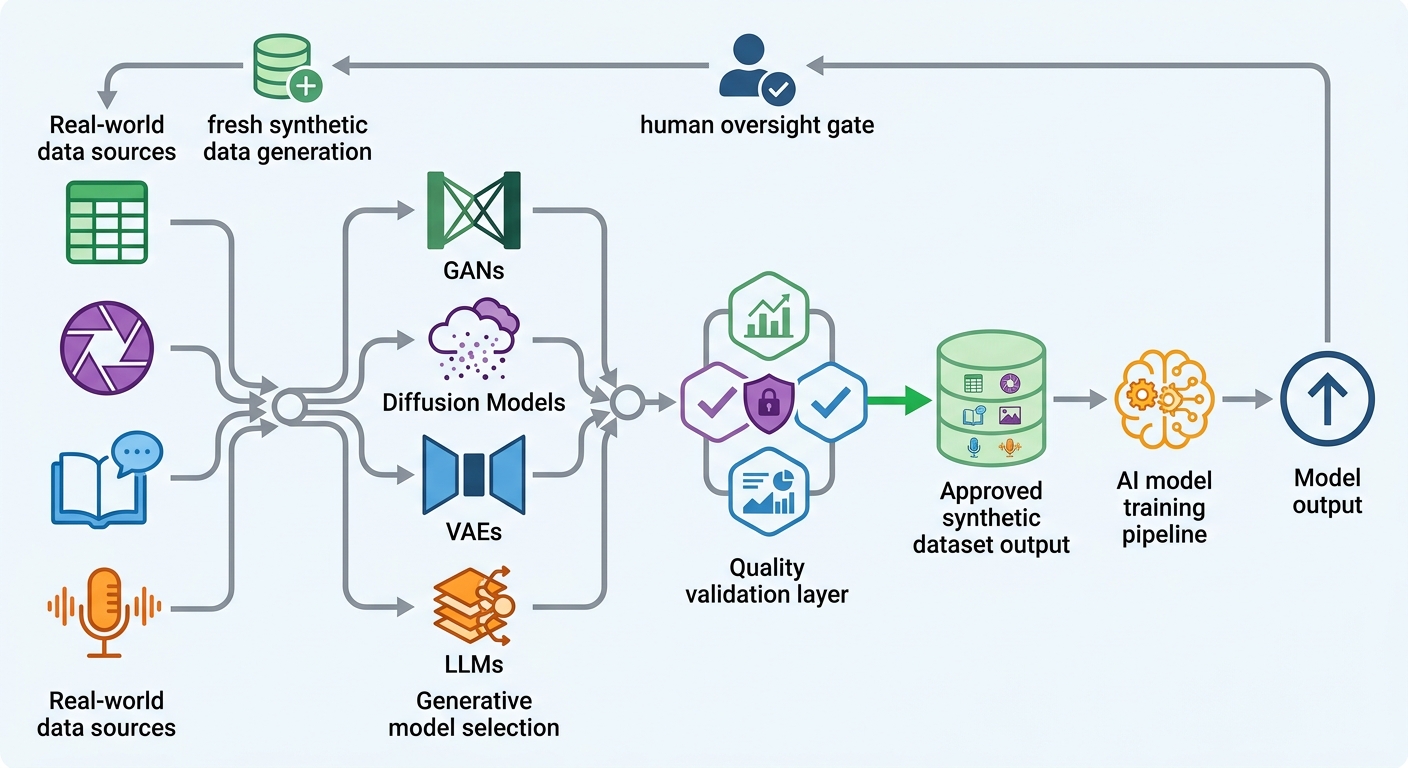
Synthetic data is algorithmically generated information that mimics the statistical properties of real-world datasets without containing any actual personal or sensitive records. Generative AI models — GANs, diffusion models, VAEs, and large language models — produce this data at scale. The result is unlimited training material that never exposes a real patient's record or a real customer's card number.
The strategic case for synthetic data rests on three converging forces. First, high-quality human-generated data is becoming scarce. By April 2025, an estimated 74% of web content was AI-generated, which means models training on scraped internet data are increasingly training on their own kind. Second, privacy regulations — GDPR, the EU AI Act, HIPAA — are locking real-world datasets behind compliance walls that make collection legally risky and financially expensive. Third, the most important AI use cases involve edge cases: fraud that happens once in ten thousand transactions, cancers visible in fewer than one in a hundred thousand scans. Real data cannot provide enough of these rare events to train reliable models.
Gartner projects that by 2026, synthetic data will constitute approximately 75% of data used in AI development projects. The global synthetic data market is valued at roughly $2.3 billion and expected to grow substantially through the decade.
The shift is not theoretical. Enterprises building production AI systems in 2026 are already treating synthetic data generation as a core infrastructure capability, not a research experiment.
The Four Modalities of Synthetic Data
Synthetic data is not a single technology. It spans four distinct data types, each with its own generation methods and use cases.
Language and text is the fastest-moving category. Large language models generate synthetic conversation logs, intent variations, tool-calling traces, and evaluation datasets. This modality is critical for training domain-specific chatbots, customer service agents, and specialized assistants that need domain knowledge unavailable in public datasets.
Images and video relies primarily on GANs and diffusion models. These tools produce synthetic photographs, annotated visual data, and video sequences used to train computer vision systems. Medical imaging augmentation, autonomous vehicle perception training, and retail visual search all depend on this modality.
Audio covers voice synthesis, speech recognition training data, and acoustic environment simulation. Synthetic audio is particularly valuable for low-resource languages where real speech recordings are scarce.
Tabular data is the workhorse of enterprise AI. Structured datasets representing financial transactions, patient records, insurance claims, and supply chain logs are generated using statistical models and rules engines. This is the modality most often blocked behind firewalls, making synthetic alternatives the only viable path to cross-organizational data sharing.
Each modality requires different generation techniques and validation approaches — a point most introductory articles miss entirely.
The AI Data Wall — Why Real Data Is No Longer Enough
The phrase "AI data wall" describes a supply-side crisis that is forcing a fundamental rethink of how AI systems are trained. Data science leaders at MIT, including Kalyan Veeramachaneni and colleagues, have documented the operational realities across enterprise synthetic data deployments — finding that the difference between a successful and a failed initiative typically comes down to validation rigor and domain fit, not the sophistication of the generative model itself.
The problem has several layers. Human-generated data at internet scale was always finite. The easy era of scraping billions of web pages and calling it training data is ending. When 74% of web content is AI-generated, the marginal value of the remaining human data skyrockets — and models trained on increasingly synthetic internet archives are vulnerable to quality degradation that is difficult to detect until it is too late.
Privacy regulations compound the scarcity. GDPR imposes strict requirements on how personal data can be collected, stored, and used in model training. The EU AI Act adds disclosure and transparency obligations that make unlabeled synthetic data usage a legal liability. Healthcare organizations face HIPAA constraints that effectively prevent them from sharing patient records, even in anonymized form, without extensive compliance overhead. Financial institutions are similarly restricted by data protection requirements that limit what can be shared across borders or business units.
Edge case scarcity is perhaps the most technically acute problem. A fraud detection model needs to learn what fraud looks like, but fraud is rare by definition. A diagnostic AI for a rare disease needs to see enough examples of that disease to recognize it reliably. Real-world data collection for these scenarios is slow, expensive, and often practically impossible.
74% of web content was AI-generated by April 2025 — a contamination rate that is accelerating faster than new human-generated data enters the pool.
The "tragedy of the commons" dynamic makes the problem urgent from a competitive standpoint as well. Organizations that move first to adopt high-quality synthetic data training pipelines gain performance advantages. Late adopters face training pools already contaminated by lower-quality synthetic data produced by competitors, creating a collective action problem where individual rational adoption decisions worsen the shared training environment for everyone.
The Economics — Cost, Speed, and Scale
The financial case for synthetic data is concrete and measurable.
Organizations using synthetic data for training report up to 70% cost reduction in data collection and labeling compared to traditional approaches. The reason is straightforward: generating a billion synthetic fraud transactions costs a fraction of waiting to observe a billion real ones. Labeling is similarly automated — synthetic data can be generated with ground truth built in, eliminating the expensive human annotation step.
Speed improvements are dramatic. A scenario that requires months of real-world data collection can be simulated in hours. Medical device companies that previously waited months for sufficient rare-event imaging data can now generate diverse synthetic datasets overnight. Autonomous vehicle developers run billions of virtual miles in simulation before a single test vehicle moves.
On-demand generation is a capability with strategic weight. Once a generative pipeline exists, it produces any scenario on request — including scenarios that have never occurred in the real world but are plausible. This means AI systems can be stress-tested against conditions that exist only in simulation.
PII exposure is eliminated entirely. Synthetic records do not correspond to real individuals, which removes an entire compliance risk category and the associated legal overhead.
How Synthetic Data Is Generated — Techniques and Tools
Understanding how synthetic data is generated helps AI leaders make informed platform decisions. The field has matured beyond academic prototypes into a practitioner-ready toolkit.
GANs (Generative Adversarial Networks) pit two neural networks against each other. A generator creates synthetic records; a discriminator evaluates whether they are real or generated. Competition drives both networks to improve. GANs excel at image and video generation and have been the dominant approach for visual data since their 2014 introduction. They are computationally intensive and can suffer from mode collapse, where the generator produces a limited variety of outputs.
Diffusion models work by iteratively denoising random data. The model learns to reverse a gradual corruption process, producing high-fidelity outputs from noise. They became the dominant image generation approach in the early 2020s and are increasingly applied to tabular and text data. Diffusion models are generally more stable than GANs and produce more diverse outputs.
VAEs (Variational Autoencoders) compress data into a learned latent space and then decode it back into synthetic samples. VAEs offer more stable training than GANs and handle structured data well, making them popular for enterprise tabular synthetic data generation.
LLMs as generators represent a newer category. Large language models produce synthetic text, conversation logs, evaluation datasets, and structured data in domains where text is the primary representation. GPT-class models and their successors generate tool-calling traces, domain-specific instruction datasets, and evaluation suites.
Statistical modeling and simulation remain relevant for structured enterprise data. These approaches use learned statistical distributions to generate synthetic records that preserve relationships between variables. Rules engines ensure relational integrity — for example, that a synthetic patient record contains a valid date of birth before the date of death.
Enterprise Tool Landscape — Who Is Building the Pipelines
The vendor landscape for synthetic data has expanded significantly. Platform choice depends heavily on data modality and enterprise context.
For 3D simulation — robotics, autonomous vehicles, and physical systems — one platform dominates the enterprise space with physically accurate rendering and sensor simulation. These pipelines generate synthetic camera feeds, lidar point clouds, and radar returns that train perception systems without real-world test drives.
For large-scale enterprise perception AI, integrations between data platforms and generation tools are becoming standard. The combination of scalable data infrastructure with synthetic generation capabilities enables organizations to build end-to-end pipelines that handle raw data through to model training.
Privacy-focused tabular synthetic data tools have become essential in regulated industries. Platforms specializing in this space emphasize statistical fidelity — ensuring the synthetic data preserves the correlations and distributions of the original — alongside privacy guarantees that provably prevent re-identification of real individuals.
Computer vision synthetic data platforms generate annotated image datasets for specific domains. Medical imaging, retail visual search, industrial quality inspection, and agricultural monitoring all benefit from synthetic visual data that would otherwise require expensive and slow real-world data collection.
For organizations evaluating tools, the critical selection criteria are domain fit (tabular enterprise data versus computer vision versus healthcare versus LLM fine-tuning), privacy guarantees (differential privacy, k-anonymity guarantees), and integration with existing MLOps infrastructure. No single platform is optimal for all modalities.
Industry Applications — Where Synthetic Data Is Already Moving the Needle
The proof points for synthetic data are no longer theoretical. Across multiple industries, organizations are reporting measurable improvements in model performance and development velocity.
Healthcare has emerged as a high-impact application area. Synthetic patient records enable diagnostic AI development without exposing real patient data — a critical capability under HIPAA and GDPR. Clinical trial design benefits from synthetic control arms that augment small patient populations. Medical imaging AI uses synthetic augmentation to compensate for class imbalance in rare disease detection. Organizations like Philips have published research showing diagnostic model improvements when trained on synthetic patient data that preserves the statistical characteristics of real patient populations without exposing individual records.
Finance relies heavily on synthetic data for fraud detection, where real fraudulent transactions are too rare to train reliable models. Credit scoring and anti-money laundering systems use synthetic transaction data to augment imbalanced training sets. Stress testing and scenario analysis — simulating how models perform under market conditions that have never occurred — is only possible with synthetic data. Fintech sandboxes use synthetic transaction histories to test new products without risking real customer information.
Autonomous vehicles represent perhaps the most demanding synthetic data use case. Training a perception stack requires billions of miles of diverse driving scenarios, including the rare edge cases that are impossible to collect reliably in real-world testing. Simulation-based validation enables closed-loop testing where the vehicle AI interacts with a realistic virtual environment. The autonomous vehicle synthetic data market is projected to reach $6.94 billion by 2034.
LLM and agentic AI training increasingly depends on synthetic data pipelines. Domain-specific conversation data, varied intent formulations, tool-calling traces, and evaluation suites are generated synthetically to train models on knowledge domains where real conversational data is proprietary, scarce, or privacy-restricted. Agentic AI systems — models that take multi-step actions in external environments — require synthetic interaction logs that represent the full distribution of possible action sequences.
The pattern across industries is consistent: synthetic data works best where real data is scarce, privacy-restricted, or class-imbalanced. It is an augmentation tool, not a wholesale data replacement, and the highest-impact applications understand this distinction.
The Existential Risk — Model Collapse and the Synthetic Data Feedback Loop
No honest assessment of synthetic data for AI training can avoid the central risk: model collapse.
Model collapse (sometimes called Model Autophagy Disorder or MAD) occurs when AI models are trained recursively on synthetic data generated by earlier model generations. Without sufficient grounding in real-world distributions, model quality degrades. Output becomes generic and repetitive. Rare knowledge — the "tails" of the data distribution — is progressively lost.
Oxford researchers documented the effect with striking clarity. In experiments with text models, doubling perplexity scores (indicating substantially worse performance) occurred after just nine generations of recursive training on synthetic data. Image generation models trained recursively on synthetic data progressively "forgot" underrepresented categories, eventually generating only the most common output classes — imagine a dog breed model that can only produce golden retrievers because rarer breeds were lost in the earlier synthetic data generations.
The root causes are well understood. Tail truncation occurs because synthetic data generation tends to sample from high-probability regions of the distribution. Rare events, unusual edge cases, and low-frequency knowledge are the first casualties. Error accumulation means that each generation of synthetic data can inherit and amplify errors from the previous generation, creating cascading degradation. Bias amplification happens when generative models learn the biases present in their training data more strongly with each generation.
Oxford research: doubled perplexity scores after just 9 generations of recursive synthetic data training on text models.
The feedback loop is already active. With 74% of web content AI-generated as of April 2025, models training on scraped internet data are already consuming synthetic data at scale. The contamination spreads faster than new human-generated data enters the pool. Organizations that do not actively curate their training data for synthetic contamination are already experiencing quality degradation that is difficult to diagnose.
Early research offers a critical mitigation finding: introducing even a single human-generated data point into synthetic training loops can help bypass collapse. The mechanism appears to be that authentic human data preserves the distribution tails that recursive synthetic generation progressively erodes.
Verifier-Guided Training and Provenance Filtering
The response to model collapse is becoming an engineering discipline in its own right.
Verifier-guided training involves screening synthetic data quality before it enters the training pipeline. Rather than trusting generated data at face value, organizations run statistical fidelity checks that compare synthetic distributions against reference real-world distributions. Data that deviates beyond acceptable thresholds is rejected or re-generated.
Data provenance tracking addresses contamination at its source. Organizations that know which training samples were generated synthetically — and by which model — can selectively downweight or remove synthetic samples that correspond to degraded generations. Provenance tracking is also a regulatory requirement under the EU AI Act's labeling provisions.
"Freshening" synthetic pools with authentic human-generated data is a practical mitigation. The single human data point research finding suggests that even small, carefully curated additions of real-world data to synthetic training sets can preserve distribution tails. Organizations with access to proprietary real-world data have a structural advantage here — that data is a strategic reserve against model collapse.
RLHF and human feedback integration provides an ongoing calibration mechanism. Human raters identifying outputs that feel generic or wrong signal to the training process that the distribution has shifted. This feedback is especially valuable for detecting the qualitative hallmarks of model collapse — loss of nuance, increased genericness, flattening of voice — before they become severe.
The bottom line: synthetic data is safe when used with rigorous validation, provenance tracking, and intentional grounding in real-world distributions. The organizations that build these safeguards into their training pipelines from the start will avoid the collapse trap.
The Regulatory Landscape — EU AI Act and Compliance by 2026
The EU AI Act shifts synthetic data governance from a best practice to a legal requirement for many organizations.
Enforcement of the EU AI Act begins in August 2026. Among its provisions, the Act mandates labeling of all AI-generated and synthetic content. Organizations deploying AI systems in high-stakes domains — healthcare, finance, autonomous vehicles — must document the provenance of their training data and implement quality assurance processes for synthetic data used in those systems.
GDPR remains in force alongside the EU AI Act. Any synthetic data derived from real personal records must be generated through privacy-compliant derivation pipelines. Anonymization and pseudonymization requirements apply to the source data, even when the output synthetic records do not correspond to real individuals.
For enterprise decision-makers, the regulatory timeline creates a concrete compliance deadline. AI systems deployed or significantly updated after August 2026 must meet these requirements. The practical implication is that organizations without synthetic data governance frameworks in place today are already behind the compliance curve.
EU AI Act enforcement begins August 2026 — mandatory labeling of synthetic content and documented data provenance for high-stakes AI systems.
Synthetic data governance is no longer an optional data science consideration. It is a board-level risk item with a fixed enforcement date.
Building a Synthetic Data Strategy — A Framework for AI Leaders
A synthetic data strategy is only as good as the decision framework behind it. Here is a practitioner's approach to deciding when and how to use synthetic data in AI training.
Assess data readiness first. Before investing in synthetic data pipelines, evaluate whether real data is scarce, privacy-restricted, or imbalanced in the relevant domain. Synthetic data is indicated when at least one of these conditions is true. If high-quality real-world data is abundant, accessible, and balanced, synthetic augmentation may add complexity without proportional benefit.
Match generation methods to data modality. Text and language tasks call for LLM-based generation. Tabular enterprise data favors VAEs and statistical models. Image and video data is best served by GANs or diffusion models. Forcing the wrong generation method onto a mismatched data type produces poor results.
Validate before training. Always compare synthetic data distributions against real-world reference distributions before using synthetic data in model training. Statistical fidelity checks should be a mandatory pipeline stage, not an optional quality step. This is the primary defense against model collapse.
Implement human-in-the-loop refresh cycles. Do not train exclusively on synthetic data. Establish a cadence for introducing fresh real-world samples into training pipelines, even if those samples represent a small fraction of total training data. The single human-generated data point research finding applies at scale.
Track data provenance from day one. Provenance tracking serves both regulatory compliance (EU AI Act labeling requirements) and collapse prevention (selective downweighting of degraded synthetic generations). Build this capability before you need it, not after.
Augment, do not replace. Synthetic data works best as a complement to real-world training data. It expands coverage of edge cases, balances class distributions, and provides privacy-safe training material. It is not a wholesale substitute for real data.
Start with high-stakes edge cases. The highest-ROI synthetic data applications involve rare, high-impact scenarios — fraud, rare medical conditions, safety-critical edge cases in autonomous systems. These are the scenarios where real data is most scarce and synthetic augmentation delivers the greatest performance improvement.
The Road Ahead — Synthetic Data as AI Infrastructure by 2030
The trajectory is clear. Synthetic data is transitioning from an experimental technique to foundational AI infrastructure.
By 2026 and 2027, mature synthetic data governance will be a competitive differentiator, not a differentiator at all. Organizations that have built the capability now are building compounding advantages: cleaner training pipelines, regulatory compliance already in place, collapse-resistant training practices. Those that delay face both the technical debt of contaminated training pools and the compliance risk of scrambling to meet EU AI Act requirements at the last moment.
The race to preserve human-generated data as a strategic reserve has already begun. Real-world data with verified provenance is increasingly valuable precisely because it is the antidote to model collapse. Organizations with access to proprietary real data — whether through customer relationships, clinical partnerships, or industrial sensor networks — hold assets that will appreciate as synthetic contamination spreads.
Hybrid training pipelines, combining real and synthetic data with rigorous validation, are the emerging standard for organizations building safe and scalable AI. The future is not synthetic or real — it is both, intelligently combined.
Frequently Asked Questions
Q: What is synthetic data in AI training? A: Synthetic data is artificially generated information that mimics the statistical properties of real-world data without containing any actual personal or sensitive information. It is produced by generative AI models (GANs, diffusion models, VAEs, or LLMs) trained on real data samples, then scaled to produce unlimited training datasets on demand.
Q: Can you train AI models entirely on synthetic data? A: It is technically possible but not recommended without safeguards. Training exclusively on synthetic data risks model collapse — a phenomenon where model quality degrades across generations, diversity of outputs shrinks, and errors compound. Best practice is to use synthetic data to augment real data, not replace it entirely.
Q: What is model collapse in AI? A: Model collapse occurs when AI models are trained repeatedly on synthetic data generated by earlier models, without sufficient grounding in real-world distributions. Performance degrades, output becomes generic and repetitive, and rare knowledge ("tails" of the data distribution) is lost. Oxford researchers documented doubled perplexity scores after just nine generations of recursive synthetic data training.
Q: How much does synthetic data cost compared to real data collection? A: Synthetic data generation can reduce data-related costs by up to 70% compared to traditional collection and labeling methods. It also dramatically accelerates development cycles — scenarios that take months to collect in the real world can be simulated in hours.
Q: What are the legal requirements for synthetic data under the EU AI Act? A: The EU AI Act, with enforcement beginning August 2026, will legally require labeling of all AI-generated synthetic content. Organizations using synthetic data in high-stakes AI systems (healthcare, finance, autonomous vehicles) must also document data provenance and implement quality assurance processes.
Q: Which industries benefit most from synthetic data in AI training? A: Healthcare (diagnostic AI, clinical trials, medical imaging), finance (fraud detection, credit scoring, stress testing), and autonomous vehicles (simulation, edge case generation, perception training) see the highest-impact applications. Synthetic data is also critical for training LLMs and agentic AI systems where domain-specific conversation data is scarce.
Q: What tools are used to generate synthetic data? A: Leading enterprise tools include NVIDIA Omniverse Replicator (3D simulation), Databricks Agent Bricks (enterprise pipelines), Mostly AI and Gretel.ai (tabular/privacy-focused), Synthesis AI and Datagen (computer vision), and the open-source Synthetic Data Vault (SDV). Tool choice depends on data modality and use case.
Expert Q&A
Q: We already use data augmentation (oversampling, SMOTE, noise injection). Why would we need full synthetic data generation? A: Data augmentation and synthetic data generation address different problems. Augmentation techniques like SMOTE operate within the statistical manifold of your existing data — they cannot produce samples outside that manifold. True synthetic data generation (GANs, diffusion models, VAEs) can generate samples that are plausible but not present in your original dataset, including entirely novel edge cases. If your problem is genuinely missing coverage — rare fraud patterns you have never observed, medical conditions with insufficient imaging examples — augmentation cannot help. Synthetic generation can. The practical decision rule: if augmentation solves your problem, use it. If your class imbalance or coverage gap is structural (some events genuinely never occurred in your historical data), you need full synthetic generation.
Q: How do you actually measure whether synthetic data is high quality before using it to train a model? A: The practitioner standard is a three-layer fidelity check. First, statistical fidelity: does the synthetic data reproduce the univariate and multivariate distributions of the original? Tools like the Synthetic Data Vault provide fidelity reports that compare marginals, correlations, and mutual information between real and synthetic datasets. Second, privacy fidelity: does the synthetic data pass a re-identification attack test? Platforms like Mostly AI offer formal k-anonymity and diversity guarantees. Third, downstream fidelity: you train a model on synthetic data and test it on a held-out real data split. If performance transfers, your synthetic data is useful. If not, you have a distribution mismatch. The third check is the most important — statistical fidelity does not guarantee usefulness for your specific task.
Q: The article mentions model collapse is a serious risk. Is there a consensus on the threshold where it becomes critical? A: The Oxford 2024 paper (Alemohammad et al.) found measurable degradation in text models after 5–9 generations of recursive synthetic training, with perplexity roughly doubling. For image models, similar patterns appeared after fewer generations. In practice, the critical threshold depends on how close your training distribution is to the synthetic data distribution — domains with narrow, well-defined distributions (financial transactions, medical imaging) collapse faster than domains with wide distributional spread. The working rule practitioners use: if more than 30–40% of your training data is known to be synthetic from prior model generations, you should assume some collapse risk and implement provenance filtering. The 74% web contamination figure makes this concern urgent for any model trained on scraped internet data.
Q: Can you use synthetic data to train a model that will then generate even more synthetic data — is that ever a legitimate pattern? A: It can be legitimate but requires rigorous safeguards. The key requirement is that each generation is grounded in real-world distributions before producing the next. This typically means: synthetic generation round 1 grounded in real data → train model A → synthetic output from A is validated against real reference distributions → if fidelity passes, that synthetic output can be mixed with fresh real data for the next round. What makes this dangerous is skipping the validation step or generating exclusively from synthetic data across multiple rounds without re-grounding. The single human-generated data point finding (Oxford) suggests even a small real data anchor in each round can prevent collapse. The pattern is legitimate when each synthetic generation round includes a re-grounding step with verified real data.
Q: How does the EU AI Act labeling requirement work in practice for training data — do you need to label every synthetic record? A: The EU AI Act's labeling requirement applies to AI-generated output content (text, images, audio produced by an AI system) and to synthetic data used in high-risk AI systems. For training data specifically, the Act requires documentation of data provenance and quality assurance processes — not necessarily individual record-level labels. Practically, this means organizations need to maintain a data lineage record showing which portions of training data were synthetic, which generative model produced them, and what validation was performed. This is a pipeline documentation requirement, not a data marking requirement for every record. Organizations should implement provenance tracking infrastructure before August 2026 enforcement date to avoid scrambling.
Q: What is the biggest mistake teams make when building their first synthetic data pipeline? A: The most common failure mode is treating synthetic data generation as a one-time infrastructure build rather than a continuous operational process. Teams spend months building a generative model, declare victory when fidelity metrics look good, and then train models on the synthetic data without establishing the ongoing validation, provenance tracking, and data refresh cycles described in this article. The second most common mistake is ignoring the domain fit requirement — using the same generation approach (say, a GAN) across data modalities where it is not optimal, then being surprised when fidelity is poor. The synthetic data field has enough practitioner maturity that "best generation method for each modality" guidance is widely available. Following it is the difference between a pipeline that produces useful training data and one that produces statistically plausible but practically useless noise.