Model Merging in Practice: Weight Averaging Without Retraining
Learn model merging techniques—task arithmetic, TIES, DARE, model soups—to combine fine-tuned LLMs by averaging weights, no retraining required.
The Checkpoint Sprawl Problem
Every team running fine-tuned LLMs eventually hits the same wall. A base model gets fine-tuned for support triage, then for contract review, then for a domain-specific summarizer. Each checkpoint is useful. None of them covers everything. Combining those capabilities used to mean one of two bad options: retrain a model on the union of all datasets, or run several models side by side and pay the latency and infrastructure bill.
The infrastructure bill is not trivial. Serving three 13B models in bfloat16 requires roughly 78 GB of weights in memory before you count KV cache, plus three separate inference paths to monitor, version, and secure. A retraining run on the union of three datasets means reconciling label conventions, rebalancing class distributions, and paying for a full fine-tune—often tens to hundreds of GPU-hours for a 7B–13B model, more if you need to sweep hyperparameters.
Model merging offers a third path. It combines the weights of independently fine-tuned models into a single model, with no gradient updates and no access to the original training data. In practice, that means a merge job that runs in minutes on a CPU for 7B–13B models (larger models are memory-bound and often need a GPU or sharded merge), followed by evaluation. The payoff is real: faster iteration, lower compute spend, and one model to serve instead of three.
The caveat is equally real. Model merging is not a free lunch. It demands compatible architectures, shared base lineage, careful coefficient tuning, and honest evaluation. Done carelessly, it commonly produces a model that is worse at everything than any of its parents—not always, but often enough that evaluation is non-negotiable. The failure is usually quiet: the merged model still generates fluent text, still follows simple instructions, and only reveals its degradation on the specific edge cases each parent was trained to handle. This article covers what model merging does to weights, the techniques that work in 2026, a step-by-step workflow, and where the approach breaks down. (See also: How to Choose a Base Model for Fine-Tuning)
What Model Merging Actually Does to Weights
Model merging operates directly on parameter space. Given two models with identical architecture, you produce a new model whose weights are a function of the parents' weights. The simplest form is linear interpolation: for each parameter, the merged value is a weighted average of the two source values. Spherical interpolation (slerp) does the same thing along the surface of a hypersphere rather than a straight line—applied per normalized weight vector (e.g., per filter or row), not to the whole tensor at once. Slerp sometimes preserves more of each parent's behavior when weights are far apart, though for multi-model merges it has largely been superseded by task arithmetic and TIES.
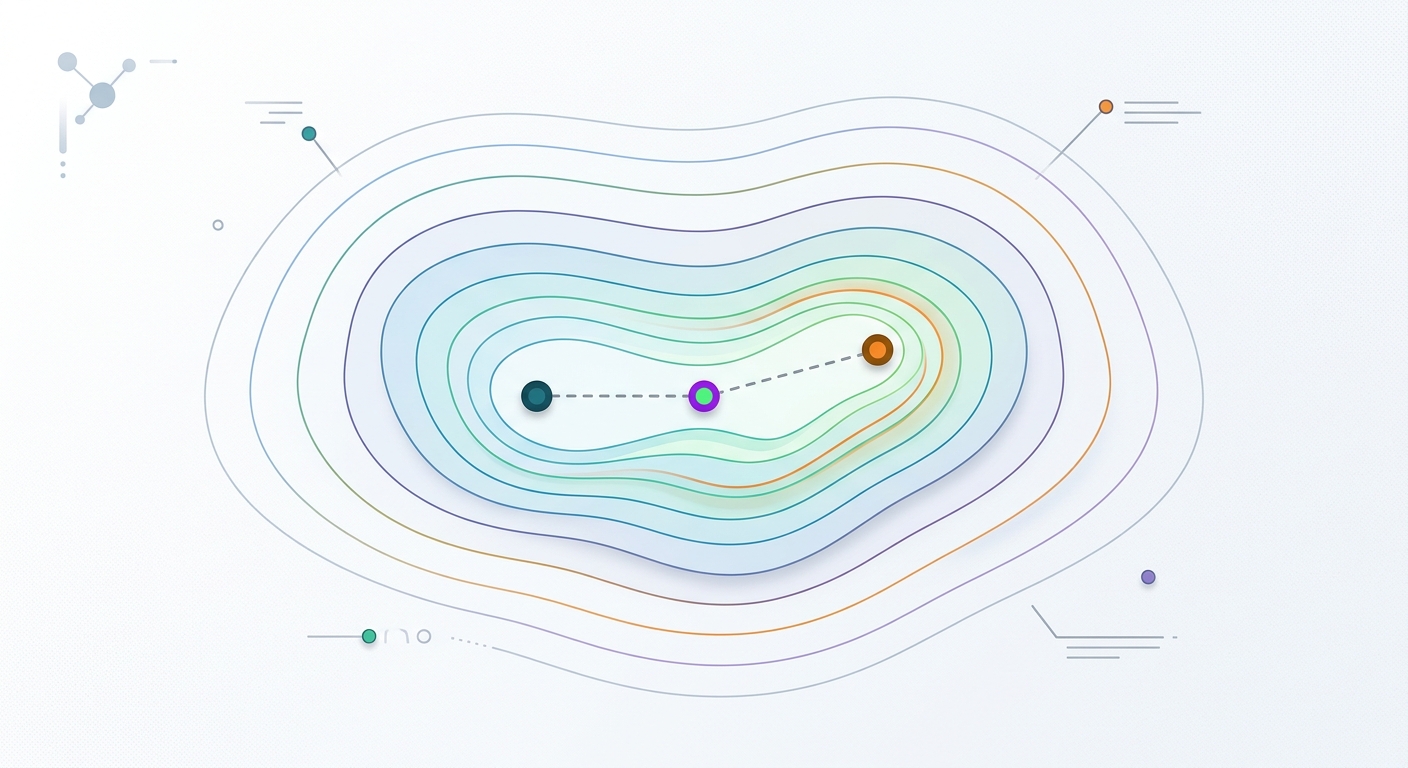
The working assumption is linear mode connectivity: fine-tuned models derived from the same base and shared initialization often sit in a region of parameter space where the loss surface is smooth enough that interpolating between two good solutions lands on another good solution. This is empirically observed, not guaranteed. It tends to hold when fine-tunes start from the same checkpoint and use moderate learning rates; it can break down—producing a merged model with sharply higher loss—even for same-base models when fine-tuning diverges far from the base or uses very different data regimes. When models come from different bases, the assumption fails outright. (See also: Fine-Tuning vs. Prompt Engineering: When to Train)
A useful mental model: merging works because fine-tuning is a small perturbation of the base. If two fine-tunes each move the weights a little in compatible directions, their average stays near both. If one fine-tune moves the weights far—say, a long run on a narrow dataset with a high learning rate—the average can land in a region neither parent occupies, and quality collapses on both tasks.
Weight Averaging vs. Ensembling vs. Retraining
| Approach | What you get | Inference cost | Compute to produce | Control |
|---|---|---|---|---|
| Weight averaging | One model | Same as one model | Minutes to hours | Low–medium |
| Ensembling | N models, combined outputs | N× latency/cost | Zero (reuse checkpoints) | Low |
| Retraining | One model, trained on union data | Same as one model | Full training run | Highest |
Averaging gives you a single model with no inference overhead, but limited control over the blend. Ensembling preserves each model's strengths but multiplies serving cost. Retraining gives the most control and usually the best ceiling—if you have the data, the GPUs, and the time. (See also: LLM Inference Cost Optimization: A Practical Guide)
The practical decision rule: if you can afford the data reconciliation and the training run, retraining usually wins on quality. If you cannot—because the source datasets are proprietary, incompatible, or simply gone—merging is the only option that produces a single deployable model. Ensembling is the fallback when tasks genuinely conflict and you need per-request routing anyway.
The Four Model Merging Techniques Practitioners Use in 2026
Model Soups
A model soup averages checkpoints from the same fine-tuning run—different learning rates, seeds, or epochs—rather than merging distinct tasks. The goal is robustness: averaging several good solutions within one basin tends to generalize better than any single checkpoint. Reach for soups when you want a more stable version of a model you already trained, not when you need to combine new capabilities.
Soups are the lowest-risk merge because all checkpoints share the same task and the same data. A typical recipe: fine-tune with three learning rates (e.g., 1e-5, 2e-5, 4e-5), then uniformly average the best checkpoint from each run. The result often beats the best individual checkpoint on held-out data by a small but consistent margin, and it costs almost nothing beyond the extra fine-tuning runs you may already be doing.
Task Arithmetic
Task arithmetic treats the difference between a fine-tuned model and its base as a task vector: τ = θ_finetuned − θ_base. You compose capabilities by adding scaled task vectors to the base:
θ_merged = θ_base + Σ λᵢ τᵢ
Positive λ adds a capability, negative λ subtracts a behavior (toxicity, a specific style), and the magnitude dials intensity up or down. Because task vectors are base-relative, every source model must share the identical base checkpoint. This is the most intuitive technique for combining distinct skills, and the one most teams start with.
A concrete example: to combine a triage model and a contract-review model, compute each task vector against the shared base, then merge with θ_merged = θ_base + 0.6·τ_triage + 0.4·τ_contract. The coefficients are not probabilities; they are intensities. A λ of 1.0 applies the full fine-tune delta, and values above 1.0 amplify the behavior—sometimes useful, often unstable. Most working merges land between 0.3 and 0.8 per task vector.
TIES-Merging and DARE
Naive averaging of many task vectors causes parameter interference: updates from different tasks conflict and cancel each other out. TIES-Merging addresses this in three steps applied to the task vectors—(1) trim the smallest-magnitude deltas (keep the top-k%), (2) elect a consensus sign per parameter by summing the signs weighted by magnitude, then (3) merge only the values that agree with the elected sign. DARE takes a different angle: it randomly drops most delta parameters with probability p and rescales the survivors by 1/(1−p), which preserves the expected value while reducing redundancy before merging. Both are practical when you're merging three or more models and seeing degraded results from simple arithmetic. (See also: Evaluating Fine-Tuned Models: Benchmarks That Actually Predict Production Performance)
Typical starting points: TIES with density around 0.2–0.5 (keep 20–50% of deltas) and equal weights across models; DARE with p around 0.9 before a TIES merge. These are starting points, not defaults—sweep them against the same evaluation harness you use for everything else. The symptom that tells you to reach for these methods is specific: simple task arithmetic works for two models but degrades as you add a third or fourth, because the conflicting signs increasingly cancel.
A Practical Workflow: Merging Two Fine-Tuned Checkpoints
Prerequisites and Compatibility Checks
Before merging anything, confirm:
- Identical architecture—same layer count, hidden dimensions, attention configuration.
- Same tokenizer and vocabulary—differing tokenizers make weights incomparable.
- Shared base lineage—both models fine-tuned from the same base checkpoint (or a documented lineage).
- License compatibility—every source model's license must permit the merged derivative and your intended use.
If any of these fail, stop. There is no clever coefficient that fixes a tokenizer mismatch. The failure mode is silent and expensive: a tokenizer mismatch can produce a model that loads without error and generates plausible-looking text that is subtly wrong on every input, because the same token ID now maps to a different string.
Choosing Merge Coefficients
Start simple. For two models, a uniform 0.5/0.5 average is the baseline. For task arithmetic, begin with equal task-vector weights. Then grid-search a small set of coefficients—say, 0.3/0.7, 0.4/0.6, 0.5/0.5, 0.6/0.4, 0.7/0.3—on a held-out validation set that reflects both tasks. Resist the urge to search a large space; you'll overfit the validation set and mistake noise for signal.
A useful guardrail: keep a locked test set that you touch exactly once, after coefficient selection. If the chosen merge wins on validation but loses on the locked set, the coefficient search overfit and you should fall back to the uniform baseline.
Running the Merge
Use a merge library rather than hand-rolled scripts. With mergekit, a task-arithmetic merge of two checkpoints is a short YAML config:
merge_method: task_arithmetic
base_model: base-checkpoint
models:
  - model: triage-finetune
    parameters: { weight: 0.6 }
  - model: contract-finetune
    parameters: { weight: 0.4 }
dtype: bfloat16
Swap merge_method to ties (with density and weight per model) or dare_ties to test interference-reducing variants against the same baseline. Run every candidate through the same evaluation harness so the comparison is apples-to-apples.
Keep the merge config in version control alongside the model card. When a merged model misbehaves in production six months later, the config is the only record of how it was built—and the coefficients are the first thing you will want to re-examine.
Evaluating the Merge
A merge that wins on your validation set but loses on production traffic is worse than no merge. Evaluate in four passes:
- Per-task eval—run each parent's task benchmark on the merged model. Both should be close to their respective parents.
- Regression suite—check that the merge didn't erase base capabilities (instruction-following, refusal behavior, general reasoning).
- Held-out set spanning both tasks—the merge must handle inputs where the tasks overlap or conflict.
- Production shadow traffic—route a slice of real requests to the merged model and compare against the current production model before cutover.
If the merge degrades a task relative to its parent, lower that task's coefficient or move to TIES/DARE. If it degrades across the board, the parents likely don't share a basin—stop and reconsider.
Define "close to parent" before you look at results. A reasonable bar: within 2–3 points on the task's primary metric, with no regression on safety-critical behaviors. Decide the threshold first so the evaluation doesn't become a negotiation with yourself.
When Not to Merge
Model merging is the wrong tool when:
- Models come from different bases or tokenizers. No coefficient fixes this; retrain on union data or serve separately.
- Tasks require conflicting behaviors (e.g., strict refusal vs. permissive completion). Averaging produces a model that does neither well; use a router or separate endpoints.
- You need a capability the parents never learned. Merging composes existing skills; it cannot synthesize new ones.
- Regulatory or licensing constraints prohibit derivative models. A merged model is a derivative of every parent; if any parent's license forbids redistribution or commercial use of derivatives, the merge inherits that restriction. Check before you spend the compute.