Do You Still Need a Feature Store in 2026? Architecture for LLM Applications
Still need a feature store in 2026? See how LLM apps use feature stores for online serving, point-in-time correctness, and three architecture patterns.
Do You Still Need a Feature Store in 2026?
If LLMs can ingest raw context and "figure out" the semantics, is a feature store still worth the operational overhead? That's the question engineering leaders are asking as they rebuild their ML stacks around retrieval-augmented generation and agentic workflows.
The short answer: yes, but the job has narrowed and shifted. Feature stores are no longer the universal backbone of every model pipeline. For tabular ML, much of that role has been absorbed into broader ML platforms. For LLM applications, the feature store survives as a governed online serving layer for structured signals — user history, entitlements, freshness, business rules — that a vector index cannot represent.
This article is an architecture decision framework, not a vendor pitch. We'll cover what LLM systems actually need from feature infrastructure, three deployment patterns, when you can skip the feature store entirely, and how to reason about the make-vs-buy and cost trade-offs that determine whether the investment pays back.
The 2026 Context: What Changed Since the Feature Store Hype Cycle
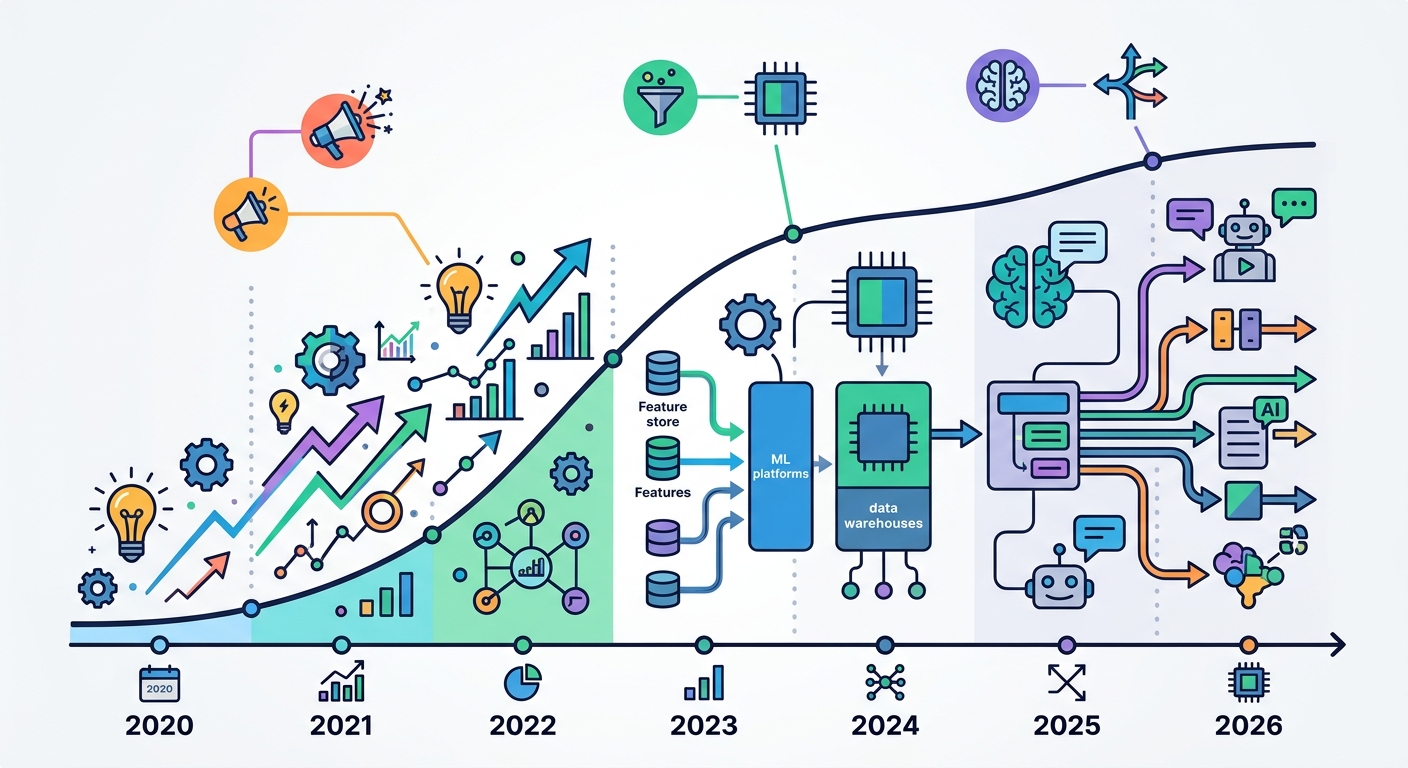
The arc is easy to trace. From 2020 to 2022, feature stores were pitched as mandatory infrastructure for every ML team. Vendors proliferated, and "point-in-time correctness" became a board-level talking point. Every conference talk assumed a dedicated feature store sat between the warehouse and the model server, and buying one was treated as a maturity milestone rather than an architectural choice.
Then came consolidation. Through 2023 and 2024, standalone feature stores were folded into broader ML platforms — Databricks, Snowflake, and the major cloud ML suites absorbed the category into their catalogs. The absorption was uneven: some platforms ship a genuine low-latency online store, while others offer only a batch feature registry with lineage. That distinction matters, because lineage without online serving doesn't solve the LLM runtime problem this article is about. A registry that can tell you which feature version a model consumed is valuable for governance, but it does nothing for a support agent that needs an entitlement tier in 40 milliseconds. Dedicated vendors either specialized (narrowing to real-time serving and streaming correctness) or pivoted toward the LLM/vector adjacency.
By 2024–2026, the LLM wave forced a re-evaluation. Teams rebuilding around RAG and agents asked a fair question: if the model does the reasoning, why maintain a separate serving layer for structured data? The question is legitimate, and the honest answer is that the reasoning layer and the serving layer solve different problems — but the burden of proof has correctly shifted onto the feature store. (Related: The Consolidation of the ML Platform Stack.)
From Tabular ML to Retrieval-Augmented and Agentic Systems
LLM applications still depend heavily on structured signals. A support agent needs the customer's entitlement tier before it promises a refund. A recommendation pipeline needs recency and engagement counts to re-rank retrieved candidates. A guardrail needs rate-limit and abuse scores in real time. An agent deciding whether to call a payments tool needs to know the account's verification status and jurisdiction before it acts.
None of these live in the vector index. They live in operational databases, event streams, and warehouse tables — and they need the same governed, low-latency serving that feature stores were built to provide. The vector index answers "what text is semantically similar to this query?" It does not answer "is this customer allowed to see this document?" or "how many times has this user hit the API in the last five minutes?" Those are entity-keyed lookups against structured state, and that is precisely the shape of an online feature store.
What changed is the consumer of those features. In 2021, the consumer was a gradient-boosted model expecting a fixed-width vector. In 2026, the consumer is often an orchestrator that assembles a prompt, a re-ranker that scores retrieved candidates, or a policy check that gates a tool call. The serving contract is looser — you may inject a handful of scalar features into a prompt template rather than a dense vector — but the correctness, freshness, and latency requirements are just as strict, and in some ways stricter because the features now influence natural-language decisions that are harder to debug after the fact.
Where the "LLMs Kill Feature Stores" Argument Breaks Down
The argument conflates two different problems: context assembly and feature serving. Context assembly is the runtime job of pulling relevant text chunks and formatting them into a prompt. Feature serving is the governed job of delivering point-in-time-correct, versioned values to both training and inference.
An LLM can assemble context. It cannot guarantee that the engagement count you fed it at inference matches the one your evaluation set saw three weeks ago. That's a data infrastructure problem, not a prompting problem.
There is a second, subtler failure the argument misses. When teams inline feature logic directly into prompt-building code — a SQL query here, a Redis GET there — they fork the definition. The eval harness computes "days since last purchase" one way; the production orchestrator computes it another, perhaps using a different timezone or a different null-handling convention. Neither is wrong in isolation, but they are not the same feature, and the resulting training/serving skew is invisible until quality regresses in production. A feature store's real value is not the storage engine; it is the single definition that both paths compile from. That value does not disappear because the downstream consumer happens to be an LLM.
What LLM Applications Actually Need From ML Infrastructure
Strip away the hype and LLM systems have the same foundational requirements as any production ML system — plus a few new ones. The requirements below are the ones that most often justify keeping (or building) a serving layer, and each comes with a concrete failure mode when it's absent.
Point-in-Time Correctness and Training/Serving Skew
Evaluation and fine-tuning datasets need the same feature definitions as production. If your eval harness pulls current user state instead of the state at the time of each logged interaction, you get leakage — and leakage produces false confidence in your LLM pipeline. Teams routinely see a prompt change that appears to lift offline metrics double digits, then regress in production, because the offline set was contaminated with future information.
Feature stores address this with point-in-time joins against an event-time-correct history. Be precise about what that buys you: the store makes the join correct given well-formed event timestamps. It does not fix late-arriving events, clock skew, or backfills that rewrite history — those remain your responsibility through watermark discipline and immutable event logs. Without a store, you're reconstructing historical state from audit logs, which is fragile and slow. (Read more: Point-in-Time Correctness Explained.)
Worked example. A team evaluates a new re-ranking prompt against 90 days of logged support interactions. For each interaction, they need the customer's tier, open-ticket count, and 30-day order count as of the interaction timestamp. With a feature store, this is a single point-in-time join over the interaction log keyed by customer_id and event_time. Without one, an engineer writes a query against the current customers table — which reflects today's tier, not the tier at interaction time. A customer who upgraded last week now appears as a premium user in historical data, the eval set over-represents premium behavior, and the prompt looks better than it is. The regression surfaces two weeks after launch, and the root cause is a join, not a prompt.
Online/Offline Parity: The Mechanism Behind the Promise
The reason a feature store reduces training/serving skew is structural, not magical: one feature definition compiles to both the offline (batch/streaming backfill) and online (low-latency key-value lookup) paths. When a definition changes, both paths change together, and backfills recompute history consistently. Tools like Feast express this as a declarative feature view; Tecton and Chronon express it as a transformation that materializes to both a warehouse table and an online store; dbt can own the offline side while a serving layer mirrors it.
Two operational disciplines make this real:
- Parity testing. Sample production requests, replay the online lookup, and diff against the offline value for the same entity and timestamp. Alert on divergence.
- Backfill contracts. Every feature has an explicit backfill strategy and retention window, so an eval set built three months ago can be reproduced.
If your platform can't do both, you have a feature registry, not a feature store — and the skew problem is unsolved regardless of what the vendor calls it. The parity test is the single highest-leverage investment here: it converts an abstract promise ("online and offline agree") into a monitored SLO with an alert when it drifts. In practice, most parity failures come from three sources — a streaming job that lags behind its batch counterpart, a null-handling difference between the SQL and the online transform, and a schema change applied to one path but not the other. A sampled diff catches all three.
Real-Time Features for Retrieval, Ranking, and Guardrails
Several LLM workloads have hard latency budgets, typically expressed as a p99 target at the orchestrator — often 100–300ms end-to-end for a synchronous turn. The feature lookup must fit within that budget, not consume it:
- Re-ranking signals: recency, engagement counts, inventory status, price sensitivity
- Personalization gates: which tools or documents a user is entitled to see
- Abuse and rate-limit signals: request velocity, prior violations, risk scores
- Guardrail inputs: account age, verification status, jurisdiction
These are online serving problems, and they map directly onto what a feature store's online store does well — key-value lookups with strict tail-latency SLOs, plus freshness guarantees for streaming sources. (See: Designing a Low-Latency Online Store.)
The cost/latency reasoning is worth spelling out. A single LLM turn may involve several sequential network hops: retrieve from the vector store, look up features, call the model, then post-process. If each hop adds 30–50ms at p99, the budget evaporates before the model is even invoked. This is why feature lookups for LLM orchestration are usually batched into one round trip (fetch all entities for a request in a single multi-get) and why the online store must be co-located with the orchestrator, not behind a cross-region hop. A Redis-backed online store serving sub-10ms multi-gets is a very different cost profile from a warehouse query that takes seconds — and the warehouse, however well-governed, cannot sit on the synchronous path.
Embeddings, Context, and the New "Feature" Types
Embeddings and chunk metadata are now governed artifacts in their own right. Feature versioning has expanded to include embedding model version and index generation lineage — if you re-embed your corpus with a new model, every downstream evaluation and fine-tune needs to know which index generation it saw.
The failure mode is quiet and expensive: re-embed without recording the generation, and your eval sets silently compare retrieval from two incompatible vector spaces. Quality regressions become unattributable. Vector databases increasingly carry their own metadata and versioning, so the feature store's role here is lineage across stores — binding embedding-model version, index generation, and the structured features that fed the same request — not owning the vectors themselves. This is a natural extension of the feature store's lineage model, not a replacement for it.
Worked example. A team swaps its embedding model and re-indexes the corpus over a weekend. Monday's eval run compares new retrieval against last month's golden set — but the golden set's expected chunks were produced under the old index generation. Retrieval quality appears to drop sharply. The team spends a week tuning chunk size before someone checks the lineage and discovers the comparison was invalid. Had the request log recorded index_generation alongside the structured features, the mismatch would have been visible in minutes. The lesson: when the feature store already owns request-level lineage, extending it to cover embedding-model version is cheap; retrofitting that lineage after an incident is not.
When You Can Skip the Feature Store Entirely
Not every LLM team needs one, and pretending otherwise is how you end up with an underused platform. Skip the feature store — or defer it — when most of the following hold:
- Your structured features are few and slow-changing. A handful of low-cardinality attributes (plan tier, region, language) that change on the order of days can be served from a replicated Postgres read or a small Redis cache with a simple, versioned loader. The governance overhead of a full feature store exceeds the skew risk.
- You have no offline evaluation loop yet. If you are not building point-in-time eval sets, the store's headline benefit is theoretical. Build the eval harness first; the serving requirement will announce itself.
- Your platform already ships a genuine online store. If Databricks or Snowflake is already your system of record and its online serving meets your latency SLO, adding a second serving layer is duplication, not governance.
- Your team is small and the feature surface is stable. A single team owning both the offline transform (dbt) and the online loader can maintain parity by discipline. The store earns its keep when multiple teams share definitions and drift becomes likely.
The signal to revisit is concrete: the moment you have two or more consumers computing the same feature differently, or an eval set you cannot reproduce because history was overwritten, you have crossed the threshold. That is the point at which a governed serving layer stops being overhead and starts being the cheaper option.
Feature Store Architecture Patterns for LLM Systems
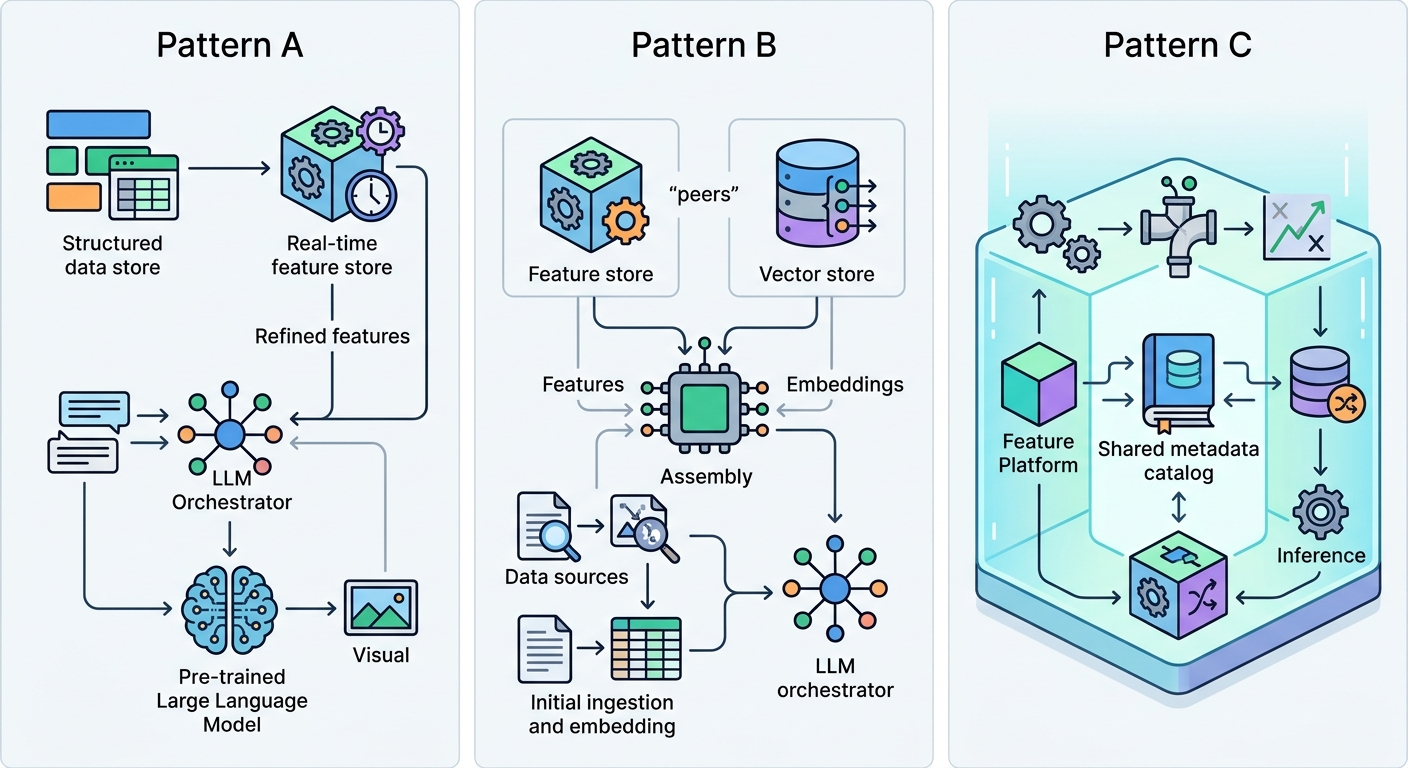
Three patterns dominate in 2026. They differ in where the online serving responsibility sits and how tightly the feature store couples to the vector layer.
Pattern A: Feature Store as the Online Serving Layer
Here the feature store owns the synchronous path. The orchestrator issues a single multi-get against the online store for every entity in the request, receives structured signals, and merges them into the prompt or the ranking step. Streaming sources (Kafka topics for request velocity, order events, risk scores) feed the online store continuously; batch sources backfill the offline store from Iceberg tables on a schedule.
This pattern gives the tightest control over tail latency and the cleanest parity story, because one definition drives both paths. The trade-off is operational: you now run a stateful serving tier with its own SLO, capacity planning, and on-call rotation. It is the right choice when structured signals are on the critical path of a synchronous turn — entitlements, guardrails, re-ranking — and when multiple teams consume the same features. Feast on Redis or DynamoDB, or a managed store like Tecton, fits here. The cost model is dominated by the online store's memory footprint and the streaming compute that keeps it fresh, both of which scale with entity cardinality and update frequency, not with request volume alone.
Pattern B: Hybrid — Vector Store for Context, Feature Store for Signals
The most common production shape in 2026 is a split: the vector database owns retrieval (chunks, embeddings, semantic search) and the feature store owns structured signals, with the orchestrator fanning out to both in parallel and joining the results before the model call. The two stores stay loosely coupled; the feature store's role in lineage is to record which signals accompanied which retrieval generation for a given request.
The advantage is that each store does what it is good at, and neither team is forced to adopt the other's tooling. The cost is a second network hop and a join in the orchestrator, plus the discipline to keep the two stores' notions of entity identity aligned — a customer_id must mean the same thing in both. The failure mode here is fan-out latency: if the two lookups are issued sequentially rather than concurrently, you pay both latencies in series. Issue them in parallel and join on the orchestrator's event loop.
Pattern C: Feature Store as a Governance and Lineage Layer Only
In this pattern the feature store does not sit on the synchronous path at all. It serves as the system of record for feature definitions, lineage, and point-in-time offline joins, while a separate lightweight cache (often Redis or the application database) handles runtime lookups. The store's value is governance and reproducibility; the runtime path is optimized independently.
This is the right fit for teams whose LLM latency budget is too tight for an extra hop, or whose online serving is already handled by an existing service. The risk is definitional drift: if the runtime cache is populated by a hand-written loader rather than compiled from the store's definition, you have reintroduced the skew the store was meant to prevent. The mitigation is to generate the loader from the store's definitions and run parity tests against the store's offline values — the store governs, even if it does not serve.
Migration and Make-vs-Buy
Most teams arrive at one of these patterns incrementally, and the migration path matters as much as the destination. The lowest-risk sequence is to start with offline governance — define features in the store, generate point-in-time eval sets from it, and leave the runtime path untouched. Once eval reproducibility is established, move the synchronous lookups onto the online store one feature group at a time, running parity tests in shadow mode before cutting over. This lets you validate that online and offline agree on real traffic before any user-facing decision depends on it.
On make-vs-buy: building a minimal online store on Redis with a definition layer and a backfill job is achievable for a small team, but the hidden cost is not the storage — it is the point-in-time join engine, the streaming materialization, and the parity tooling. Those are where homegrown stores accumulate debt. Buying (or adopting an open-source store like Feast, or a transformation framework like Chronon) trades that debt for licensing and operational coupling. The decision usually turns on team topology: if no team owns data infrastructure full-time, buy; if a platform team already exists and the feature surface is idiosyncratic, building on open-source primitives is often cheaper over a multi-year horizon.