Guardrails in the Wild: A Practical Field Guide to Deploying LLM Safety Systems That Don't Kill Your UX
Layer your controls, keep the happy path fast, and measure false positives. A practical field guide to shipping LLM safety systems that don't break UX.
Your LLM app works in the demo. In production, it leaks PII, gets jailbroken, and hallucinates. You add guardrails. Then users hit walls of refusals and slow replies. The app is safe — and dead.
This guide fixes that. It shows how to deploy safety systems that protect users without punishing them. Good guardrails are layered, measured, and fast. Let us build them.
Why System Prompts Aren't Enough
System prompts feel like a safety net. They are a polite request, not a defense.
An attacker can bypass them with a single crafted input. Jailbreaks, prompt injection, and topic drift all slip through. Model alignment from training also has limits. Red-team data teaches general refusal, not your policy.
Consider what your prompt actually controls. It sets tone and scope. It cannot inspect what a determined user pastes into your interface. It cannot verify a claim before the model repeats it. It cannot stop your model from copying a secret from retrieved context.
Runtime guardrails enforce rules at the moment of interaction. They act as a gate between the user, the model, and the response. This is the layer that catches what alignment misses. It is code you control, version, and test.
A guardrail is not a better prompt. It is a separate, testable control that runs around the model.
Treat it that way. Give it its own code, its own tests, and its own failure modes. A prompt change is a content edit. A guardrail change is a system change. Keep those distinct.
The False Positive Tax
Safety has a hidden cost: blocking legitimate requests. Call this the false positive tax.
A false positive rate of four percent sounds small. Run the math against a million daily users. That is forty thousand valid requests blocked every day. Each one is a frustrated human who asked a reasonable question.
At fifteen percent, that number jumps past one hundred fifty thousand. Users hit a wall and leave. Trust erodes. Churn climbs. Your product earns a reputation for being broken, not safe. Support tickets spike. Your team burns hours explaining why the bot refused.
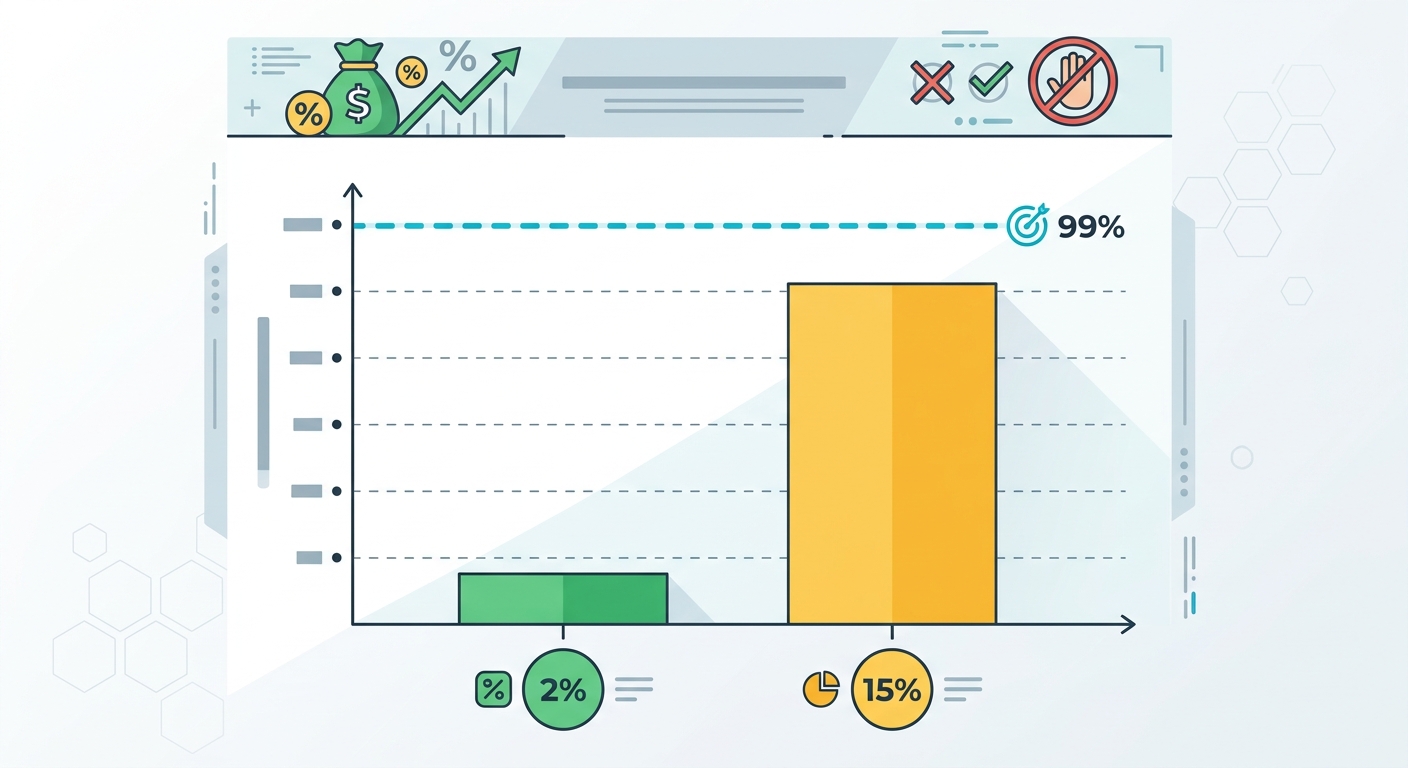
Teams in 2026 target precision above ninety-nine percent. That leaves room for real threats while sparing everyday users. The target is not zero false negatives. It is a controlled, visible tradeoff you choose on purpose.
Aggressive guardrails create another problem. They teach users to game the system. People rephrase questions to dodge filters. They stop trusting the answers they do get. Over-guarding undermines the value your model was meant to add.
Measure your refusal and intervention rates from day one. If you cannot see false positives, you are flying blind. Put these numbers on a dashboard before you touch enforcement.
Build in Layers: The Architecture
Do not put one guardrail in front of everything. It will be either too strict or too weak. A single filter tries to do every job and fails at most.
A production stack uses several layers. Each layer handles one job. Each runs at the right speed. Each fails independently. If one layer breaks, the others still hold the line.
Input guardrails inspect the user query first. They catch prompt injection, jailbreaks, PII, and off-topic requests. This is the first fence. It is cheap because most traffic is benign.
Retrieval guardrails check content pulled from your knowledge base. This stops context poisoning in RAG systems. A poisoned document cannot steer your model if it never reaches the prompt.
Output guardrails review the model reply for hallucination, sensitive data, and toxicity. This is your last chance before the user sees anything. Catching a mistake here beats explaining it later.
Execution guardrails constrain tool calls for agents. They limit which actions run and with what parameters. Agents multiply risk, so this layer matters more every quarter.
An async audit layer logs every blocked interaction for compliance. It runs slowly, off the critical path. Regulators and incident reviews read it later.
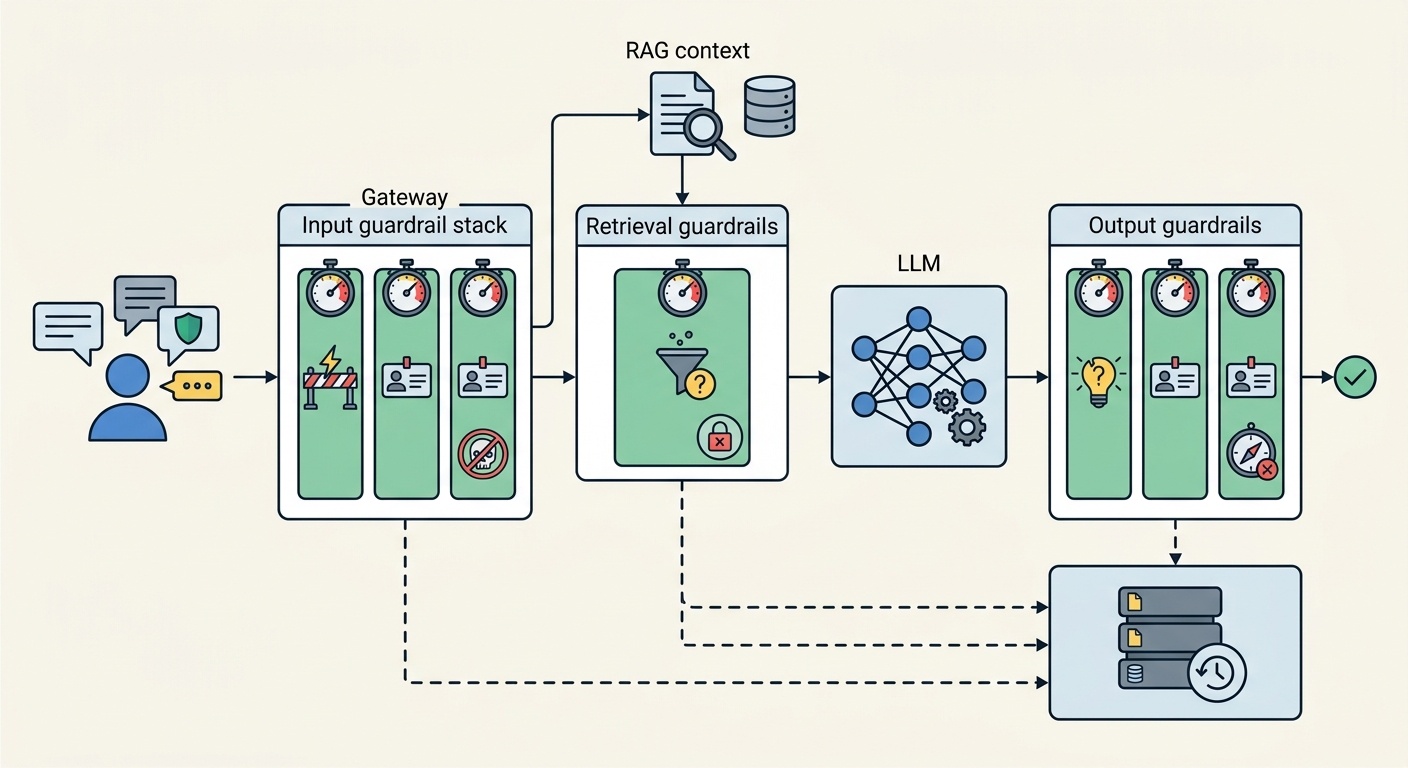
The inline layers must be fast. The audit layer can be slow. Separate them clearly.
Fast inline guardrails catch the obvious. Deep async passes catch the subtle. Run both, but never mix their latency budgets.
This split keeps your response time healthy while still recording everything for review. It is the difference between a product and a compliance exercise.
Latency-Aware Guardrail Design
Guardrails add work. Uncontrolled, they become your slowest dependency. Users notice a half-second delay. They notice it every single time. That compounds into a slow-feeling product.
Set aggressive budgets. Aim under one hundred milliseconds for input. Target under one hundred fifty for output. The guardrail must never outrun the model in cost. Guard against this in design, not in retrospect.
Use cheap checks first. Pattern matching and small classifiers catch the common cases instantly. Reserve expensive model calls for ambiguous inputs. This is a tiered ladder, not one heavy gate.
Run independent validation in parallel. Multiple filters can inspect the same text at once. This beats a serial chain that stacks every delay. Parallelism keeps total latency near the slowest single check.
Optimize the happy path. The typical user sends clean text and gets a clean reply. That path should be nearly free of guardrail cost. Reserve deep analysis for the rare, suspicious case.
Consider caching known clean patterns. Repeated benign queries skip expensive checks. Hot paths get faster as usage grows. This is a standard performance technique applied to safety.
Measure guardrail latency separately from model latency. You need to see where the time goes. A guardrail that doubles your response time is a bug, not a feature.
Framework Orientation
The 2026 toolkit is mature. Pick by workload, not by hype. The big three serve different needs. Know the difference before you pick.
NeMo Guardrails handles conversational flow. Its Colang language controls dialog paths and off-topic behavior. It shines on the NVIDIA stack and multi-turn chat. It gives you five rail types spanning input to output.
Guardrails AI validates structured output. Its validators enforce schemas and catch PII in Python-native stacks. It pairs well with RAG and LangChain agents. It offers a hub of community validators to compose.
Lakera Guard is a security-first SaaS layer. It claims over ninety-eight percent attack detection with sub-fifty-millisecond latency. It brings threat-intel feeds and compliance dashboards. It works with any LLM, including self-hosted models.
Choose the tool that matches your risk, not the loudest vendor. Flow control, schema validation, and runtime security serve different jobs.
Open source gives you control and zero license cost. SaaS gives you maintained threat feeds and ready audit output. Many teams run an open library for logic plus a managed layer for threats. Test the fit before committing.
Securing RAG Pipelines
RAG adds a new attack surface: indirect prompt injection. Malicious instructions hide inside documents your system trusts and retrieves.
The user never types the attack. The retrieved page carries it. Poisoned context then steers your model. This is a real threat in 2026, and it is growing as RAG adoption grows.
Attackers hide payloads in many ways. White text on white background. HTML comments. Obscure data attributes. A cleaned document still reaches your model as instructions.
Defend architecturally. Label retrieved content with trust levels. Treat external data as evidence, never as instructions. Isolate context in clearly separated blocks. Explicitly forbid executing commands found in retrieved text.
A full mitigation stack cut attack success rates from over forty percent to near zero in tests. No single defense is enough. Combine provenance, hierarchy, and isolation.
Update your trust model as sources change. A document that was safe yesterday may be poisoned today. Re-scoring provenance is part of the job.
Guardrails for Agents and Tools
Agents multiply risk. They do not just talk; they act. Every tool call is a surface you must constrain before it executes.
Define allowed actions up front. Validate parameters before execution. Keep a deny-list for destructive operations. Monitor what an agent does across the whole task, not just one step.
Rule-based and model-based checks both belong here. Fast rules block obvious abuse. Deeper reasoning catches novel chains. Layer them for both speed and coverage.
Log every action for audit and incident response. You cannot review what you did not record. Agent chains are hard to replay without full traces. Capture the intent, the tool, the parameters, and the outcome.
Re-evaluate tool permissions as the agent changes. New tools add new risk. A narrow allow-list beats a long explanation later. Principle of least privilege applies to bots too.
Evaluation and Rollout
Ship nothing you cannot measure. Guardrails need the same rigor as your model evals. Otherwise you are guessing about safety and UX alike.
Track false positive rate and false negative rate. Track attack success rate on red-team probes. Watch refusal rate and intervention rate in production. These numbers tell you if you are safe or just annoying.
Use public benchmarks to calibrate. SafetyBench, AgentHarm, and ToxiGen offer repeatable baselines. Run them before launch and after every change. Regression is the silent killer. It sneaks in with a harmless-looking update.
Roll out in stages. Start in shadow mode, where guardrails log but do not block. Compare what they catch against reality. Tune to remove false positives. Then escalate to enforcement slowly.
Shadow mode is how you learn your false positive rate without paying its cost. Enforce only after you trust the numbers.
Keep a red-team loop alive after launch. Attacks evolve monthly. Scheduled adversarial campaigns keep your defenses honest. A guardrail that never faces fresh attacks is already stale.
This saves your users from half-built safety systems. It also protects your launch. Careful rollout beats a confident rollback.
Compliance and Audit
Regulation is arriving. The EU AI Act and ISO/IEC 42001 demand evidence of control. Hope is not a compliance strategy.
Your audit layer provides the evidence. Every blocked interaction becomes a record. Every decision becomes explainable. Build logging that survives a review.
Document your guardrail policy and its version. Show why each control exists. Link it to a stated risk. This turns safety engineering into a compliance asset, not an afterthought.
Keep retention rules explicit. Know how long you keep logs and why. Align retention with the standards you must meet. Consistency beats volume.
Ship Safety That Feels Like Nothing
Great guardrails are invisible. Users never notice them because they never trip. That is the mark of good design.
That is the goal: protection without friction. Layer your controls. Keep the happy path fast. Measure false positives relentlessly. Test before you enforce.
Start with one metric: intervention rate. Then add false positives and latency. Let data drive every tightening. Safety is a process, not a one-time install.
Your model is your product. Your guardrails protect it. Build them so well that nobody sees them — and everybody stays safe.
Closing Checklist
- System prompts are not a defense; add runtime controls
- Set a precision target above ninety-nine percent
- Separate fast inline checks from slow audit passes
- Keep input under one hundred milliseconds
- Label and isolate all retrieved context
- Constrain every agent tool call
- Track FPR, FNR, and attack success rate
- Test in shadow mode before enforcement
- Log everything for EU AI Act and ISO 42001
- Run red-team campaigns after launch
The wild is not tame. But it is navigable. Deploy guardrails that hold the line — and keep your users moving.
Expert Q&A
Q: I am shipping our first LLM feature. Where do I start with guardrails?
Start small and measure everything. Deploy one input guardrail for prompt injection and PII. Add one output guardrail for toxicity and hallucination. Run them in shadow mode first. Log every decision. Then track your false positive rate for a week before enforcing. That baseline tells you how aggressive you can be.
Q: How do I keep guardrails fast without paying for a huge model?
Use a tiered ladder. Cheap pattern checks and small classifiers catch the common cases in milliseconds. Only escalate to a larger model when the cheap checks are uncertain. Run independent checks in parallel. Cache known clean inputs. The happy path should cost almost nothing.
Q: My chatbot keeps refusing legitimate questions. What is wrong?
That is a false positive problem, not a safety win. Look at your intervention rate and refusal rate. If they are high, your guardrails are too aggressive. Raise the precision threshold. Test in shadow mode and compare what the guardrail blocks against what it should block. The goal is ninety-nine percent precision, not maximum blocking.
Q: Does a simpler system prompt count as a guardrail?
No. A system prompt is a request, not a control. An attacker can bypass it with one crafted input. Runtime guardrails enforce rules at the moment of interaction as separate, testable code. Use both, but understand that only the runtime layer is a real control.
Q: How do I defend RAG systems against prompt injection?
Treat retrieved content as untrusted evidence, never as instructions. Label context with trust levels. Isolate it in clearly separated blocks. Explicitly forbid executing commands found in retrieved text. A full stack of these defenses cut attack success rates from over forty percent to near zero in tests.
Q: What compliance standards should I prepare for?
The EU AI Act and ISO/IEC 42001 are the current anchors. Both want evidence of control. Keep a complete audit log of blocked interactions. Document your guardrail policy and version. Link each control to a stated risk. That logging turns safety engineering into a compliance asset.
Q: Should I use an open-source or a managed guardrail layer?
It depends on your threat model and team. Open source gives control and no license cost. A managed layer like Lakera brings maintained threat feeds and ready audit dashboards. Many teams run both: an open library for custom logic plus a managed layer for threat intelligence. Test the fit before committing.