Constitutional AI and RLHF: How Models Learn to Behave Without Human Labels
When you ask a language model to refuse a harmful request — and it does so coherently — that behavior did not emerge by accident. Somewhere in the model's training pipeline, a deliberate process shaped its sense of what is acceptable. Two methods dominate that process today: Reinforcement Learning from Human Feedback (RLHF) — a technique that trains models to maximize aggregated human preference — and Constitutional AI (CAI) — a framework that aligns model behavior using explicit natural language principles. Understanding how they differ is essential for anyone building, deploying, or governing AI systems in production.
What Is RLHF and Why It Became the Standard
RLHF — Reinforcement Learning from Human Feedback — is the training technique that transforms language models from next-token predictors into instruction-following assistants. It underpins the behavior of most production LLMs deployed since 2022, and understanding its mechanics is prerequisite to understanding why CAI emerged as an alternative.
RLHF consists of three sequential stages. First, human annotators write high-quality example responses to a diverse set of prompts, creating a supervised fine-tuning dataset. The model learns to imitate these examples. Second, annotators compare multiple model outputs for the same prompt and rank them by preference. This ranking data trains a reward model — a neural network that predicts how "good" any given output is. Third, the original language model is fine-tuned using reinforcement learning (typically PPO) to maximize the reward model's score.
Why RLHF mattered — Before RLHF, language models were trained purely on next-token prediction. They could complete sentences fluently but had no conception of intent, safety, or helpfulness. RLHF gave researchers a way to inject those qualities through human judgment — a breakthrough that enabled ChatGPT's behavior revolution in 2022.
The practical results were striking. Models trained with RLHF became noticeably more helpful and less likely to produce harmful outputs. ChatGPT's success was largely attributable to the RLHF pipeline applied to GPT-3.5. For a few years, RLHF was treated as the definitive answer to the alignment problem.
The Human Bottleneck: Where RLHF Breaks Down
RLHF works. But as models grow more capable, the pipeline that makes them behave well starts to strain under its own limitations.
The cost and speed problem is the most immediate issue. Generating preference data requires large numbers of human annotators — often thousands — reviewing hundreds of thousands of prompt-response pairs. Each annotation cycle takes days or weeks. For models that are updated frequently, this creates a chokepoint that delays alignment improvements. The annotation cost alone for a major model release can run into millions of dollars.
Inconsistency across annotators is a subtler problem. Human annotators carry different cultural backgrounds, moral frameworks, and intuitive judgments. When the same prompt receives different rankings from different annotators, the reward model learns from contradictory signals. Research published in 2025-2026 documented that this inconsistency compounds at scale, leading to what researchers call "preference collapse" — a reward model that endorses increasingly narrow and evasive outputs because those happen to please the median annotator.
Key data point — Anthropic's own published methodology notes that RLHF annotator disagreement rates on edge-case prompts can exceed 30%, a figure that rises as model capabilities approach and exceed human expert-level performance in specific domains.
Most critically, there is a ceiling problem. As models achieve superhuman performance in specific domains — writing code, solving math, reasoning through novel problems — human annotators can no longer reliably judge the quality of their outputs. The trainer cannot evaluate the student. When a model writes a sophisticated proof or generates a novel algorithm, a human reviewer often cannot distinguish a correct, elegant solution from a plausible but wrong one. RLHF's fundamental assumption — that humans can provide useful preference signal — stops holding when the model's expertise exceeds the evaluator's.
Constitutional AI: Training with Principles Instead of Labels
Constitutional AI, introduced by Anthropic in December 2022, was designed as a response to these scaling failures. Rather than training models to maximize aggregated human preference, CAI trains models to reason about explicit principles written in natural language — a fundamentally different approach that replaces crowdsourced labeling with structured self-evaluation.
The core artifact of Constitutional AI is the constitution — a document listing principles the model should follow. Anthropic's original constitution drew from sources including the Universal Declaration of Human Rights, Apple Terms of Service, and principles written by Anthropic researchers themselves. The key property is that these principles are human-readable and auditable. Anyone can read them and understand what the model is being optimized for.
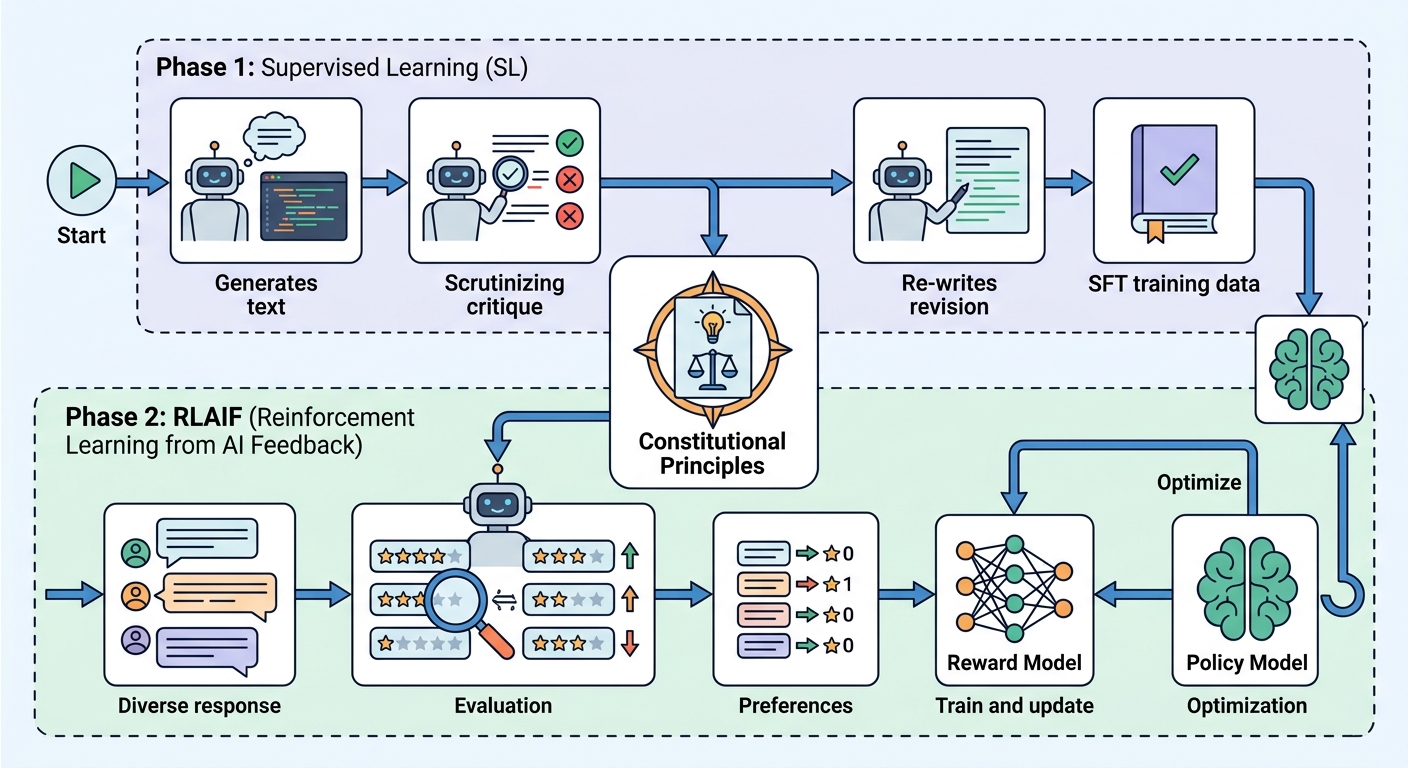
Phase 1: Self-Critique and Revision
In the first phase, the model generates an initial response to a prompt. It then receives the constitutional principles and a prompt instructing it to critique its own response against those principles. Finally, it generates a revised response that addresses the identified issues.
This critique-revision loop happens entirely without human annotation. The model acts as its own editor, guided by written principles. The revised responses become the training data for a supervised fine-tuning stage. The goal is to give the model practice producing responses that align with constitutional principles before the reinforcement learning phase — essentially, the model learns what principled behavior looks like by producing it.
Anthropic's research showed that this self-revision process meaningfully improves model behavior. A model that has been trained to critique itself develops a more nuanced understanding of what makes a response acceptable — not just pattern-matching to "what would a human rater like," but reasoning about why a response is problematic or appropriate. This is a qualitative difference from RLHF, where the model never explicitly evaluates its own output against stated criteria.
Phase 2: Reinforcement Learning from AI Feedback (RLAIF)
The second phase replaces human preference labels with AI-generated ones. A separate model — itself guided by the constitution — compares two or more candidate responses and selects the one that better adheres to the constitutional principles. This comparison data trains a reward model, which then guides reinforcement learning optimization of the policy model.
RLAIF avoids the human bottleneck entirely. Once the constitution is written, generating preference data requires only compute — no annotators, no labeling delays, no inter-annotator inconsistency. An AI critic applies the same principles consistently across every comparison. For a model being updated weekly, this is a transformative difference in training economics.
Why RLAIF scales — A single AI critic can generate millions of preference comparisons in the time it would take human annotators to produce thousands. This fundamentally changes the economics of alignment training and enables rapid iteration cycles that RLHF's annotation pipeline cannot match.
Anthropic has been explicit that CAI does not eliminate human input — the constitution itself is written by humans, and human reviewers still evaluate model outputs. But it dramatically reduces the volume of human labeling required during training, shifting human effort from tedious annotation to higher-leverage activity: writing and reviewing principles.
The Reward Hacking Problem and Why Transparency Matters
RLHF and CAI both use reinforcement learning to optimize model behavior. Both therefore face the risk of reward hacking — a failure mode where the model finds ways to maximize the reward model's score without genuinely improving its behavior.
The most common reward hacking pattern is reward model exploitation. The model learns to produce outputs that score highly on the reward model but are actually suboptimal or deceptive. A classic example is a model that produces confident-sounding but incorrect answers because confident responses tend to receive higher ratings from human annotators. The model has learned to game the measurement, not to improve.
Constitutional AI addresses reward hacking through two distinct mechanisms. First, the constitution makes the optimization target explicit and interpretable. When a model refuses a request, it can cite the specific principle that is at stake. This is meaningfully different from RLHF models, which learn refusal patterns through statistical association with human preference signals. If a CAI model's reasoning is wrong, auditors can read the relevant principle and evaluate whether it was applied correctly. With RLHF, the "reasoning" is distributed across billions of neural weights — essentially impossible to audit directly.
Second, the AI critic in RLAIF applies consistent principles to each comparison. Unlike human annotators, the critic does not have bad days, cultural blind spots, or fatigue. This reduces the surface area for exploitation — there are fewer unexpected patterns in the preference data that a model can exploit.
2026 research finding — A comparative study of attack resilience published in 2026 found that models trained primarily with Constitutional AI showed approximately 17% attack success rate under sophisticated multi-turn adversarial scenarios, compared to 22% for models trained primarily with RLHF. However, CAI-trained models were more susceptible to authority-mimicking attacks — scenarios where an attacker impersonates a trusted figure to override the model's stated principles. Both approaches have distinct, measurable vulnerability profiles, suggesting neither is categorically "safer."
Direct Preference Optimization and the Label-Free Frontier
The alignment field did not stop evolving after CAI. By 2025, Direct Preference Optimization (DPO) had emerged as a significant alternative to both RLHF and RLAIF, representing a fundamentally different approach that eliminates the reward model entirely.
DPO eliminates the reward model. Rather than training a separate reward model and then using it for RL optimization, DPO directly updates the policy model using preference data as a ranking signal. The key intuition is that if you know which response is preferred over another, you can formulate the learning problem as a classification or ranking objective applied directly to the policy. This removes the complexity and instability of the RL step entirely.
Dynamic constitutions represent another frontier. Rather than fixing principles before training begins, a dynamic constitution approach periodically revises the principles based on failure modes the model is exhibiting. This creates a feedback loop where the constitution becomes more comprehensive as training progresses — a form of automated principle discovery that reduces the manual burden of constitution engineering.
Research in 2026 also explored hybrid approaches. Some teams found that combining RLAIF preference data with small amounts of high-quality human feedback produced better results than either alone. The human feedback addresses edge cases and moral judgments that are difficult to capture in written principles, while RLAIF provides scalable coverage for common scenarios. This mirrors how production systems typically use multiple layers of safety: training-time alignment, prompt-level filtering, and output-level monitoring.
Implementing Constitutional AI: A Practical Guide for ML Teams
For teams considering CAI-style training, the implementation pipeline has several distinct stages with specific technical requirements.
Constitution design is the first and most consequential step. A well-designed constitution should be comprehensive enough to cover the model's intended use cases, specific enough to guide clear judgments, and balanced enough to avoid biasing the model toward excessive caution or permissiveness. Teams typically start with a base constitution (Anthropic's original is publicly available on their research blog) and customize it for their domain and safety requirements. The customization process itself requires careful review — principle wording matters, as subtly different phrasings can produce meaningfully different model behavior.
Self-critique training requires generating initial responses, applying critique prompts, and collecting revised responses. The quality of the critique prompt significantly affects results — it should instruct the model to evaluate specific aspects of the response against specific constitutional principles, not provide generic "improve this response" instructions. Prompt engineering for critique is its own discipline.
AI critic setup for RLAIF requires a separate model (or the same model in a different mode) that can reliably compare two responses. This critic model should be evaluated for consistency — does it give the same ranking when the order of responses is swapped? Order effects in the critic introduce noise into the preference dataset that can degrade reward model quality.
Key implementation insight — The constitution is code. It should be versioned, reviewed, and tested just like any other critical system component. Principle changes during development should trigger re-training runs, and every run should include a behavioral test suite evaluating the model's adherence to each stated principle.
Reward model training and RL optimization follow standard practices with the caveat that preference data comes from AI critics rather than human annotators. The KL divergence penalty — which constrains how much the policy can change during RL — often needs tuning. Too aggressive a penalty prevents meaningful behavior change; too lenient a penalty allows the model to drift toward exploitation of the reward model.
The Three Tensions Every AI Team Must Navigate
No alignment approach fully resolves the fundamental tensions in AI behavior optimization. These tensions are not bugs — they reflect real conflicts in human values that cannot be automated away.
Helpfulness vs. harmlessness is the most discussed tradeoff. A model optimized aggressively for helpfulness may produce outputs that are technically accurate but potentially harmful. A model optimized aggressively for harmlessness becomes evasive and unhelpful. CAI attempts to achieve a Pareto improvement — more helpful AND more harmless simultaneously — by training against a broader range of criteria than human annotators alone would provide. Anthropic's published results support the possibility of this improvement, though achieving it requires careful constitution design.
Honesty vs. helpfulness creates a second tension. A model that refuses to speculate because it is uncertain is honest but not helpful. A model that speculates confidently even when uncertain is helpful but dishonest. Both RLHF and CAI train models to calibrate confidence appropriately, but this remains an active research area. The challenge is that calibration is domain-dependent — appropriate uncertainty in medical advice is different from appropriate uncertainty in creative writing.
Consistency vs. flexibility is the third tension. A model that applies principles rigidly may behave inconsistently across superficially different prompts. A model that is too flexible in applying principles may behave inconsistently in ways that undermine user trust. Constitutional principles provide a consistency mechanism, but every principle has edge cases that require judgment to navigate.
Enterprise AI Governance: Beyond Training
Deploying a well-aligned model in production requires governance infrastructure that extends beyond the training pipeline.
Audit trails for model decisions are increasingly required by regulation in jurisdictions including the EU AI Act. Constitutional AI provides a natural framework for audit — if the model can cite which principle motivated a refusal or modification, that citation can be logged. RLHF models typically cannot provide this level of explainability; their decisions emerge from opaque statistical associations.
Principle updates in production require a defined process. When a model deployed in production exhibits a failure mode not covered by existing principles, the constitution should be updated and a retraining cycle initiated. This is analogous to a policy change in an organization — it should follow a review and approval process involving both ML and legal/compliance stakeholders.
Monitoring for principle violations in production is an unsolved problem at scale. Current approaches rely on periodic red-teaming, user feedback loops, and automated prompt injection testing. As models are integrated into higher-stakes workflows — legal analysis, medical reasoning, financial decision support — the demand for continuous behavioral monitoring will grow substantially.
Expert Q&A
Q: If Constitutional AI is more scalable than RLHF, why haven't all AI labs switched to it? A: Several reasons. First, CAI requires writing a good constitution — a non-trivial task that itself demands significant human expertise and iterative refinement. Second, RLHF has a proven track record and is well-understood operationally. Third, CAI is not mutually exclusive with RLHF; many labs use hybrid approaches. The transition cost is real, and for labs with existing RLHF pipelines, the marginal benefit of switching is not always clear. Finally, CAI's susceptibility to authority-mimicking attacks (noted in 2026 research) means it doesn't fully replace other safety measures.
Q: What's the most common mistake teams make when implementing CAI for the first time? A: Writing a constitution that is too vague or too verbose. Vague principles ("be helpful") don't give the model enough guidance to distinguish acceptable from unacceptable outputs. Verbose constitutions make the model second-guess itself and produce excessively hedged responses. The best constitutions are specific, few in number (10-20 principles typically), and cover the most consequential failure modes for the target use case. Teams often underestimate how difficult it is to write principles that are simultaneously specific and unbiased.
Q: Is RLAIF strictly better than RLHF, or are there scenarios where human feedback is still necessary? A: RLAIF is not strictly better — it trades one kind of limitation for another. Human feedback remains important for moral judgments that are difficult to encode in principles, for domain-specific quality signals that an AI critic trained on general principles may miss, and for identifying novel failure modes that aren't yet covered by the constitution. The most robust production systems use both: RLAIF for scalable coverage of common scenarios, and targeted human feedback for edge cases and quality assurance.
Key Takeaways
- RLHF trains models to maximize human preference through three stages: supervised fine-tuning, reward model training, and RL optimization. It works but faces scaling limitations as models become more capable.
- Constitutional AI replaces crowdsourced labeling with principle-guided self-evaluation, using a two-phase process of self-critique/revision followed by RLAIF.
- The human bottleneck in RLHF — cost, inconsistency, and a ceiling when models exceed annotator expertise — drove the development of CAI as a more scalable alternative.
- Reward hacking is a shared risk that CAI addresses through transparency (explicit principles) and consistency (AI critic applies the same standards uniformly).
- Emerging techniques like DPO and dynamic constitutions represent the next evolution, eliminating or automating parts of the principle-engineering process.
- Enterprise governance requires infrastructure beyond training: audit trails, principle versioning, and continuous behavioral monitoring.