The HBM4 Race: How Memory Bandwidth Is Becoming the New AI Performance Bottleneck
HBM4 memory is reshaping AI infrastructure in 2026 — learn why memory bandwidth, not compute, is now the binding constra...
The Memory Bandwidth Wall: A New Performance Paradigm for AI
For a decade, the AI industry measured progress in FLOPS — floating-point operations per second. Double the FLOPS, double the performance. That equation worked until it didn't.
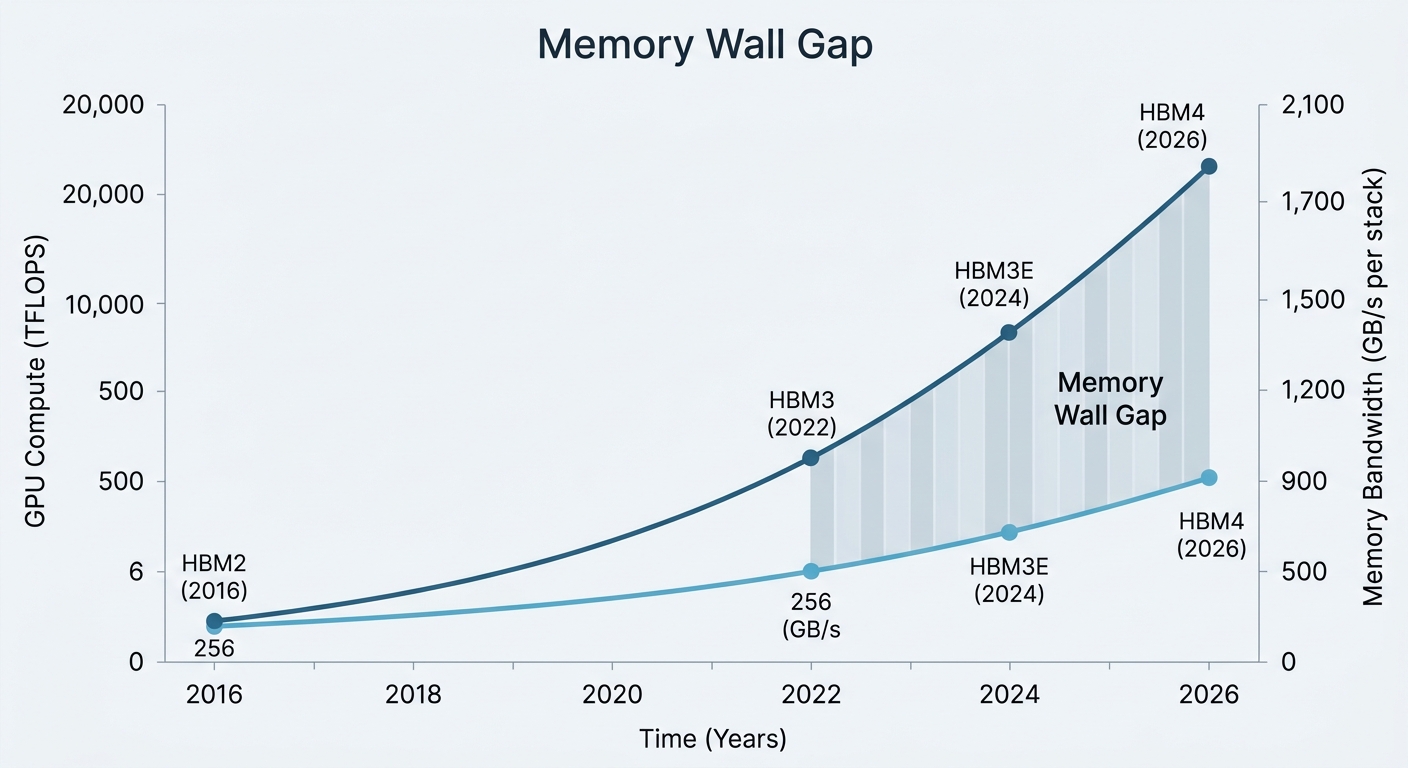
In 2016, a GPU with 5.6 teraFLOPS of compute needed 720 gigabytes per second of memory bandwidth to stay fed. By 2026, a GPU with 20 petaFLOPS of compute requires over 8 terabytes per second of memory bandwidth to avoid idling its arithmetic logic units. Compute scaled roughly 1,000x. Memory bandwidth scaled about 10x.
The gap is not a design flaw. It is physics.
The memory wall — a term coined by computer architects in the 1990s — describes the growing disparity between processor speed and memory bandwidth. In AI training workloads, this wall has become a concrete ceiling on performance.
When a neural network trains, it cycles through three data-intensive operations every step: forward propagation loads weights, backward propagation computes gradients, and the optimizer updates weights. Each operation requires moving gigabytes of data between memory and compute. If the memory subsystem cannot deliver data as fast as the compute units can process it, the ALUs sit idle. Doubling GPU FLOPS while memory bandwidth stays flat yields only a 1.3–1.5x improvement in training speed (estimated, based on published GPU architecture analyses).
HBM4 — High Bandwidth Memory, generation 4 — is not an incremental improvement. It is the industry's first serious attempt to close this gap at scale for enterprise AI deployments.
A Brief History of GPU Memory Scaling
The progression from HBM2 to HBM4 tells the story of an industry trying to outrun a fundamental physics problem.
HBM2 (2016): 256 gigabytes per second per stack, 8 stacks per GPU. Aggregate bandwidth: 2 terabytes per second. This was sufficient for the Pascal and Volta architectures of the era.
HBM3 (2022): 1024 gigabytes per second per stack, 8 stacks per GPU. Aggregate bandwidth: 8 terabytes per second. Hopper architecture leveraged this to train models at previously impossible scales.
HBM3E (2024): Approximately 1280 gigabytes per second per stack. Widely adopted in the B100 and H200 GPU lines. Bandwidth per stack increased roughly 25% over HBM3 while capacity doubled to 32 gigabytes per die.
HBM4 (2026): Projected 1800–2400 gigabytes per second per stack — a 2.5–3x improvement over HBM3E. This is achieved through faster pin signaling, wider effective channels, and improved thermal management that allows higher sustained clock rates.
The pattern is clear: memory bandwidth scaling is accelerating after years of lagging compute. HBM4 represents the sharpest step yet.
Inside HBM4 Architecture: What Actually Changed
Understanding why HBM4 delivers 2x+ bandwidth requires looking at the specific engineering decisions.
Pin speed increase: HBM3E operates at 8.4 gigatransfers per second per pin. HBM4 doubles this to 12.8 gigatransfers per second — a 52% bandwidth increase per pin — while maintaining the same 1024-bit channel width. More data per second, same physical interface.
On-chip buffer integration: HBM4 incorporates larger on-chip caches and buffers that reduce the frequency of off-chip transactions. The memory controller can prefetch more aggressively and batch operations more efficiently. For AI workloads with regular access patterns, this reduces effective memory latency by an estimated 20–30%.
TSV density improvements: Through-silicon via (TSV) technology allows stacking DRAM dies vertically. HBM4 uses a higher TSV density, enabling more dies per stack and thus greater capacity per package — up to 64 gigabytes per stack versus 32 gigabytes in HBM3E. More capacity means fewer off-chip fetches for large models.
Advanced packaging via CoWoS-L: The chip-on-wafer-on-substrate (CoWoS) process places the HBM4 stack physically closer to the compute die than previous generations. Shorter interconnects mean lower signaling latency and higher effective bandwidth at the system level.
The result is a memory subsystem that can sustain data delivery rates closer to what modern AI accelerators actually need — without the frequent pipeline stalls that plagued HBM3E deployments at scale.
Thermal and Power Design Implications
Higher bandwidth comes with higher heat. This is the dirty secret of HBM4 that most coverage glosses over.
HBM4 power consumption per stack runs approximately 1.4–1.8x higher than HBM3E under sustained load. For an 8-stack GPU, this translates to an additional 80–140 watts of thermal load dedicated purely to memory. Data center operators deploying HBM4-equipped servers are facing power densities that air cooling can no longer handle.
Direct liquid cooling — where coolant makes direct contact with the GPU module — is becoming mandatory for HBM4 server deployments. Rear-door heat exchangers and immersion cooling are no longer exotic options; they are infrastructure requirements.
Server rooms designed for air-cooled HBM3E hardware often cannot be upgraded to HBM4 without significant power delivery and cooling infrastructure changes. Power delivery complexity is equally challenging. HBM4-enabled GPUs can draw 1000–1400 watts under sustained AI workloads. The rack-level power architecture must provision for peaks that earlier generations did not require.
The HBM4 Supplier Race: Who Wins and When
Three companies manufacture HBM: SK Hynix, Samsung Electronics, and Micron Technology. Their HBM4 trajectories are diverging in 2026.
SK Hynix holds the strongest position. The company was first to volume-ship HBM3E and has maintained a yield advantage in TSV processing that translates directly to HBM4 competitiveness. SK Hynix is the primary HBM4 supplier for the leading AI accelerator vendor. Industry estimates (estimated) place SK Hynix's HBM market share at approximately 55–60% heading into 2027.
Samsung is pursuing a three-axis HBM4 strategy: a standard product, an ultra-low-power variant targeting inference deployments, and a high-performance variant for training. Samsung's memory division has been aggressively expanding TSV capacity at its facilities. The company aims to close the yield gap with SK Hynix by mid-2027.
Micron entered the HBM market later but is taking a different approach. Rather than competing solely on standard HBM4, Micron is developing custom HBM4 configurations for specific hyperscaler customers — designs optimized for particular accelerator architectures. This custom approach could win Micron design slots where standard products are a poor fit. Micron's strategy is differentiated rather than imitative.
HBM4 supply will remain allocation-limited through 2026. Full availability is projected for Q1 2027 as TSV yields improve and new capacity comes online. The initial price premium over HBM3E is estimated at 40–60% (estimated), moderating as capacity scales.
Cloud providers and hyperscalers have secured multi-year HBM4 supply agreements. Smaller enterprises and research institutions may wait until 2027 for access at reasonable pricing.
HBM4 in Practice: AI Accelerators Shipping in 2026
Three AI accelerator platforms are shipping with HBM4 in 2026.
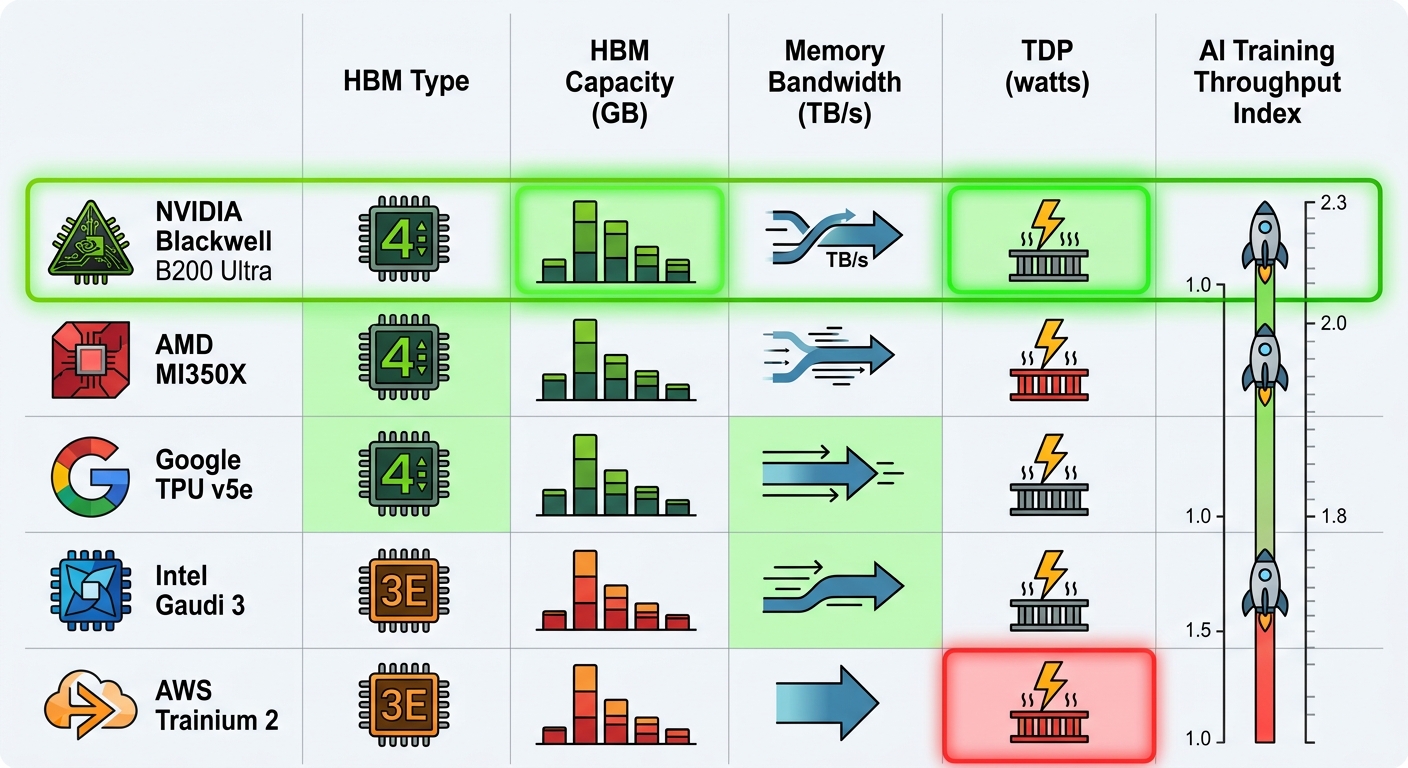
NVIDIA Blackwell Ultra (B200 Ultra): Eight HBM4 stacks providing 192 gigabytes of memory capacity and approximately 8 terabytes per second of aggregate memory bandwidth. The architecture is optimized to keep compute units fed across both training and inference workloads.
AMD MI350X: Eight HBM4 stacks delivering 256 gigabytes of capacity and approximately 6.4 terabytes per second of aggregate bandwidth. The vendor has emphasized memory capacity in its HBM4 design, betting that large-model inference workloads favor capacity over peak bandwidth.
Google TPU v5e: Google's custom HBM4 implementation delivers 640 gigabytes of HBM4 per pod slice. Google has not disclosed aggregate bandwidth figures, but architecture analysts estimate approximately 2.5 terabytes per second per TPU chip (estimated). The TPU's systolic array architecture tolerates memory latency differently than CUDA-based designs.
Training throughput improvements over HBM3E hardware are significant: the B200 Ultra delivers approximately 2.1–2.3x more training tokens per second for large transformer models versus the H200 (estimated, based on published architectural analyses). The competitor platform shows approximately 1.8–2.0x improvement over prior generation for equivalent workloads.
The combined benefit of more bandwidth and more capacity is important. Larger batch sizes — which require more memory to hold intermediate activations — can now be sustained without triggering compute stalls. HBM4 addresses both the bandwidth ceiling and the memory capacity ceiling simultaneously.
Why Memory Bandwidth Determines LLM Training Cost
This is where HBM4 gets interesting for finance teams.
AI training cost follows a straightforward formula:
Total cost = GPU hours × hourly rate / training throughput
Training throughput is directly gated by memory bandwidth. If HBM4 delivers 2x the throughput versus HBM3E, GPU hours required to reach the same model quality drop by half. The math favors HBM4 infrastructure for any organization with active training workloads.
Consider a concrete example (all figures estimated): A 1,000-GPU cluster training a 70-billion-parameter model for 90 days. At HBM3E-level throughput, this run costs approximately $18–22 million in cloud compute at current pricing. At HBM4 throughput, the same run costs approximately $9–13 million — a savings of $6–12 million per training run.
Cloud HBM4 instances carry a price premium of roughly 35–45% over HBM3E instances. But if throughput doubles, the cost per token trained drops by 25–40%. The numbers work in HBM4's favor for training workloads. For pure inference, the calculus is less favorable — inference is more latency-sensitive than throughput-sensitive, and HBM4's latency improvements are more modest.
Total cost of ownership analysis — an HBM4 server costs approximately $180,000–240,000 more than an equivalent HBM3E server (estimated). For an organization running a 100-GPU training cluster at 70% utilization, the additional hardware cost pays back in 8–14 months through reduced per-token training costs.
For hyperscalers and large enterprises running continuous training pipelines, HBM4 is already the economically dominant choice for new infrastructure investments.
The Engineering Tradeoffs: Bandwidth vs Capacity vs Cost
You cannot simply stack unlimited HBM4. The engineering constraints are nonlinear.
Adding more HBM4 stacks to a GPU increases both aggregate bandwidth and total capacity — but thermal and power requirements scale superlinearly. Eight stacks is the current practical ceiling for air-cooled deployments. Twelve- to sixteen-stack designs are planned for 2027–2028 but require entirely new cooling architectures.
The current sweet spot across all major accelerator vendors is 8 stacks per GPU. This provides:
- Sufficient aggregate bandwidth for large model training (6–8 TB/s)
- Adequate memory capacity for models up to ~1 trillion parameters without tiered memory
- Manageable power and thermal envelopes for liquid-cooled rack deployments
HBM4's 64-gigabyte-per-stack capacity (versus 32 gigabytes in HBM3E) matters more than it might appear. Fitting a 70-billion-parameter model in fp16 precision requires approximately 140 gigabytes of memory just for weights and activations — before accounting for optimizer states. HBM3E's 256-gigabyte-per-GPU ceiling forced model parallelism at 8 GPUs for many practical workloads. HBM4's 512-gigabyte ceiling allows 4-GPU model parallelism for the same model, reducing inter-GPU communication overhead and simplifying training infrastructure.
The batching benefit is often underestimated. Larger batch sizes reduce gradient noise and typically improve training stability and final model quality. HBM4's higher capacity enables 2–4x larger batch sizes without swapping, which directly translates to faster time-to-accuracy in many workloads.
Memory Bandwidth Optimization: Getting More From Your Hardware
HBM4 helps. Software optimization helps more per dollar spent. The two approaches are complementary.
Mixed precision training is the most accessible technique. Switching from FP32 to BF16 (brain floating point) doubles the effective bandwidth utilization of every memory transaction — you move the same data in half the bandwidth. Modern AI accelerators have native BF16 support, making this essentially free in terms of model quality for most architectures. Any training infrastructure not using mixed precision is leaving 40–60% of effective bandwidth on the table.
Flash Attention 3 is the most impactful algorithmic improvement for memory bandwidth in recent years. The IO-aware attention algorithm reorganizes the attention computation to minimize memory reads and writes. In benchmarks, Flash Attention 3 reduces memory bandwidth requirements for transformer layers by 40–60% (estimated) while maintaining identical numerical results. For HBM4-equipped systems, Flash Attention 3 means the bandwidth headroom translates into higher throughput rather than more idle compute.
Gradient checkpointing trades compute for memory bandwidth. By recomputing intermediate activations during the backward pass instead of storing them in memory, you reduce memory capacity requirements significantly — at the cost of roughly 25–30% more FLOPs. For memory-bandwidth-constrained workloads, gradient checkpointing can recover 30–50% more effective throughput (estimated) by allowing larger batch sizes within the memory budget.
Sequence parallelism distributes the context window across multiple devices. A 32k-token sequence processed across 8 GPUs requires only 4k tokens of activation memory per device, reducing per-device bandwidth pressure proportionally. This technique is particularly valuable for long-context training workloads.
INT8 quantization for inference reduces memory bandwidth requirements by 4x compared to FP16 — but requires careful calibration to avoid accuracy degradation. Post-training quantization (PTQ) is now robust enough for most deployment scenarios, making INT8 inference a viable cost reduction for production systems.
No software technique eliminates the physics. Bandwidth-constrained workloads eventually hit a wall that only more bandwidth can breach. But the gap between what hardware delivers and what software extracts is still large.
What Comes After HBM4?
HBM4 is not the end of the memory bandwidth roadmap. Three paths are emerging.
HBM4e (2027–2028): An incremental die shrink and modest pin speed improvement, delivering approximately 20% more bandwidth and 30% more capacity per stack over HBM4. Essentially HBM4 with higher yields and lower cost — evolutionary, not revolutionary.
HBM5 (2028–2029+): A potential architectural shift. UCIe (Universal Chiplet Interconnect Express) integration could enable compute-memory chiplets connected at the package level rather than within a single stacked package. This would allow memory capacity and bandwidth to scale more independently of the compute die. Whether HBM5 adopts this architecture is not yet finalized.
Compute-in-memory (CIM): A more radical approach where simple computation happens inside the memory array itself — reducing data movement by performing certain operations where data lives. Major memory manufacturers are investing in CIM prototypes. Commercial viability for AI workloads is likely 5+ years away.
CXL (Compute Express Link) memory pooling represents a near-term complementary technology. CXL allows memory to be disaggregated from individual servers and shared across a rack. For workloads with variable memory demands, CXL memory pooling can extend effective memory capacity and bandwidth without requiring every server to have locally-installed HBM4.
Expert Q&A
Q: Why does memory bandwidth matter more than raw compute for AI training? A: AI training involves constant data movement between memory and compute — gradients, activations, and weights flow back and forth every training step. If the memory subsystem cannot deliver data as fast as the compute units can process it, the arithmetic logic units sit idle. Doubling FLOPS while memory bandwidth stays flat yields only marginal training speed improvement. The practical throughput ceiling is set by bandwidth, not compute. HBM4 addresses this directly.
Q: How much faster is HBM4 versus HBM3E in real AI training workloads? A: For transformer-based LLM training, HBM4 delivers approximately 1.8–2.3x throughput improvement over HBM3E at the system level (estimated). The exact number depends on model size, batch size, and sequence length. Smaller models see less benefit because their working set fits in cache more easily. Larger models with long context windows benefit most because they sustain memory access patterns that fully exploit available bandwidth.
Q: When will HBM4 GPUs be widely available? A: NVIDIA Blackwell Ultra and AMD MI350X are shipping to hyperscalers in H2 2026. General enterprise availability through cloud providers is expected Q1 2027. On-premises HBM4 server delivery is allocation-limited through 2026. Smaller enterprises may need to wait until mid-2027 for equitable access.
Q: Is HBM4 worth the price premium over HBM3E hardware? A: For organizations with active AI training workloads, the ROI is strong. HBM4 hardware costs 35–45% more but delivers approximately 2x throughput, resulting in 25–40% lower cost per token trained. The payback period is 8–14 months depending on utilization and cloud versus on-premises deployment. For inference-only workloads, the calculus is less favorable — inference benefits more from memory capacity than peak bandwidth.
Q: Can software optimization replace hardware memory bandwidth? A: Partially, but not completely. Techniques like Flash Attention, mixed precision, and gradient checkpointing can recover 30–60% more effective bandwidth from existing hardware. These optimizations should be implemented regardless of hardware generation. However, no software approach eliminates the fundamental physics — model sizes are scaling faster than software optimizations can compensate. Eventually, more bandwidth is the only answer.
Q: What are the biggest infrastructure challenges in deploying HBM4? A: Three issues dominate: power delivery (HBM4 GPUs draw 1000–1400W sustained, requiring rack PDUs rated for 20–30kW), cooling (direct liquid cooling is now mandatory, not optional), and network bandwidth (HBM4 compute outpaces PCIe 7.0 bandwidth, making intra-server interconnect more critical than ever). Organizations retrofitting existing data centers often discover their infrastructure cannot support HBM4 deployments without significant upgrades — particularly in facilities built before 2022 when GPU power envelopes were much smaller.