AI Music and Video Generation Reaches Production Quality: The Enterprise Playbook
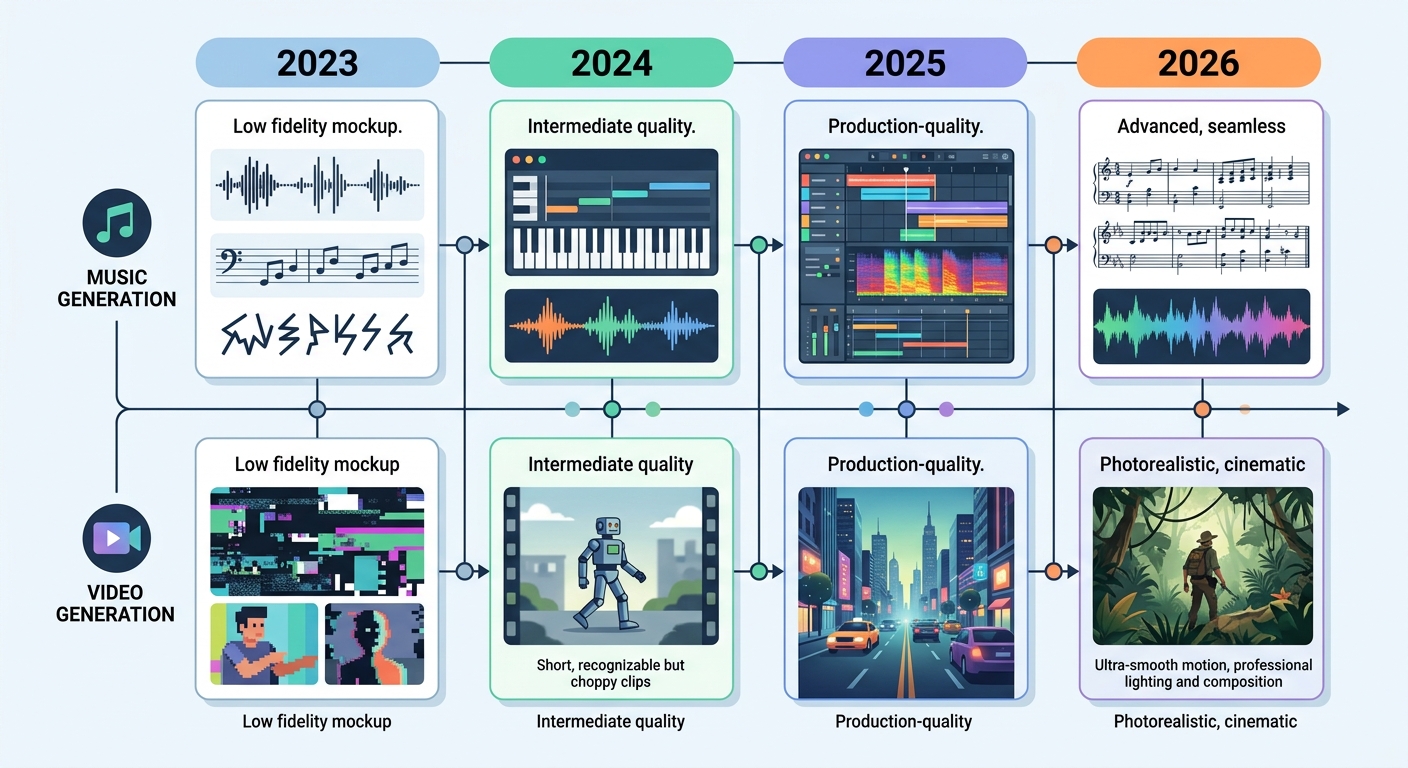
In just three years, generative AI has rewritten the rules of media production. Tools that once produced blurry, six-fingered images now generate photorealistic visuals, cinematic video, and studio-quality music.
Enterprise teams are now deploying AI-generated video and music at production scale. This playbook covers platforms, workflows, ROI, and the challenges that matter.
In just three years, generative AI has rewritten the rules of media production. Tools that once produced blurry, six-fingered images now generate photorealistic visuals, cinematic video, and studio-quality music. The question for enterprise teams in 2026 is no longer whether AI media generation works. It is how to deploy it reliably, cost-effectively, and at scale.
The numbers tell the story. The global generative AI media market reached $2.8 billion in 2026. That figure is projected to climb to $21.2 billion by 2035, a compound annual growth rate of 25.2 percent. More than 15 billion AI-generated images have been created since 2022. Users create approximately 34 million new AI images every single day. AI-generated creative is expected to account for 40 percent of all digital video advertisements by the end of 2026.
These are not projections from a research lab. They are current measurements of a market that has crossed the threshold from novelty to necessity.
This playbook exists to help enterprise marketing leaders, creative directors, and technology decision-makers move from AI experimentation to production deployment. It covers the platforms that matter, the workflows that work, and the risks that deserve honest attention.
The AI Video Generation Landscape in 2026
The global AI video generator market illustrates how quickly this space is evolving. It was valued at $788.5 million in 2025. Analysts expect it to reach $946.4 million in 2026. Conservative long-range projections put the market at $3.44 billion by 2033. Some analysts project it could hit $18.6 billion when adjacent tools and platforms are included.
The competitive landscape is remarkably fragmented. According to data from fal and a16z, enterprise production deployments use a median of 14 different AI models simultaneously. This is a sharp contrast to the large language model market, where OpenAI, Gemini, and Anthropic together command 89 percent of enterprise wallet share. In generative video, no single provider dominates.
This diversity makes practical sense. No single model excels at every task. A model that produces extraordinary photorealistic images may underperform on anime aesthetics. A video model strong on physics simulation may struggle with character consistency across multiple shots. Enterprises are learning to match specific models to specific jobs.
The major platforms have each staked out distinct territory. OpenAI's Sora has gained enterprise attention for its narrative coherence and length capabilities. Runway has emerged as a revenue leader, generating approximately $300 million with a valuation of $5.3 billion. Its platform serves Hollywood studios, advertising agencies, and independent creators. Kling, a Chinese platform, has driven Asia-Pacific to a 31 percent share of the global AI video market. The Asia-Pacific region is growing at 42 percent CAGR, outpacing every other geography.
DeepMind's Veo and Seedance have also pushed quality boundaries. Seedance 1.0 topped leaderboards in June 2025. Previews of Seedance 2.0 have impressed observers with improved coherence and controllability. The pace of releases has been relentless, with significant model updates arriving every four to six weeks.
Quality has evolved dramatically. The four-second experimental clips of 2023 have given way to multi-shot narratives with persistent characters and improved physics. AI-generated creative is now embedded in real advertising campaigns, not just pilot projects.
AI Music and Audio: From Demo Quality to Studio Ready
The transformation in AI music generation has been equally striking. Suno, one of the leading platforms, grew its annual recurring revenue by 404 percent, reaching $300 million. That growth trajectory reflects a platform that moved from a curiosity to a legitimate production tool.
Udio has emerged as a competing platform focused on commercial music creation. It offers capabilities for generating background scores, advertising jingles, and personalized audio content. The competition between Suno and Udio has accelerated quality improvements across both platforms.
ElevenLabs has carved out a dominant position in voice synthesis and audio generation. The company reached an $11 billion valuation, reflecting the broad enterprise demand for high-quality voice cloning and synthetic audio. Its tools are now used in podcast production, audiobook narration, localization, and customer service applications.
The combined AI music and audio market reached $1.98 billion in 2026. That figure is climbing as enterprise adoption expands. Marketing teams use AI-generated music for campaign soundtracks without licensing fees. Podcast networks generate intro and outro music automatically. Game studios produce adaptive audio that responds to gameplay.
The quality milestone matters for enterprise adoption. In many commercial applications, AI-generated music is now indistinguishable from human-produced tracks. The ability to generate unlimited variations also creates new possibilities. Teams can produce dozens of audio options for A/B testing. They can localize music for different markets without re-recording sessions. They can generate personalized audio at scale for direct-to-consumer applications.
The economics are difficult to ignore. Traditional music production involves session fees, licensing, and revision cycles. AI music generation compresses that timeline dramatically. A campaign soundtrack that once took weeks and thousands of dollars can be produced in hours for a fraction of the cost.
The Enterprise Integration Playbook
Moving from AI experiments to production workflows is where many enterprises struggle. The gap between a compelling demo and a reliable pipeline is wider than it appears. This section outlines the playbook that successful enterprise deployments follow.
The first principle is multi-model orchestration. The median enterprise production deployment uses 14 different AI models. This is not chaos. It reflects the reality that different tasks require different tools. A single polished asset rarely comes from a single inference call. More often, it requires a pipeline: generate an image, remove the background, upscale it, recolor it, apply a brand-consistent LoRA. Each step uses a specialized model optimized for that specific task.
This pipeline approach has significant infrastructure implications. Each model in the pipeline may have a different API shape, authentication method, error handling, and asynchronous behavior. Without unified tooling, engineering teams spend more time on plumbing than product. Infrastructure providers like fal, Replicate, and modal.com have emerged to address this need. They offer unified interfaces across models, workflow primitives for chaining steps, streaming for intermediate results, and queue management for long-running jobs.
Cost optimization requires a tiered approach. Not every asset warrants the same investment in model quality. High-volume utilitarian assets like product thumbnails or feed images benefit from fast and inexpensive models. The marginal value of perfection is low when the asset will be viewed briefly and discarded. Models like Flux serve this use case well. Conversely, hero assets like ad campaign visuals or brand imagery demand premium models where small imperfections will be scrutinized. Here, paying for higher quality makes financial sense.
The data from enterprise adoption confirms these patterns. In a survey by Artificial Analysis, 58 percent of organizations identified cost optimization as their primary criterion when selecting model infrastructure. This ranked ahead of model availability and generation speed. Competition is happening at two layers simultaneously: between infrastructure providers offering cost-effective model runs, and between models along the cost-quality frontier.
Team structures are evolving in response. New roles are emerging around AI orchestration and prompt engineering. The traditional creative team now includes specialists who can build and maintain AI workflows, optimize prompt libraries, and manage the quality assurance process for generated assets. These roles did not exist three years ago.
ROI and the Business Case for Enterprise Teams
The financial case for AI media generation in enterprise settings has become compelling. Cost efficiency ranks as the top benefit of AI in advertising, cited by 64 percent of respondents in 2026 surveys. That is a practical driver, not a theoretical one.
Eighty-six percent of ad buyers are now using or planning to use generative AI for video ad creative. Nearly eight in ten plan to increase their focus on generative AI in media campaigns in 2026, compared to 62 percent in 2025. The advertising industry is moving faster than most enterprise decision-makers expected.
The productivity gains are measurable. Large language models and AI tools are projected to reduce up to 72 percent of editors' work time on repetitive tasks. That time shifts to strategic and creative work rather than disappearing. Editors spend less on mechanical revision and more on concept development, quality judgment, and campaign strategy.
Adobe Firefly provides a telling case study. The platform reached 24 billion asset generations by May 2025. It added 6 billion new generations between October 2024 and April 2025 alone. Seventy-five percent of Fortune 500 companies now use Firefly. The platform generates approximately 1.5 billion assets monthly, with 70 percent weekly active usage among registered users.
Campaign economics are being rewritten. Production cycles that once took weeks now produce hundreds of personalized variations in hours. A global campaign that required separate shoots for each market can now generate localized versions from the same core assets. The marginal cost of variation approaches zero, while the strategic value of personalization climbs.
This shift is spawning new startup categories. Companies are emerging to help enterprises optimize AI creative workflows, manage brand consistency across generated assets, and measure the performance of AI-generated content. The infrastructure layer for AI media is becoming as important as the models themselves.
Risks, Challenges, and the Honest Assessment
The enterprise adoption gap deserves attention alongside the opportunity. Only 10 percent of enterprises consider AI core to their operations in 2026. Many organizations are moving faster in ambition than in execution. The technology is ready, but the organizational readiness varies widely.
Data quality ranks as the primary barrier to adoption. It is cited by 52 percent of businesses as a key challenge. AI models are only as good as the data they are trained on and the inputs they receive. Enterprises with fragmented data systems, inconsistent brand assets, or poor metadata face significant hurdles in deploying AI media generation reliably.
Hallucination risk creates verification demands. AI models can generate content that looks plausible but contains factual errors, visual artifacts, or audio inconsistencies. The demand for quality assurance and verification work has increased accordingly. Some enterprises have added dedicated AI audit roles to catch errors before generated content reaches audiences.
Brand consistency presents a different kind of challenge. AI models trained on broad datasets may generate assets that deviate from established brand guidelines. Maintaining visual and audio identity across thousands of AI-generated variations requires careful workflow design, consistent prompt engineering, and human oversight. This is achievable but not automatic.
Intellectual property concerns remain unresolved. Training data provenance, royalty-free ambiguity, and copyright questions around AI-generated content continue to create legal uncertainty. Enterprises with strict compliance requirements face additional complexity in deploying AI media generation for customer-facing content.
Workforce impact is real and deserves acknowledgment. Automation is affecting roles in editing, transcription, content moderation, and production management. Enterprises that deploy AI media generation responsibly pair the technology transition with workforce development programs. They retrain existing employees for higher-value creative and strategic roles rather than simply reducing headcount.
Organizational change management matters as much as technology selection. Successful deployments involve cross-functional teams spanning creative, technology, legal, and compliance. The playbook for AI media integration is as much about process as it is about platforms.
What's Next: The 2026–2027 Outlook
The pace of advancement shows no sign of slowing. Model releases in 2025 arrived every four to six weeks. There is no reason to expect that cadence to ease in 2026 and beyond.
World models represent the most significant frontier. World Labs demonstrated Marble in late 2025, showing that persistent, interactive 3D environments can be generated from a single image or text prompt. DeepMind's Genie 3 pushes toward real-time video that users can explore like a game. These capabilities will transform applications in gaming, entertainment, simulation, and training autonomous systems.
Video coherence is improving rapidly. Multi-shot narrative consistency and character persistence across scenes are the key technical challenges. The progress in 2025 was substantial, and the trajectory suggests further breakthroughs in 2026. Longer-form video generation, once considered years away, is approaching practical viability.
Open-source models are closing the quality gap. Flux and Qwen Image Edit both released capabilities in 2025 that surprised observers with how quickly they matched proprietary alternatives. Enterprises increasingly prefer open-source models for production not because they are cheaper, but because they are customizable. When brand consistency, character persistence, and product fidelity across millions of generated assets matter, fine-tuning on proprietary data is not optional. It is essential.
Closed APIs generally do not support that level of customization. Open-source models give enterprises the ability to train on their own data and maintain full control over their workflows. This dynamic is shifting the competitive landscape in ways that favor enterprise flexibility over convenience.
The key watch list for 2026 includes Seedance 2.0, continued Sora development, Grok video capabilities, and further Kling advances. Each release pushes the quality frontier. Enterprises that build flexible, multi-model pipelines will be best positioned to incorporate improvements as they arrive.
Summary: Building Your AI Media Production Capability
The enterprise playbook for AI music and video generation in 2026 rests on four principles.
First, multi-model orchestration is the standard, not the exception. Plan workflows that chain specialized models together rather than relying on a single tool for every task.
Second, tier your cost-quality decisions. Use fast, inexpensive models for high-volume utilitarian assets. Reserve premium models for hero assets where quality matters most.
Third, build for flexibility. The model landscape is fragmenting, not consolidating. Infrastructure that can absorb new models as they arrive will outperform rigid single-vendor approaches.
Fourth, invest in the human layer. AI orchestration specialists, prompt engineers, and AI audit roles are essential infrastructure. The technology is ready. The organizational capability to deploy it reliably is what separates leaders from laggards.
The era of production-grade AI media generation is here. The enterprises that build the workflows, teams, and processes to use it effectively will define the next chapter of creative production.