Enterprise Generative AI Adoption 2026: Adoption Rates, ROI Data, and Implementation Challenges
After years of hype, enterprise generative AI adoption has reached a critical inflection point in 2026. Our report covers adoption rates, ROI data, and the strategic paths separating AI leaders from laggards.
After years of breathless hype, enterprise generative AI has crossed a threshold: over 70% of organizations now use it in some form. Yet fewer than a third have scaled AI beyond pilot projects, and an alarming 90–95% report little to no measurable financial return from their investments. The organizations achieving outsized ROI are deploying AI differently — with rigorous data foundations, carefully selected use cases, and governance frameworks that actually work.
This report synthesizes the state of enterprise generative AI adoption 2026: the adoption landscape, the hard ROI numbers, the barriers blocking most organizations from value, and the strategic paths separating AI leaders from the rest.
The 2026 Enterprise AI Adoption Landscape
Enterprise generative AI has reached escape velocity. According to McKinsey's State of AI survey, 88% of organizations now use AI in at least one business function — and 72% specifically use generative AI, up from just 33% two years ago. Gartner projects that over 80% of enterprises will deploy generative AI in a production environment by the end of 2026.
But raw adoption numbers obscure a troubling gap between experimentation and actual production deployment. Only about one-third of organizations have successfully scaled AI initiatives beyond pilot projects into full production across the enterprise. Just 25% of companies have moved at least 40% of their AI experiments into production environments.
Key statistic — McKinsey reports that 72% of enterprises now use generative AI, but only ~33% have scaled AI beyond pilot projects into genuine production deployment.
Geographic variation is significant. In the EU, Denmark leads enterprise AI adoption at 42.0%, followed by Finland (37.8%) and Sweden (35.0%). The EU27 average stands at 20.2%, roughly equal to the OECD firm adoption average. In the United States, adoption rates are substantially higher — driven by a tech sector that has embedded AI capabilities deep into core business workflows.
Financial services, technology, and healthcare lead by industry sector. Banks are deploying AI for fraud detection, document processing, and customer service automation. Healthcare organizations are using generative AI for clinical documentation and diagnostic support. Tech companies lead the pack, with AI woven into software development, content operations, and internal knowledge management.
The ROI Reality Check
Here's where the narrative gets uncomfortable.
Organizations claim an average return of $1.49 for every $1 invested in generative AI. Early adopters broadly report positive ROI. But these averages mask a brutal distribution: only 29% of organizations report seeing significant ROI from generative AI initiatives. For AI agents specifically, that number drops to 23%.
Worse, 90–95% of organizations report little to no measurable financial return from their AI investments. This isn't a data quality issue or a measurement lag — it's a structural problem rooted in how most enterprises approach AI deployment.
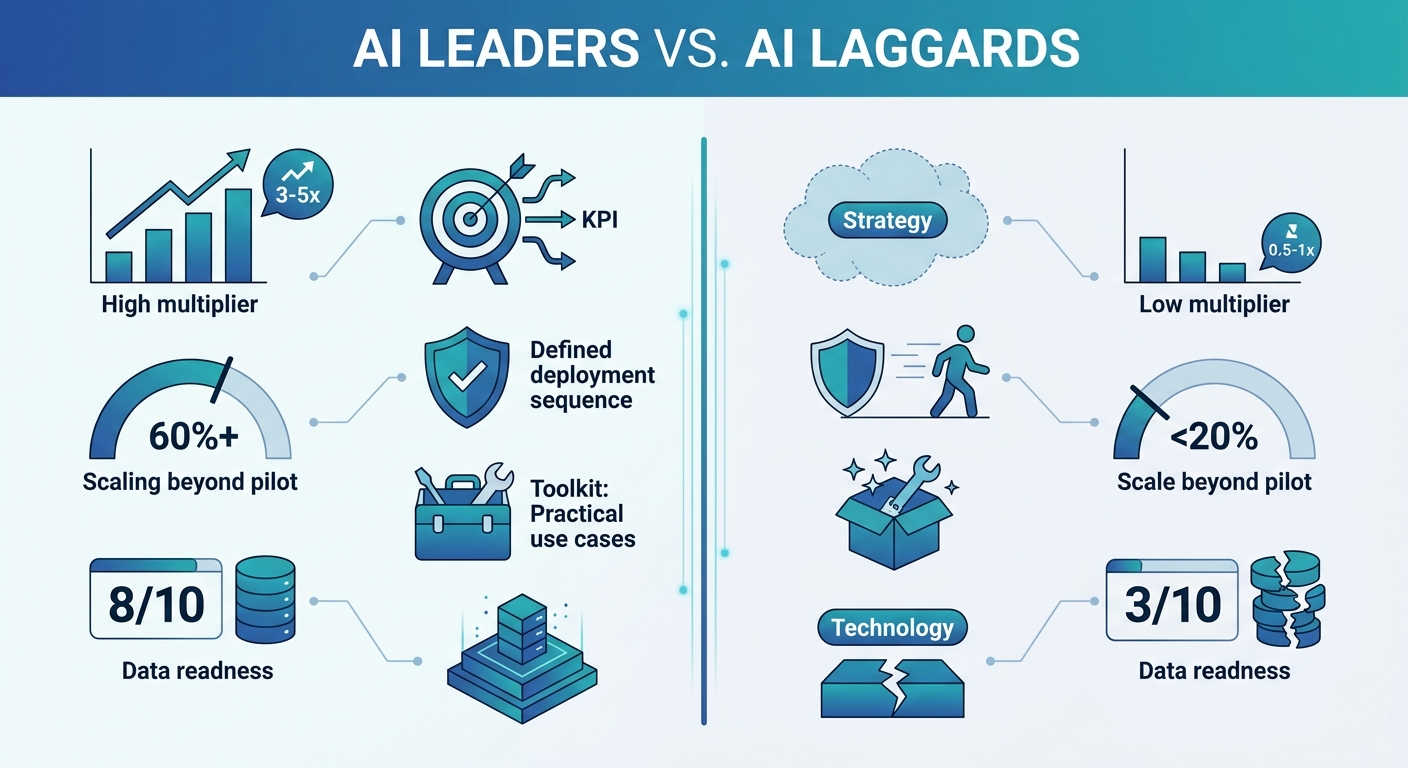
The organizations attributing significant profit to AI — roughly 6% of enterprises, widely cited across MIT Sloan, BCG, and Deloitte AI research — share a common pattern: they treat AI as a business transformation initiative, not a technology procurement exercise. They select use cases with clear ROI pathways, measure against specific financial KPIs, and invest as heavily in data infrastructure as in AI tools themselves.
Expert insight — "The organizations seeing real returns aren't deploying more AI — they're deploying it with much better judgment about where AI creates actual value versus where it creates the appearance of innovation." — Enterprise AI transformation leader
The hard numbers are compelling in specific domains. Enterprises implementing AI for repetitive workflow automation report 40–70% reductions in labor costs. Knowledge workers using AI efficiency tools show 30–60% productivity boosts. Software engineering teams using AI coding assistants ship 26–55% more code per sprint. Customer support teams resolve tickets 25–40% faster while improving satisfaction scores.
Key statistic — Generative AI is projected to contribute $2.6 to $4.4 trillion annually to the global economy (McKinsey), but this value is highly concentrated among the top 5–10% of AI-deploying enterprises.
Agentic AI: From Chatbots to Autonomous Workflows
The next inflection point is already arriving.
Agentic AI — systems that plan, execute multi-step tasks, adapt autonomously, and collaborate with other agents under human oversight — is scaling fast. In 2026, 62% of organizations are experimenting with AI agents, and 51% are already running at least one AI agent in a production environment.
Gartner forecasts that 40% of enterprise applications will embed task-specific AI agents by the end of 2026, up from under 5% in 2025. This is not a speculative trend — it's an operational shift happening now.
Use cases gaining traction include automated invoice reconciliation, meeting scheduling across complex calendars, automated customer response drafting with brand-voice consistency, and AI-assisted code review. These aren't futuristic scenarios; they're production workloads at organizations that have moved past the chatbot stage.
The shift from single-prompt interactions to agentic workflows represents a fundamental change in how AI creates value. Rather than answering questions, agents complete tasks. Rather than suggesting content, they execute processes end-to-end.
Key statistic — 51% of enterprises are now running AI agents in production, and Gartner projects 40% of enterprise apps will embed task-specific AI agents by end of 2026.
Human-in-the-loop oversight remains essential. The organizations deploying agents most effectively treat human review not as a bottleneck but as a quality control mechanism that improves agent performance over time. Agents that route uncertain decisions to humans — and learn from those handoffs — outperform fully autonomous systems in regulated industries where errors carry significant costs.
Why Most Enterprise AI Initiatives Are Stalling
Most enterprise AI programs stall not because the technology fails, but because organizations fail to prepare for it. Five interlocking barriers explain why 90–95% of enterprises see little financial return.
Data Readiness Crisis
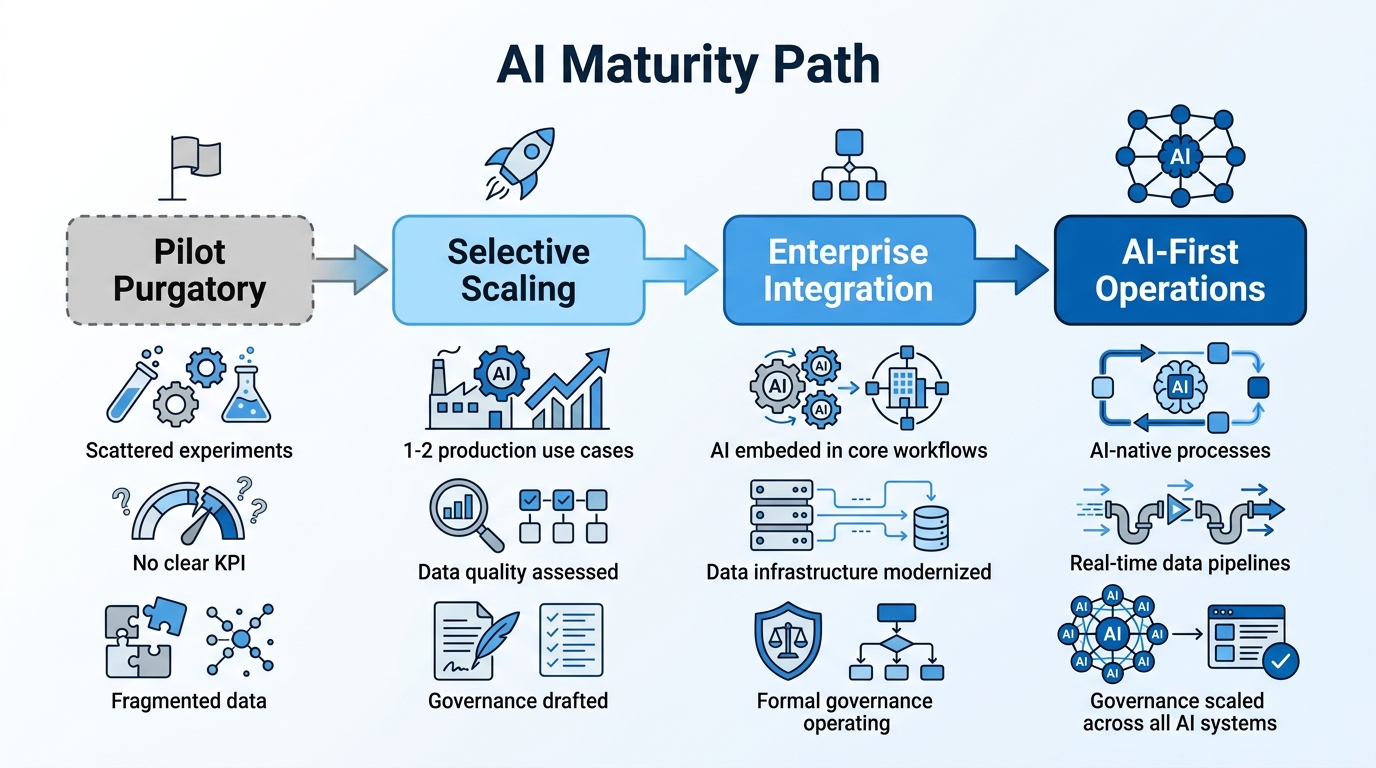
The most cited barrier — named by 40–61% of enterprises as their primary obstacle to AI scaling — is data quality and governance. Organizations invested heavily in AI tools without first fixing the data foundations those tools depend on.
Generative AI systems produce accurate outputs only when trained on reliable, well-structured data. Enterprises with siloed data stores, outdated pipelines, and inconsistent data definitions are essentially building AI systems on sand. The result: inaccurate recommendations, compliance exposure, and staff who distrust AI-driven decisions.
Strategy Without Substance
Three-quarters of executives admit their company's AI strategy is "more for show" than actual guidance. Even more striking, 39% of organizations lack a formal plan to generate revenue from AI tools.
This creates a specific failure mode: organizations spend AI budgets without a clear pathway to profit and loss impact. They deploy AI because competitors are deploying AI, or because board decks require an AI slide. The result is scattered experimentation without strategic coherence — and without measurable financial returns.
Integration with Legacy Systems
Thirty-one percent of organizations cite integration with legacy systems as a major implementation hurdle. Modern AI capabilities deployed alongside aging ERP, CRM, and ITSM platforms create technical friction that slows deployment and increases maintenance overhead.
The integration problem is often underweighted in AI strategies, which tend to focus on model capabilities rather than the enterprise systems those models must connect with.
Security and Governance Gaps
Sixty-seven percent of executives believe their company has experienced a data breach linked to unauthorized AI tools — a sobering statistic given that most AI adoption has happened outside formal IT governance.
Thirty-six percent of enterprises lack formal plans for supervising AI agents. As agentic AI deployment accelerates, this governance gap becomes a material risk: agents making decisions, executing transactions, and accessing sensitive data without defined oversight frameworks create both security and compliance exposure.
Human Resistance
Twenty-nine percent of employees admit to actively or passively "sabotaging" their company's AI strategy. This ranges from deliberate non-adoption to unconscious resistance — the reflexive skepticism of workers who see AI as a threat rather than a tool.
Change management is consistently underfunded in AI initiatives. Organizations spend millions on technology and almost nothing on the organizational work required to make that technology stick.
Key statistic — 75% of executives admit their AI strategy is "more for show" than actual guidance, while 39% have no formal plan to generate revenue from AI tools.
What AI Leaders Do Differently
The roughly 6% of organizations classified as "AI high performers" — those attributing significant profit to AI — share patterns that separate them from the AI laggards.
They tie AI directly to financial KPIs. Not generic productivity gains, but specific revenue or cost reduction targets. When an AI initiative can't be connected to a measurable business outcome, it doesn't get funded.
They fix the data foundation first. Before deploying any AI tool at scale, they invest in modernizing data pipelines, consolidating data silos, and establishing data quality standards. They spend as much on data infrastructure as on AI software.
They choose boring AI before flashy AI. The highest-ROI AI deployments are unglamorous: document processing, coding assistance, customer service automation. These use cases have clear ROI calculations, low regulatory risk, and measurable productivity gains. Organizations that start here build the experience and governance muscle to tackle more complex AI later.
They invest in change management. AI adoption fails when employees aren't brought along. Leaders allocate real resources to training, communication, and incentives that make AI adoption attractive rather than threatening.
They define governance before deploying agents. The organizations most advanced in agentic AI are also the most rigorous about supervision frameworks. They can't scale what they haven't defined — and they understand that agents operating without governance create risks that outweigh their benefits.
Expert insight — "The question isn't whether AI can create value — it clearly can. The question is whether your organization has the data, the governance, and the change management capacity to capture that value at scale." — Chief Digital Officer, Fortune 500 financial services firm
The Road Ahead: 2027 and Beyond
Several structural shifts will define the next phase of enterprise generative AI adoption.
AI is becoming built-in rather than bolt-on. Rather than standalone AI tools, generative AI capabilities are being embedded directly into enterprise software platforms — CRM, ERP, ITSM, and HR systems. This integration reduces adoption friction and makes AI-native workflows the default rather than the exception.
Context-aware AI is improving output quality. Advanced systems are blending large language model capabilities with company-specific data, historical records, real-time business signals, and defined business rules. This reduces hallucination rates and makes AI outputs more relevant and reliable for enterprise use cases.
Multimodal AI is becoming enterprise-ready. Generative AI is expanding beyond text to process and integrate images, video, audio, sensor data, and geospatial information. This enables applications like automated visual inspection in manufacturing, media analysis, and complex document understanding that combines text with embedded diagrams and tables.
Domain-specific models are reducing risk in regulated industries. Rather than relying on general-purpose large language models, enterprises are adopting specialized models trained on industry-specific data. These domain-tuned systems produce more accurate outputs in healthcare, legal, financial, and compliance contexts — reducing the hallucination risks that make regulated industries cautious about AI deployment.
Total worldwide AI spending is projected to reach $2.59 trillion in 2026, representing a 47% year-over-year increase. This level of investment reflects genuine business commitment — and will inevitably produce both significant winners and expensive lessons.
Strategic Recommendations for Enterprise Leaders
For organizations navigating the enterprise generative AI adoption 2026 landscape, five actions separate the AI leaders from the laggards.
Conduct an honest AI readiness assessment before scaling. Most organizations are years away from the data infrastructure maturity required for reliable AI at scale. An honest assessment — one that identifies gaps rather than green-lighting ambitious roadmaps — prevents expensive failures.
Start with boring, high-ROI use cases. Document processing, coding assistance, and customer service automation deliver clear returns with manageable risk. These applications build organizational experience and governance capacity that more ambitious AI initiatives require.
Allocate as much budget for data infrastructure as for AI tools. The ROI of AI tools is fundamentally constrained by the quality of the data they operate on. Organizations that invest only in AI software while neglecting data modernization are optimizing the wrong variable.
Define your AI governance framework before deploying agents. Agentic AI creates both significant value and significant risk. Governance frameworks — defining what agents can do, how they make decisions, how humans oversee their work — must be established before agents operate at scale, not retrofitted after problems emerge.
Measure what matters. Tie every AI initiative to a specific financial KPI — revenue generated, cost reduced, errors eliminated. AI programs that can't be connected to measurable business outcomes shouldn't receive continued investment.
Conclusion
Enterprise generative AI in 2026 tells a story of stark contrasts: widespread adoption alongside concentrated value, ambitious experimentation alongside sparse production scaling, enormous investment alongside meager measurable returns.
The organizations capturing real value from AI aren't deploying more tools. They're deploying AI with better judgment — grounded in data infrastructure maturity, governed by clear frameworks, focused on use cases with calculable ROI, and supported by change management investments that help employees work with AI rather than against it.
For enterprise leaders, the imperative is clear: resist the pressure to deploy AI for its own sake. Instead, build the foundations that make AI deployment actually valuable — and then deploy selectively, measure rigorously, and scale only what proves its worth.
The technology is ready. The question is whether your organization is.
This report synthesizes data from McKinsey, Gartner, Forbes, and enterprise AI research published through mid-2026. Statistics reflect reported adoption rates and survey data; individual organization results vary based on implementation quality, use case selection, and organizational readiness.
Expert Q&A
Q: We want to move beyond pilot projects. What's the most common mistake enterprises make when trying to scale generative AI?
A: The most common mistake is treating scaling as a technology problem when it's actually a data and organizational problem. Enterprises procure AI platforms, deploy them broadly, and then discover that the AI outputs are unreliable because the underlying data is siloed, inconsistent, or outdated. Scaling AI requires investing as heavily in data pipeline modernization, data quality governance, and integration architecture as in the AI tools themselves. The organizations that scale successfully typically spend 12–18 months on data foundation work before deploying AI at scale.
Q: Our AI agents are making decisions autonomously, but we don't have a formal governance framework. What's the minimum viable governance structure for agentic AI?
A: At minimum, you need three elements: (1) a decision taxonomy that categorizes agent decisions by risk level — what can agents decide autonomously, what requires human review, what must be escalated; (2) audit logging for every agent decision, including the inputs, the reasoning path, and the outcome; and (3) a human review process for high-risk decisions that includes both approval authority and feedback loops that improve agent performance over time. Many enterprises implement these as tiered autonomy levels — low-risk, medium-risk, and high-risk — with different oversight requirements at each tier.
Q: The 90–95% figure for enterprises seeing little ROI is alarming. Are some industries or company sizes more likely to see real returns?
A: The ROI concentration is real, but the pattern isn't primarily industry-driven — it's infrastructure and strategy-driven. Companies seeing strong ROI typically share three characteristics: mature data infrastructure (not just AI infrastructure), AI initiatives tied to specific measurable business KPIs (not generic "efficiency"), and executive sponsorship that extends to change management. Company size matters indirectly: larger enterprises have more data to work with and can spread implementation costs across more use cases. But a mid-size company with clean data and a focused use case can outperform a large enterprise with massive AI spending and fragmented data.
Q: How should enterprises think about AI ROI measurement? We're struggling to attribute business outcomes to specific AI initiatives.
A: Attribution difficulty is a real problem, and it's partly self-inflicted. Enterprises often measure AI success by activity metrics — prompts processed, tasks completed, user adoption rates — rather than business outcome metrics. The organizations with the clearest ROI stories started with the business outcome and worked backward: what do we want AI to accomplish, what KPI does that map to, and how will we measure it? They also tend to run controlled experiments — AI-enabled workflows versus control groups — which most enterprises don't do because they require more upfront design work. If you can't attribute outcomes to AI, you probably haven't defined the outcome clearly enough.
Q: What should we look for in a domain-specific AI model versus a general-purpose LLM for regulated industry use cases?
A: The key advantage of domain-specific models is reduced hallucination rates on industry vocabulary and compliance-relevant content. When a model has been trained or fine-tuned on medical literature, legal contracts, or financial reports, it produces more accurate outputs in those domains without requiring extensive prompt engineering. The practical evaluation criteria are: (1) accuracy on domain-specific benchmarks versus general-purpose models; (2) transparency about training data provenance — regulated industries need to know what the model learned from; (3) update cadence for domain knowledge; and (4) audit trail capabilities for regulatory compliance. For highly regulated decisions (credit, medical, legal), many enterprises still require human-in-the-loop validation even with domain-specific models.
FAQ
Q: What percentage of enterprises have adopted generative AI in 2026? A: According to McKinsey's State of AI survey, 72% of enterprises specifically use generative AI — up from 33% two years ago. Gartner projects over 80% will deploy generative AI in production by year-end 2026.
Q: What is the average ROI of generative AI in enterprise settings? A: Organizations claim an average of $1.49 return per $1 invested. However, only 29% report significant ROI from generative AI, and 90–95% report little to no measurable financial return — highlighting a massive distribution gap between AI leaders and the majority.
Q: What are the top challenges in enterprise AI implementation? A: The top five barriers are: (1) poor data quality and governance (40–61% cite this as primary), (2) AI strategy lacking substance (75% of executives describe their strategy as cosmetic), (3) legacy system integration (31%), (4) security and governance gaps (67% report data breaches linked to unauthorized AI), and (5) employee resistance (29% admit to undermining AI initiatives).
Q: Which industries lead in generative AI adoption? A: Financial services, technology, and healthcare lead by sector. By country, Denmark (42%), Finland (37.8%), and Sweden (35%) lead in the EU. US adoption rates are substantially higher, driven by the technology sector's deep integration of AI across operations.
Q: What is agentic AI and why does it matter for enterprises in 2026? A: Agentic AI refers to systems that autonomously plan and execute multi-step tasks rather than responding to single prompts. In 2026, 51% of enterprises run AI agents in production, and Gartner projects 40% of enterprise applications will embed task-specific agents by year-end — making agent governance a critical enterprise priority.