LLM Gateway Patterns in 2026: Routing, Rate Limiting, and Cost Governance at Scale
A practical guide to LLM gateway architecture covering intelligent routing, token-aware rate limiting, hierarchical cost governance, EU AI Act compliance, and a 2026 comparison of open-source options including Bifrost, LiteLLM, and Portkey.
What Is an LLM Gateway?
An LLM gateway is a centralized control plane that sits between your applications and the language model providers you use — whether those are OpenAI, Anthropic, self-hosted Llama, or any other vendor. Instead of each service managing its own API keys, retry logic, and cost tracking, the gateway handles all of that in one place.
Think of it like a nightclub bouncer. Every request must pass through the gateway. The bouncer checks your credentials. It makes sure you are not too rowdy. It keeps track of how long you have been inside. It can redirect you to a different VIP area if the main floor is full.
In 2026, three forces have made LLM gateways non-negotiable. First, AI agents are now chaining dozens or hundreds of model calls per workflow. A single user action might trigger a cascade of reasoning, retrieval, and synthesis steps. Second, the EU AI Act took full effect on August 2, 2026, introducing mandatory governance requirements for AI systems deployed in Europe. Third, AI inference has become a top-three cloud cost line item for most engineering organizations. When a single product can generate tens of thousands of dollars in daily API bills, the lack of centralized control becomes untenable.
A gateway gives you four things at once. Unified API access means your application code talks to one interface regardless of which provider powers it. Security enforcement means API keys stay hidden, PII gets filtered, and RBAC policies apply everywhere. Observability means you know exactly which team, user, or feature generated every token of usage. Cost control means you can set budgets, enforce limits, and route requests to the most cost-effective model for each task.
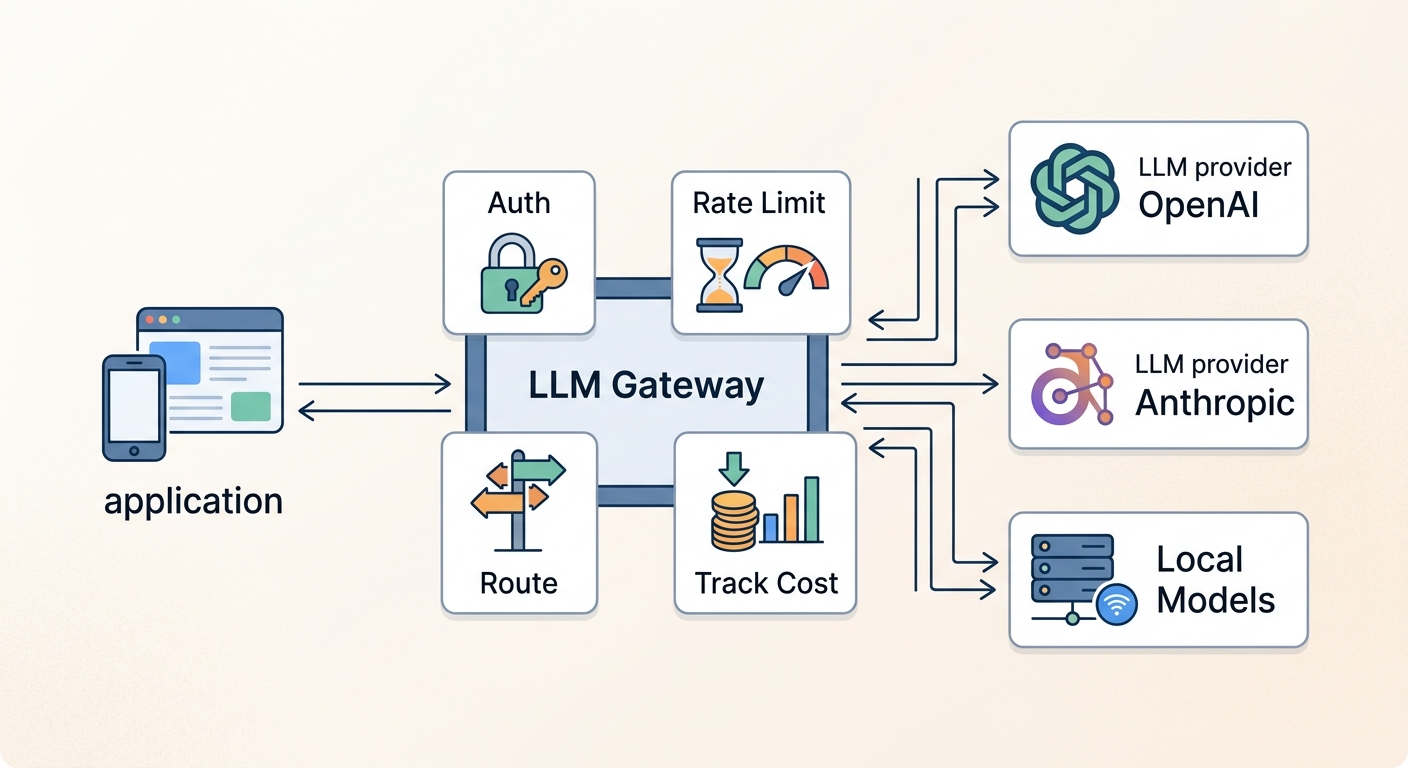
The term LLM gateway has largely replaced earlier names like "AI proxy" or "model router" because the function has expanded beyond simple routing. Modern gateways manage governance, compliance, and cost attribution — not just traffic distribution. This shift reflects how enterprise AI usage has matured from experimental pilots to production workloads generating real spend.
Routing — Sending the Right Request to the Right Model
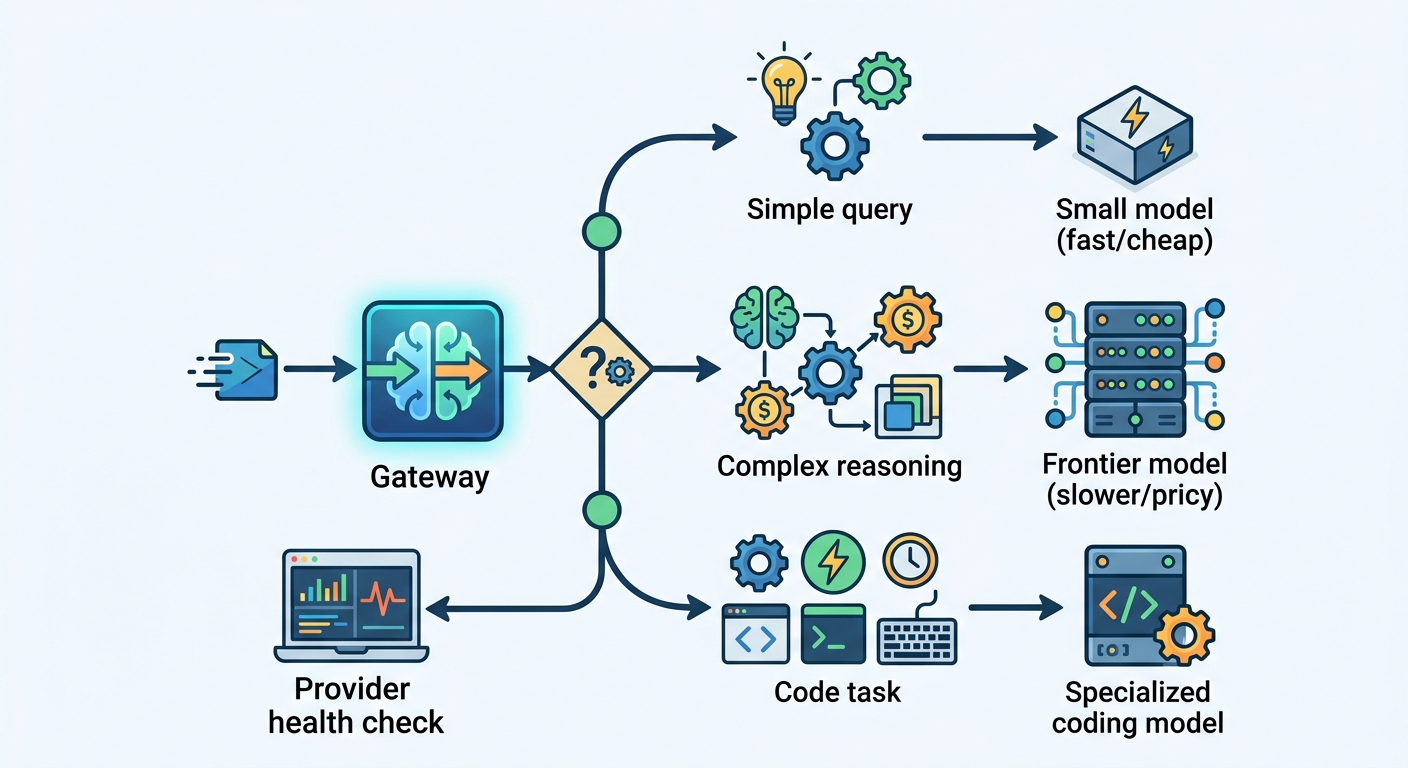
Routing is where LLM gateways earn their keep. Routing is the logic that decides which model handles which request. In 2026, four patterns dominate production deployments.
Capability-based routing assigns specific tasks to specialized models. Code generation goes to a coding-focused model. Simple classification goes to a cheap, fast model. The gateway classifies each request and dispatches it to the best-fit model for that job. A request that reads "classify this support ticket as billing, shipping, or general" is a straightforward classification task. A request that reads "design a REST API for a multiplayer game with 50,000 concurrent users" is a complex design task. Different models, different costs.
Complexity-based routing is where the real cost savings live. A short factual question might need only a small, inexpensive model. A multi-step reasoning problem needs a frontier model. The gateway estimates the cognitive load of the request — often by analyzing the prompt length, structure, and keywords — and routes accordingly.
Research from RouteLLM, published at ICLR 2025, demonstrated that complexity-based routing reduces AI inference costs by up to 85% while maintaining approximately 95% of the quality of frontier models on standard benchmarks. In enterprise settings with mixed workloads, realistic savings typically fall in the 50–70% range. A $0.50 request to a frontier model becomes a $0.002 request to a small model when the gateway correctly identifies that the question is simple. This is the core mechanism behind effective LLM cost governance.
Intent-aware routing detects what the user is trying to accomplish. Customer support queries route differently than code review requests. Marketing copy generation routes differently than data analysis. This requires either a lightweight classification step or pattern matching on the prompt structure. Some teams train small classifiers on their specific intent patterns. Others rely on semantic embeddings to cluster requests and route based on historical performance data.
Health-aware and adaptive load balancing distributes traffic based on real-time provider performance. If OpenAI's API is responding slowly, the gateway shifts traffic to Anthropic. Sophisticated systems recalculate routing weights every few seconds, factoring in error rates, latency scores, and utilization. This is not simple round-robin. It is a feedback loop that keeps applications running even when providers stumble.
Adaptive load balancing works by continuously sampling provider health. Every few seconds, a well-configured gateway fires a lightweight probe request to each provider. It measures response time and error rate. It combines these into a health score. Requests then route proportionally to that score. When a provider's score drops, its share of traffic drops automatically. When it recovers, traffic flows back. The result is an auto-healing system that requires no human intervention during provider incidents.
The alternative to adaptive routing is static weighted round-robin. You set weights upfront and the gateway distributes requests accordingly. Static weights are simple. They are also brittle. A provider that degrades but does not fail completely will continue receiving its full weighted share. Your users feel the slowdown even though technically nothing broke. For production systems handling real user traffic, adaptive load balancing is the practical minimum.
Rate Limiting — Taming the Token Beast
Traditional API rate limiting counts requests per second or per minute. LLM APIs do not work that way. The resource that matters is tokens, not requests. A single request with a large context window can consume as many tokens as dozens of short queries. A 128,000-token prompt to a frontier model costs roughly the same as 1,000 typical conversational exchanges. Counting requests tells you almost nothing about actual resource usage.
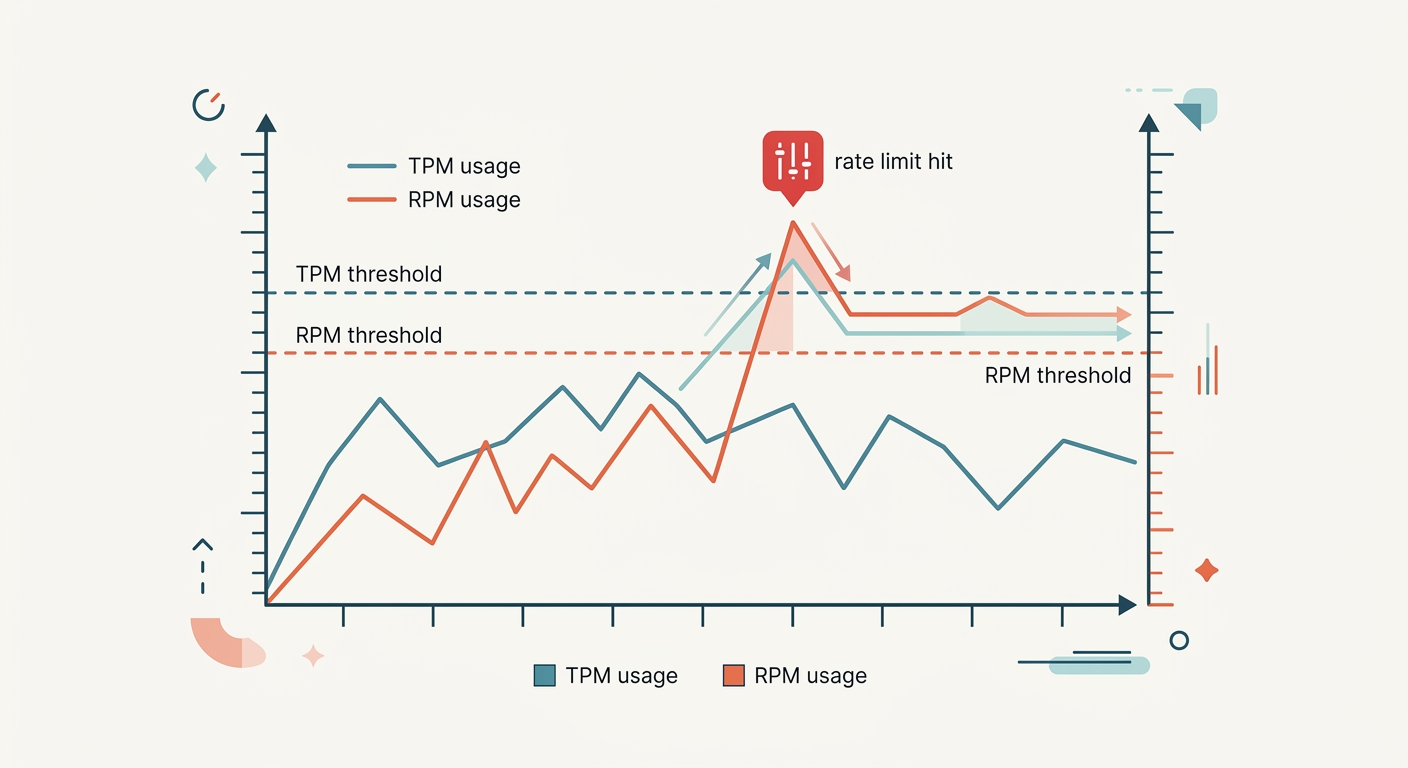
Token-per-minute (TPM) limits cap the volume of prompt and completion tokens flowing through a key or endpoint within a rolling time window. This is the most important rate limit for LLM APIs because it directly maps to cost and compute. Every major provider — OpenAI, Anthropic, Google — sets TPM limits on their accounts. A gateway enforces these at a more granular level — per team, per application, per user — inside your organization. Without gateway-level TPM enforcement, one team can exhaust the shared provider account limit and block every other team.
Request-per-minute (RPM) limits still matter for protecting against burst traffic. A misconfigured client that spins up aggressive parallel requests can saturate a provider connection even if each request is small. RPM limits catch this. Combined with TPM, they provide defense in depth. TPM limits catch the large-request problem. RPM limits catch the burst-request problem. You need both.
Cost-based limits and budget caps set a ceiling on total spend. A daily budget cap stops a runaway batch job from burning through a month's allocation in an hour. Budget caps are enforced at the gateway level. They are provider-agnostic. Whether you are spending on OpenAI, Anthropic, or a self-hosted model, the budget cap gives you a single dial to turn. When the cap hits, the gateway queues or rejects requests. No surprises on the monthly bill.
Tiered rate limiting applies different limits to different classes of users. Free-tier users get 100 TPM. Paid users get 10,000 TPM. Internal platform services get unlimited TPM with a budget alert at $1,000 per day. Tiered limits protect the system from external abuse and internal misconfiguration. A compromised API key for a free-tier integration cannot take down your production traffic. The gateway enforces the tier boundary before the request ever reaches the provider.
The critical insight is that TPM and RPM limits interact in complex ways. A single large request might hit TPM but not RPM. A flood of small requests might hit RPM but not TPM. A well-configured gateway monitors both and shows operators which limit is actually constraining them at any given moment. Without that visibility, teams spend hours debugging apparent outages that are really just one limit being hit. This is a common pain point in rate limiting LLM deployments that most tutorials ignore.
Cost Governance — From Cost Center to Controllable Line Item
When AI requests are scattered across dozens of services, each with its own API keys and provider accounts, cost visibility is nonexistent. Your finance team sees a line item that says "AI services" and a number that changes every month for reasons no one can explain. An LLM gateway changes that.
Token budget hierarchies let you set limits at multiple levels. A global budget is a hard ceiling for the entire organization. Team or product budgets allocate spend to specific features or departments. User or tenant budgets control per-customer spend in multi-tenant applications. Request-level limits cap the tokens in any single API call. Hierarchical budgets mean you can be generous at the organizational level while still containing blast radius at the team level. One team's experiment does not consume the entire company's AI budget.
Real-time tracking is the foundation of effective LLM gateway cost governance. Modern gateways track token consumption per request and aggregate it in real time. When a request completes, the provider response includes token counts — prompt tokens, completion tokens, total. The gateway logs these and updates running totals against each budget. When a budget hits 80%, operators get an alert. When it hits 100%, the gateway rejects new requests. This is not a batch process that runs overnight. It is a live dashboard that reflects what is happening right now.
Context compaction is a technique for staying within budget without degrading quality. As a conversation grows, its context window fills up. Context window size is a direct cost driver — a 128,000-token conversation costs roughly 16 times more than an 8,000-token conversation. A gateway can automatically summarize or truncate older conversation turns to keep token usage within budget. This is especially important for long-running agents that accumulate thousands of tokens of history.
Semantic caching goes beyond simple response caching. A basic cache stores exact matches. A semantic cache stores responses and, on a new request, retrieves not just exact matches but semantically similar prior responses. If two users ask "how do I reset my password" in different wording, the cached answer serves both. No token cost. No provider call. Semantic caching typically reduces redundant API calls by 20–40% in production workloads with high rates of similar queries. This is particularly valuable for customer support, FAQ systems, and documentation chatbots where query patterns repeat frequently.
Attribution and chargeback complete the governance loop. Granular logs that tie token consumption to teams, features, and users enable engineering leaders to have honest conversations about AI spend. If the marketing team's AI-powered copywriting tool accounts for 40% of the monthly bill, that is a conversation worth having. Chargeback reports that attribute cost to the team generating it create accountability without requiring manual tracking.
Ready to bring this level of control to your organization? Algorithmine provides production-ready LLM gateway infrastructure with built-in routing, rate limiting, hierarchical budgets, and real-time cost attribution. Get started at algorithmine.com.
Security and Compliance — The EU AI Act Is Here
The EU AI Act took full effect on August 2, 2026. For organizations operating in or serving the European market, it introduces mandatory governance requirements for AI systems. These include who can access AI models, what data leaves the system, and what gets logged for audit purposes.
Triple-gate architecture is emerging as a best-practice pattern for enterprise AI governance. It separates three distinct control points. The AI Gateway validates prompts and enforces usage policies. The MCP Tool Gateway controls what tools and external data sources an AI agent can call. This is also called Task-Based Access Control. The API Gateway protects backend services from AI-driven traffic. Separating these concerns means each layer can be audited, updated, and scaled independently. This architectural pattern directly addresses the risk management and human oversight requirements specified in the EU AI Act.
PII filtering and data residency are technically distinct but operationally related. A gateway can detect and mask personally identifiable information before prompts leave your infrastructure. It can route sensitive requests to region-specific providers that guarantee data residency. This matters for GDPR compliance under the EU AI Act. A prompt that contains a person's name, address, or national ID number should not leave an EU data center. A properly configured gateway enforces this automatically.
Role-based access control and virtual keys let you issue scoped, revocable credentials to teams and services. A virtual key might give a customer support team access only to certain models. It might cap their TPM at a fixed budget. It might block data export entirely. If the key is compromised, revoke it in seconds. The underlying provider API key is never exposed. This is a meaningful security improvement over sharing raw provider API keys across services, and it directly supports the access control requirements under the EU AI Act's governance framework.
Audit logging captures every AI interaction. Prompt, model, tokens, latency, cost, user — all of it. For compliance and incident response, this is not optional. When a regulator asks what data left your system last quarter, you need to answer. A gateway that does not log comprehensively fails basic compliance requirements. Audit logs also help with debugging. When a team reports that their AI feature is behaving strangely, detailed logs make root cause analysis possible.
Open-Source LLM Gateways — 2026 Landscape
The open-source LLM gateway ecosystem has matured significantly. Four platforms stand out in 2026.
Bifrost is a Go-based gateway built for performance. Benchmark data from Maxim AI shows 11 microseconds of gateway overhead per request at 5,000 requests per second on a t3.xlarge instance. That is the lowest latency in this comparison. Bifrost maintains a 100% request success rate at that throughput. It is Apache 2.0 licensed and deploys as a Docker image in any Kubernetes cluster. Bifrost supports over 20 LLM providers through a unified OpenAI-compatible API. Key features include semantic caching, virtual keys, and hierarchical budget control. If raw performance is the primary concern, Bifrost delivers.
LiteLLM is the most widely adopted open-source gateway. It has an MIT license and a Python foundation that makes it easy to extend and customize. It connects to over 100 LLM providers. LiteLLM is a common choice for teams already running Python-heavy infrastructure. The trade-off is that Python-based architecture introduces latency at high request volumes. Python's Global Interpreter Lock limits true parallelism in CPU-bound workloads. This is acceptable for many use cases. It becomes a problem at very high scale. LiteLLM's commercial tier adds SSO, advanced governance, and dedicated support.
Portkey differentiates on enterprise features. Its unified gateway went fully open source on March 24, 2026, enabling self-hosted and air-gapped deployments for enterprise customers. Portkey's gateway processes over a trillion tokens and millions of AI requests daily across its managed infrastructure. It supports over 250 models and integrates deeply with LangChain. Portkey offers advanced prompt management, guardrails for PII detection and content filtering, and an MCP client. Portkey's strength is the breadth of its observability stack. If you need to debug a complex prompt pipeline, Portkey gives you the most context.
Kong AI Gateway extends the mature Kong API Gateway with AI-specific plugins. If your organization is already running Kong in Kubernetes, the AI Gateway slots in naturally. You manage AI traffic alongside traditional API traffic under a single control plane. Kong's strength is its integration ecosystem. If you need to combine AI routing with existing Kong plugins for auth, logging, or transformation, the integration already exists. Kong's gateway is written in Go and offers low overhead at high throughput.
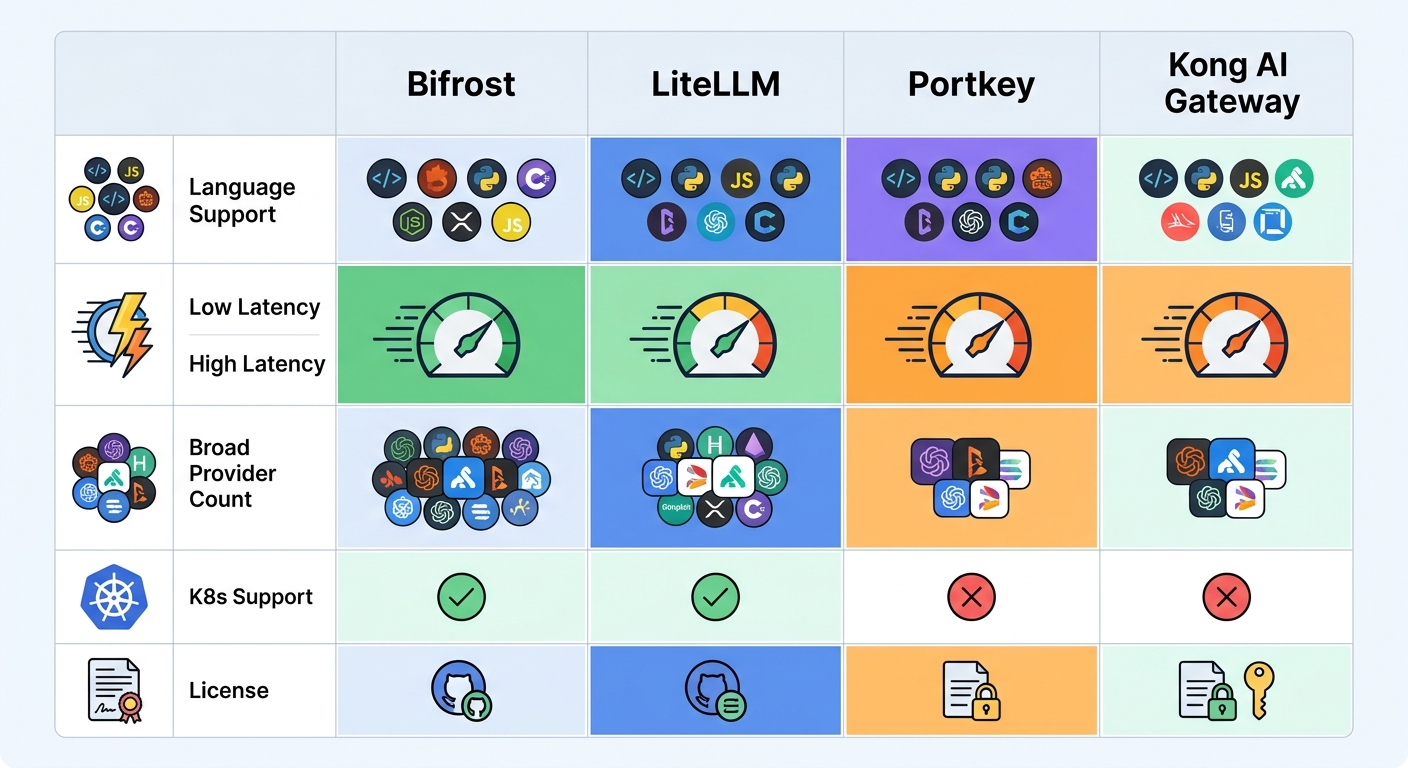
Go-based gateways outperform Python-based ones at high request volumes. This is not controversial. The performance gap is measurable and consistent across benchmarks. Python-based gateways offer easier customization and a lower barrier to entry for Python developers. The choice depends on your scale requirements and team expertise. For most teams under 10,000 requests per minute, LiteLLM's Python flexibility is the right trade-off. For teams at 50,000 requests per minute or more, Go-based Bifrost or Kong becomes the practical choice.
March 2026 was an inflection point. Both Portkey and Tyk AI Studio announced open-source releases in that month. This shifted the competitive dynamics of the enterprise AI gateway market. Organizations that were evaluating commercial-only platforms gained viable open-source alternatives. The gap between open-source and commercial feature sets has narrowed considerably in 2026.
Conclusion
LLM gateways have evolved from nice-to-have proxies to essential infrastructure. In 2026, with AI agents chaining thousands of calls per day, inference costs rivaling compute and storage, and the EU AI Act enforcing governance requirements, a centralized gateway is the only practical way to maintain control.
The core value proposition is straightforward. Route smarter, limit tighter, spend less, audit everything. Capability-based and complexity-based routing deliver 40–85% cost reductions by matching requests to the right model. Token-aware rate limiting and hierarchical budgets prevent bill shock. RBAC, virtual keys, and audit logging satisfy compliance requirements. A unified OpenAI-compatible API means you are not locked into any single provider.
Whether you choose Bifrost for raw performance, LiteLLM for flexibility, or Portkey for enterprise observability, the fundamentals are the same. Deploy a gateway. Establish routing and limit policies. Enable observability. Treat AI as a governed, measurable service — not a wild-card expense. The teams that do this in 2026 will have a competitive advantage. Those that do not will keep writing checks they cannot explain and audits they cannot pass.
Expert Q&A
Q: We already have an API gateway. Do we really need a separate LLM gateway?
Yes, in most production scenarios. Traditional API gateways manage HTTP traffic, authentication, and rate limiting for REST endpoints. LLM gateways understand the semantics of AI requests. They can route based on task complexity, enforce token-per-minute limits, attribute costs to teams or features, and apply model-specific policies. A traditional gateway sees an LLM request as an opaque HTTP POST. An LLM gateway understands that a 128,000-token prompt is different from a 200-token prompt and needs different handling. If you are running AI workloads at scale, a dedicated LLM gateway is worth the operational overhead.
Q: How do we choose between TPM-based and RPM-based rate limits for our use case?
Use both, but prioritize TPM. TPM is the primary limit for LLM APIs because token volume directly maps to cost and compute. RPM is secondary — it catches burst traffic and misconfigured clients but does not protect against a single large request consuming your entire budget. A common mistake is setting RPM limits that are generous but leaving TPM limits at provider defaults. When a team sends a large batch of short requests, they hit RPM. When they send a small batch of long-context requests, they hit TPM. Monitoring which limit fires more often tells you whether your limit configuration matches your actual traffic patterns.
Q: Complexity-based routing sounds great in theory. How does it work in practice?
In practice, complexity-based routing uses a lightweight classifier to estimate the cognitive difficulty of each request. This classifier runs locally within the gateway and adds negligible latency. It is trained on your specific request patterns — or it uses general-purpose heuristics like prompt length, presence of reasoning keywords, and structural complexity signals. When a request arrives, the classifier assigns it a complexity score. The gateway then routes requests below a threshold to a small, cheap model and requests above it to a frontier model. The threshold is tunable. A lower threshold routes more requests to expensive models — higher quality, higher cost. A higher threshold routes more to cheap models — lower cost, acceptable quality for simpler tasks. The right threshold depends on your quality requirements and cost targets.
Q: The EU AI Act is a real concern for us. What is the minimum audit logging a compliant gateway needs to capture?
The EU AI Act requires documentation sufficient to demonstrate compliance with risk management and oversight requirements. At minimum, you need logs that capture: the prompt and its timestamp, the model that handled it, the user or service identity that made the request, the token count and cost, and the response. These logs need to be tamper-resistant and retained for a defined period. The exact retention period depends on your classification under the Act. High-risk AI systems have longer retention requirements than lower-risk ones. A gateway that only logs metadata without the actual prompt content is insufficient for most compliance scenarios.
Q: We are running at about 8,000 requests per minute. Should we pick a Go-based or Python-based gateway?
At 8,000 requests per minute, both categories are viable. The Python performance ceiling becomes a real problem at 20,000–50,000 requests per minute and above. At your current scale, Python-based LiteLLM works and gives you easier customization and faster iteration on routing logic. The key question is where you expect to be in 12 months. If your traffic is growing fast, choosing a Go-based gateway like Bifrost now avoids a migration later. If your traffic is stable and your team is Python-fluent, LiteLLM is the pragmatic choice. Profile your actual p99 latency under load before deciding — the theoretical debate matters less than your observed performance numbers.
Q: Our team is evaluating Portkey versus LiteLLM. What is the practical difference in day-to-day operations?
Day-to-day, the difference is in debugging depth. LiteLLM is a proxy layer that translates requests to provider APIs. It is transparent and debuggable but gives you raw provider responses. Portkey wraps its gateway in an observability layer that adds trace context, prompt versioning, and guardrail enforcement. When something goes wrong in LiteLLM, you see the raw error from the provider. When something goes wrong in Portkey, you see a structured trace that includes which guardrail fired, what the prompt version was, and how the routing decision was made. If observability and debugging speed are priorities, Portkey's additional layer is worth it. If you prefer minimal abstraction and your team is comfortable debugging raw provider responses, LiteLLM is lighter and simpler.
Q: Semantic caching seems like a simple win. Are there cases where it causes problems?
Yes. Semantic caching works best when the same questions get asked repeatedly — FAQs, customer support queries, documentation search. It causes problems when applied to requests that look similar but have different correct answers. If your AI generates responses that depend on recent context — stock prices, weather, personalized recommendations — semantic caching can serve stale answers that look plausible. The risk is highest in domains where accuracy matters more than consistency. Before enabling semantic caching broadly, validate it against your actual request patterns. Turn it on for specific endpoints where repetition is high and answers are stable. Keep it off for dynamic, context-dependent requests. Monitor your cache hit rate and error rate together to catch the failure mode early.