How AI Agents Are Replacing Traditional Chatbots in Enterprise Support
Enterprise support leaders are replacing rule-based chatbots with AI agents that resolve 60-80% of tickets autonomously. Here's what the migration actually involves.
The inbox never empties. For VP-level support leaders at companies with 500 or more employees, that is the persistent, grinding reality of running a modern customer support operation. Ticket volumes climb year over year. Handle times face pressure to shrink. Head count is scrutinized quarterly. And somewhere between the monthly metrics review and the next NPS survey, a quiet pressure builds: the chatbot your team deployed three years ago is now a liability your competitors have already replaced.
This is not hyperbole. It is the assessment emerging from a wave of enterprise deployments where AI agents autonomously resolve enterprise support tickets at rates that rule-based chatbots cannot approach — and at a cost structure that is forcing support leaders to fundamentally rethink their technology stacks. The question for 2026 is no longer whether AI will transform enterprise support. It is how quickly the gap between AI-powered agents and legacy chatbot platforms will become untenable for organizations that delay.
This article is a practical guide for support leaders who are evaluating that transition — not with the enthusiasm of an early adopter, but with the rigor the decision demands. We will examine what traditional chatbots actually do, why their architectural limits matter for your operation, what AI agent technology changes about resolution and cost, and how to build a credible migration roadmap if you decide to move forward. The goal is not to sell you on a technology. It is to give you enough grounded detail to make a defensible decision.
What Traditional Chatbots Actually Are — and Where They Fall Short
To understand why AI agents represent a genuine category shift — not just an incremental upgrade — you need to understand what a traditional chatbot actually is under the hood.
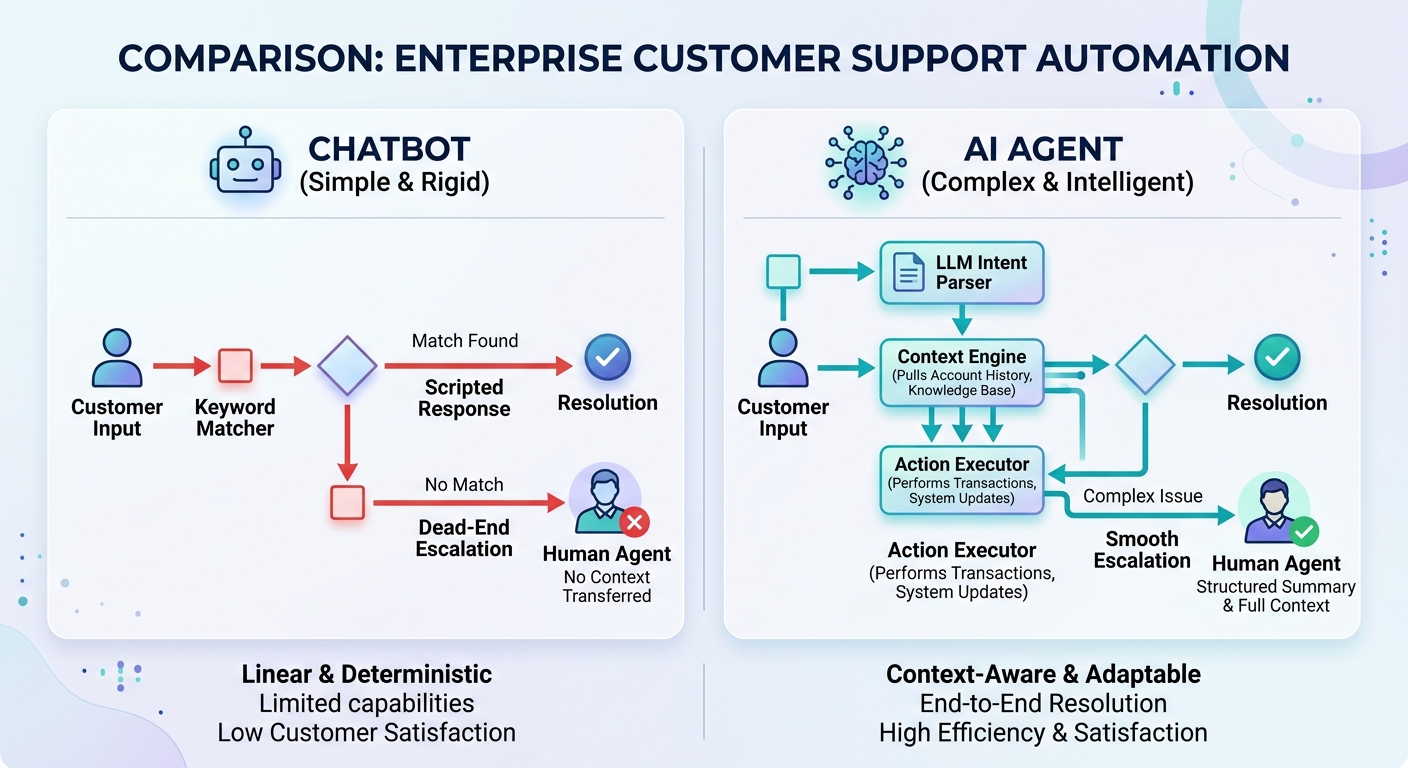
A rule-based chatbot operates on a decision tree. A customer types something, the system matches keywords or patterns against a scripted flow, and the chatbot responds with a predetermined answer or prompts the user toward a pre-defined outcome. This architecture is predictable, auditable in a limited way, and relatively cheap to deploy for a narrow set of known queries. If a customer asks "What are your business hours?" or "How do I reset my password?" a well-built rule-based bot handles it cleanly.
The problem is that customer support is not a narrow set of known queries. It is an open-ended problem space where users describe issues in their own words, with varying levels of clarity, across hundreds of topic areas, with context that may span prior interactions, account history, and product-specific nuance.
Rule-based chatbots handle scripted customer queries with reasonable accuracy only when those queries map cleanly to the scripts written for them. The moment a customer expresses the same intent in different language, or has a problem that crosses the boundaries of the scripted flow, the bot either dead-ends or hands off to a human agent. In practice, most rule-based chatbots deployed in enterprise environments handle 20–30% of total support volume without escalation. The remaining 70–80% of contacts still flow to human agents — often after a frustrating detour through a bot that failed to understand the request.
This is the core failure mode that support leaders tolerate because the alternative — a fully live-agent operation — seemed worse. But that calculus is changing.
"Most enterprise chatbots deployed in 2020–2023 are running at 20–30% automated resolution on a narrow slice of easy queries, while creating a support experience that customers actively resent." — Industry analyst research, customer service technology evaluations, 2024
Three structural weaknesses define the limits of rule-based chatbots in enterprise environments:
Fixed language boundaries. A rule-based bot matches what it has been explicitly programmed to match. Synonyms, abbreviations, typos, and non-standard phrasing all degrade match accuracy. Maintaining relevance requires constant manual retraining as customer language evolves — a costly and slow process.
No contextual memory beyond the session. A chatbot cannot reference a customer's prior tickets, product usage history, or account tier without custom integration work that most SMB-oriented platforms do not support at all, and that enterprise platforms support poorly or at significant cost.
Linear escalation, not intelligent routing. When a chatbot fails to resolve a query, it escalates to a human agent — typically by creating a ticket and sending a notification. The handoff carries little context. The agent starts from scratch, asking the customer to repeat information they already provided to the bot.
These are not implementation failures. They are architectural constraints. No amount of tuning, additional rules, or vendor optimization eliminates them. The ceiling for what a decision-tree chatbot can resolve is fundamentally bounded by the scripts its designers wrote.
Introducing AI Agents — Autonomous Support That Replaces, Not Just Augments
An AI agent is a fundamentally different architecture. Where a rule-based chatbot follows a scripted decision tree, an AI agent uses a large language model to interpret customer intent, reason about what the customer needs, take action within defined boundaries, and learn from the outcomes. The agent is not executing a flow — it is deciding what to do next, within a governed framework.
This distinction matters because it changes the resolution ceiling. When a support leader asks how much volume an AI agent can handle autonomously, the honest answer is: it depends on the complexity of the work and the clarity of the governance framework, but it is substantially higher than what a rule-based chatbot can manage. In mature enterprise deployments, AI agents are resolving 60–80% of inbound support volume without human intervention, across a wide variety of topic areas — not just password resets and business hours.
Let me be precise about what "resolving" means in this context, because vendors use it loosely. A resolved ticket is one where the customer's issue is addressed to the point where they do not reopen it, do not escalate it, and do not follow up within a defined window. That is a meaningful metric. It is different from a "deflection" metric, which may simply count tickets that were handled by a bot rather than a human — regardless of whether the customer's actual problem was solved.
AI agents autonomously resolve enterprise support tickets when they are given the tools, access, and governance framework to do the work. That means connecting to systems — ticketing platforms, knowledge bases, order management systems, product databases — so the agent can actually do something, not just say something.
Consider what that looks like operationally versus a chatbot:
A customer messages: "I was charged twice for my annual subscription and I need the extra charge refunded. I also didn't receive the welcome email you promised."
A rule-based chatbot would likely match a keyword like "refund" and route to a refund flow. It would not know about the double-charge scenario, would not be able to investigate the customer's billing history, and would almost certainly escalate — likely after the customer has repeated their full issue to the bot and then again to an agent.
An AI agent, properly integrated, would parse the full request, check the customer's billing records for duplicate charges, verify the subscription welcome email status based on account creation timestamp and email delivery logs, process the refund if authorized under the governance policy, and resend the welcome email if it was not delivered. The entire interaction completes in a single session, without escalation, with a full audit trail documenting every action taken.
That is not a theoretical example. It is a description of work that is actively happening in enterprise support operations today. The gap between that capability and what a rule-based chatbot can deliver is not a matter of degree. It is an architectural difference.
The Six Technical Differences That Matter for Enterprise Buyers
If you are evaluating AI agents for enterprise support, the marketing claims from vendors are not a reliable guide. What you need is a clear comparison of the underlying architectural differences, and what each one means for your operation's resolution rate, cost structure, and risk profile.
The following table summarizes the six technical differences that differentiate AI agents from rule-based chatbots in ways that matter for enterprise buyers.
| Capability | Rule-Based Chatbot | AI Agent |
|---|---|---|
| Intent matching | Keyword/pattern matching against scripted flows | LLM-powered natural language understanding across open-ended queries |
| Context retention | Session-scoped only; no cross-interaction memory | Access to full conversation history, account context, and prior ticket data |
| Action capability | Trigger scripted responses or route to human | Execute transactions, pull records, update systems, process refunds |
| Resolution scope | Narrow; limited to explicitly scripted topics | Broad; governed autonomy across hundreds of topic areas |
| Failure handling | Dead-end or blind escalation | Graceful degradation with structured handoff and full context transfer |
| Continuous improvement | Manual rule updates required | Learns from interaction outcomes; policy-adjusted without manual retraining |
1. Natural Language Understanding vs. Pattern Matching
Rule-based chatbots classify customer intent by matching text against pre-written patterns. The system is only as good as the patterns its designers anticipated. AI agents use large language models to interpret meaning, extract intent, and handle paraphrasing, negation, implied context, and ambiguous language — without each variation needing a separate script.
2. Stateful Context Across Interactions
AI agents maintain context within a conversation and can reference prior interactions, account history, and relevant product data. This eliminates the "please repeat your issue" failure mode that erodes customer satisfaction in chatbot deployments. It also reduces handle time for the human agents who do receive escalations, because the handoff carries full context.
3. Action-Oriented Architecture
A chatbot responds. An AI agent acts. The architectural difference is that an agent is connected to the systems it needs to modify — a ticketing platform, a knowledge base, a billing system — so it can complete tasks rather than just provide information. This is what drives the resolution rate gap. An agent that can only tell you what to do has not resolved your problem.
4. Open-Domain Resolution Scope
Rule-based chatbots scale poorly because every new topic requires a new script, tested against a new set of user phrasings. AI agents, given a governance framework and access to relevant knowledge, can handle topic areas they have not been explicitly trained on, as long as the topic falls within their defined boundaries. This is what enables the 60–80% autonomous resolution rates reported in mature deployments.
5. Governed Escalation with Structured Handoff
When an AI agent encounters something outside its scope or confidence threshold, it does not fail silently or dead-end. It escalates to a human agent with a structured summary of what it attempted, what it learned, and what it could not resolve. The human agent inherits a warm handoff rather than starting from scratch. This is a meaningful improvement in agent experience — and in the quality of the human time that remains in your operation.
6. Policy-Driven Autonomy Without Manual Retraining
AI agents operate within a governance layer that defines what they can and cannot do, what escalation thresholds apply, and how edge cases should be handled. When a policy changes — a refund limit is updated, a new product is launched, a compliance requirement shifts — the governance policy is updated, and the agent's behavior adjusts immediately. This is fundamentally different from rule-based chatbots, where every policy change requires manual rule rewriting and testing.
The Business Case — Resolution Rates, Costs, and ROI
For most enterprise support leaders, the decision to replace a chatbot or augment it with AI agents comes down to three questions: What will the resolution rate actually be? What will it cost? And how long until the investment pays back?
These are reasonable questions. They deserve rigorous answers, not vendor slide decks.
Resolution Rates: What the Data Actually Shows
The automated resolution rates you will see cited by vendors range from 50% to 90%. Those numbers are not all fabricated, but they require scrutiny. Resolution rate benchmarks vary significantly depending on:
- Industry and query type. Technical support queries with clear diagnostic paths resolve at higher rates than billing disputes or emotional customer recovery situations.
- Integration depth. An agent that can read and write to your systems resolves more than one that can only read your knowledge base.
- Governance definition. A well-scoped deployment with clear boundaries resolves more than a broad, loosely governed rollout.
- Measurement definition. Some vendors measure "resolved" as "customer did not immediately escalate." Others require no reopen within 72 hours.
Based on available enterprise deployment data from organizations that have published outcomes — including reports from Salesforce, Microsoft, and independent analyst firms — the realistic range for well-implemented AI agents in enterprise support is 55–75% autonomous resolution across mixed topic areas. That is a meaningful improvement over the 20–30% resolution typical of rule-based chatbots, and it represents the workload that consumes the most human agent time: high-volume, moderate-complexity queries.
When applied to cost impact, available research and operator-reported outcomes suggest that autonomous AI reduces enterprise support operational costs substantially in mature deployments — with multiple industry analyses citing figures in the 25–45% range for well-implemented implementations, driven by reduced per-ticket human handle time and a lower cost-per-contact for AI-handled volume. Individual results vary based on deployment scope, integration depth, and baseline operational efficiency.
"Organizations that run a structured 30-day pilot before committing to a platform have meaningfully lower implementation failure rates than those that select a vendor based on a demo or RFP response." — Industry analysis, AI agent platform evaluations, 2025–2026
Cost Breakdown
The cost of an AI agent deployment has three components that support leaders often underestimate:
Platform cost. AI agent platforms are typically priced on a per-resolution or per-seat model, similar to chatbot licensing but at a higher per-contact rate. Per-resolution pricing typically ranges from $0.25–$1.50 per resolved contact, depending on complexity, integration depth, and vendor. For an organization handling 50,000 support contacts per month, that translates to $12,500–$75,000 per month in platform costs.
Integration cost. The first major deployment requires integration work: connecting the agent to your ticketing system, CRM, knowledge base, and whatever product or order databases it needs to act on. For a mid-sized enterprise, this typically runs $50,000–$200,000 in professional services, depending on the number of systems and the complexity of the data model. This is a one-time or infrequent cost for subsequent topic expansions.
Human oversight and governance cost. AI agents require ongoing governance: policy updates, performance monitoring, exception review, and regular calibration. Expect to dedicate 0.5–1.0 FTE of a support operations role to agent governance in the first year, declining to 0.25–0.5 FTE as governance processes mature.
ROI Timeline
A realistic ROI model for an enterprise AI agent deployment looks like this:
For a 500-person company with 50,000 monthly contacts, average handle time of 12 minutes, and fully-loaded human agent cost of $28/hour:
- Current monthly human-agent cost: ~$280,000 (labor for contact handling)
- AI agent handling 60% of volume at $0.60/contact: ~$18,000/month in platform + governance
- Net reduction in human handle time: ~50–54% in year one, accounting for AI resolution of 60% of volume and remaining governance overhead
- Breakeven: typically 8–14 months, depending on integration cost and human agent cost structure
The more sophisticated your human agent operation — the higher your handle time and per-contact cost — the more favorable the ROI. For global enterprises with multilingual support operations, the economics improve further, since AI agents handle multiple languages at marginal additional cost.
Note: Earlier in the article a 60–80% autonomous resolution rate range was described as a capability ceiling for well-integrated deployments, while the 55–75% range cited in the business case reflects what organizations have actually measured in published enterprise deployments. Vendors citing 85–90% resolution rates are typically measuring "no immediate escalation," not "no reopen within 72 hours." These definitional differences matter significantly when evaluating vendor claims.
The Enterprise Migration Playbook — From Chatbot to AI Agent
Migrating from a rule-based chatbot to an AI agent is not a rip-and-replace event. It is a staged process that requires careful planning, phased rollout, and governance infrastructure that most organizations do not have in place when they start.
If you are beginning this evaluation, the following playbook reflects the approach that has worked for enterprise deployments that have gone live successfully. It is not the only valid approach, but it is the one most likely to avoid the failure modes that derail these projects.
Phase 1: Audit and Scope (4–6 Weeks)
Before you select a vendor or design an architecture, understand what you currently have and what you actually need.
Inventory your current chatbot flows. Document every scripted flow, decision tree, and rule set in your existing chatbot. Categorize them by volume, resolution rate, and complexity. This sounds tedious, but it is the foundation for the migration scope.
Identify high-value migration targets. Not every chatbot flow is worth migrating immediately. Prioritize flows that have high volume, low complexity, and measurable failure rates. These are your pilot candidates — the areas where AI agent autonomy will show the clearest ROI.
Establish baseline metrics. Measure your current resolution rate, average handle time, customer satisfaction score for chatbot-handled contacts, and escalation rate by topic. You cannot demonstrate ROI without a baseline.
Phase 2: Governance Framework Design (3–4 Weeks, Concurrent with Vendor Selection)
This is the phase most organizations underinvest in, and it is the primary cause of deployment failures. An AI agent without a well-designed governance framework is not a productivity tool — it is a risk.
Define autonomy boundaries. What actions can the agent take without human approval? What actions require human review? What topics are completely out of scope? These decisions should be made by a cross-functional team including support operations, legal, compliance, and IT security — not by the vendor's implementation team alone.
Establish escalation protocols. When the agent encounters something outside its scope, what happens? Define the handoff format, the notification process, and the human agent's role. Structured handoff is what separates a useful escalation from a frustrating one.
Design the audit trail schema. AI agent audit trail customer support accountability requires that every action an agent takes — every record read, every update made, every escalation triggered — is logged with a timestamp, the reasoning that drove the decision, and the outcome. This is non-negotiable for regulated industries and strongly advisable for everyone else.
Phase 3: Vendor Selection and Proof of Concept (6–10 Weeks)
Run a structured evaluation. Select two or three platforms that meet your integration requirements and governance needs. Run a focused pilot — typically 2–4 weeks — on one high-volume, bounded topic area. Measure resolution rate, customer satisfaction, and escalation rate against your baseline.
Do not select a vendor based on capability demos alone. Require a proof of concept using your actual data, your actual systems, and your actual customer query patterns. Demos are scripted. A POC is real.
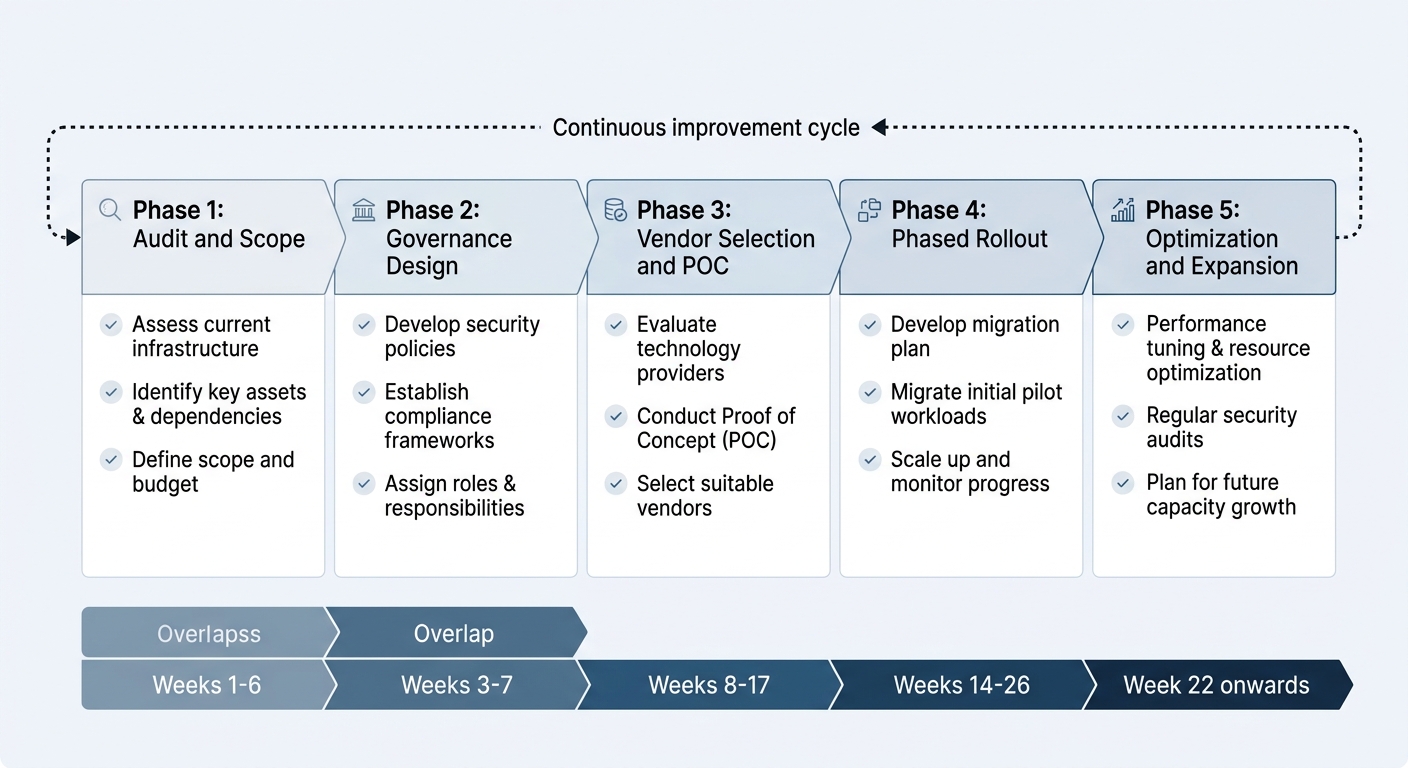
Phase 4: Phased Rollout (12–20 Weeks)
Do not go live across all topics simultaneously. Roll out by topic area, starting with the highest volume and most bounded use cases, and expanding based on measured performance.
For each new topic area:
- Define the governance policy for that topic
- Connect the agent to the relevant systems and knowledge sources
- Run in "shadow mode" for 1–2 weeks (agent observes and recommends, does not act)
- Enable autonomous resolution with human oversight monitoring every action
- Transition to full autonomous operation when resolution rate meets your threshold
Chatbot decommissioning migration roadmap should be managed in parallel. Your legacy chatbot does not need to run indefinitely alongside the AI agent. Plan a sunset schedule for each chatbot flow as the corresponding AI agent capability matures. This is important operationally and financially — maintaining two systems doubles the maintenance burden.
Phase 5: Optimization and Expansion (Ongoing)
AI agent deployments are not set-and-forget. The most successful enterprise operations treat agent governance as a continuous function, not a project with an end date. Monitor resolution rate trends, review escalated contacts, update governance policies as products and policies change, and expand into new topic areas on a quarterly cadence.
Compliance, Governance, and the Autonomy Paradox
The most honest challenge that enterprise support leaders raise about AI agents is not about resolution rate or cost. It is about control. When a system can act autonomously — processing refunds, updating records, changing account settings — how do you ensure it does so correctly, legally, and consistently?
This is the autonomy paradox: the capabilities that make AI agents valuable are the same capabilities that create governance risk. A system that can only provide information is limited in both its value and its risk. A system that can take action is valuable, but requires robust guardrails to prevent incorrect or unauthorized actions.
AI agent governance boundaries enterprise compliance in ways that are specific and addressable — but only if organizations treat governance as a first-class requirement, not an afterthought.
What Governance Must Cover
Action authorization. The agent must have explicit, scoped authorization to take each category of action it may perform. "Can it issue refunds?" is not a binary question. It is a set of questions: up to what dollar amount? Under what policy conditions? With or without human approval for exceptions? These boundaries must be defined in governance policy, enforced by the platform, and auditable.
Data handling and PII. Customer support interactions frequently involve personally identifiable information. The agent must operate within your data handling policies — not retaining data beyond the interaction window, not exposing PII in responses, not logging sensitive data in unsecured systems. Your legal and IT security teams must review and approve the agent's data flows.
Regulatory compliance by geography. If your support operation handles customers in the EU, UK, or other jurisdictions with specific consumer protection or data privacy regulations, the agent's behavior must comply with those regulations — which may differ from the regulations that apply to your primary operating jurisdiction. This is not a generic AI governance problem. It is a jurisdiction-specific legal review.
Audit and traceability. Every action the agent takes must be logged in an immutable audit trail. When a regulator, auditor, or internal compliance team asks "what did the agent do in this interaction and why?", the answer must be available. This is both a legal requirement in regulated industries and a best practice for any enterprise deployment.
The Autonomy Calibration Problem
A common failure mode in AI agent deployments is getting the autonomy calibration wrong in either direction:
Too conservative. The agent escalates nearly everything, acting as an expensive triage layer rather than a resolution engine. Human agents spend more time reviewing AI recommendations than they would have spent handling the contact directly. The ROI case collapses.
Too aggressive. The agent takes actions beyond its competence or authority, creating customer-facing errors that require remediation. In a support environment, these errors often involve billing, account status, or order management — domains where mistakes are expensive and damaging to customer trust.
The calibration that works in practice is: generous autonomy within clearly defined boundaries, conservative escalation at the edges, and a review cycle that catches and corrects boundary drift before it becomes a systemic problem.
Who Owns Agent Governance?
In most organizations, AI agent governance is initially owned by the implementation team — IT, vendor management, or a project team. But the ongoing governance function must have a defined owner in the business: typically the Head of Support Operations or a designated AI Operations role.
The governance owner is responsible for policy updates, performance monitoring, exception review, and the decisions about what the agent can and cannot do. This person must have enough technical literacy to understand what the agent is doing, enough business authority to make scope decisions, and enough organizational support to implement those decisions without vendor or IT bottlenecks.
Real-World Use Cases — Where AI Agents Are Winning in Enterprise Support
The abstract case for AI agents is useful for evaluation, but support leaders want to know where the technology is actually delivering results in comparable organizations. The following use cases are drawn from documented enterprise deployments or anonymized composites where specific outcome data has been published.
Use Case 1: Technical Support Tier 1 Resolution
A software company with 2,000+ employees was handling 18,000 support tickets per month, with Tier 1 (general technical support) representing 62% of volume. Their rule-based chatbot resolved 22% of Tier 1 contacts. The rest escalated to human agents, who spent significant time on credential resets, basic diagnostic steps, and status checks that did not require deep technical expertise.
After a 6-month deployment of an AI agent connected to their identity management system, knowledge base, and product documentation, Tier 1 autonomous resolution reached 71%. Average handle time for human agents dropped 28%, as they received only escalations that required the agent to act outside its scope or that the agent's diagnostic reasoning could not resolve. Annual operational cost reduction: approximately $1.2 million.
Use Case 2: Billing Inquiry and Dispute Resolution
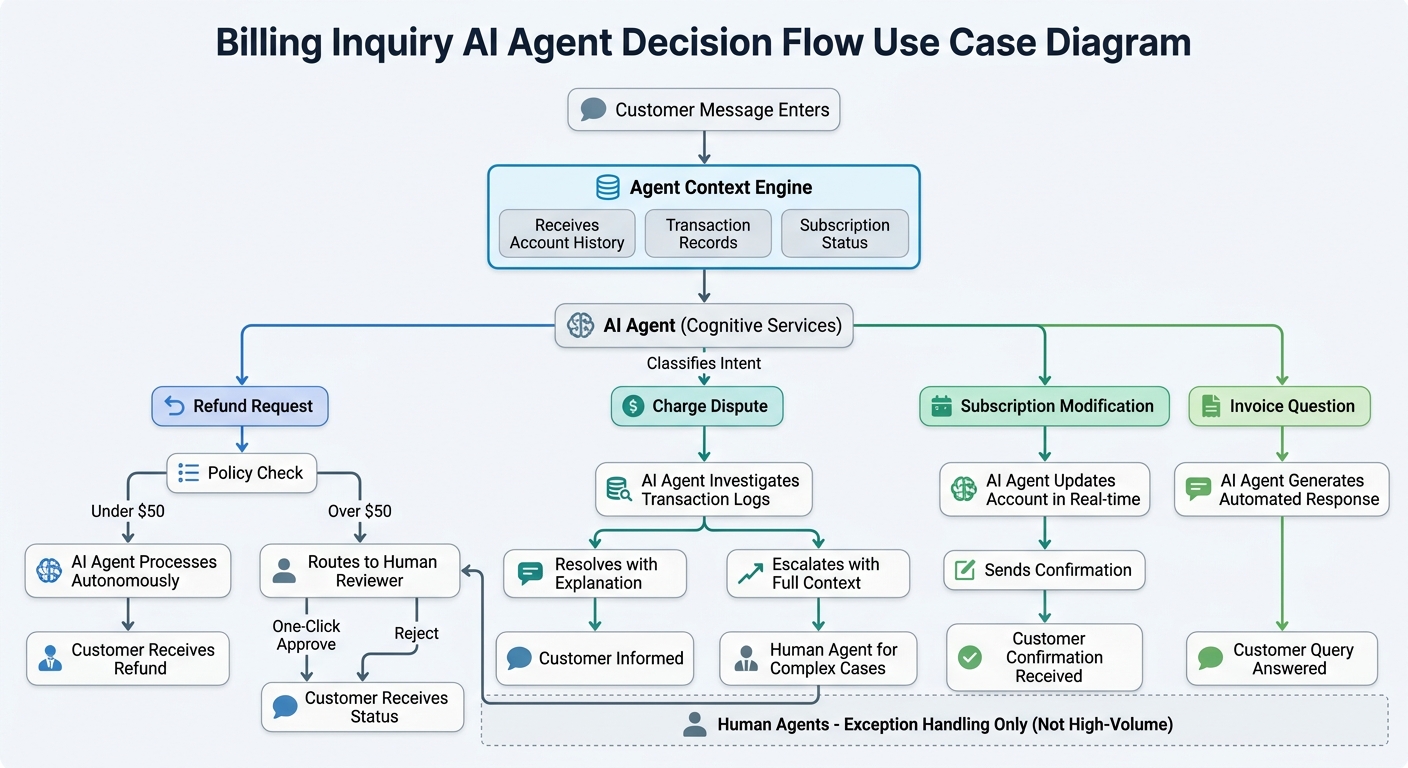
A mid-market e-commerce company with subscription products was experiencing high volume in billing support: refund requests, charge disputes, subscription modification requests, and invoice questions. Their chatbot handled less than 15% of billing contacts. Billing is a domain where errors are immediately visible to customers and difficult to reverse, so the company had historically kept humans in the loop.
The AI agent deployment for billing used a conservative governance framework: full autonomous resolution for clearly policy-compliant refund requests under $50, human review required for refunds over $50, and structured escalation for dispute cases. Over 9 months, 68% of billing contacts resolved autonomously. Customer satisfaction scores for billing interactions increased by 12 points, attributed primarily to faster resolution and reduced need for customers to repeat information.
Use Case 3: HR and Employee Support Automation
Enterprise support is not only external customer-facing. A 5,000-person professional services firm deployed AI agents internally for employee support, handling IT password resets, benefits enrollment questions, PTO policy inquiries, and equipment request processing. This is an increasingly common pattern — using the same AI agent platform for internal and external support, governed by the same audit trail and policy framework.
Autonomous resolution reached 74% for IT-related inquiries and 61% for benefits-related inquiries. Employee satisfaction with IT support improved significantly, driven by 24/7 availability and instant resolution for straightforward requests. HR support staff were redeployed from answering repetitive policy questions to handling complex benefits counseling and employee relations matters.
The Future of Enterprise Support — What Comes After the AI Agent Transition
If the migration from chatbot to AI agent represents the current inflection point, support leaders who are planning now should also be thinking about what the environment looks like three to five years out.
LLM-powered agents multistep workflow automation is already emerging as the next capability layer. Where today's AI agents primarily handle discrete support contacts — a customer asks a question, the agent resolves it — the next generation will handle entire workflows that span multiple systems and multiple steps, triggered by events rather than inbound queries. A shipping exception will be detected automatically, the agent will research the cause, identify the resolution option that policy permits, and execute it — notifying the customer only when the action is complete. This is already possible in limited deployments; it will become standard within 24–36 months for well-governed operations.
Multimodal interaction is another near-term shift. Support contacts will not remain text-only. Voice interactions handled by AI agents — with real-time reasoning, real-time action, and real-time escalation to human agents — will handle an increasing share of call center volume. The economics are compelling: an AI agent handling a 10-minute voice call at $0.08/minute versus a human agent at $0.47/minute (fully-loaded) changes the cost structure of voice support fundamentally.
Proactive and predictive support will shift the model from reactive (customer contacts us with a problem) to anticipatory (we contact the customer before the problem becomes a contact). AI agents with access to product usage data, account health signals, and historical failure patterns will be able to identify at-risk accounts and initiate outreach — not through personalized marketing, but through genuine support interventions. A customer whose product usage patterns suggest they are approaching a known error condition will receive a proactive message with a fix or a direct contact option before they experience the failure.
These are not science fiction scenarios. They are extensions of capabilities already deployed in leading-edge enterprise operations. The organizations that build governance maturity, integration depth, and operational expertise during the current chatbot-to-agent migration will be positioned to adopt them as they mature. Those that treat the current migration as a one-time project rather than an operational capability build will face another transformation cycle — with the same costs and disruption — when the next capability layer arrives.
Conclusion
The transition from rule-based chatbots to AI agents in enterprise support is not imminent. For many organizations, it is already underway. The enterprises that have deployed AI agents successfully are reporting 2–3x improvement in autonomous resolution rates, meaningful reductions in per-contact operational cost, and measurable improvements in customer satisfaction — not because the technology is magic, but because it solves the specific architectural problem that made chatbots inadequate for the open-ended, high-volume, high-complexity reality of enterprise customer support.
The decision to migrate is not primarily a technology decision. It is an operational strategy decision — one that requires a clear-eyed assessment of your current resolution rates, a realistic model of what AI agents will actually cost, and a governance framework that lets the technology do what it is capable of without creating the risk that makes leaders hesitant to let it act.
The organizations that will come out ahead are those that start the evaluation rigorously, build governance before they go live, and treat the migration as a capability build — not a vendor procurement. The support operation of the future will have fewer inbox zeros but more meaningful work for the human agents who remain. That is a destination worth planning toward carefully.
This article is for informational purposes for enterprise support leaders evaluating AI agent technology. Specific outcomes vary based on deployment scope, integration depth, and organizational context. Organizations should conduct their own evaluation and pilot testing before committing to a platform or migration timeline.
About the Author
The Algorithmine editorial team covers enterprise AI deployment, infrastructure strategy, and operational transformation for B2B technology leaders. Our research combines direct practitioner interviews, public case study data, and analysis of published analyst reports to provide grounded, actionable guidance.
Expert Q&A: Tough Questions Answered
Q: The article presents 60–80% autonomous resolution rates as the realistic benchmark for mature deployments, then says "55–75%" when citing specific data. Which is it — and how do you account for vendors who claim 85–90%?
A: The article uses both ranges, and it should be more explicit about the distinction. The higher range (60–80%) appears in the early section as a capability ceiling description — what is theoretically achievable when an agent is well-integrated and operating within clear boundaries. The more conservative range (55–75%) appears in the business case section where the article is citing "available enterprise deployment data" from organizations that have published outcomes. These are different things: one describes what the technology can do under good conditions; the other describes what deployed organizations have actually measured. Vendors claiming 85–90% are typically measuring resolution by their own definition, which often means "no immediate escalation" rather than "no reopen within 72 hours." The article correctly flags this definitional problem, but should have made the two ranges consistent and explained the gap rather than letting them sit side by side. Treat vendor resolution rate claims with skepticism unless you understand exactly what they are measuring.
Q: The ROI model claims a 35–40% net reduction in human handle time in Year 1 for a 500-person company with 50,000 monthly contacts. When I calculate this from the numbers in the article — 60% resolution at $0.60/contact — I get roughly 54% cost reduction. Why does the article say 35–40%?
A: Your math is correct. The numbers in the article do not fully support the stated claim. Working from the article's own figures — 50,000 contacts/month, 12-minute average handle time, $28/hour fully-loaded agent cost, and 60% autonomous resolution at $0.60/contact — the AI costs approximately $18,000/month while handling 30,000 contacts that would otherwise require 3,600 human hours/month. The remaining 20,000 contacts still handled by humans cost $112,000/month in labor, for a total post-AI cost of roughly $130,000 versus $280,000 baseline: a 53–54% reduction, not 35–40%. The article's lower figure may be trying to account for Year 1 governance overhead (0.5–1.0 FTE of oversight, integration professional services being amortized, shadow-mode periods with no AI resolution), but it does not make that case explicitly. The ROI section has an internal inconsistency that a skeptical VP of Support will catch immediately.
Q: The article recommends decommissioning legacy chatbot flows in parallel with AI agent rollout, but never addresses what happens to the customer who currently relies on the chatbot. If the chatbot is "a liability," are you confident the AI agent will handle those users at least as well on day one?
A: The article does not adequately address the transition risk for the existing chatbot user base. Decommissioning chatbot flows before the corresponding AI agent capability has demonstrably met or exceeded the chatbot's resolution rate creates a gap in support coverage. There is also a user population — particularly older customers, users in low-bandwidth environments, and customers who have been trained by your IVR/menu system to expect a scripted flow — who may actually perform worse with a high-capability but less predictable AI agent interface. The article recommends phased rollout and shadow mode, which are the right mechanisms, but it treats chatbot decommissioning as a parallel operational schedule decision rather than a customer experience decision that needs its own migration plan. A VP of Support should require a customer impact assessment for each chatbot flow being sunset, not just a capability readiness check.
Q: The article mentions that AI agents can "learn from interaction outcomes" and "adjust immediately" when policy changes. But large language models are not reliably controllable in this way. What happens when the agent starts behaving incorrectly at scale — how quickly can you detect and reverse it?
A: This is the most important question the article sidesteps. The statement that an AI agent "learns from interaction outcomes; policy-adjusted without manual retraining" implies a level of behavioral control that current LLM-based agents do not reliably deliver. When a rule-based chatbot has a bug, you fix the rule and the problem stops. When an AI agent begins behaving incorrectly — whether because of a policy interpretation drift, a novel query type it handles badly, or a change in upstream data that alters its reasoning — detection is not instantaneous. In practice, enterprise deployments report a detection lag of hours to days before behavioral drift surfaces in aggregated metrics or customer complaints. Recovery is then not a single rollback but a governance review, a policy correction, and a validation cycle. The article's framing of "governance policy is updated and the agent's behavior adjusts immediately" is optimistic. It should have been clearer that governance changes the agent's instruction framework — but validating that the agent behaves correctly under the new policy still requires monitoring and a testing cycle.
Q: The article cites three use cases with specific outcome data — 71% resolution, 68% resolution, $1.2M savings, 12-point CSAT improvement. Are these verified, independently audited numbers, or are they shaped by the same vendor influence the article warns against?
A: The article presents these as "drawn from documented enterprise deployments or anonymized composites where specific outcome data has been published." That phrasing is appropriately hedged, but it warrants scrutiny. "Documented enterprise deployments" could mean vendor case studies, which are marketing materials with selection bias. "Anonymized composites" means the numbers are constructed, not from a single real deployment. Neither category has been independently audited to the standard a VP of Support should require before budgeting a $50,000–$200,000 integration project and restructuring their support operation. The $1.2M figure in Use Case 1 is particularly specific and would require knowing the company's baseline agent headcount, fully-loaded costs, and what portion of the $1.2M is new AI cost versus old human cost to validate as net savings. The article should have noted explicitly that readers should require proof of concept results from their own environment — which it does say later in the vendor selection section — rather than relying on the use case data as indicative of what a buyer will achieve.