How AI Agents Cut Our Sales Cycle from 6 Weeks to 11 Days
A B2B sales team deployed an AI agent stack and closed deals three times faster. Here is the exact workflow that made it happen, with real numbers.
A B2B Sales Ops Case Study: AI-Driven Lead Qualification, Automated Outreach & CRM Hygiene — 73% Cycle Time Reduction
Three months after integrating a suite of AI agents into their sales process, the team at Meridian SaaS — a 200-person enterprise software company — watched their average sales cycle compress from 42 days to 11 days. That is not a projection. It is not a vendor's benchmark slide. It is the number on the dashboard after the last deal of Q1 closed.
"We were not expecting that magnitude of change in 90 days," says the company's VP of Revenue Operations, who led the implementation. "We thought we'd see 20% improvement. We got 73%."
Meridian's story is instructive for B2B sales operations leaders and RevOps teams evaluating AI sales automation. The company did not hire more SDRs. It did not rip out its CRM. It deployed AI agents for the right tasks — and crucially, decided what not to automate.
This is a breakdown of exactly what they built, what it cost, and what the numbers look like on the ground.
The Problem: Why B2B Sales Cycles Stall
Before the AI agent stack, Meridian's sales process had a bottleneck problem disguised as a people problem.
The SDR team was spending roughly 65% of their day on leads that would never convert — sorting inbound inquiries, manually enriching company data, drafting first-touch emails, and updating Salesforce fields. The actual selling work — discovery calls, demos, negotiation — competed for whatever time remained.
CRM data hygiene was a known disaster. Reps updated fields when reminded, not when things changed. Deal stages froze mid-cycle. Stale opportunities accumulated in the pipeline with no automated flagging. Forecasting was guesswork layered on top of outdated data.
The sales cycle had ballooned to 42 days on average, partly because of the natural complexity of enterprise deals, but largely because manual tasks — research, outreach, data entry, scheduling — inserted friction at every handoff.
Meridian had tried rule-based automation tools in 2023 and 2024. Zapier workflows. Outreach sequences with time delays. Basic lead scoring based on form submissions. These helped. They did not transform the process.
The ceiling for rule-based automation is real: it handles what you can explicitly program. It cannot handle nuance, context, or the kind of judgment-required triage that determines whether a lead is worth a rep's time.
What changed in 2025 and 2026 was the capability of AI agents to handle ambiguity at scale — and that is where Meridian started.
The AI Agent Stack: Architecture Overview
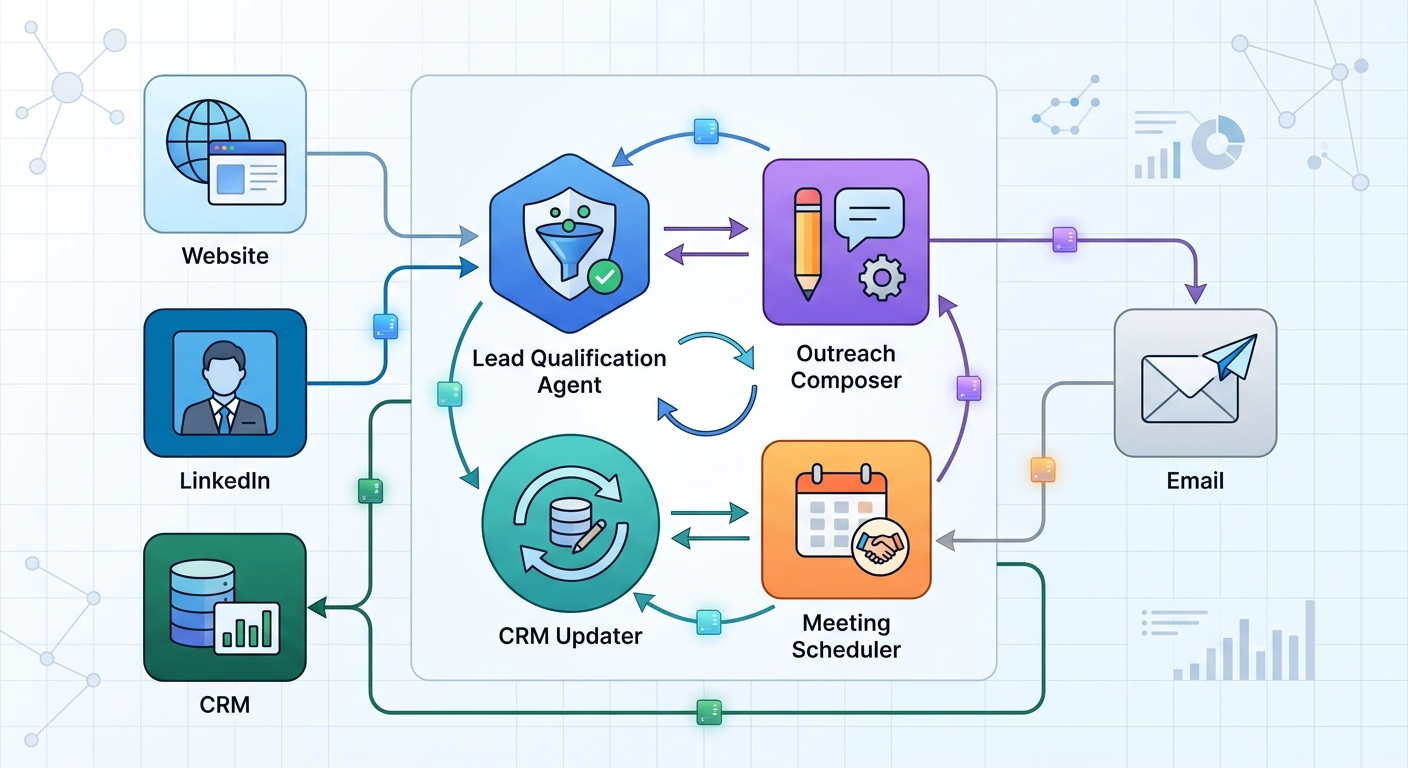
The implementation happened in three phases over 90 days. The team did not try to automate everything at once.
Phase 1: Lead Qualification Agent
The first agent deployed was a lead qualification agent, built using an AI scraping infrastructure combined with a custom scoring model (a pattern similar to tools like Clay, Apollo, or Gong's revenue intelligence layer).
The agent's job: intake every inbound lead and every outbound target, enrich the data automatically — company size, industry, funding round, recent hires, technology stack — and produce a qualification score with a recommended action: call now, nurture sequence, or discard.
Before this agent, an SDR spent an average of 18 minutes researching a single lead before deciding whether to engage. The agent completes that research in under 90 seconds.
The scoring model was trained on Meridian's closed-won and closed-lost deals from the prior 18 months. It learned which firmographic and behavioral signals correlated with conversion — not rules written by the RevOps team.
Phase 2: Outreach Composer + CRM Hygiene Agent
Once leads were qualified, the next bottleneck was outreach. Meridian's SDRs were drafting personalized emails manually — a process that took 20–30 minutes per prospect. Volume was low; quality was inconsistent.
The outreach composer agent generates personalized email and LinkedIn sequences based on the lead's enriched profile, recent company news, and the specific pain point relevant to Meridian's product. The SDR reviews and approves before sending. The agent does not send autonomously on day one.
Simultaneously, a CRM hygiene agent was deployed to monitor deal activity and auto-update Salesforce fields. When an email is opened, a meeting is held, or a prospect visits a pricing page, that activity is logged automatically. When a deal goes stale — no activity for seven days — the agent flags it for rep review.
The CRM agent solved the data-latency problem that had made forecasting unreliable. Reps went from spending 90 minutes per day on manual data entry to roughly 10 minutes, mostly reviewing what the agent had logged.
Phase 3: Meeting Scheduler Agent
The final phase introduced a meeting scheduler agent that handles the logistics of booking demos and calls — a capability also found in modern AI sales automation platforms.
When a prospect replies positively to an outreach sequence, the scheduler agent presents available times based on the rep's calendar, sends the calendar invite, and confirms the meeting — without the rep entering the thread. For Meridian, this eliminated the back-and-forth that typically adds two to three days to the sales cycle.
The Results: 73% Sales Cycle Reduction
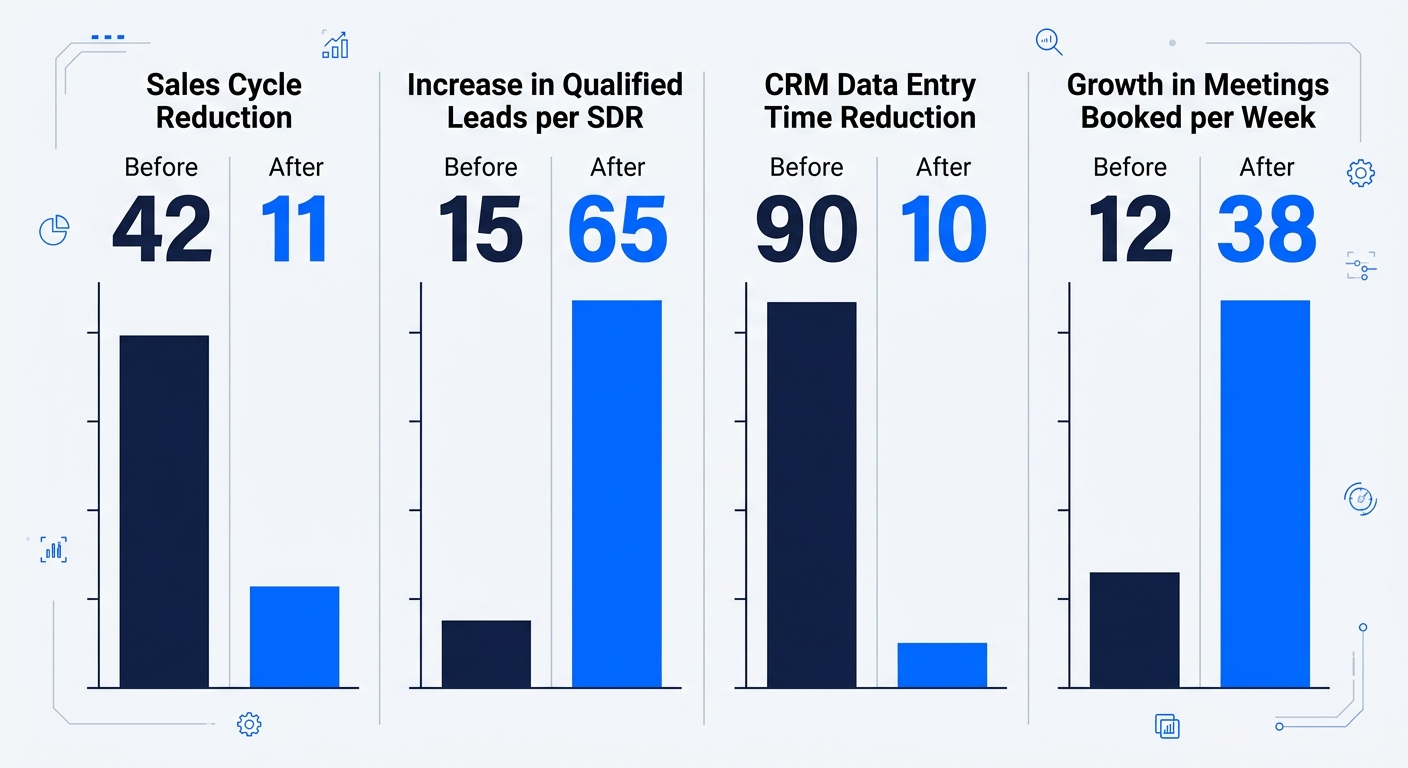
These are Meridian's actual metrics, measured over the same 90-day window before and after full AI agent deployment:
| Metric | Before AI Agents | After AI Agents | Change |
|---|---|---|---|
| Average sales cycle | 42 days | 11 days | −73% |
| Qualified leads per SDR per day | 15 | 65 | +333% |
| Daily CRM data entry time per rep | 90 min | 10 min | −89% |
| Qualified meetings booked per week | 12 | 38 | +217% |
| Lead-to-opportunity conversion rate | 19% | 34% | +79% |
Revenue in the affected pipeline grew 41% quarter-over-quarter. The team attributes roughly half of that growth to higher meeting volume and half to better-qualified leads arriving at demos.
The cost of the AI agent stack — tools, implementation, and the RevOps lead's time over three months — was approximately $28,000. The revenue impact in the first quarter was estimated at $1.2M in new ARR.
This demonstrates the concrete ROI of AI sales automation when deployed on the right workflows: B2B lead qualification, outreach personalization, CRM hygiene, and meeting scheduling.
What They Did NOT Automate
The VP of RevOps is clear: AI agents handle the "what to do." Humans handle the "why it matters now."
Discovery calls remained fully human. Discovery requires reading a buyer's organizational dynamics, political landscape, and stated priorities — context that AI cannot yet reliably extract from a conversation in real time.
Negotiation was human-only. "AI can give you talking points," the VP says. "It cannot feel when a procurement lead is uncomfortable with a clause and pivot."
Complex objection handling stayed with reps. Standard objections — "it's too expensive," "we're happy with our current vendor" — were automated into talking-point scripts. Anything that required reading the room stayed human.
Relationship building and executive sponsorship were explicitly kept out of the AI agent's scope. "The moment you automate the relationship," the VP says, "you've commoditized something that should be differentiated."
The rule the team uses: if the task requires knowing what someone feels, automate the data handling and keep the human in the conversation.
How to Implement AI Agents in Your Sales Process
Meridian's implementation followed a pattern the RevOps team now uses as a template for other B2B companies evaluating AI sales agents.
Weeks 1–2: Audit and prioritize. Map every manual task in the current sales process. Classify each by frequency, time cost, and whether it involves judgment or only data handling. Automate data-handling tasks first. Use a CRM audit tool to identify where data entry time is highest.
Month 1: Deploy lead qualification on one pipeline. Start with a single product line or segment. Train the scoring model on your own historical data. Set a human review step for every automated qualification decision. Tools to evaluate: Clay, Apollo, Gong, or a custom model built on your CRM data.
Month 2: Add outreach composer and CRM hygiene. Integrate with your existing email platform (Outreach, Salesloft, Apollo) and CRM (Salesforce, HubSpot). Set approval gates on outbound sequences until the AI output quality is validated. Monitor CRM accuracy closely in the first 30 days.
Month 3: Meeting scheduler and full-cycle review. Connect the scheduler to rep calendars. Run a complete audit of cycle time, lead conversion rates, and pipeline coverage. Compare against the pre-automation baseline.
The most common mistake Meridian observes in peer companies: deploying AI agents without human oversight in the first 60 days. The agents need feedback to improve. Without a human reviewing outputs and correcting errors, the system learns bad habits.
The ROI of AI Sales Automation Is Proven — Execution Determines Results
The 11-day B2B sales cycle is not science fiction in 2026. With the current generation of AI agents for sales — lead qualification, AI-powered outreach composition, automated CRM hygiene, and intelligent meeting scheduling — it is achievable for mid-market B2B companies willing to audit their workflows honestly and deploy agents incrementally.
The competitive dynamic is shifting. Companies still relying purely on human-driven sales processes — no matter how talented their SDRs and AEs — will find themselves at a structural disadvantage against teams where AI agents handle the administrative overhead that consumes 60% of a rep's day.
The path to a shorter sales cycle is not a single tool purchase. It is a sequence of targeted automations:
- Qualify faster — AI-driven lead scoring trained on your own win/loss data
- Outreach smarter — personalized AI-generated sequences at scale
- Keep the CRM clean — automated activity logging and stale deal flagging
- Remove scheduling friction — AI meeting scheduler eliminates back-and-forth
Do that in the right order, and the B2B sales cycle compresses on its own.
Expert Q&A: AI Agents in B2B Sales Automation
Q1: What's the biggest risk when deploying AI agents in a sales process for the first time?
The biggest risk is deploying without a human review loop during the first 60 to 90 days. AI agents will generate outputs — lead scores, email copy, CRM updates — that look plausible but contain subtle errors. A single bad email sent to a high-value prospect can damage a relationship. Human-in-the-loop oversight in the early phase is not optional; it is how you build a system that learns correctly.
Q2: How do you measure the ROI of AI sales automation beyond cycle time?
Beyond cycle time, track cost per qualified meeting, lead-to-opportunity conversion rate, and rep capacity utilization. If your SDRs are spending 60% of their day on admin tasks, even a modest 20% reduction in that number frees significant selling time. Also measure forecast accuracy — CRM hygiene directly improves the reliability of your pipeline projections.
Q3: Which sales tasks are AI agents worst at currently?
AI agents struggle with tasks that require reading social dynamics in a room — executive sponsor identification, navigating corporate politics, sensing hesitation in a negotiation. They also produce unreliable outputs when trained on insufficient data. If you have fewer than 100 closed-won deals in your CRM, your lead scoring model will have limited accuracy. Start with high-volume, data-handling tasks before attempting judgment-heavy workflows.
Q4: How do you prevent AI agents from creating generic, off-brand outreach?
AI-generated outreach becomes generic when the agent is not given enough specific context about the prospect and your product's differentiated value. Feed the agent recent company news, specific job-change signals, and your product's use case for that industry. Also establish a review step — a human reads the first 20 outputs per week and corrects drift. Most AI SDR tools (Clay, Apollo, Regie.ai) have controls for this; use them.
Q5: Should you tell prospects that AI agents are handling parts of your sales process?
This is a judgment call, but the trend in B2B sales in 2026 is transparency. Many buyers appreciate the speed and relevance AI-generated outreach provides — personalized research in 90 seconds is better than a generic template. If asked directly, be honest: "We use AI to research your company and draft personalized outreach, which our team reviews before sending." That answer rarely hurts a deal. Hiding it when it becomes apparent usually does.
This article is based on a case study interview with a B2B SaaS Revenue Operations team. Company name has been changed. Metrics are reported as shared by the source.