Vision-Language Models Beyond Chat: How Multimodal Models Are Rebuilding Industrial Inspection
Vision-language models are moving beyond chatbots into industrial inspection. Here's how grounding, zero-shot detection, and robotics are rebuilding quality control — and the honest tradeoffs IT teams must weigh.
Section: Research | Category: Computer Vision | Updated: 2026-09-15
Top takeaway: Vision-language models let factories inspect parts by describing them in plain language, without retraining — but they complement, not replace, classical machine vision.
Introduction
Vision-language models (VLMs) stopped being just chatbots with eyes. They now read images, reason about them in natural language, and act on what they see. Industrial inspection is one of the earliest proving grounds for vision-language models beyond chat. Factories already lean on machine vision for quality control. VLMs add something machines historically lacked: flexible reasoning about the image itself. This article explains how VLMs work, where they genuinely help, and the honest tradeoffs that IT professionals must weigh before deploying them.
What Is a Vision-Language Model?
A vision-language model merges an image encoder with a language model. The image encoder turns pixels into a compressed representation. The language model reads that representation alongside your text. Text becomes the interface. You describe what to look for, and the model applies that description to the image.
"Multimodal" simply means the model handles both image and text inputs at once. It does not mean it is smarter than a dedicated vision system. It means it is more flexible about what you ask it to do with a picture. A single VLM can check a label, count parts, and describe a defect — tasks that would each need a separate classical model.
How VLMs Differ From Classical Computer Vision
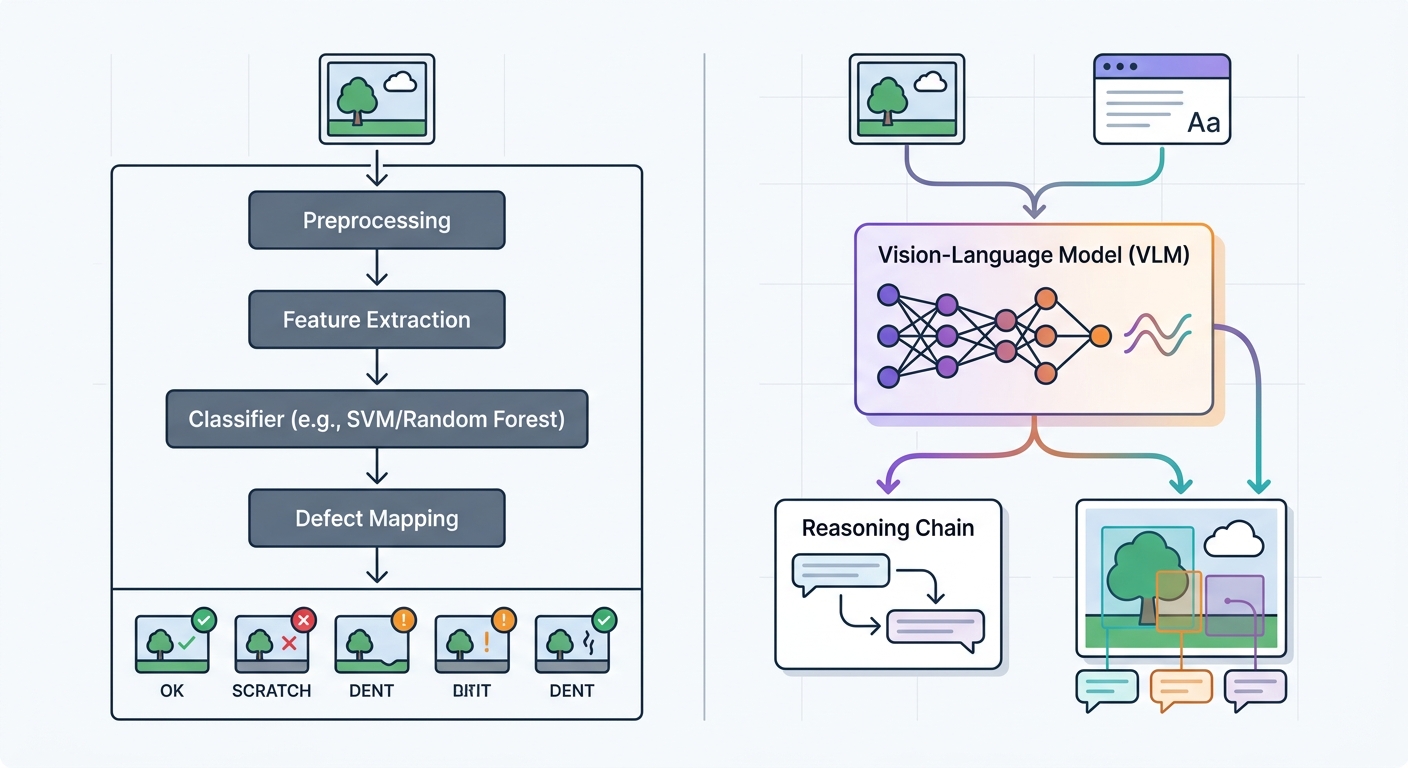
Classical computer vision (CV) uses fixed functions or trained networks to solve one task. A convolutional neural network (CNN) learns to detect a specific defect. Once trained, it does that one job well. It is precise and fast. It is also rigid. Add a new defect type, and you retrain or rebuild the model.
A VLM reasons about the image with language instead. It does not have a fixed label set baked in. You prompt it on the fly. That flexibility is powerful. It is also less deterministic. Classical CV emits the same answer for the same input every time. A VLM answers probabilistically. That difference matters in production.
The practical view: these systems coexist. Classical CV handles precise, repetitive measurements. VLMs handle semantic judgments and edge cases. Neither replaces the other.
Multimodal Grounding: The Key to Actionable Inspection
Grounding is the capability that makes VLMs useful for inspection. It connects language to specific image locations. When a model grounds, the phrase "the scratch on panel 4" maps to actual pixel coordinates. The defect becomes referenceable, not just descriptive.
Grounding is what turns chat-like vision into actionable quality control. A model that only says "there is a defect" is not enough for a factory. A model that localizes the defect so an operator or robot can act on it is useful. Grounding gives the model spatial awareness tied to the language it produces.
Zero-Shot Inspection: Why It Is the Big Lever
Zero-shot means the model inspects a new part without retraining. It has seen no labeled examples of that specific part or defect. It works from your text description alone. For classical CV, this is a hard blocker. You need labeled images of every defect class you want to catch.
For a VLM, the barrier is much lower. A new product line with a new defect can often be handled by writing a better prompt. This is a major lever for factories with changing SKUs or rare defect types. You trade some precision for dramatically faster setup time.
Where VLMs Shine in the Factory
VLMs earn their keep in several realistic scenarios.
Defect detection with flexible descriptions. Operators write natural-language rules for what "wrong" looks like. The VLM flags candidates for review. This works well for cosmetic issues that are hard to encode in fixed rules.
Assembly verification. Confirm the right parts are present and in the right place. A VLM reasons about spatial relationships that would require many classical detectors.
Packaging and label inspection. Check text, logos, and placement against a description. Language-based checks map naturally to language-prompted models.
Robotics vision. Pick-and-place robots use grounding to locate and grasp objects. "Pick up the red bracket from the right tray" becomes a concrete motor command. This pairs well with flexible warehouse setups.
Each scenario is a partial-adoption case. You do not rip out your existing vision stack. You add VLM reasoning where rigidity hurts you most.

The Honest Tradeoffs of VLM Inspection
VLMs are not a universal upgrade. Their output is probabilistic, not deterministic. A high-volume line measuring sub-millimeter tolerances still needs precise measurement, not language reasoning. Classical metrology wins there.
Latency and compute are real. VLMs are larger and slower than a purpose-built CNN. Running them on the factory edge requires careful budgeting of GPU resources and inference time. Cloud inference adds network latency a production line may not tolerate.
Safety and auditability matter in regulated industries. Regulators and customers want to know why a product was rejected. A grounding signal helps, but a probabilistic model is harder to defend than a deterministic threshold. You must be able to explain a decision to an auditor.
There are clear cases where you should NOT use a VLM: extreme speed, micrometer precision, and workflows that require a fixed, reproducible answer every run. Choose the right tool for each part of the pipeline.
Deployment Reality: A Practical Checklist
Start with a constrained pilot, not a full rollout. Pick one station and one defect family. Measure precision, latency, and false-reject rate against your current baseline.
Keep classical CV for precise measurements. Use the VLM for semantic reasoning on top. This hybrid pattern is the most defensible starting point. Budget for verification and rollback. You need confidence metrics and a path back to the old system if performance dips.
Keep a human in the loop. Humans review flagged items until the model proves itself. This protects quality and builds the audit trail you will eventually need.
Frequently Asked Questions
What is a vision-language model? A vision-language model combines an image encoder with a language model, so it can reason about images using natural-language instructions.
How is a VLM different from classical computer vision? Classical CV uses fixed, task-specific models. A VLM reasons flexibly using language, at the cost of some determinism.
What is multimodal grounding? Grounding maps language to specific image locations, so a described defect becomes referenceable in pixel coordinates.
Can VLMs do zero-shot defect detection? Yes. A VLM can inspect a new part from a text description alone, without labeled training examples for that part.
Are VLMs accurate enough for industrial quality control? They are strong for semantic judgments, but weak for extreme speed and sub-millimeter precision, where classical metrology still wins.
When should you NOT use a VLM for inspection? Avoid VLMs for micrometer precision, ultra-high-speed lines, or workflows that demand a fixed, auditable answer every run.
Do VLMs replace traditional machine-vision systems? No. The strongest setups pair deterministic classical CV with flexible VLM reasoning.
Conclusion
VLMs expand industrial vision; they do not replace it. The winning pattern pairs deterministic classical CV with flexible VLM reasoning. Informed adoption beats hype-driven replacement. Start small, measure honestly, and let the data decide where multimodal models earn their place on your floor.
Want more practical coverage of AI-driven automation and computer vision? Subscribe to the Algorithmine portal for research-backed explainers and deployment playbooks delivered straight to your inbox.