Vision-Language Models in Industrial Inspection: The 2026 Playbook for Quality Control at Scale
Vision-Language Models in Industrial Inspection: The 2026 Playbook for Quality Control at Scale
Quality control in manufacturing has a quiet failure mode: it does not scale. For decades, factories have hired more inspectors, trained bigger neural networks, or thrown more pixels at the problem. None of that solves the real bottleneck.
A vision-language model (VLM) is different. It pairs a vision encoder with a language model so a system can reason about what it sees instead of matching pixels to a memorized defect class. This article is a practical 2026 playbook: how VLMs work inside a factory vision system, the architectures that actually ship, and the honest cases where a VLM is the wrong tool.
The Inspection Bottleneck That Labeled Data Could Not Solve
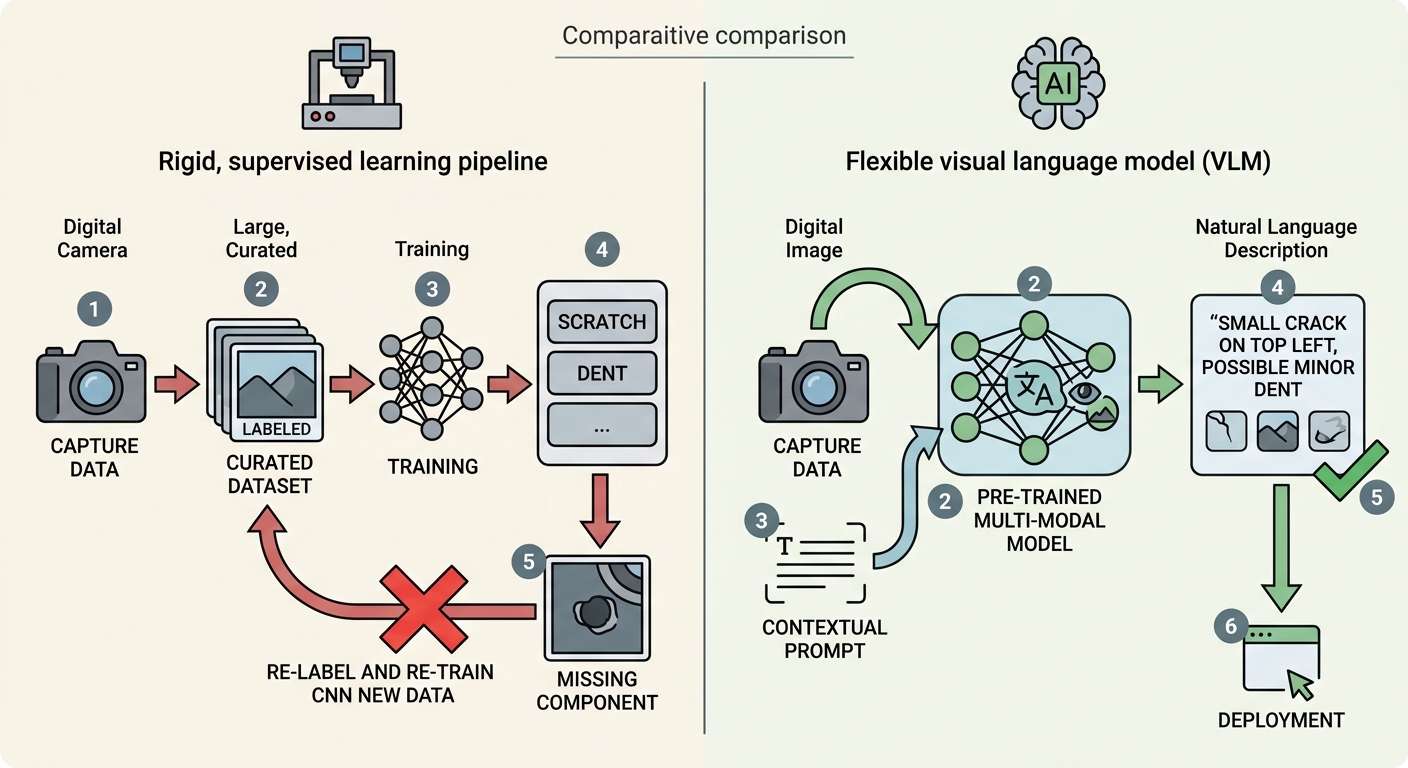
Traditional defect detection relies on supervised deep learning. You collect thousands of images of scratches, dents, and misalignments, label them, and train a CNN to recognize those exact classes. The system works well — until a new defect appears.
That happens constantly. A supplier changes a mold. A new coating alters reflectance. A batch arrives from a different line. Each new flaw means new labels, retraining, and downtime. In fast-rotating production, that cycle never finishes.
Human inspection has its own ceiling. Industry reporting puts trained inspectors around 87% detection accuracy, falling to roughly 70% under fatigue over a shift. At high throughput, that is tens of thousands of escaped defects per year. It is also expensive to staff and impossible to scale.
The demand pressure is real. Manufacturing quality teams that use AI grew from about 33% of respondents in 2025 to 47% in 2026, with defect detection the dominant use case (reported figures; treat as estimates). The shift is not optional anymore — the old approaches simply cap out.
Key insight — AI adoption in manufacturing quality control jumped from 33% (2025) to 47% (2026), and defect detection is the leading application. Human inspection accuracy drops from ~87% to ~70% under fatigue — an unsustainable failure mode at scale.
Vision-language models break the retraining loop. A VLM does not need a label set for every possible flaw. It answers from a general understanding of what a product should look like, described in natural language. That one change reopens the scalability door.
What Vision-Language Models Actually Do in a Factory Vision System
Understanding VLMs starts with their anatomy. A VLM combines a vision encoder and a language model. A vision encoder turns image regions into numeric embeddings. A language model then reasons over those embeddings together with a text prompt.
The key step is image-text alignment during training. The model learns to connect what things look like to how they are described. Image-text alignment provides cross-modal world knowledge: what a clean circuit board looks like, what a burr on a machined edge means, what "normal wear" versus "damage" is.
That is why zero-shot works. Zero-shot detection eliminates retraining on new defect classes. The VLM answers from cross-modal priors rather than a memorized class list. Ask it to find a "discoloration not present in the reference," and it reasons about the concept even if it never saw your exact defect before.
The difference from a plain classifier matters. A traditional classifier returns a label and a confidence score. A VLM returns natural language: "scratch on the upper-right casing, roughly 4 mm long, low severity." That single output is a description, an explanation, and a starting point for action.
Do not confuse a VLM with a smarter classifier. It is a reasoning layer over vision. That distinction drives every design decision downstream.
The 2026 Two-Stage Architecture That Actually Ships
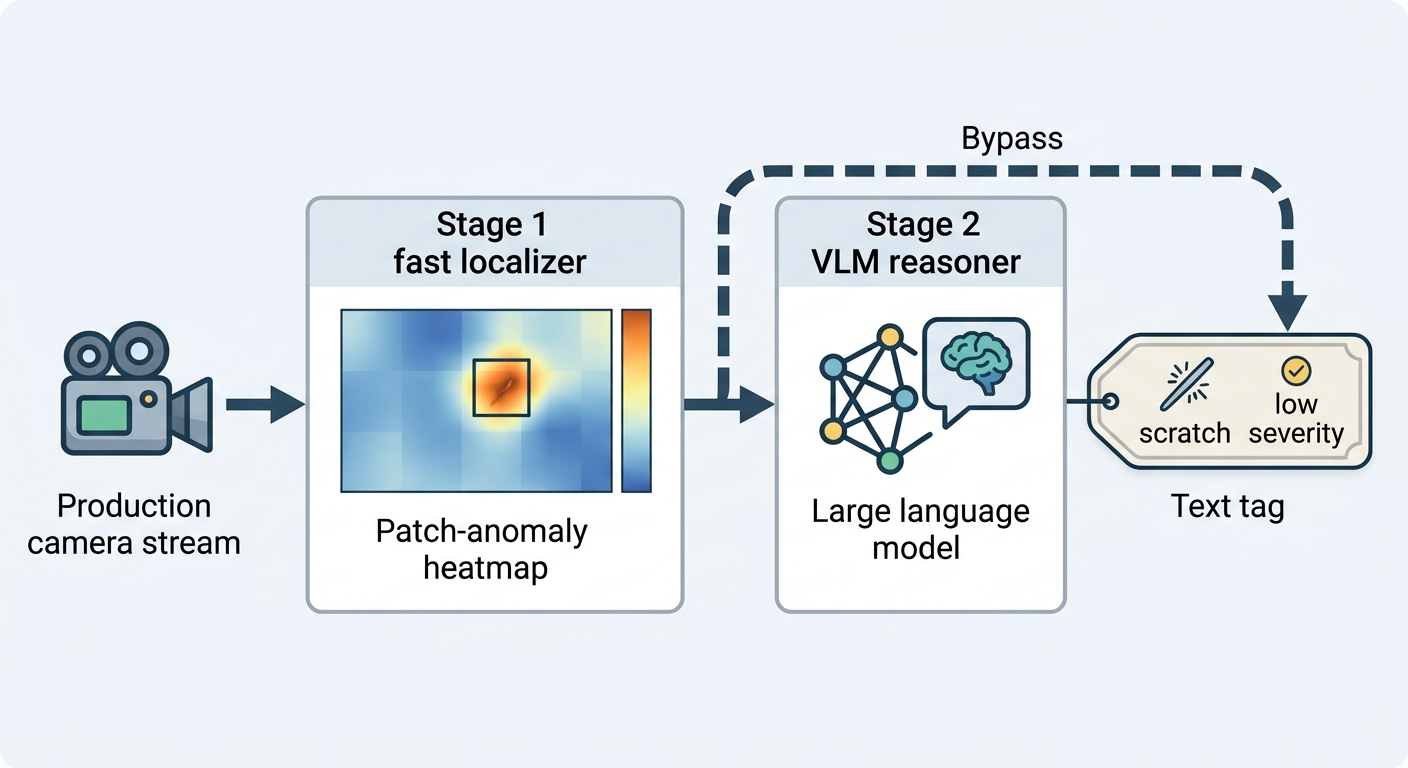
Running a full VLM on every frame of a high-speed line is the fastest way to blow your latency budget. Production teams rarely do that. The pattern that ships in 2026 is a two-stage hybrid.
Stage one is a fast localizer. It is often an unsupervised model that scores patches for how anomalous they are, using reconstruction error or feature matching. This stage runs at line speed and flags candidate regions. It is cheap, deterministic, and does not need labels.
Stage two is the VLM reasoner. It receives only the candidates the localizer flagged, plus a semantic prompt. The VLM classifies each region and, crucially, describes it in text. Because it only sees a handful of crops instead of every frame, the token budget — and therefore the cost and latency — stays bounded.
Key insight — Production systems use a two-stage design: a fast unsupervised localizer finds candidate defects, and a VLM reasoner classifies and describes only those candidates. The two-stage architecture bounds inference latency and cost.
This split is why reported deployments achieve large throughput gains over manual inspection — in some cases up to 15x. A VLM reasoner transforms pass/fail flags into root-cause insight. The localizer does the boring filtering. The VLM does the intelligent judgment. Each does what it is good at.
There is a practical benefit beyond speed. Because the localizer is unsupervised, it also catches defects you did not anticipate. New flaws still surface as candidates, and the VLM reasons about them, instead of silently passing them like a fixed-class CNN would.
Zero-Shot and Few-Shot: The Annotation Math
The biggest cost in traditional inspection is labels. A new product line may demand thousands of annotated defect images before a model is trustworthy. VLMs collapse that number.
Zero-shot means no examples at all. You write a prompt describing what to look for, and the VLM applies it to a brand-new product on day one. This is ideal for broad triage: does anything look wrong here?
Few-shot means a handful of reference images, sometimes just five to ten, shown in-context alongside the prompt. Few-shot inspection requires only a handful of reference images. This sharpens precision for domain-specific defects that general world knowledge does not fully cover. The model learns "these specific scratches on this coating are rejects" from a few examples.
The practical guidance is a ladder. Start zero-shot to stand up inspection of a new line immediately. Then add few-shot examples to tune precision on the defect families you actually see. Most teams find a mix works best.
Key insight — Zero-shot inspection works on day one with no labels; few-shot adds 5–10 reference images for precision on known defect families. The two are a ladder, not a choice: start zero-shot, tighten with few-shot.
The annotation math is the core sell. Going from thousands of labeled defect images to five reference shots changes the economics of bringing up a new production line. It also removes the labeling bottleneck from the critical path of product launches.
Semantic Reject Reporting: Building the Audit Trail
A pass/fail flag is not enough when a customer disputes a rejection or a regulator asks for proof. This is where VLMs change the game.
Semantic reporting transforms pass/fail flags into root-cause insight. A VLM generates a readable reason for every reject: "scratch on the upper-right casing, length ~4 mm." That text is data. It feeds root-cause analysis, tells a supplier exactly why a lot was returned, and documents every decision for ISO 9001-style auditability.
Traditional AOI outputs a pixel mask or a pass flag. To understand a rejection, an engineer has to re-inspect, interpret the mask, and reconstruct the context. VLM reject reports generate natural-language audit trails that are ready at the moment of detection.
Operators benefit immediately. Instead of chasing down why a part was rejected, they read the reason and act. Quality engineers get structured, queryable descriptions instead of a sea of binary flags.
Key insight — VLM reject reports turn pass/fail flags into natural-language audit trails: machine-readable explanations that support root-cause analysis, supplier disputes, and quality compliance.
This semantic layer is a genuine advantage over classical vision. It does not just detect defects — it documents them in a form humans and processes can actually use.
Real-Time and Edge Deployment: Meeting the Cycle Time
Line cycle times are unforgiving. A packaging or electronics line may demand sub-second decisions per part. A heavy VLM on every frame will not fit. You partition the problem.
Quantization is the first lever. INT8 or FP16 weights cut latency and memory with modest accuracy loss, often acceptable for inspection. Distillation is another: train a small model on the outputs of a larger VLM for the narrow task at hand.
Where the model runs matters. Edge accelerators handle on-device inference for the common case, keeping data local and latency low. Complex or rare cases can fall back to cloud or on-prem GPU inference, where accuracy matters more than speed.
The partitioning decision is conceptual first. Which decisions must happen on the line in real time, and which can be reviewed in a batch? Reject/accept usually needs to be real time. Trend analysis and root-cause investigation scale naturally offline. Edge quantization enables line-cycle-time VLM inference within the partitioned workload.
Key insight — Meeting cycle time is an engineering problem, not a model problem: quantize weights, distill to a small task model, run the common case at the edge, and reserve GPU/cloud inference for complex rare cases.
The localizer-first architecture from earlier is the foundation. Because the VLM only sees candidates, real-time VLM inference becomes affordable. Strip the workload down and line-speed semantic inspection is achievable.
Tribal Knowledge Capture: Before the Experts Retire
A quiet crisis faces many factories: the senior inspectors are retiring, and their judgment walks out the door.
Experienced inspectors make decisions that are fast and accurate but hard to articulate. They have seen thousands of rejections and internalized the rules. That tacit knowledge is rarely written down, and documentation cannot fully capture it.
VLMs offer a new path. Multimodal visual question answering lets you interrogate an expert directly: show them a part and ask, "is this a reject, and why?" Their answers become prompts and reference examples that encode the decision logic. Each session grows a queryable record of expert judgment.
Key insight — VLMs capture retiring inspectors' tacit knowledge: interactive Q&A sessions convert unwritten judgment into reusable prompts and reference examples.
The result is a living asset rather than a departing human's private memory. The VLM becomes the institutional record of what "good enough to ship" means — and it keeps learning as new experts contribute.
The 2026 Playbook — A Decision Framework
Use a VLM when the problem has characteristics classical vision cannot meet.
A VLM wins when defect types are not fully known in advance, when labels are scarce, when you need explanation and auditability, or when product lines rotate quickly. A VLM is the right tool when reasoning about a new visual situation is the actual job.
A VLM is the wrong tool when the defect set is fixed and small, when you need extreme latency on every frame, or when a cheap deterministic check already solves the problem. Replacing a robust AOI with a heavy VLM for a stable, repetitive check is overkill and expensive.
Run a pilot on one line. Measure false positives and false negatives against your current baseline. Track accuracy, latency, and cost per inspected part before you scale.
Key insight — Adopt a VLM when flaws are unknown, labels are scarce, or explanation is required; skip it when a deterministic check already handles a fixed defect set. Pilot on one line, measure FPs/FNs and cost per part, then scale.
Budget for the operations layer. A VLM in production is a machine-learning asset: prompt versions change, behaviors drift, and reference sets need review. A model registry, prompt versioning, and drift monitoring are not optional extras. They are the difference between a pilot and a reliable system.
FAQ
Q: Do VLMs fully replace traditional AOI and machine vision? A: No. VLMs add a semantic reasoning layer; fast deterministic checks and localizers still do the heavy lifting at line speed. The winning systems combine both rather than replacing one with the other.
Q: How accurate is zero-shot inspection on a brand-new product line? A: It varies by domain and part complexity, and honestly the number is workload- and model-dependent. Expect it to be a strong first pass for triage, with few-shot refinement to hit production-grade precision on known defect families.
Q: Is it safe to send factory images to a cloud VLM? A: Only if your data policy allows it. Many teams run on-prem or air-gapped VLMs for confidential product images, using edge accelerators or local GPU clusters. Send nothing classified or customer-confidential to external services.
Q: How many reference images does few-shot inspection really need? A: Often five to ten well-chosen shots per defect family, presented in-context. It is far less than the thousands needed to train a supervised detector, but the examples must be representative and cover the variation you expect.
Q: What is the biggest risk of depending on a VLM for QC? A: Silent drift or overconfidence on a case the model was never shown. Mitigate with a localizer that still catches anomalies, a human review loop for uncertain rejects, and continuous monitoring of confidence and false-negative rates.
Conclusions
Vision-language models are not a fantasy. They are a working pattern in 2026 manufacturing, and they fix a real bottleneck: inspection that no longer scales because labels and retraining cannot keep up.
The playbook is straightforward. Start with a two-stage architecture that keeps latency bounded. Use zero-shot for day-one coverage and few-shot to tighten precision. Capture the semantic audit trail that classical vision cannot produce. And be honest about when a VLM is overkill.
If you want to stay current on computer vision and industrial AI, subscribe to the Algorithmine portal — we publish hands-on research and implementation playbooks every week. The factory floor is changing faster than most roadmaps assume; the teams that start now will be the ones defining quality control at scale in 2027.