Transformer Architecture Innovations Beyond Attention: The 2026 Landscape
Explore how state space models, linear attention mechanisms, and hybrid architectures are reshaping LLM infrastructure in 2026.
The End of Attention's Quadratic Stranglehold
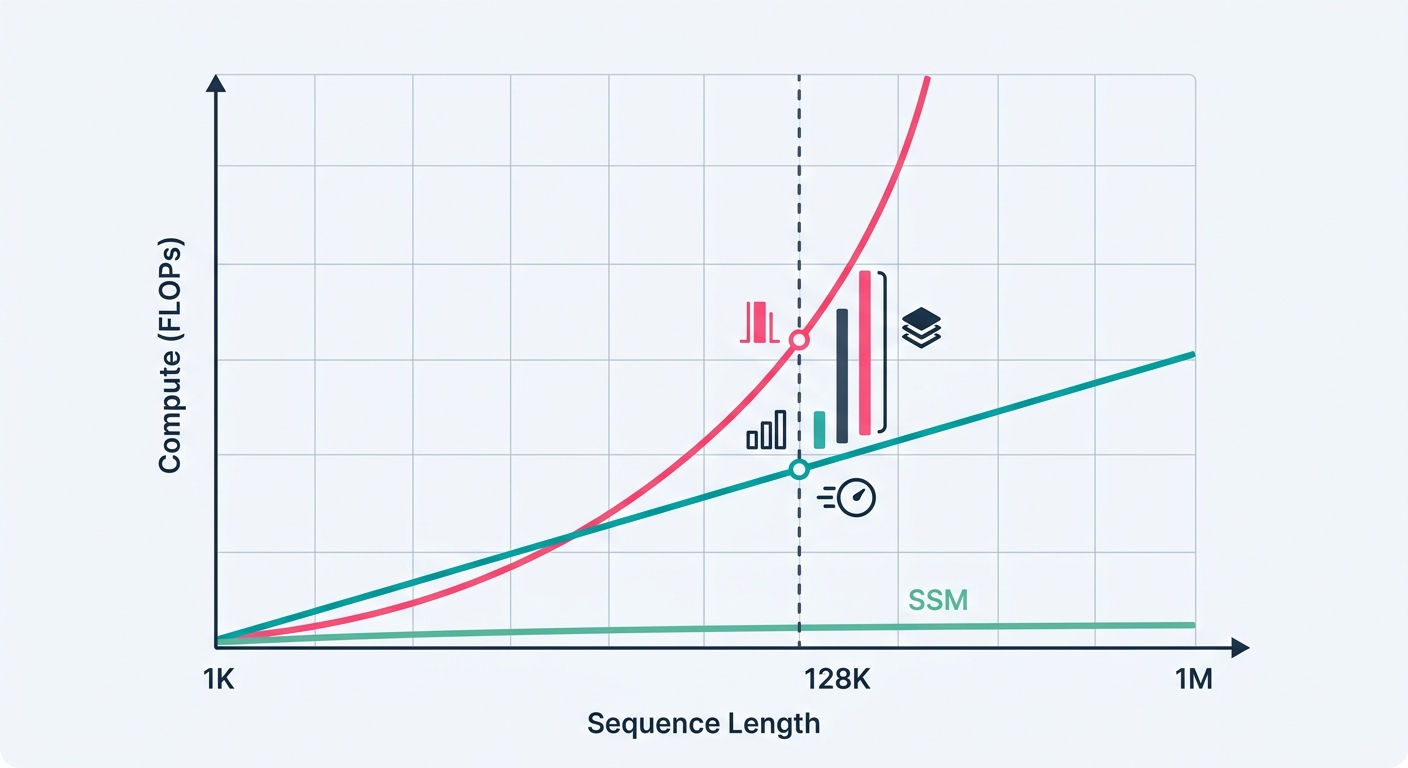
Standard self-attention has O(n²) computational complexity with respect to sequence length. What does that mean in practice?
Each token in a sequence attends to every other token. A sequence of 1,024 tokens requires roughly one million token-pair computations. Scale to 131,072 tokens — a context window increasingly common in 2026 models — and you need over 17 billion pairings. The compute bill grows quadratically, not linearly.
This isn't merely a theoretical concern. The KV-cache — memory for key and value tensors during inference — grows linearly with context, but the attention computation itself expands quadratically. During training, this limits batch sizes. During inference on long documents, it creates latency spikes that real-time applications cannot tolerate.
The research community recognized this bottleneck years ago. Between 2022 and 2024, alternative architectures proliferated: state space models, linear attention variants, mixture-of-experts layers. In 2025, the first production deployments of non-standard-Transformer designs appeared. By 2026, the question is no longer whether to go beyond attention, but which alternative fits your use case.
Understanding the Quadratic Cost
Picture a 128K-token context window — roughly equivalent to a medium-length novel. With standard attention, the model computes attention scores across all 128K positions for every single token being processed. The total number of computations scales with the square of the sequence length.
Engineers have developed workarounds: Flash Attention maximizes GPU memory hierarchy utilization, sliding window attention restricts the visible context, and sparse attention patterns approximate full attention with fewer computations. These are optimizations within the attention paradigm.
The architectural alternatives we're examining in this article take a different approach: they redesign the underlying computation to eliminate the quadratic scaling problem entirely. The result isn't a faster approximation of attention — it's a fundamentally different mechanism that achieves comparable or superior results on many tasks.
State Space Models: The Control Theory Roots
State space models (SSMs) trace their lineage to control systems engineering, where they have been used for decades to model dynamical systems — systems that evolve over time according to fixed rules.
An SSM maps an input sequence x(t) to an output sequence y(t) through a hidden state h(t). The mathematics are continuous by origin: a set of differential equations describing how the hidden state evolves. Discretization transforms these continuous equations into a form that neural networks can learn: a recurrence where each step depends on the previous hidden state and the current input.
This recurrence gives SSMs a critical property: constant memory usage. The hidden state has a fixed size regardless of input length. SSMs processing a million-token context maintain the same memory footprint as those processing a thousand tokens.
The problem with traditional SSMs, however, was expressiveness. Fixed recurrence parameters meant the model couldn't selectively focus on relevant information. An SSM with fixed parameters processes every input identically — it has no mechanism to "decide" that a particular token deserves more attention.
Mamba's Selective Mechanism Explained
Mamba — introduced in late 2023 and refined in Mamba-2 through 2024 — solved this problem with a deceptively simple innovation: input-dependent parameters.
In a traditional SSM, the matrices governing state transitions are fixed after training. In Mamba's selective SSM, these matrices become functions of the current input token. The model learns to create parameters that dynamically gate information — selective SSM dynamically gates input based on what the current token demands.
This gives Mamba the content-aware selection that made attention powerful. Unlike attention's full pairwise comparison, SSMs maintain a compressed hidden state updated via recurrence. The result: linear scaling in both memory and compute with sequence length, while maintaining the ability to focus selectively on relevant information.
Mamba's selective scan mechanism processes sequences by stepping through them recurrently, maintaining the hidden state. This recurrence is hardware-unfriendly for GPU parallelization — a trade-off that Mamba's creators accepted for the inference efficiency gains.
Mamba-2 Performance and Improvements
Mamba-2, released in mid-2024, represents a significant refinement. Its core innovation is Structural State Space Duality (SSD): a mathematical framework connecting selective SSMs to attention-based methods.
This connection isn't merely theoretical. SSD enables Mamba-2 to use attention-optimized GPU kernels — specifically, the CUTLASS-style compute kernels developed for Flash Attention. The result is a 2× to 8× throughput improvement over Mamba-1 on equivalent hardware, with performance that matches or approaches Transformer baselines on standard language modeling benchmarks.
The Mamba architecture has spawned an ecosystem. Research releases from the Mamba team include models ranging from 130M to 2.8B parameters, with third-party fine-tunes extending to larger scales. For teams evaluating alternatives to Transformer-based models, Mamba-2 represents the most mature SSM implementation available in 2026.
Mamba-2 throughput advantage — On standard language modeling benchmarks, Mamba-2 achieves 2–8× faster processing while using identical model architectures, thanks to SSD-enabled hardware optimization.
Linear Attention — Subquadratic Without Approximation
Linear attention rewrites the attention equation to factor out the sequence dimension. The key insight: certain operations can be computed in a different order without changing the result.
Standard attention computes: Attention(Q, K, V) = softmax(QK^T)V
The softmax operation creates a probability distribution over all positions, which creates the n² dependency. Linear attention factors sequence complexity by replacing softmax with kernel functions that satisfy associative properties, allowing matrix multiplication reordering that reduces complexity to O(n).
Three architectures have emerged as the primary implementations: RetNet, RWKV, and Hyena. Each takes a different path to linear scaling.
RetNet — Microsoft's Retention Alternative
RetNet, developed by Microsoft Research and published in 2023, introduces "retention" — a linear recurrence mechanism that replaces self-attention entirely.
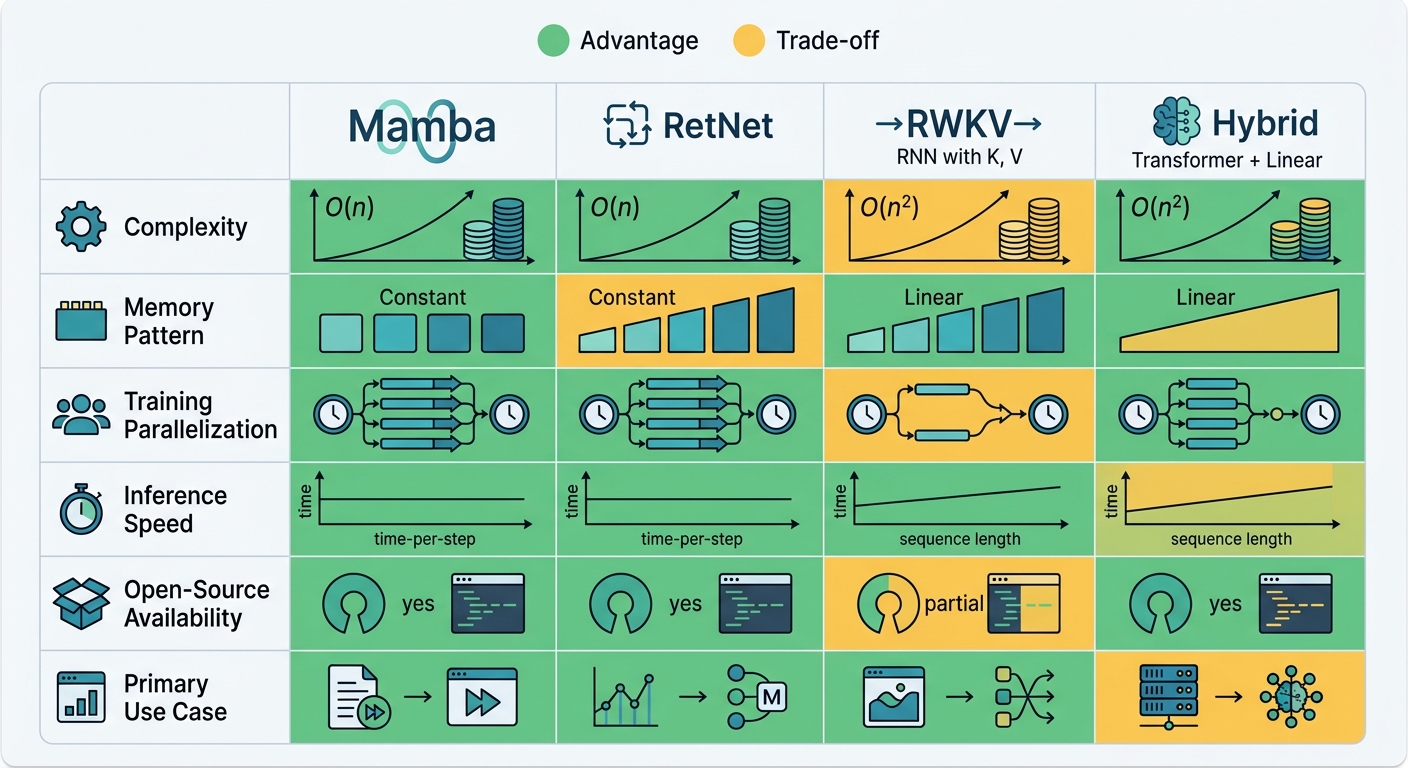
Retention in RetNet computes a weighted sum of historical values, where the weights are determined by a retention matrix. RetNet enables constant-time generation — O(1) per token, meaning each new token takes the same time regardless of context length.
The architecture achieves both parallel training (like Transformers) and efficient recurrent inference (like RNNs) through a factorization that makes the retention mechanism hardware-friendly across both modes.
By 2026, Microsoft has integrated RetNet-derived concepts into several internal production systems, particularly for applications requiring long-context generation with strict latency requirements.
RWKV — RNN Quality with Transformer Training
RWKV (Receptance Weighted Key Value) occupies a unique position in the landscape. Pronounced "RaakuV," it is the only architecture combining recurrent inference with fully parallelizable training.
The architecture processes tokens in parallel during training, leveraging standard Transformer libraries and hardware. During inference, it unfolds into an RNN — RWKV combines RNN efficiency with transformer quality. Each token depends only on the accumulated hidden state, giving constant memory usage and constant generation time.
RWKV is attention-free — there is no attention mechanism whatsoever. Yet RWKV achieves GPT-class quality on standard benchmarks, a remarkable result given how central attention has been to language model progress.
RWKV-7, codenamed "Goose" and released in early 2025, introduced Dynamic State Evolution. This mechanism allows the recurrent state to adapt its representation based on the current token's characteristics, closing the gap between RWKV's quality and frontier Transformer performance.
The project is an open-source non-profit organization under the Linux Foundation. Model weights, training code, and a growing ecosystem of fine-tunes are freely available.
RWKV inference efficiency — During text generation, RWKV's memory usage remains constant regardless of context length, eliminating the KV-cache growth that drives up memory costs in Transformers.
Mixture of Experts — Selective Activation at Scale
Mixture of experts (MoE) takes a fundamentally different approach to efficiency. Rather than redesigning attention, MoE modifies the feedforward network layers within a Transformer block.
A standard Transformer applies every parameter to every token. MoE activates sparse parameters through a router that selects which experts process each token.
Only the selected experts compute for a given token. A model with 8 experts and 2 active per token uses roughly 25% of the feedforward compute that a dense model would require. The remaining parameters remain idle but loaded in memory.
Mixtral 8×7B — a landmark 2023 release — demonstrated the approach dramatically: a model with 46.7B total parameters but only 12.9B active per token, matching the quality of a dense 46.7B model at roughly 40% of the compute cost.
Load Balancing and Training Challenges
MoE training introduces complications that dense Transformers avoid. Expert routing can collapse — if the router consistently favors certain experts, others never activate, wasting their parameters and creating load imbalance.
To prevent collapse, MoE models incorporate auxiliary load-balancing losses that penalize uneven expert utilization. These losses add training complexity but are well-understood by 2026. Production MoE training pipelines routinely achieve stable expert utilization.
Communication overhead in distributed MoE training is another engineering challenge. When experts are distributed across multiple GPUs, token routing requires transferring activations between devices. This communication cost can negate the compute savings for single-node configurations. MoE architectures shine on multi-node clusters where the communication overhead amortizes across many compute nodes.
Hybrid Architectures — Best of Both Worlds
The most significant architectural trend of 2025-2026 isn't a single replacement for attention — it's combination.
No current architecture dominates all tasks. Standard Transformers excel at reasoning and precise dependency tracking. SSMs handle long contexts with minimal memory. Linear attention variants offer efficient constant-time inference. Hybrid architecture blends attention with SSM layers to capture multiple strengths.
The typical pattern in production hybrids: Transformer attention blocks handle precise local reasoning and complex dependency tasks, while SSM blocks manage long-range memory and information compression. The model learns when to rely on each mechanism, often through learned routing between layers.
Google's Titans architecture introduced a neural memory module alongside standard attention. The memory module learns to compress and store information that attention would otherwise recompute at each layer. For contexts exceeding 100K tokens, Titans demonstrates substantial efficiency gains over pure attention architectures.
Jina AI released a production hybrid model in late 2025, combining attention with Mamba-derived SSM layers. Early benchmarks show the hybrid matching pure Transformer quality on standard tasks while using 30–40% less memory for long-context operations.
Hybrid architecture advantage — Production hybrid models combining attention and SSM layers demonstrate 30–40% memory reduction for long-context tasks while maintaining Transformer-quality reasoning on standard benchmarks.
Engineering Trade-offs — Choosing Your Architecture
For teams evaluating these alternatives, the decision framework has become more nuanced than "Transformer or not Transformer."
Use standard Transformers when frontier-level quality is non-negotiable and hardware is sufficient. The ecosystem — quantization tools, serving infrastructure, fine-tuning pipelines — remains most mature for Transformer architectures. If your team prioritizes reliability over efficiency optimization, Transformers remain the pragmatic choice.
Use Mamba or SSM-based designs when inference efficiency, long contexts, or on-device deployment are primary concerns. Mamba-2 in particular offers a production-viable alternative with a growing ecosystem. The efficiency gains are substantial: 2–8× throughput improvements translate directly to cost savings or latency reductions.
Use RWKV or RetNet when constant memory during inference is critical. Applications generating unbounded text — transcription, live transcription, continuous monitoring — benefit from the O(1) generation time that recurrent architectures provide.
Use MoE when you need scale but face compute budget constraints. The upfront engineering investment is significant, but the efficiency gains at scale are proven. Expect 3–5× active parameter reduction compared to dense models of equivalent quality.
Use hybrid architectures when your application has mixed attention-intensive and memory-intensive phases. Long-document summarization, research assistants, and agentic workflows often involve both precise reasoning and broad context integration — tasks where hybrid architectures offer natural advantages.
For teams building on Algorithmine, these architectural innovations are accessible through our managed endpoints. Our platform abstracts the complexity of architecture selection, providing optimized serving for Transformer, Mamba, and hybrid models through a unified API. Subscribe to stay current with architecture deep dives and implementation guides as this space evolves.
What Comes After Attention
The next three to four years will likely see architecture selection become task-specific — a significant shift from the one-architecture-fits-all era of 2020–2024.
Modular AI systems are emerging where specialized models collaborate, each using the architecture best suited to its role. A reasoning-focused module might use a dense Transformer. A memory-intensive retrieval module might use Mamba. The system composes them through learned routing.
Neuromorphic computing represents a longer-term direction. Spiking neural networks — which encode information in timing rather than continuous values — offer theoretical energy efficiency advantages orders of magnitude beyond current GPUs. The integration of neuromorphic hardware with transformer-derived architectures is an active research area.
Diffusion-based sequence models represent an entirely different paradigm. Rather than generating tokens autoregressively, these models denoise complete sequences in parallel. For tasks where generation speed matters more than incremental quality, diffusion approaches may eventually dominate.
The transformer architecture evolves beyond attention — it's becoming one tool among several, selected for tasks where its strengths matter and replaced where its quadratic complexity creates unacceptable costs. The architectural diversity emerging in 2026 isn't fragmentation; it's maturation.
Expert Q&A
Q: Can state space models match Transformer quality on all tasks? A: As of 2026, SSMs like Mamba-2 match or approach Transformers on most standard benchmarks but haven't consistently surpassed frontier models on reasoning-heavy tasks. The gap is narrowing rapidly with each architecture generation. For specific use cases — long-context retrieval, efficient inference, on-device deployment — SSMs already offer superior trade-offs.
Q: Why hasn't RWKV displaced Transformers given its efficiency advantages? A: RWKV's training stability and ecosystem maturity lag behind Transformers. The open-source tooling, quantized models, and production deployment pipelines are less mature than Transformer alternatives. For teams with engineering capacity to invest in custom infrastructure, RWKV's advantages are substantial and production-viable. For teams prioritizing reliability over efficiency, the ecosystem gap remains significant.
Q: Should I rewrite my Transformer-based application to use Mamba? A: Only if your application has specific pain points that Mamba addresses: long context requirements, inference cost concerns, or on-device deployment constraints. For general-purpose applications with manageable context windows and ample inference budget, Transformers remain the safer choice with a richer ecosystem and more predictable behavior.
Q: How do hybrid architectures actually work in practice? A: Most hybrid models layer attention and SSM blocks alternately. Attention layers handle precise local dependencies and reasoning. SSM layers compress and retain long-range information. The model learns when to use which mechanism, often through learned routing between layers. In production, this typically appears as alternating block types with learned gates controlling information flow.
Q: Is MoE a replacement for attention? A: No — MoE doesn't change the attention mechanism at all. It replaces the feedforward network layers with multiple parallel expert networks and a router that selects which experts process each token. This reduces compute per token while keeping attention intact. MoE and attention-alternative architectures are complementary approaches that can be combined in the same system.