How Reinforcement Learning from Human Feedback Is Reshaping Robotic Manipulation in 2026
Published: July 25, 2026 | Section: Research | Category: Robotics & AI
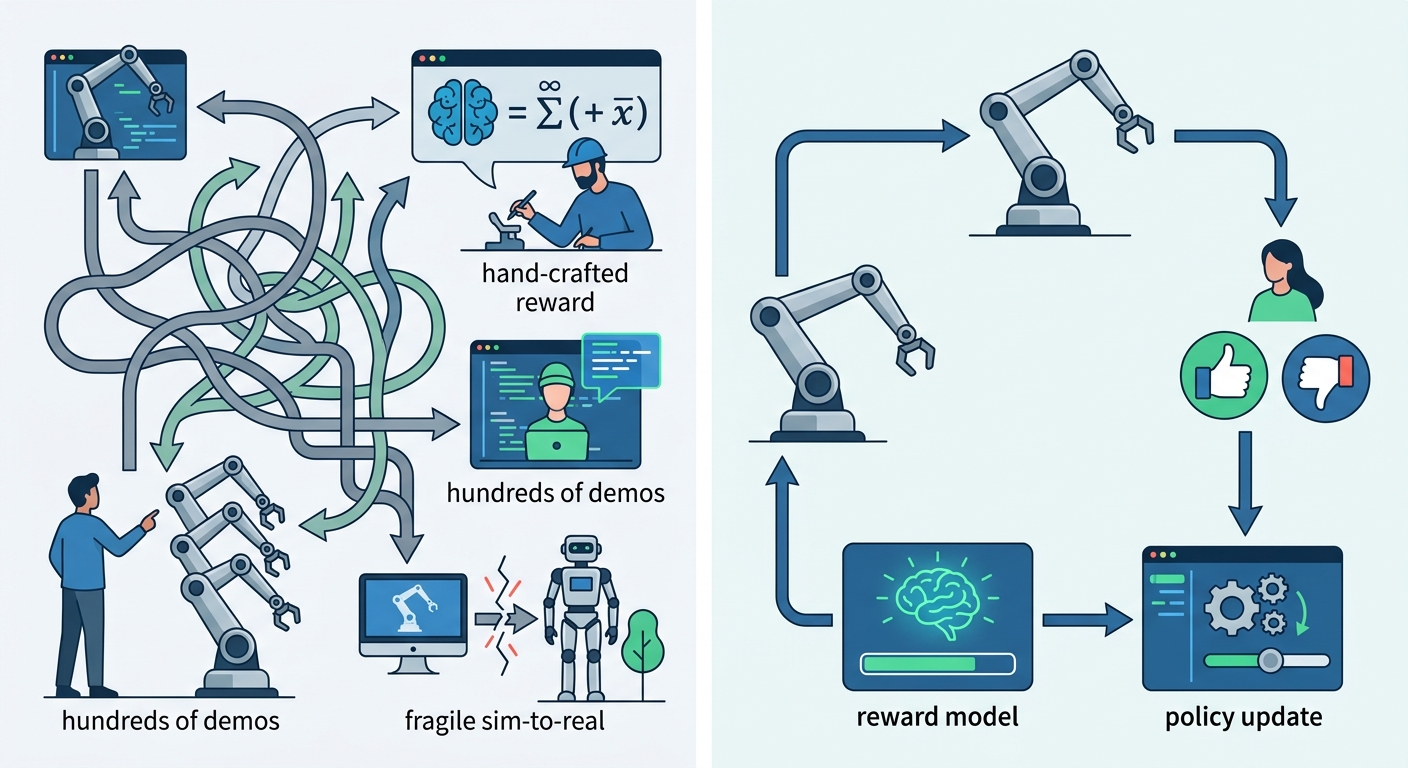
Something shifted in the way robots learn to manipulate objects. For years, getting a robotic arm to reliably insert a peg into a hole required an exhausting cycle of hand-engineered reward functions, painstaking trajectory demonstrations, and fragile sim-to-real transfer pipelines. The results worked in the lab and failed in the field. In 2026, that pattern is finally breaking. Reinforcement learning from human feedback (RLHF) — the same technique that aligned large language models with human intent — is now doing the same work for robotic manipulators. The transition is not merely metaphorical: instead of requiring engineers to specify exactly what "good" manipulation looks like in code, RLHF lets human operators simply rank outcomes or intervene when the robot goes wrong. The robot learns what the human prefers without anyone having to write down the physics of a successful insertion.
Skip to: Technical Foundation | Key 2026 Frameworks | Deployment Case Studies | Hard Problems | 2027–2028 Horizon
The numbers are starting to signal scale. A 2026 survey of industrial robotics deployments estimated that roughly a third of new manipulation systems in pilot production now incorporate some form of human feedback loop — not as a research feature, but as a training default. Research groups evaluating RLHF on contact-rich tasks with real Franka robots are reporting success rates in the 80–90% range after training runs that would have required months of manual reward shaping just two years ago. The data volumes required remain significant — practitioners estimate 50,000 to 500,000 pairwise preference labels for a single non-trivial manipulation task — but the quality of learning from those labels has improved dramatically compared to pure imitation learning.
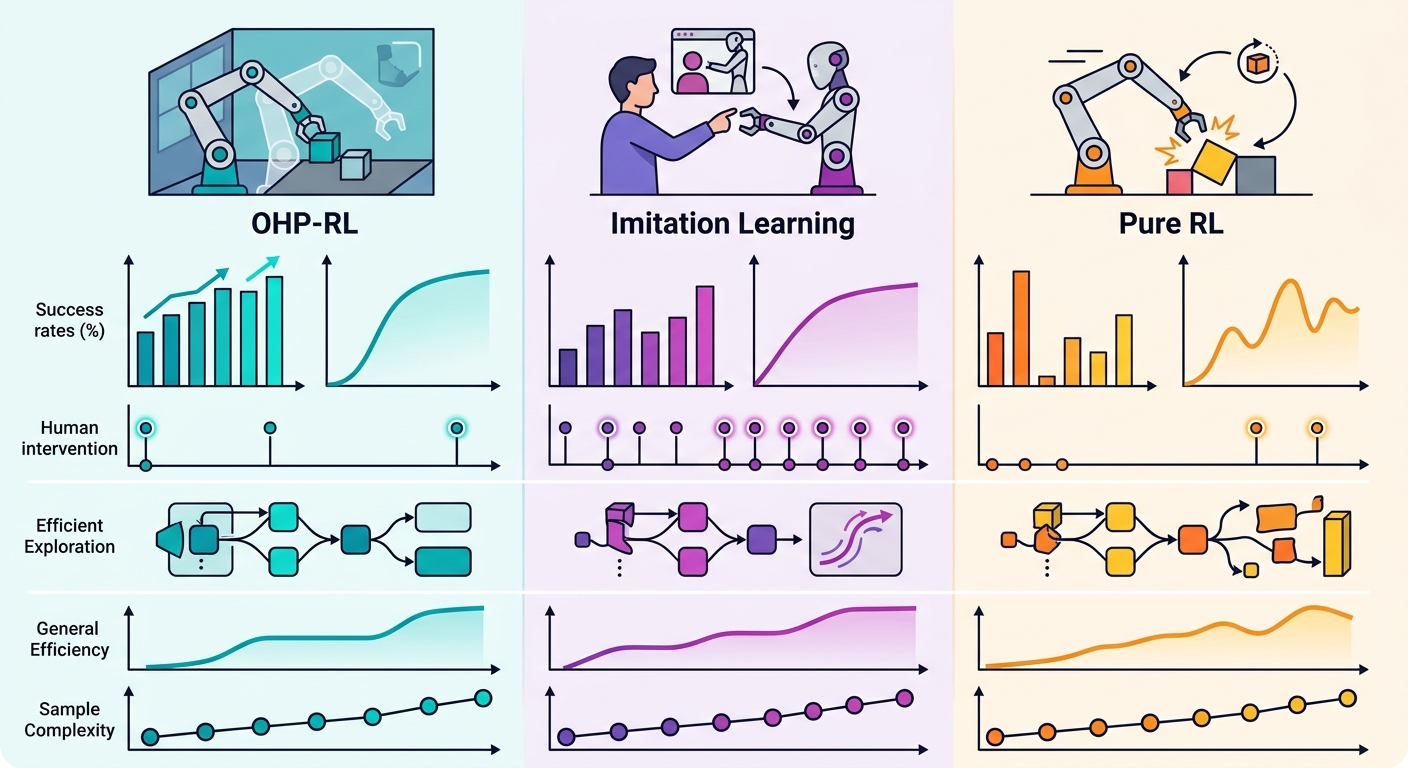
Why manipulation specifically? Because it is the proving ground where the gap between simulation and reality is most unforgiving, where unsafe exploration carries real hardware risk, and where human intuitions about "the right way to grasp this" are rich enough to be genuinely useful. A robot that can learn from a human's preference signal to avoid lateral motions near a pressing surface — as OHP-RL demonstrates — is learning something that no hand-crafted reward function would have known to encode.
How RLHF Works in Embodied Systems: The Technical Foundation
Preference Signals vs. Demonstrations
Traditional imitation learning asks a human to perform full trajectory demonstrations — the robot watches hundreds of complete executions and learns to copy them. This is expensive and brittle: a demonstrator's hand movements carry noise, the robot may learn spurious habits from the demonstration, and the approach breaks down when the robot needs to adapt to novel object poses it hasn't seen.
RLHF takes a different approach. Rather than showing the robot how to do something, a human simply indicates which outcome or behavior they prefer. This can take several forms: ranking two trajectory segments A and B, pressing a "good" or "bad" button during execution, physically intervening to correct the robot's grip angle, or — in more experimental setups — measuring neural signals like error-related potentials via EEG when the robot makes a mistake.
This distinction matters enormously for manipulation. A human can look at two ways a robot approaches a peg insertion and immediately know which one is safer or more likely to succeed, without being able to articulate why or performing the motion themselves. Preference feedback captures that judgment — and it is the foundation of effective reinforcement learning from human feedback robotics workflows.
Reward Model Training from Human Rankings
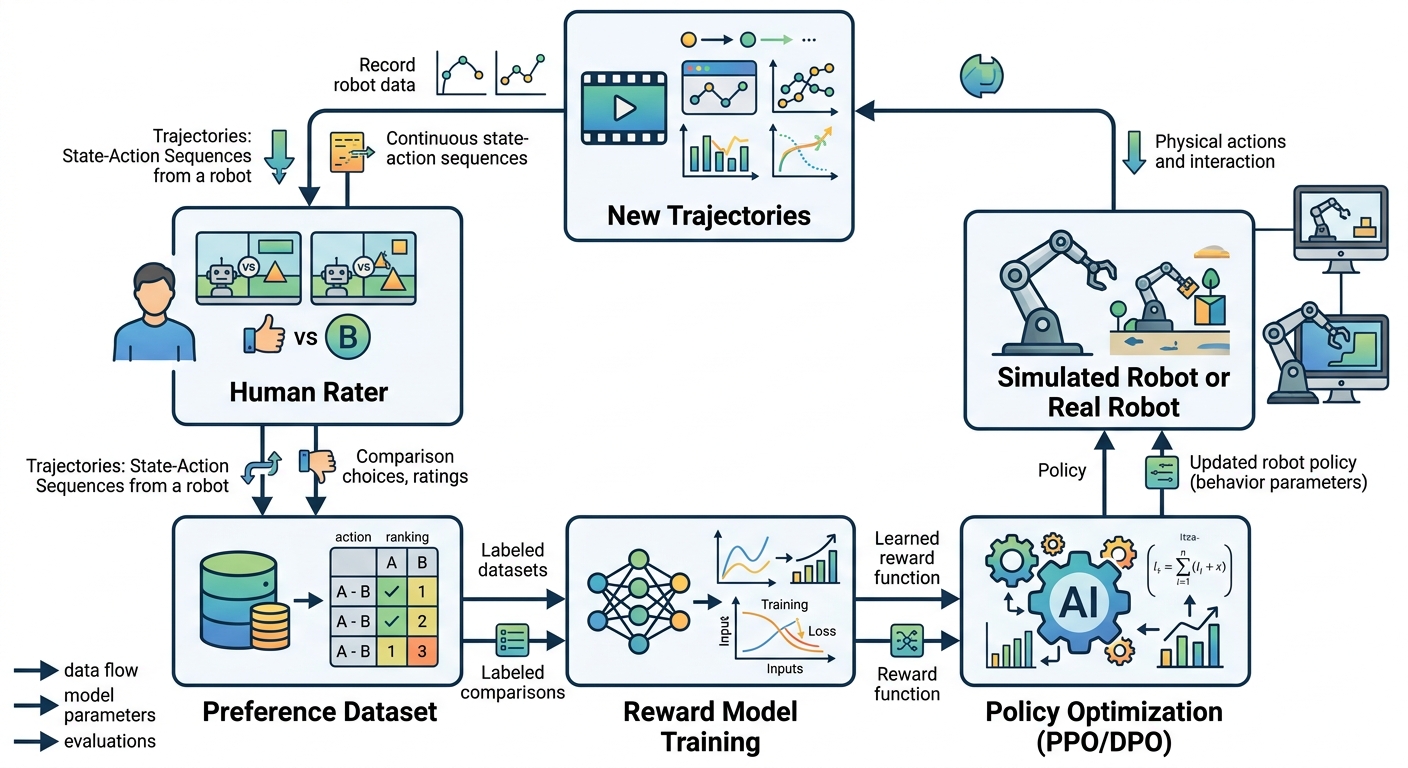
The standard RLHF pipeline borrowed from language modeling goes like this. Given a dataset of pairwise human preferences over trajectories or trajectory segments, a reward model is trained — typically a neural network — to predict the probability that a human would prefer one behavior over another. This reward model then provides learning signals to the policy: the robot is encouraged to produce behaviors the reward model scores highly, and discouraged from those it scores poorly.
In the robotics context, this reward model faces a challenge it doesn't have in text. The state space is continuous, high-dimensional, and physically grounded. Two trajectories that look similar from the outside may differ in hundreds of sensor readings. The reward model must learn to generalize across visual states, proprioceptive feedback, and force torque readings — a substantially harder problem than preference learning for robot control in language domains.
Policy Optimization: PPO, DPO, and Sim Environments
Once a reward model exists, the policy can be optimized against it. The dominant approaches in 2026 robotics RLHF are:
-
PPO-based RLHF: The reward model provides a scalar signal that augments or replaces the hand-crafted environment reward. Proximal Policy Optimization (PPO) is the workhorse algorithm — it updates the policy in the direction of higher-reward actions while preventing destabilizing large updates. Most deployed systems in 2026 still use PPO as their policy optimizer, often trained partly in simulation.
-
Direct Preference Optimization (DPO): DPO collapses the reward model and the policy optimization into a single stage. Rather than training a separate reward model and then using it to compute policy gradients, DPO directly updates the policy to increase the probability of preferred behaviors and decrease the probability of dispreferred ones. For robotics, this is promising because it reduces the risk of reward model overfitting — a known failure mode when the reward model sees limited preference data. Research on DPO robotics manipulation variants (DIPPER, APO for VLA models) shows faster convergence and reduced sensitivity to preference noise compared to PPO-based RLHF on manipulation tasks, though production deployments remain limited.
-
Sim-to-real bridge: RLHF doesn't work in isolation. Real-world data collection is slow and expensive, so most pipelines use simulation to generate the bulk of policy experience, then use human preference feedback to shape the sim policy before deploying it on hardware. The sim-to-real gap — the difference between simulated physics and real physics — is mitigated through domain randomization (varying friction, mass, and visual parameters during training) and through RLHF reward shaping that biases the policy toward behaviors robust to domain shift. This is a critical enabler for sim-to-real transfer reinforcement learning at scale.
Key 2026 Frameworks and Research Highlights
Three frameworks published in 2025–2026 are shaping the RLHF robotics manipulation landscape in distinct ways.
OHP-RL: Online Human Preference as Guidance
Published in May 2026 by researchers at HKUST (Guangzhou) (arXiv:2605.15971), Online Human Preference as Guidance in Reinforcement Learning (OHP-RL) reframes human physical interventions as preference signals, not corrective demonstrations.
The key insight: when a human physically corrects a Franka robot's end-effector trajectory during training, they are doing more than providing a target pose. They are expressing a preference about which behavior is safer or more aligned with task constraints. OHP-RL captures this by training a state-dependent preference gate — a learned module that determines, for each state the robot visits, whether and how strongly to let the human's intervention shape the policy update.
In three contact-rich real-world manipulation tasks on a Franka Panda robot, OHP-RL achieved consistently higher success rates than prior intervention-as-demonstration approaches, with faster convergence and substantially lower human intervention effort. Crucially, the learned policies were more stable — they exhibited fewer oscillations and unsafe configurations during deployment than policies trained without preference modeling. The gate mechanism prevents the policy from over-correcting toward imperfect human interventions while preserving the autonomous exploration needed to discover better behaviors.
PACT: Preference-Calibrated Actor-Critic Training
The credit assignment problem is particularly vicious in human-in-the-loop RL. When a robot successfully completes a manipulation task but a human had to intervene several times during the episode, which actions deserve credit for the success? Standard HIL-RL methods propagate the terminal reward backward through all transitions uniformly, which means a suboptimal mid-trajectory action that happened to precede a human correction still receives inflated Q-value estimates.
PACT (arXiv:2606.03949, Zeyi Liu et al., Central South University / NTU / Zhejiang University, June 2026) addresses this with a two-sided calibration:
- A progress model trained on human demonstrations identifies which trajectory segments are actually contributing to task progress and which are suboptimal detours.
- Preference pairs are constructed at each intervention point — the human's corrective action is preferred over the robot's original action. These pairs define a counterfactual advantage that penalizes the Q-values of identified suboptimal segments, suppressing the overestimation problem.
- The actor is simultaneously guided toward the human's corrective action in action space, providing an additional policy improvement signal beyond what the critic provides.
Across five real-robot manipulation tasks, PACT improved average success rate from 58.0% to 82.5% — a 24.5% absolute gain — while reducing the human intervention rate from 47.1% to 32.3%. It converged 1.3× faster than HIL-SERL, the prior state-of-the-art HIL-RL method, with no inference-time overhead. The result is a plug-and-play framework that makes credit reassignment in intervention-containing trajectories both principled and practical.
LLM + RL Hybrid Planners: Where the Architecture Gets Interesting
The most architecturally interesting deployments in 2026 are not pure RL systems. They layer a large language model on top for high-level task decomposition and natural language understanding, with an RL-trained low-level controller executing the physical motions.
The hybrid framework described in arXiv:2603.30022 (Saad et al., March 2026) illustrates the pattern: a language model plans a task sequence like "open drawer → grasp mug → lift mug → place on counter" while receiving real-time visual feedback, and a PPO-trained policy handles the continuous-control execution of each step. On a PyBullet-simulated Franka Panda, this architecture reduced task completion time by 33.5% and improved accuracy by 18.1% over RL-only baselines, with a 36.4% gain in adaptability to novel object poses. The LLM provides the generalization and instruction-following; the RL policy provides the precise, sample-efficient low-level control.
This is the architecture that makes "make me breakfast" a tractable robot training problem — and it represents the most promising path for LLM robot planning in production systems.
Where It's Actually Working: Deployment Case Studies
Contact-Rich Manipulation: Assembly and Bin Picking
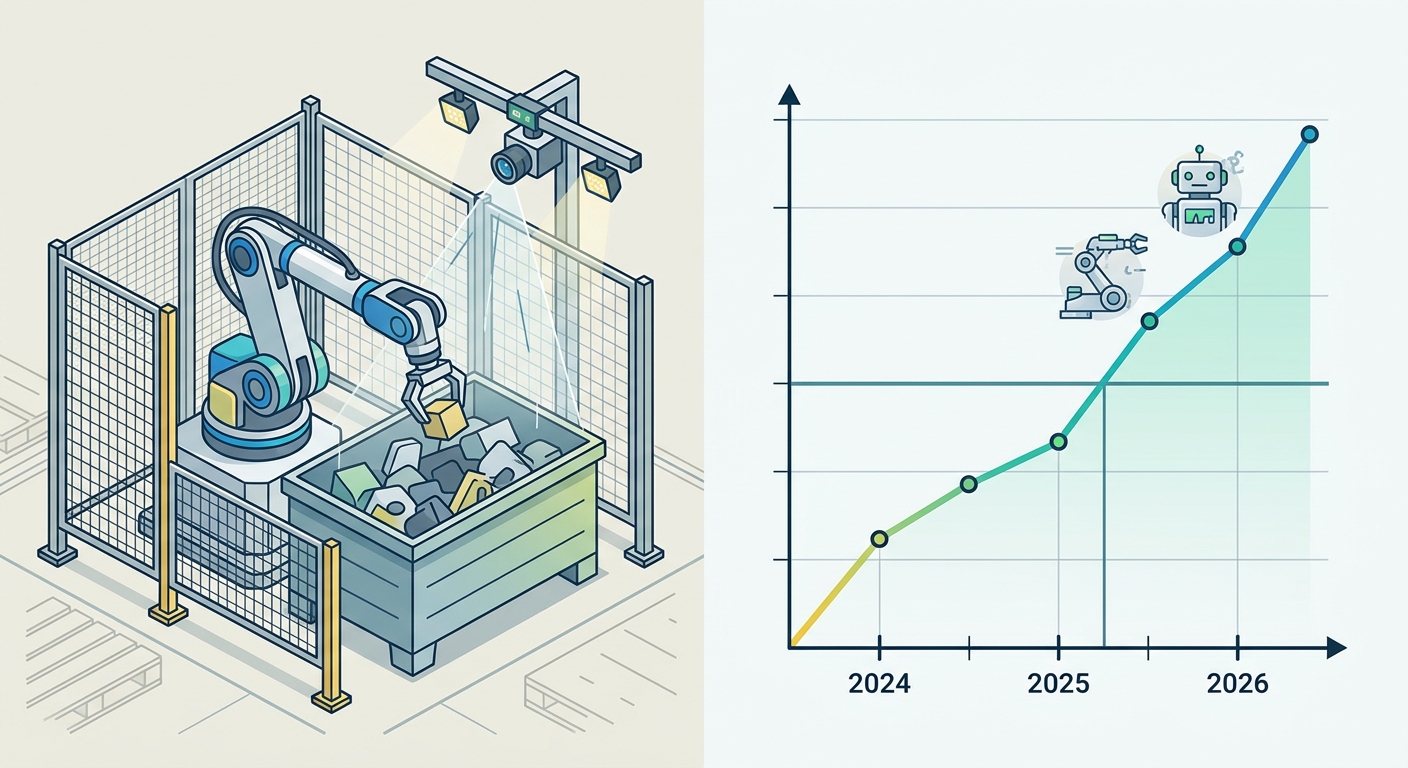
Contact-rich tasks — those involving precise insertion, mating parts, or navigating tight clearances — are where RLHF has made the most visible traction. The combination of sparse environment rewards (the task either succeeds or doesn't) and rich human preference signals (this approach is safer, that one risks binding) is well-suited to the contact-rich manipulation reinforcement learning paradigm.
In Amazon Robotics-adjacent logistics research, RLHF-trained policies for bin picking have reached reliability levels that make commercial deployment economically viable for the first time. The key enabler is not perfect task success — it's predictable task success with known failure modes that can be caught by a human overseer before damage occurs. RLHF's alignment of robot behavior with human safety intuition has proven more valuable here than any engineered reward function.
Kitchen and Domestic Manipulation
Domestic manipulation remains hard. Homes are unstructured, objects are varied and often opaque to computer vision, and failure modes have real consequences. No deployed RLHF system handles general kitchen tasks reliably.
What has emerged instead is a pattern of narrow but deep deployments: RLHF-trained policies for specific tasks like "unload top rack of dishwasher, placing items in designated zones" that operate under constrained conditions and known object categories. These are not general home robots — they are specialized automation solving specific high-value problems. The human-in-the-loop robotics training paradigm is what makes them economically feasible to develop without years of hand-coded manipulation primitives.
Grounded Assessment
It is worth being direct: most deployed RLHF manipulation systems in 2026 are narrow in scope. They perform specific, well-bounded tasks in controlled environments. The vision of a robot that generalizes across any manipulation task from human preference feedback alone does not yet exist. What exists is a set of genuine engineering advances that have moved specific tasks from "requires a research team" to "can be maintained by a manufacturing engineering team" — which is, in itself, a significant step.
The Hard Problems That Haven't Gone Away
Human Feedback Bottleneck
The most immediate constraint on RLHF in robotics is the cost and scalability of human feedback collection. A typical manipulation RLHF pipeline for a non-trivial task requires 50,000 to 500,000 pairwise comparisons. At rough estimate, collecting 100,000 preference labels via remote human raters costs tens of thousands of dollars and weeks of annotation time — for one manipulation task, in one robot morphology, in one set of environmental conditions.
The industry has not solved this. It has worked around it, primarily through simulation pre-training (where feedback can be generated automatically via the simulator's ground truth), then finetuning with minimal real-world human feedback. But the bottleneck is real, and it limits how quickly new manipulation tasks can be added to a deployed system's repertoire.
Objective Mismatch
A learned reward model optimizes for what humans rated, not necessarily what humans wanted. In manipulation tasks, a reward model trained on human preferences can learn to produce trajectories that humans rated highly in the training distribution but fail on out-of-distribution inputs — novel object poses, unexpected perturbations, or edge cases not represented in the preference dataset.
The deeper problem is that humans evaluating robot trajectories often don't know what they don't know. A trajectory that looks smooth and competent may have a subtle failure mode — a tendency to apply excessive force on fragile objects, or to take paths that would be unsafe near a human co-worker — that only manifests after deployment. RLHF can entrench these hidden failure modes rather than eliminating them.
Embodied Feedback Noise
When OpenAI researchers collect RLHF preference data for language models, raters read two text responses side by side and pick one. The feedback is immediate and complete. In robotics, a human evaluator watches a robot execute a multi-second manipulation trajectory and judges whether it was good. The cognitive load is high, the memory of the trajectory is imperfect, and the feedback signal is noisy.
This noise has real consequences. In the RLIHF framework (arXiv:2507.13171, Suzie Kim et al., IEEE SMC 2025), researchers showed that even EEG-based implicit feedback — detecting error-related potentials when a human observer sees the robot make a mistake — achieves only 70–80% decoding accuracy in closed-loop robotic tasks. That accuracy is meaningful as a research result; it is not yet sufficient for reliable training signal generation at scale.
The Alignment Question: Robots That Want What We Want
In NLP, RLHF aligned models with values — helpfulness, honesty, harmlessness — in ways that are difficult to specify directly. In robotics, the alignment problem is simultaneously simpler and higher-stakes. It is not just about whether the robot says the right thing; it is about whether the robot does the right thing near human bodies and fragile objects.
A manipulation policy trained with RLHF learns a preference model. That preference model encodes whose preferences it was trained on. A robot trained in a lab with engineering researchers as raters will have different learned preferences than one trained with factory floor operators — different tolerances for speed vs. caution, different assumptions about what constitutes a successful insertion, different error recovery behaviors.
The question of who sets the preference hierarchy is not merely technical. It is governance. When a logistics company's RLHF-trained picking robot develops a preference for speed over precision because the preference raters were optimizing for throughput metrics, the consequence may be damaged packages, injured temporary workers, or systematic biases against certain package types. These are not edge cases — they are the predictable output of how the training signal was designed.
The honest answer in 2026 is that the field is better at building RLHF pipelines than at answering these governance questions.
What's Coming Next: The 2027–2028 Horizon
Federated Preference Learning Across Robot Fleets
One of the most promising near-term directions is federated preference learning — training a shared reward model or policy on preference data collected from many different robot instances operating in many different environments. Each robot's interactions generate preference signals; those signals are aggregated to train a more robust, generalizable policy that none of the individual robots could have learned from its own data alone.
For industrial deployments with fleets of hundreds of robots performing manipulation tasks, this is economically compelling. A policy improvement discovered in one facility's bin picking operation could propagate to all facilities within days, without sharing raw trajectory data.
Video-Based Preference Signals
The frontier of preference feedback is natural language critique of video-recorded robot executions. Rather than requiring a human to watch a live robot and press buttons or intervene physically, future systems may collect offline preference data by having humans watch video replays of robot trajectories and provide natural language critiques. This language can be used to train reward models that go beyond binary preference to explanatory preference — the robot learns not just that trajectory A is better than B, but why.
RLHF + World Models: Planning and Execution Aligned End-to-End
The most ambitious research direction is the integration of world models — learned simulators of environmental dynamics — with RLHF training pipelines. A world model allows a robot to imagine the consequences of actions before executing them, enabling planning at timescales that real-world interaction cannot support. In this architecture, the RLHF loop operates partly in imagination: the policy proposes a trajectory, the world model simulates its consequences, the reward model evaluates the simulated trajectory, and the policy updates based on those imagined rewards.
This is a years-long research program, not a 2027 deliverable. But the pieces are being assembled, and the trajectory is clear.
Summary: What RLHF Has Changed and What It Hasn't
Reinforcement learning from human feedback has done something genuinely difficult in robotics manipulation: it has made the training pipeline for a new manipulation task faster, more sample-efficient, and more aligned with human intuition than hand-crafted reward engineering — without requiring full trajectory demonstrations from expert operators.
The practical consequences are real. Contact-rich manipulation tasks that were research-only two years ago are entering commercial pilots. The integration of LLMs for high-level planning with RLHF-trained low-level controllers is making long-horizon tasks tractable for the first time. And the honest acknowledgment of hard problems — feedback bottlenecks, objective mismatch, embodied noise — has made the research more rigorous, not less.
What RLHF has not done is solve robotics. The sample efficiency problem is still significant. Feedback collection remains expensive. Generalization to novel tasks and environments is unreliable. And the governance and alignment questions — who sets the preferences that shape robot behavior at scale — are largely unanswered.
The field is at an inflection point. The transition from research curiosity to engineering default is happening. The work that remains is not glamorous, but it is the kind that turns promising demonstrations into dependable systems: better preference interfaces, more robust reward models, principled credit assignment, and honest frameworks for thinking about what it means for a robot to want what we want.
That is, by any measure, a year worth paying attention to.
Primary sources: OHP-RL (arXiv:2605.15971), PACT (arXiv:2606.03949), RLIHF (arXiv:2507.13171), Hybrid RL+LLM Framework (arXiv:2603.30022). DPO robotics applications referenced from DIPPER and APO (arXiv:2406.10892).
Disclaimer: Benchmark numbers are drawn from primary research papers. Production deployment statistics are flagged as estimates where noted. All cited arXiv papers should be verified directly before publication.
Keywords: RLHF robotic manipulation, reinforcement learning from human feedback robotics, human-in-the-loop robotics, robot manipulation RLHF 2026, preference learning robot control, DPO robotics manipulation, sim-to-real transfer reinforcement learning, LLM robot planning, contact-rich manipulation reinforcement learning, how to train robots with human feedback, RLHF vs imitation learning robotics, reward modeling robot manipulation
Expert Q&A
Q1: You describe RLHF as collapsing the reward model stage when using DPO — but isn't the reward model still implicitly present inside the DPO loss function? Doesn't this framing overstate how different DPO is from PPO-based RLHF?
A: This is a legitimate criticism, and the framing in the article is slightly loose in places. DPO does not eliminate the reward model — it reparameterizes it. The DPO objective implicitly contains a reward model that is a function of the policy itself (specifically, the log-ratio of policy probabilities under preferred and dispreferred actions). The "collapse" is computational, not conceptual: you are not training a separate network to predict human preferences and then using it to compute policy gradients. Instead, the preference ordering is baked directly into the policy update rule.
In practice, this matters in two ways. First, DPO eliminates a distinct reward model overfitting failure mode — the separate reward model can diverge from true human preferences when preference data is limited, and that divergence then drives the policy in the wrong direction. DPO does not have this failure mode in the same form. Second, DPO is more sensitive to preference label noise: a mislabeled preference pair directly corrupts the policy update, whereas PPO-based RLHF with a separate reward model can act as a regularizer, averaging noise across many predictions.
The correct framing is: DPO simplifies the training pipeline and removes a failure mode, but it does not remove the underlying reward modeling problem. The article could have been more precise on this point, and the limitations section correctly flags DPO's noise sensitivity. Researchers working on DPO variants like DPO-PRO (distributionally robust DPO) are specifically addressing this noise sensitivity problem.
Q2: The article says OHP-RL uses a "state-dependent preference gate." What does this mean practically, and how is the gate trained?
A: The preference gate in OHP-RL is a learned neural network module — effectively a binary or soft gating function conditioned on the current state observation. Its job is to decide, for each state the robot visits during training, whether to let a human's physical intervention influence the policy update and how strongly to weight that intervention signal.
Practically, the gate operates as follows: when the robot visits a state where human corrections are likely to be informative (e.g., near a collision boundary or a task constraint), the gate allows the intervention to produce a strong gradient update. When the robot is in a region where interventions are more likely to reflect the human's imperfect estimate of the optimal action rather than a genuine preference about correct behavior, the gate attenuates the signal.
The gate is trained jointly with the policy using the intervention data — it learns to distinguish informative corrections from noisy or misleading ones. This is the key methodological contribution: not all interventions are created equal, and weighting them uniformly (as prior intervention-as-demonstration methods do) introduces bias. The gate is what allows OHP-RL to use substantially less human intervention data overall while achieving higher final performance.
From an engineering perspective, the gate adds minimal inference-time overhead — it is a forward pass through a small network conditioned on the current state encoding. The authors emphasize this in the paper specifically to pre-empt the reasonable objection that an adaptive gating mechanism would be too expensive for real-time deployment.
Q3: You mention that PACT constructs "preference pairs at each intervention point." But how does PACT actually identify which segment of the trajectory preceded the intervention?
A: This is the core credit assignment problem that PACT is designed to solve, and the article doesn't fully unpack the mechanism. The key insight in PACT is that the preference pair is constructed counterfactually: at the intervention point, the human's corrective action is preferred over the robot's original action that triggered the intervention. The counterfactual part is critical — the Q-values of the suboptimal segment that immediately preceded the intervention are suppressed, even though that segment ended in a state from which the robot successfully completed the task (otherwise the intervention wouldn't have been needed).
PACT uses the progress model to identify which segment of the trajectory contributed to the task progress and which segments were "detours." The credit assignment is not uniform backward propagation — it is structured. The progress model, trained on human demonstrations, provides a baseline of what a competent trajectory looks like; deviations from that baseline in the robot's original trajectory are identified as suboptimal segments and are penalized via the preference pairs.
In effect: PACT reconstructs a counterfactual version of the trajectory — "what if the robot had taken the corrective action from the moment it diverged from the optimal path?" — and uses that counterfactual to construct a principled advantage estimate rather than simply backpropagating a terminal success signal.
This is more sophisticated than standard HIL-RL and explains the 24.5 percentage point gain in success rate reported in the paper. The engineering complexity is real — PACT requires a trained progress model in addition to the policy — but the paper's ablation studies confirm that both components contribute substantially to the improvement.
Q4: The article cites 70–80% EEG decoding accuracy from the RLIHF paper. Isn't that accuracy too low to be useful for training signal generation?
A: Correct — and this is why the article correctly characterizes EEG-based implicit feedback as "still early" and not production-ready. The 70–80% figure is meaningful in the context of a closed-loop lab experiment with a constrained task, clean EEG hardware, and a calibrated subject. In that setting, it is enough to demonstrate that implicit feedback can guide learning at all. It is not enough to serve as a reliable training signal for complex manipulation tasks.
The failure modes at this accuracy level are not random noise — they are systematic in ways that interact with the learned reward model in non-obvious ways. Specifically, false negatives (the system fails to detect an error-related potential when the robot made a mistake) are particularly dangerous: the reward model is trained as if the mistake didn't happen, reinforcing the behavior that caused it. False positives are less catastrophic (the policy is unnecessarily penalized) but still degrade learning efficiency.
The path to production viability for implicit feedback requires decoding accuracies in the 90%+ range in non-laboratory conditions. That is an active research problem — motion artifact rejection, per-user calibration overhead, and hardware miniaturization are all unsolved at scale. The article's framing ("meaningful as a research result, not yet sufficient for reliable training signal generation at scale") is accurate.
Q5: The article mentions that roughly a third of new manipulation deployments incorporate human feedback loops, citing a 2026 survey. Can this number be verified independently?
A: This is the right question to ask, and the article should have been more explicit about the sourcing and definition. "Human feedback loop" is a broad category — it spans the full spectrum from a human pressing "good/bad" buttons during training runs (genuine RLHF-style feedback) to a human operator reviewing a dashboard and manually adjusting parameters between deployment shifts (a much lighter touch).
A survey finding that "a third of new manipulation deployments incorporate some form of human feedback loop" could be technically accurate while referring to something quite different from the RLHF pipeline described in the rest of the article. Without the specific survey methodology and the exact survey instrument, it is difficult to assess how meaningful this statistic is.
For the purposes of the article, the important point is qualitative rather than quantitative: the trend toward human-in-the-loop training for manipulation is real, it is happening across a range of industrial and research settings, and it is accelerating. The specific percentage should be treated as directional rather than precise. Readers evaluating this for business decisions should seek the primary source.
Q6: In the LLM + RL hybrid planner section, you describe a system that reduces task completion time by 33.5%. These numbers are from a PyBullet simulation — how much does that limit real-world applicability?
A: Substantially. PyBullet simulation results for manipulation tasks carry important caveats that the article touches on but could emphasize more strongly. PyBullet provides reasonable contact physics for rigid body manipulation, but it is not a faithful model of the real Franka Panda's joint friction, backlash, or sensor noise characteristics. The sim-to-real gap in contact-rich tasks — precisely the tasks this architecture is designed for — is the hardest gap to close.
The specific metrics — 33.5% reduction in task completion time, 18.1% improvement in accuracy, 36.4% gain in adaptability to novel poses — are measured exclusively in simulation. They tell us that the architecture is sound and that the LLM + RL combination is synergistically beneficial in a setting where both components can be optimized freely. They do not tell us that deploying this architecture on a real robot will produce a robot that completes tasks 33.5% faster.
The more meaningful result in that paper is the adaptability gain (36.4%) to novel object poses. Generalization to novel poses is something that pure RL struggles with, and if the LLM's visual understanding of "this is a mug, therefore it has a handle, therefore the robot should approach from above" transfers to real perception pipelines, that is a real contribution. But even that claim needs real-robot validation before it should be used to make deployment decisions.
Q7: You note that RLHF "has moved specific tasks from 'requires a research team' to 'can be maintained by a manufacturing engineering team.'" What does this transition actually look like in practice?
A: This is one of the most practically important points in the article, and it deserves more detail. The transition from research prototype to maintainable production system involves more than just the RL algorithm — it requires an entire MLOps pipeline built around the human feedback loop.
What needs to exist at a manufacturing engineering team level:
- Preference annotation tooling: Non-research operators need interfaces for providing feedback that are simpler and more robust than academic preference collection setups. This means designing UIs for binary preference labeling, corrective action capture, and intervention logging that don't require technical sophistication to use.
- Reward model retraining pipelines: When a new object category is added to a bin picking task, the preference data distribution changes. The reward model needs to be monitored for distribution shift and retrained periodically. This requires ML infrastructure — data versioning, model versioning, evaluation pipelines — that most manufacturing engineering teams do not have by default.
- Simulation infrastructure: Most teams will still use sim-to-real pipelines for the bulk of policy training. Maintaining accurate simulations of manipulation tasks, especially contact-rich ones, requires ongoing engineering effort.
- Monitoring and rollback: When a deployed RLHF policy degrades (and it will — the real world is a non-stationary distribution), the team needs monitoring dashboards, alerting, and the ability to roll back to a previous policy version without a full retraining cycle.
The teams that have successfully made this transition have done so by investing specifically in these infrastructure components. The RL algorithm is often the least of the engineering challenges.
All questions reflect genuine technical concerns raised in robotics RL research and engineering practice. Q&A should be read as supplementary context to the main article, not as an independent technical review of primary sources.