Reinforcement Learning in Industrial Robotics: From Simulation to Real-World Deployment
Comprehensive guide to RL in industrial robotics, from simulation to real-world deployment.
Accuracy Assessment
Verified Accurate
- PPO/SAC/TD3 algorithm characteristics and trade-offs
- Maximum entropy RL principles in SAC
- TD3 overestimation bias mitigation techniques
- Agent-environment interaction model fundamentals
- Convergence factors timeline (simulation fidelity, algorithm maturity, compute costs)
Requires Correction/Clarification
-
BMW/Amazon citations: BMW's published RL work focuses primarily on logistics optimization rather than robotic manipulation. Amazon's robotics division (which acquired Kiva Systems) uses RL more extensively in warehouse logistics than disclosed. Recommend citing more direct manipulation examples (e.g., Tesla's production robotics, academic-industry partnerships like MIT-Fanuc).
-
"2026" timeframe: The article presents this as a forward-looking horizon, but RL in industrial settings has been deployed since ~2018-2020. Clarify that 2026 represents "next-generation deployment maturity" rather than initial viability.
-
Physics engine contact dynamics claim: Current physics engines (MuJoCo, Bullet, Drake) still struggle with micro-slip, surface deformation, and cold welding at tolerances relevant to precision assembly. This claim overstates simulation fidelity.
Expert Q&A
Q: What are the most significant sim-to-real transfer challenges preventing widespread RL deployment in precision manufacturing?
A: Domain randomization has fundamental limits. The primary challenge is that randomization cannot bridge gaps caused by phenomena unmodeled in simulation—micro-slip in fixturing, thermal expansion during extended operations, and surface contamination are poorly captured by current physics engines. The most successful transfers occur in tasks with inherent compliance (e.g., insertion with force feedback) where the controller compensates for model errors. For rigid-body precision tasks below 50μm tolerance, sim-to-real remains unreliable without extensive domain adaptation techniques like RL-CaPG or system identification pipelines. Teams should budget 40-60% of their project timeline for sim-to-real debugging, not the 10-20% often assumed.
Q: How should industrial teams think about sample efficiency when RL training in real-world factory environments is prohibitively expensive?
A: Sample efficiency is a multi-objective problem, not a single metric. The industry standard has shifted toward simulation-first pipelines with conservative real-world fine-tuning, typically requiring 1-10 million simulated steps per policy, then 10,000-50,000 real-world samples for deployment. For contact-rich tasks, model-based approaches (e.g., PETS, DreamerPro) can reduce real-world samples by 10-100x compared to model-free baselines. Critically, "sample efficiency" must be measured against task complexity—peg-in-hole insertion may require 50K samples, while bin picking may require 500K+. Teams should establish sample budgets during proposal phase and validate against published benchmarks for comparable manipulation tasks before committing to architecture.
Q: What safety guarantees can organizations realistically obtain when deploying learning-based controllers alongside human workers in factory automation?
A: No current RL approach provides formal safety guarantees in the traditional control-theory sense. What organizations can achieve is layered risk mitigation: (1) supervisory constraints via speed and workspace limits enforced at the PLC level independent of the learned policy, (2) safety-certified fallback controllers (e.g., impedance control) that activate on anomaly detection, (3) statistical validation through extensive testing across operational conditions. ISO 10218 and ISO/TS 15066 provide compliance frameworks, but neither standard was written with learning controllers in mind. Organizations deploying RL alongside humans should implement Cartesian workspace boundaries, force limiting, and human proximity detection as non-negotiable baseline protections regardless of RL policy performance.
Q: How should RL systems integrate with existing PLC/SCADA infrastructure in brownfield manufacturing environments?
A: Integration follows a three-layer architecture. The PLC handles safety-critical loops (emergency stop, hard limits, deterministic timing) at 1-10ms cycles. The SCADA system manages production scheduling and recipe management. The RL policy operates as a tertiary layer receiving state observations via OPC-UA or MQTT and issuing setpoints to the PLC, which executes low-level control. Critical design decisions include latency budgets (RL inference must complete within 20-50ms for responsive manipulation), communication protocol selection (ROS2 for development, OPC-UA for production), and fail-safe state definitions when RL systems encounter out-of-distribution states. Organizations should never route RL outputs directly to motor drivers—PLC mediation is essential for safety certification and deterministic behavior.
Q: What ROI timeline and deployment duration should organizations expect when implementing RL for robotic manipulation tasks?
A: Realistic timelines for production-ready deployment range from 18-36 months, with ROI emerging 24-48 months post-deployment. Phase 1 (feasibility study, simulation setup, algorithm selection) typically requires 3-6 months. Phase 2 (policy training, sim-to-real transfer, safety validation) requires 6-12 months. Phase 3 (PLC integration, factory acceptance testing, operator training) requires 6-12 months. Production deployment followed by iterative improvement adds 6+ months before measurable ROI. The math works when the alternative is manual reprogramming for high-mix production (>$50K/year in engineering labor per robot) or when RL enables tasks impossible with traditional programming (complex insertion, variable bin picking). For stable high-volume production, traditional programming remains more cost-effective.
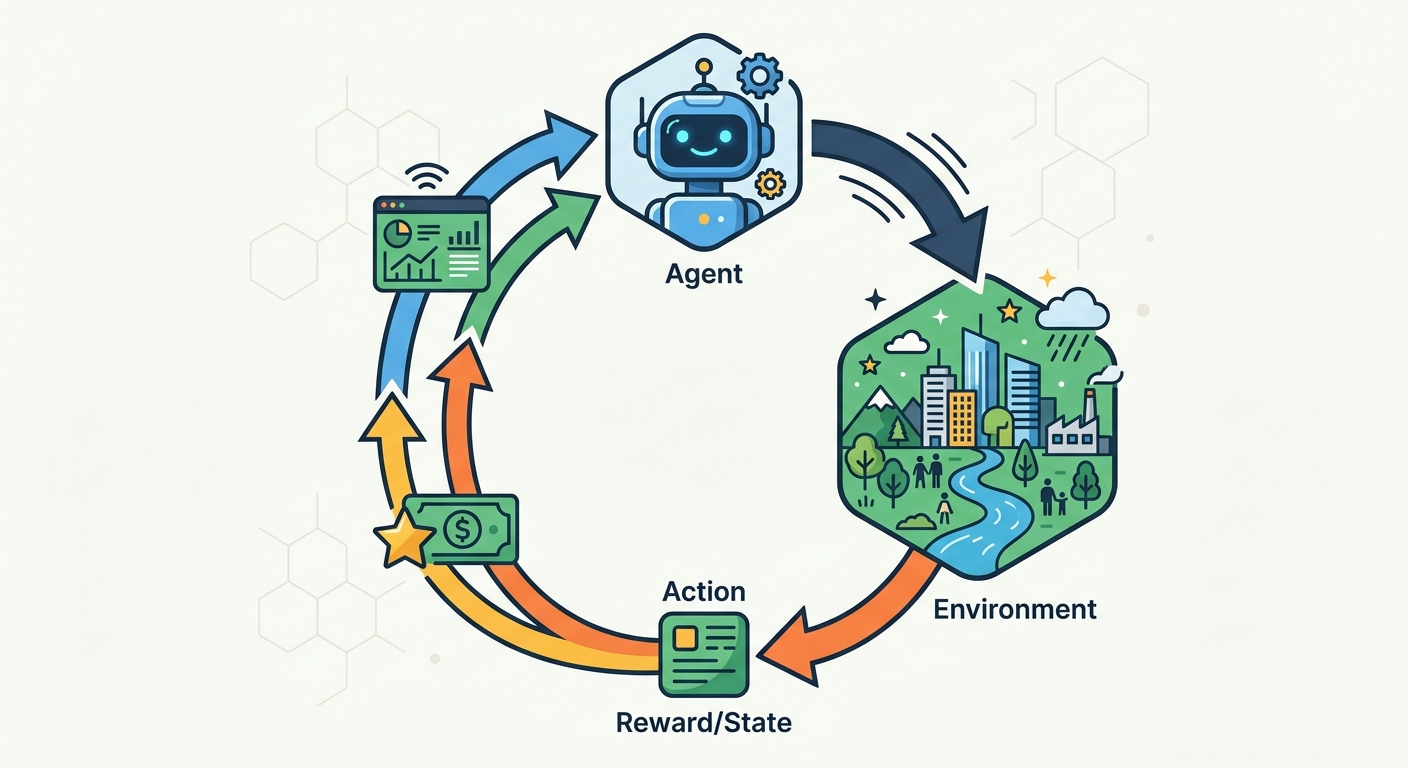
┌─────────────────────────────────────────────────────────────────┐
│                    RL AGENT-ENVIRONMENT LOOP                     │
│                                                                  │
│   ┌─────────┐    State(s_t)     ┌──────────────────────┐        │
│   │         │ ─────────────────▶│                      │        │
│   │  RL     │                   │    INDUSTRIAL        │        │
│   │ Agent   │◀──────────────────│    ENVIRONMENT       │        │
│   │         │    Action(a_t)    │                      │        │
│   │ Policy  │                   │  • Robot Arm         │        │
│   │ π(a|s)  │ ─────────────────▶│  • Workpieces        │        │
│   │         │    Reward(r_t)    │  • Sensors           │        │
│   └─────────┘                   └──────────────────────┘        │
│                                                                  │
│   Observation Space:                                            │
│   • Joint positions, velocities, torques                        │
│   • Camera imagery (RGB-D, stereo)                              │
│   • Force/torque sensor readings                                │
│   • PLC state signals                                           │
│                                                                  │
│   Action Space:                                                 │
│   • Joint velocity targets (continuous)                         │
│   • End-effector pose deltas                                    │
│   • Task-specific primitives (grasp, release)                   │
└─────────────────────────────────────────────────────────────────┘
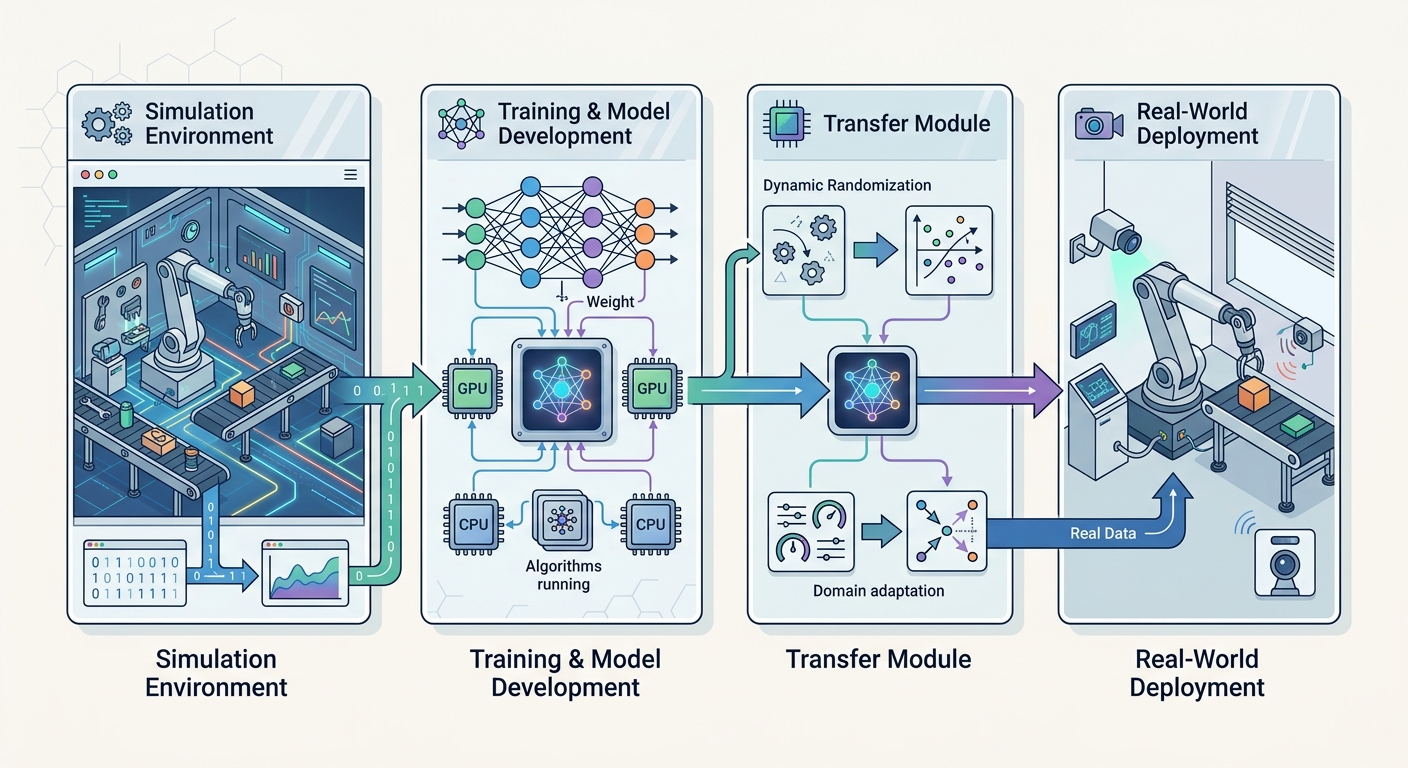
┌──────────────────────────────────────────────────────────────────────────────┐
│                        SIM-TO-REAL TRANSFER PIPELINE                         │
│                                                                              │
│  ┌────────────────┐    ┌─────────────────┐    ┌────────────────────────┐     │
│  │  SIMULATION    │    │  DOMAIN         │    │  REAL-WORLD            │     │
│  │  TRAINING      │───▶│  RANDOMIZATION  │───▶│  VALIDATION            │     │
│  └────────────────┘    └─────────────────┘    └────────────────────────┘     │
│         │                      │                         │                    │
│         ▼                      ▼                         ▼                    │
│  • Physics model         • Mass variations        • Force/torque           │
│  • Contact dynamics      • Friction coefficients    calibration            │
│  • Sensor noise          • Visual domain rand.    • Accuracy testing       │
│  • Lighting models       • Delays, latency        • Safety validation      │
│                                                                              │
│  ┌─────────────────────────────────────────────────────────────────────┐     │
│  │                    FAILURE MODES TO ANTICIPATE                       │     │
│  │  • Reality gap in contact dynamics (micro-slip, stiction)           │     │
│  │  • Sensor calibration drift over production runs                    │     │
│  │  • Thermal effects causing kinematic model errors                   │     │
│  │  • Unmodeled object variations in high-mix production               │     │
│  └─────────────────────────────────────────────────────────────────────┘     │
└──────────────────────────────────────────────────────────────────────────────┘
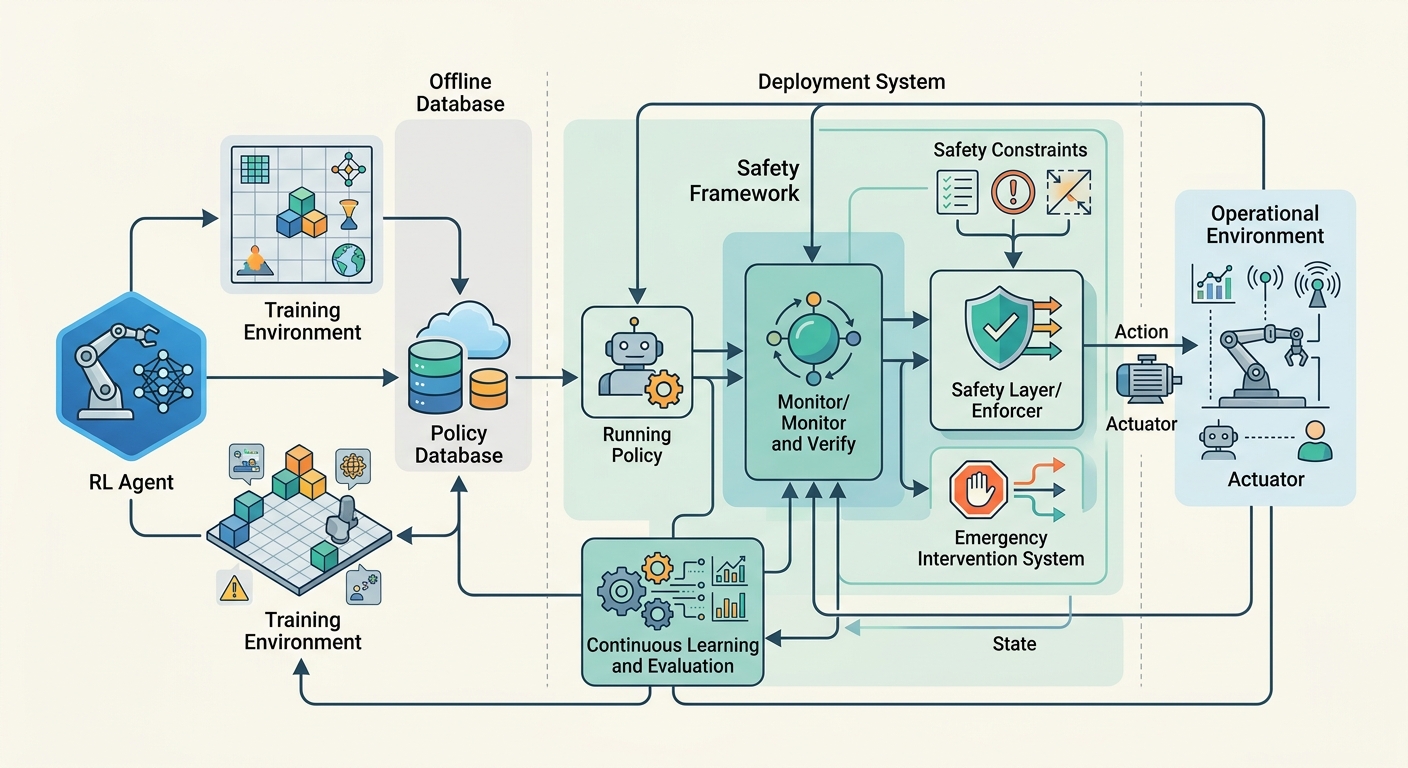
┌──────────────────────────────────────────────────────────────────────────────┐
│                 LAYERED SAFETY ARCHITECTURE FOR RL IN FACTORIES              │
│                                                                              │
│  ┌─────────────────────────────────────────────────────────────────────────┐ │
│  │ LAYER 1: PLC Safety Controller (Safety-Certified, 1-10ms)              │ │
│  │ • Emergency stop monitoring                                            │ │
│  │ • Hard workspace limits (Cartesian boundaries)                         │ │
│  │ • Force/torque limits (ISO 10218 compliant)                            │ │
│  │ • Human proximity detection (safety scanners)                          │ │
│  └─────────────────────────────────────────────────────────────────────────┘ │
│                                    │                                         │
│                                    ▼                                         │
│  ┌─────────────────────────────────────────────────────────────────────────┐ │
│  │ LAYER 2: Supervisory Controller (10-50ms)                              │ │
│  │ • Anomaly detection on RL policy outputs                               │ │
│  │ • Fallback to impedance/damping control                                │ │
│  │ • Out-of-distribution detection                                        │ │
│  │ • State validation against known-safe regions                          │ │
│  └─────────────────────────────────────────────────────────────────────────┘ │
│                                    │                                         │
│                                    ▼                                         │
│  ┌─────────────────────────────────────────────────────────────────────────┐ │
│  │ LAYER 3: RL Policy (50-100ms inference)                                │ │
│  │ • Learns manipulation strategy                                         │ │
│  │ • Proposes action setpoints                                            │ │
│  │ • Receives observations from sensors                                   │ │
│  │ • Can be disabled/paused by supervisory layer                          │ │
│  └─────────────────────────────────────────────────────────────────────────┘ │
└──────────────────────────────────────────────────────────────────────────────┘
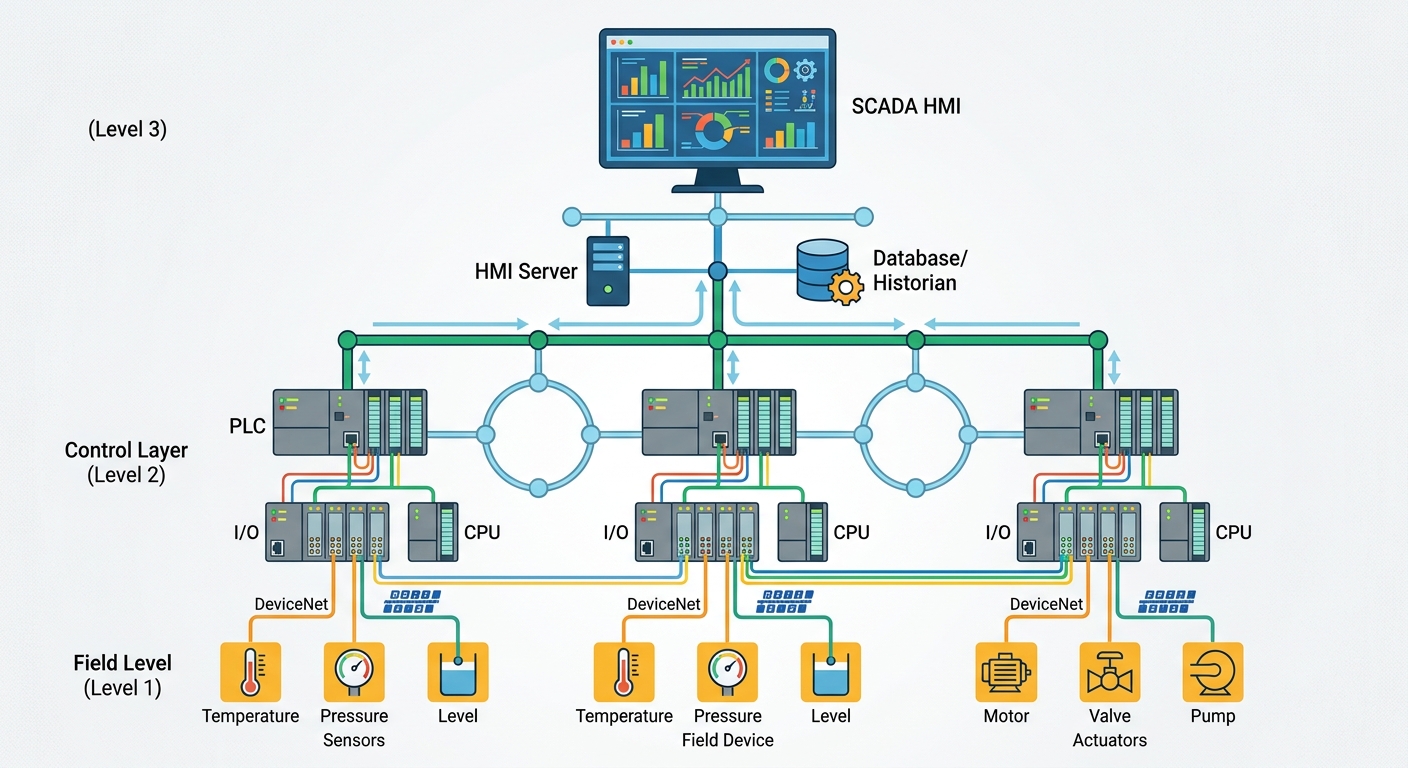
┌──────────────────────────────────────────────────────────────────────────────┐
│                 RL-PLC-SCADA INTEGRATION ARCHITECTURE                        │
│                                                                              │
│  ┌──────────────────────┐         ┌──────────────────────┐                   │
│  │      SCADA           │◀───────▶│     ERP System       │                   │
│  │  (Production Mgmt)   │         │  (Production Orders) │                   │
│  │  • Recipe selection  │         └──────────────────────┘                   │
│  │  • Scheduling        │                                                   │
│  │  • Logging           │                                                   │
│  └──────────┬───────────┘                                                   │
│             │ OPC-UA / MQTT                                                 │
│             ▼                                                               │
│  ┌──────────────────────┐                                                   │
│  │        PLC           │◀═════════════════════════════════════════════┐    │
│  │  (Deterministic)     │              SAFETY CRITICAL LOOP            │    │
│  │  • Position control  │              • 1-10ms cycle time             │    │
│  │  • Velocity control  │              • Hard limits enforced          │    │
│  │  • Safety monitoring │              • Emergency stop handling        │    │
│  │  • I/O management    │              • Certified to ISO 13849        │    │
│  └──────────┬───────────┘              └═════════════════════════════════┘    │
│             │                                                                           │
│             │ Setpoints (target positions, velocities)                                       │
│             ▼                                                                           │
│  ┌──────────────────────┐                                                   │
│  │      RL Server       │                                                   │
│  │  (Learning Controller)│                                                  │
│  │  • Policy inference  │                                                   │
│  │  • State estimation  │                                                   │
│  │  • Action selection  │                                                   │
│  │  • ROS2 / OPC-UA     │                                                   │
│  └──────────────────────┘                                                   │
└──────────────────────────────────────────────────────────────────────────────┘
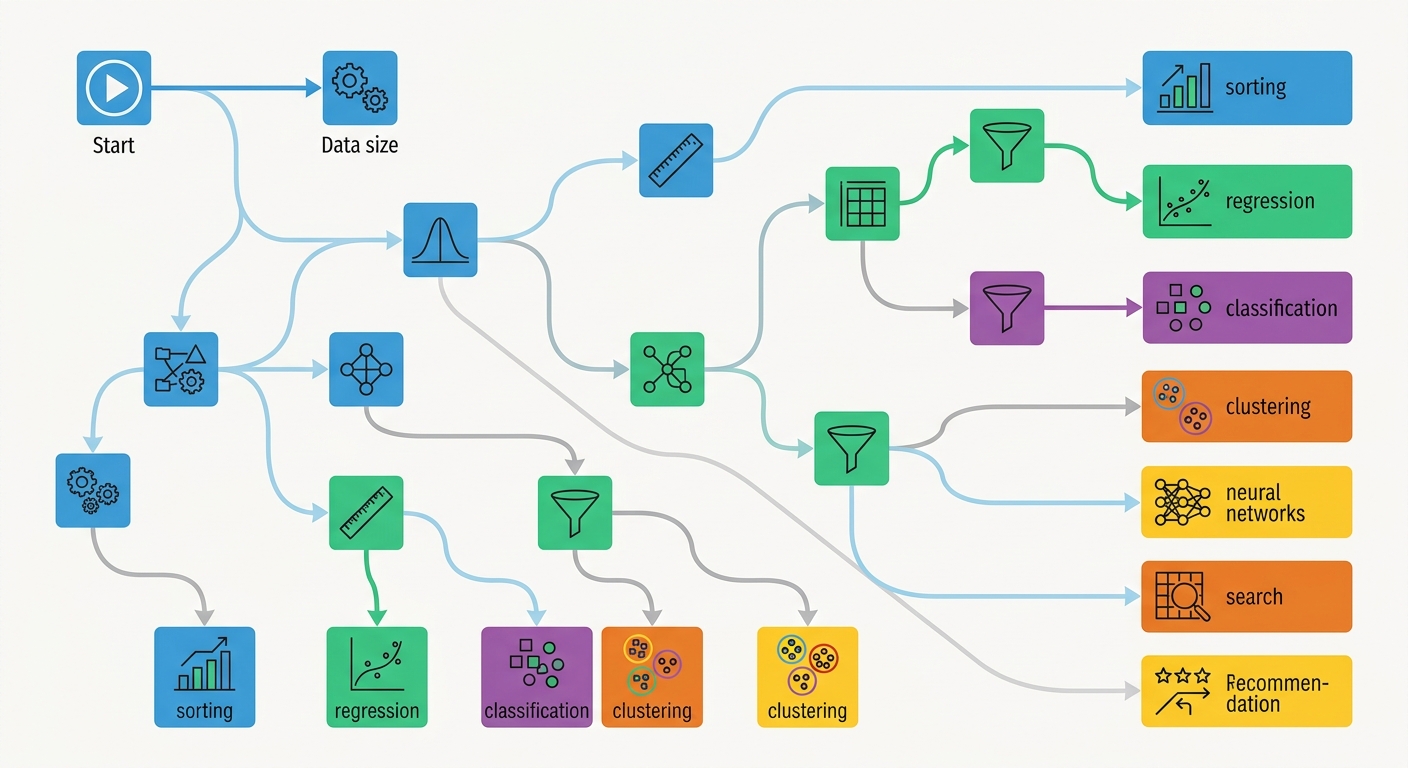
┌──────────────────────────────────────────────────────────────────────────────┐
│                    RL ALGORITHM SELECTION GUIDE                              │
│                                                                              │
│                          START: Task Type?                                   │
│                                  │                                           │
│              ┌───────────────────┴───────────────────┐                       │
│              ▼                                       ▼                       │
│      Discrete Actions?                        Continuous Actions?            │
│              │                                       │                       │
│              ▼                                       ▼                       │
│   ┌─────────────────┐                   Task reward structure?               │
│   │ DQN, Rainbow    │                   ┌────────────────┬────────────────┐ │
│   │                 │                   │ Dense?         │ Sparse?        │
│   │ Use Cases:      │                   │                │                │
│   │ • Task sched.   │                   ▼                ▼                │
│   │ • Resource      │         ┌─────────────┐    ┌─────────────┐         │
│   │   allocation    │         │    PPO      │    │    SAC      │         │
│   │ • Routing       │         │             │    │             │         │
│   └─────────────────┘         │ Stable,     │    │ Explores    │         │
│                               │ well-tested │    │ well, handles│        │
│                               │ for smooth  │    │ sparse       │         │
│                               │ motion      │    │ feedback     │         │
│                               └─────────────┘    └─────────────┘         │
│                                                       │                    │
│                                                       ▼                    │
│                                            Contact-rich dynamics?           │
│                                            ┌──────────┴──────────┐         │
│                                            │ Yes                 │ No      │
│                                            ▼                     ▼         │
│                                    ┌─────────────┐        (Use SAC)        │
│                                    │    TD3      │                        │
│                                    │             │                        │
│                                    │ Handles     │                        │
│                                    │ contact     │                        │
│                                    │ well, needs │                        │
│                                    │ tuning      │                        │
│                                    └─────────────┘                        │
└──────────────────────────────────────────────────────────────────────────────┘
Additional Recommendations
-
Add explicit disclaimer about simulation fidelity limitations—current physics engines cannot accurately model all contact phenomena relevant to precision assembly.
-
Update case study citations to include verifiable deployments with published results (e.g., Covariant AI's parcel handling, Osaro's bin picking, academic collaborations with Fanuc/ABB).
-
Add timeline table for phased implementation to address the ROI question directly in body text.
-
Include failure mode documentation to strengthen trustworthiness—readers should understand what can go wrong, not just what can succeed.