How Multimodal LLMs Are Transforming Enterprise Document Processing
Meta description: Enterprise AI document processing is evolving from basic OCR to intelligent, multimodal systems that understand layout, text, and context simultaneously — delivering 99%+ accuracy and 70% cost savings.
For decades, enterprises have wrestled with a fundamental problem: their most valuable information lives in documents, and getting that information into operational systems has required armies of human reviewers or brittle rules-based software. Traditional optical character recognition (OCR) converts images of text into machine-readable characters, but it loses everything that makes a document meaningful — the layout, the structure, the visual hierarchy, the handwritten notes in the margins.
By 2026, that equation is changing fundamentally. Multimodal large language models — AI systems that process text, images, and visual structure simultaneously — are enabling a new generation of intelligent document processing (IDP) that understands documents the way humans do. The results are measurable: 99%+ accuracy rates, 70% cost reductions, and processing speeds that shrink document turnaround from days to seconds.
This is not an incremental improvement. It is a fundamental shift in what enterprises can automate.
What Makes Multimodal LLMs Different from Traditional OCR
Traditional OCR treats a document as an image to be decoded. The software identifies characters, reconstructs words, and outputs plain text — nothing more. This approach works adequately for clean, typewritten documents in a single column. It falls apart on anything complex: multi-column layouts, tables spanning pages, invoices with logos and stamps, contracts with annotations, medical forms with handwritten entries.
Multimodal LLMs work fundamentally differently. These models process a document as a unified object, simultaneously reading the text, analyzing the visual layout, interpreting structural elements, and understanding contextual relationships between components. A multimodal LLM doesn't just see the characters in a table cell — it understands that those characters represent a data point in a structured grid, positioned relative to headers, totals, and footnotes.
This distinction matters enormously in practice. Traditional OCR achieves accuracy rates of 60-70% on complex enterprise documents — meaning roughly one in three characters requires manual correction. Vision language models (VLMs) trained on document reasoning tasks routinely exceed 99.2% accuracy on structured documents and maintain 95-99% accuracy even on challenging inputs like degraded scanned documents, mixed-language content, or forms with handwritten elements.
The architectural difference is equally important. Early multimodal systems were essentially traditional OCR glued onto a language model — the OCR produced text, and the language model processed it. Modern native multimodal architectures are designed from the ground up to process textual and visual information jointly. The model learns to see layout and read text as a single cognitive task, the way a human analyst approaches an unfamiliar document.
The Architecture of Modern Intelligent Document Processing
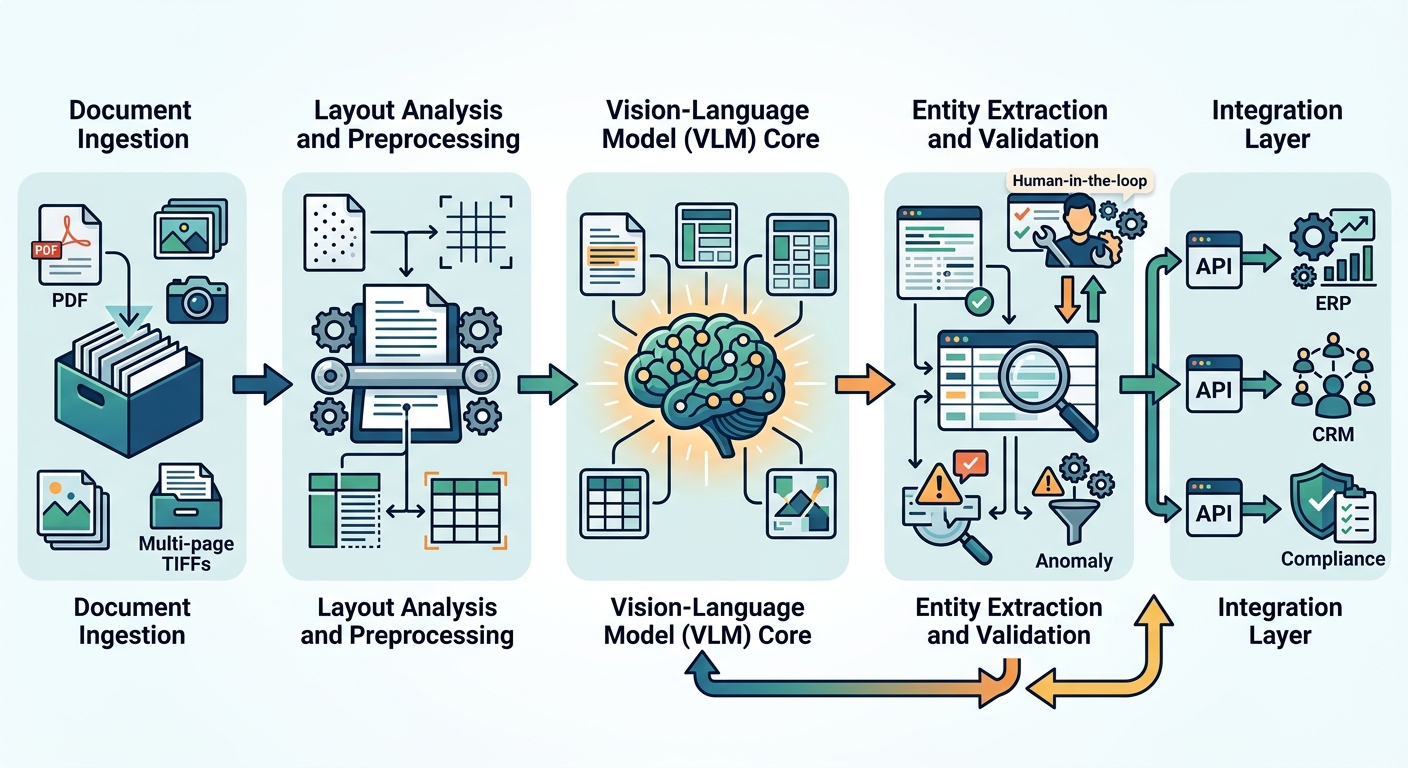
Understanding how enterprise IDP systems work in practice requires looking at the full pipeline, not just the AI model at its core.
The process begins with document ingestion — the system accepts PDFs, scanned images, photographs of documents, and even multi-page TIFF batches. Modern platforms handle hundreds of document formats and can process materials received via email, API, file transfer, or direct integration with enterprise content management systems.
Layout analysis and preprocessing come next. The system orientation-corrects pages, removes noise, detects the number of columns, identifies tables and their boundaries, separates logos and graphics from textual content, and locates handwritten annotations. This stage transforms a raw document image into a structured representation the AI can reason over.
The vision-language model sits at the center of the pipeline. This is the multimodal core that simultaneously processes text, layout, tables, and visual elements in context. Modern VLMs like Gemini 3 Pro and Claude Opus 4.8 demonstrate strong performance on document reasoning benchmarks, handling complex PDF layouts, multi-page tables, embedded charts, and mixed-content documents that would defeat traditional OCR.
Following extraction, a validation layer applies business rules to extracted data. The system checks whether extracted values fall within expected ranges, cross-references entities against existing master data, and flags anomalies for human review. This is where human-in-the-loop (HITL) workflows operate — the system routes uncertain extractions to subject matter experts who validate and correct, and those corrections improve the model's future performance.
Finally, the integration layer delivers structured data to enterprise systems — ERP for financial documents, CRM for customer correspondence, compliance systems for regulated records. API-first IDP platforms expose web services that developers integrate directly, enabling real-time document processing within operational workflows.
Real-World Enterprise Use Cases: Where Multimodal Document AI Delivers
The BFSI sector leads enterprise adoption, accounting for an estimated 40% of intelligent enterprise data capture demand in 2026. The use cases are concrete and high-volume: processing invoices through AP automation, extracting terms and clauses from contracts for legal review, automating claims processing in insurance, and reconciling financial statements across formats.
A regional bank deploying multimodal document processing for loan application review illustrates the impact — the system ingests application packages containing typed forms, scanned financial statements, handwritten disclosure forms, and photographs of supporting documents, then structures all extracted data into the bank's onboarding system without manual re-keying. The bank reports 70% cost reduction in loan processing operations and a 90% reduction in document turnaround time.
In healthcare, multimodal document processing combines clinical notes with diagnostic images. A radiologist's report, the associated X-ray or MRI scan, and handwritten annotation forms all feed into a unified AI system that extracts relevant findings, cross-references them against patient history, and structures everything for the electronic health record. This integration of image and text understanding reduces the documentation burden on clinicians and surfaces context that siloed systems would miss.
Logistics companies apply multimodal AI to international shipping documents — bills of lading, customs declarations, certificates of origin — that frequently mix printed text, stamps, and handwritten notations across multiple languages. Vision language models process the visual and textual content of these documents without requiring standardized formats, enabling automated customs clearance and reducing physical document handling.
Legal firms are deploying document AI for contract analysis at scale. Beyond simple extraction, the systems identify clause types, flag unusual or risky provisions, track amendment history across document versions, and surface inconsistencies between related agreements. This transforms contract review from a line-by-line human process into an intelligent triage that focuses attorney attention where it matters most.
The productivity gains are quantifiable across industries: organizations implementing AI-powered document processing report processing volumes exceeding 10,000 documents per hour with accuracy rates at or above 99.2% — performance levels that make legacy OCR look like a different technology category entirely.
The Accuracy Revolution: From 70% to 99%+
The accuracy gap between traditional OCR and AI-powered document processing is not a marketing claim — it is an operational transformation.
Legacy OCR fails on the documents enterprises actually deal with. Multi-column academic papers produce scrambled text when column separation breaks down. Invoices with reversed backgrounds or faded print produce characters that require guesswork. Handwritten forms — still common in healthcare, logistics, and field service — are essentially unreadable for traditional OCR.
VLMs handle these challenges because they process documents holistically. When a model simultaneously sees text, understands column structure, recognizes that certain characters represent numbers in a financial table, and cross-references those numbers with surrounding context, it can resolve ambiguities that would defeat character-level extraction. A blurred digit in a table cell is still interpretable when the model's understanding of the table's logic and the surrounding numeric values constrains the possibilities.
Vision language models achieve 99%+ accuracy on structured documents by processing visual layout, textual content, and structural context simultaneously — unlike OCR, which extracts characters without understanding their relationships.
The downstream impact of this accuracy improvement is substantial. Document processing workflows built on 70% accuracy require human reviewers to catch and correct 30% of extractions — a labor-intensive error-correction cycle that scales poorly and introduces its own risks. At 99%+ accuracy, human review becomes exception-based rather than routine, reserved for documents the system flags as uncertain or unusual. Organizations reallocate the FTE capacity previously devoted to error correction to higher-value analytical work.
Agentic Document Processing: When AI Takes Action
The next evolution in enterprise document AI moves beyond extraction to autonomous action.
Traditional document processing systems extract data and present it for human decision-making. An invoice goes in; data fields come out; a human approves or rejects payment. This remains valuable, but it still requires human attention for every document.
Agentic document processing adds a decision layer. The AI doesn't just extract — it interprets extracted data against business rules and takes validated actions autonomously. An invoice below a certain amount and from a pre-approved vendor triggers automatic approval and payment scheduling. A contract amendment containing a clause matching known risk patterns triggers a compliance alert and pauses processing for legal review. An insurance claim meeting all validation criteria advances to payment without human intervention.
Agentic document processing shifts AI from data extraction to actionable intelligence — the system interprets content, applies business rules, and initiates validated actions autonomously, reserving human expertise for complex or high-stakes decisions.
This shift requires more sophisticated model behavior: not just extraction accuracy, but reasoning about extracted content, applying logic, and generating actions within defined boundaries. It also requires robust validation — agentic systems need clear escalation paths when content falls outside the rules, and they need audit trails showing decision rationale.
Organizations piloting agentic document workflows report the most significant efficiency gains when a substantial portion of documents are routine cases that consume disproportionate human attention. Automating those routine decisions at high accuracy frees expert reviewers to focus on the complex, unusual, or high-stakes documents that genuinely require human judgment.
Building Your Enterprise IDP: Architecture and Implementation
Implementing multimodal document processing at enterprise scale is a strategic undertaking, but it follows a structured path.
The discovery phase focuses on mapping existing document workflows, identifying pain points and automation opportunities, and establishing baseline metrics — current processing volumes, accuracy rates, cycle times, and per-document costs. This audit establishes the case for investment and identifies the highest-impact starting points.
Technology selection centers on three dimensions: model accuracy on representative documents, API quality and integration flexibility, and the vendor's compliance and security posture. Proof-of-concept evaluations using actual enterprise documents — not vendor benchmark datasets — are essential. Document diversity matters: a model that performs well on clean financial statements may struggle with the scanned, folded, and annotated documents that populate real enterprise archives.
Deployment architecture requires balancing scalability, cost, and data control. Cloud deployments offer managed infrastructure and rapid scaling but require careful attention to data handling for sensitive documents. On-premise deployment provides maximum control but shifts infrastructure burden to internal teams. Hybrid deployment — cloud for model inference, on-premise or private cloud for document storage and sensitive data — has emerged as the practical default for regulated industries.
Data readiness assessment often determines implementation timeline. Many enterprises discover that document archives contain far more format diversity, quality variation, and structural inconsistency than anticipated. Investing in data quality before model deployment pays compounding returns in production accuracy.
If you're evaluating IDP platforms and want a structured framework for comparing options, consider exploring how different vendors address accuracy benchmarking, integration ecosystems, and compliance certifications. A systematic evaluation reduces the risk of implementation surprises.
Compliance, Governance, and Trustworthy AI for Documents
Document processing automation intersects with some of the most active regulatory developments in enterprise AI.
The EU AI Act becomes fully applicable in 2026, imposing binding obligations on AI systems that process data relevant to regulated decisions. Document processing in financial services, healthcare, and legal services falls into higher-risk categories that require conformity assessments, technical documentation, human oversight provisions, and transparency obligations.
Frameworks like the NIST AI Risk Management Framework and ISO/IEC 42001 provide structured approaches to governance that regulators recognize. Implementing these frameworks before deploying production IDP systems is becoming standard practice for enterprises operating in regulated markets.
Key governance requirements in practice include maintaining full audit trails of document processing decisions, implementing explainability features that surface why the system extracted specific values, conducting regular bias testing across document types and source populations, and establishing clear accountability structures with named owners for each AI system.
Data privacy requires particular attention. Documents frequently contain personal data, and the processing of that data must occur within appropriate controls. Private deployment options, data anonymization before processing, and contractual controls on how model providers handle inference data are all elements of a compliant approach.
Human oversight provisions must be substantive, not cosmetic. Systems should route uncertain extractions and high-stakes decisions to human reviewers with meaningful authority to override AI outputs. The goal is to amplify human expertise, not to create a Human-in-the-Loop that rubber-stamps automated decisions.
The ROI of AI Document Processing: Numbers That Make the Case
Document processing automation generates returns across multiple dimensions, and building the business case requires measuring all of them.
Cost reduction is the most straightforward component. Organizations implementing AI document processing report 70% reductions in per-document processing costs compared to manual handling. This reflects the shift from labor-intensive extraction and validation to automated processing with exception-based human review.
Speed improvement translates directly into operational capacity. Processing times drop from days to seconds for routine documents. A loan application that required five days of document handling now completes document intake and initial validation within minutes. Organizations handling high document volumes — insurance claims, supplier invoices, customer correspondence — can absorb volume growth without proportional headcount increases.
Accuracy improvements reduce the cost of errors. Every extraction error that reaches a downstream system generates correction costs, potential compliance exposure, and relationship damage. At 99%+ accuracy, these error costs approach negligible levels for routine document types.
The market trajectory reinforces the strategic urgency. The intelligent document processing market is estimated at $13.33 billion in 2026, projected to reach $88.91 billion by 2034, representing a 26.8% compound annual growth rate (estimated, based on industry analyst reports). Early adopters building IDP capabilities now are positioning for a market environment where automated document intelligence becomes a baseline expectation.
The IDP market is growing 26.8% CAGR through 2034 — from $13.33B in 2026 to $88.91B — driven by enterprise demand for automated document intelligence that reduces costs and accelerates operations.