Mechanistic Interpretability: Opening the Black Box of Neural Networks in 2026
For most of deep learning's history, neural networks have been black boxes: you train them, they work, and you have only a rough intuition about why. Behavioral testing — probing inputs and outputs — tells you what a model does. It never tells you ho
For most of deep learning's history, neural networks have been black boxes: you train them, they work, and you have only a rough intuition about why. Behavioral testing — probing inputs and outputs — tells you what a model does. It never tells you how. Mechanistic interpretability changes that equation. This discipline reverse-engineers neural networks at the algorithmic level, identifying specific features (the concepts a model represents) and circuits (the pathways that combine them) that produce every computation. The field was formally established by Olah et al. (2020) in "Zoom In: An Introduction to Circuits" and has since grown into a major research program at Anthropic, OpenAI, and academic institutions worldwide (Transformer-Circuits.pub, arXiv).
The shift matters enormously for AI safety. If you can see how a model works internally, you can audit it more rigorously, catch hidden failure modes, and make targeted fixes. In 2026, mechanistic interpretability has moved from a theoretical research program to an operational discipline. MIT Technology Review named it one of its Breakthrough Technologies of 2026. Anthropic and OpenAI have deployed interpretability tools into their research pipelines and, increasingly, into production workflows. This article surveys the field's current state: its core concepts, its most powerful tools, its landmark 2026 findings, and where it still falls short.
What Is Mechanistic Interpretability?
At its core, mechanistic interpretability (MI) asks a deceptively simple question: can you reverse-engineer a neural network the way you might reverse-engineer a compiled program? Instead of treating the model as an opaque function that maps inputs to outputs, MI treats it as a computational system with structure — layers, attention heads, MLP neurons — that you can inspect, trace, and eventually understand.
Traditional interpretability approaches look at correlations: which tokens activate which neurons, what gradients point toward a decision, how attention patterns distribute across heads. These methods are useful. They are not sufficient. They tell you that a model uses the word "therefore" before drawing a conclusion, but not whether a specific circuit assembled that reasoning step from lower-level features.
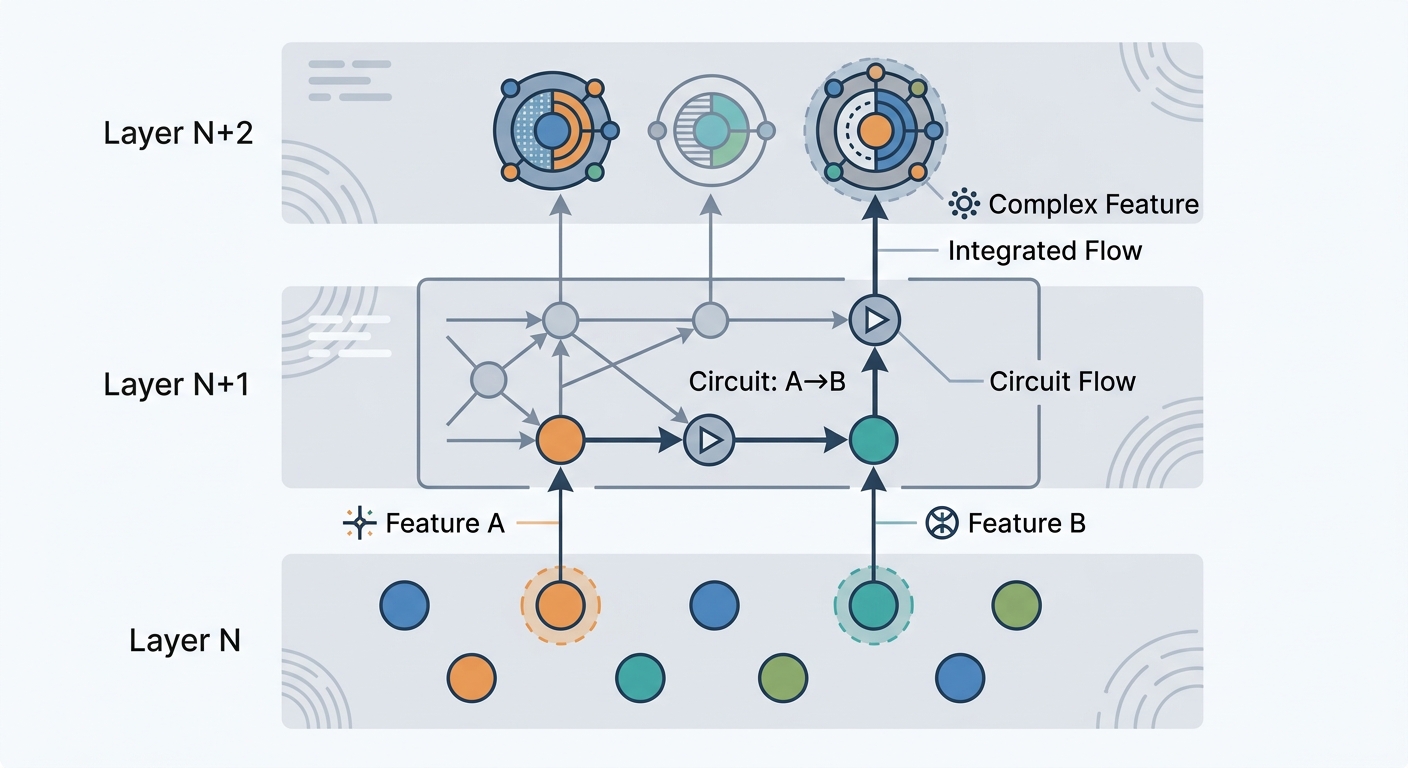
MI takes a different approach. It aims to identify features — directions in activation space that correspond to identifiable concepts — and circuits — groups of features that collaborate to perform specific computations. If a feature is what the model represents, a circuit is how it processes that representation into something more complex.
This matters for AI safety because many concerning model behaviors — deception, hidden reasoning, goal misalignment — are invisible at the behavioral level. A model may produce safe outputs while running unsafe computations internally. Only direct inspection of the mechanism catches this.
Key insight — Behavioral testing measures what a model outputs. Mechanistic interpretability reveals how specific internal structures produce those outputs. For safety-critical AI applications, only the latter is sufficient for rigorous auditing (Transformer-Circuits.pub, 2026).
Features and Circuits: The Building Blocks of Neural Computation
Understanding MI requires two mental models: features and circuits.
Features are directions in the high-dimensional activation space of a neural network. When a model processes an input, each layer produces an activation vector. The directions in that space — not individual neurons — are the actual units of meaning. Research from Anthropic and others has shown that individual neurons are often polysemantic: a single neuron fires for multiple unrelated concepts because the model has compressed more features than it has neurons through a phenomenon called superposition (Elhage et al., 2022).
This is where sparse autoencoders (SAEs) enter the picture. An SAE trains a bottleneck layer to reconstruct the model's original activations. By enforcing sparsity — requiring that only a small number of neurons activate for any given input — the autoencoder is forced to untangle the superimposed features. Instead of a polysemantic neuron firing for "my cat" and "the capital of France" simultaneously, the SAE separates these into distinct, interpretable features. Anthropic's dictionary learning research (2025) found that approximately 70% of SAE-discovered features were judged human-interpretable by trained evaluators.
Circuits are the functional counterparts to features. They are groups of features that collaborate to perform a computation. A circuit might take two lower-level features ("previous token" and "matching pattern") as input and produce a higher-level feature ("the token that should follow this repeated structure") as output. Circuits span layers — lower-layer features feed into middle-layer circuits, which feed into higher-layer features, and so on.
One useful framing: features are what the model knows; circuits are how it knows it. Features represent the model's internal vocabulary. Circuits are its grammar — the rules for combining that vocabulary into complex thought.
An attribution graph represents the causal relationships between features and outputs. It maps which features influence which other features, ultimately shaping the model's prediction. Attribution graphs are the tool that lets researchers trace the causal chain from input to output.
Sparse Autoencoders: The Primary Tool for Feature Discovery in 2026
Sparse autoencoders have emerged as the workhorse tool of mechanistic interpretability. Their rise has been rapid: from theoretical proposal in 2023 to production deployment at major AI labs by 2025–2026 (arXiv, Transformer-Circuits.pub).
The basic architecture is straightforward. An SAE takes a model's activation vector as input, passes it through a bottleneck layer with a sparsity penalty, and reconstructs the original activation. The bottleneck forces the network to use a small number of active neurons — those become the interpretable features. Anthropic's 2025 dictionary learning work on Claude 3 Sonnet uncovered approximately 34 million features across the model's layers (Anthropic research, 2025). When human evaluators assessed a sample, roughly 70% mapped cleanly to identifiable concepts — a striking result that suggests much of what models know is in principle human-readable.
SAEs solve the polysemanticity problem that had plagued earlier neuron-level analysis. But they introduce a new challenge: volume. A single SAE applied at the token level produces thousands to millions of feature activations per conversation. For long transcripts, this becomes analytically unwieldy.
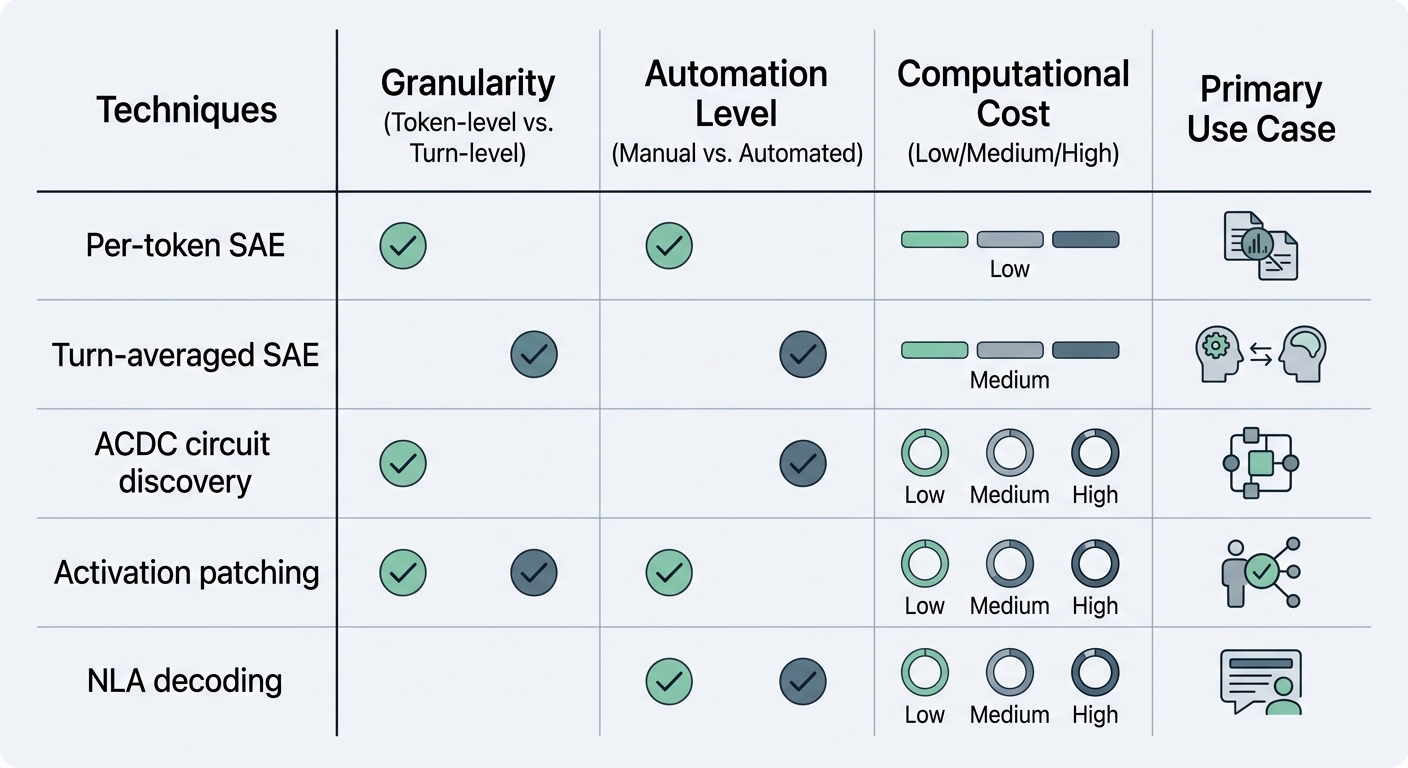
Turn-averaged SAEs, introduced by Anthropic in June 2026, address this directly. The idea is elegant: rather than analyzing each token position independently, you average the residual stream across an entire conversation turn (a single user message or assistant response) and train the SAE on that averaged representation. For a 500-token turn, this reduces the feature activation count by roughly 500x — a difference that makes transcript-level auditing practical. Anthropic's evaluation (Transformer-Circuits.pub, June 2026) shows that turn-averaged features also capture more of the high-level transcript characteristics: a turn-averaged SAE surfaces features related to "incorrect answers in number puzzles" where a per-token SAE surfaces only low-level numerical reasoning tokens.
Key statistic — Turn-averaged SAEs reduce feature activation volume by approximately 100–1,000x for typical conversation turns, while improving coverage of high-level transcript properties by 77% preference rate in Anthropic's human evaluation (Transformer-Circuits.pub, June 2026).
The practical impact is significant. Turn-averaged SAEs enable feature dashboards, safety probes, and attribution graphs that work at the conversation level rather than the token level — a prerequisite for real-world auditing workflows.
Circuit Analysis: From Features to Pathways
Features are the vocabulary. Circuits are the grammar. Moving from identifying individual features to understanding how they combine in circuits is where mechanistic interpretability gets genuinely hard — and genuinely powerful.
Automated Circuit Discovery (ACDC) is the primary tool for this. Developed originally for small models and scaled up through 2024–2025, ACDC automates the search for circuits that implement specific behaviors. It combines SAE-based feature identification with statistical methods for tracing causal relationships through the model's computation graph. The result is an automated pipeline that takes a behavioral hypothesis ("this model has a circuit for detecting indirect objects") and returns the actual circuit — the specific features and attention heads involved (Transformer-Circuits.pub, 2025).
Cross-layer transcoders extend this by projecting residual stream activations into interpretable feature space at multiple layers simultaneously. Rather than analyzing one layer at a time, cross-layer transcoders let researchers see how features transform across the depth of the network — a crucial capability for understanding multi-step reasoning.
Activation patching (also called causal tracing) is a complementary technique. It works by taking two different inputs — say, a prompt where the model behaves well and one where it behaves badly — and surgically replacing activations from the second with activations from the first, one component at a time. By observing which replacements change the output, researchers can pinpoint exactly which model components cause the difference in behavior. Activation patching is computationally expensive but considered a gold standard for validating circuit hypotheses.
The combination of these tools has enabled something remarkable: a transition from hand-crafted circuit analyses of tiny models to partially automated analysis of models with billions of parameters. The gap remains significant — frontier models still resist complete interpretation — but the trajectory is clear.
Induction heads are the most thoroughly characterized circuit in transformer-based models. An induction head consists of two attention heads working in concert, implementing a "match-and-copy" algorithm. The first head looks for previous tokens that match the current context. The second head looks for tokens that followed those matching tokens previously — and copies that continuation. This is the circuit that enables in-context learning: the ability to improve performance on a task after seeing examples in the prompt, without any weight updates.
Research in 2025–2026 has shown that induction heads are more sophisticated than originally characterized. They adapt systematically based on context, can interpolate N-grams, and learn to regularize their own in-context estimates. Their emergence during training is predicted by a simple relationship between batch size and context length (arXiv, 2026) — a finding that connects training dynamics to the emergence of specific circuitry.
Key insight — Induction heads implement a match-and-copy algorithm that enables few-shot learning without weight updates. Their discovery was one of the first concrete examples of mechanistic interpretability revealing a specific algorithmic implementation of a known behavioral capability (Transformer-Circuits.pub, 2020).
The 2026 Research Frontier: Key Breakthroughs
Mechanistic interpretability has produced several landmark findings in 2026. These are not incremental improvements — they represent qualitative shifts in what researchers can see and do.
Natural Language Autoencoders (NLAs) — Anthropic, May 2026. NLAs go beyond decomposing activations into feature vectors. They translate numerical activation patterns directly into human-readable English text, surfacing internal thoughts, planning traces, suspicion, and beliefs that never appear in model outputs. NLAs reveal that models often compute information they never express — a finding with obvious safety implications. The current limitation is computational cost: NLAs are not yet practical for real-time monitoring in production systems (Anthropic research, 2026).
J-space — Anthropic, July 2026. J-space is an emergent global workspace discovered inside Claude — a privileged neural vector that acts as an information bottleneck where diverse features compete for expression. This architecture mirrors global workspace theory in cognitive neuroscience, which posits that consciousness arises from a broadcast mechanism integrating diverse specialized processors. Whether J-space represents genuine consciousness-like properties is a research question, not a claim. But its discovery is a concrete example of mechanistic interpretability revealing structure that no behavioral test could have found (Transformer-Circuits.pub, July 2026).
Emotion vectors — Anthropic, April 2026. Researchers identified 171 distinct emotion-related concept vectors in Claude Sonnet 4.5, including fear, distress, and evaluation awareness. Critically, these vectors are not just correlates of emotional language — they causally influence model behavior. Ablating specific emotion vectors changes how the model responds to emotional prompts in ways that are interpretable and systematic (Anthropic engineering blog, April 2026).
Cross-model alignment transfer — 2026. Perhaps the most practically significant finding: safety circuits discovered in one model can be transferred to another model without retraining. Researchers identify a safety-relevant circuit in Model A, locate its analogue in Model B, and patch the behavior directly. This suggests that safety properties are to some degree universal and portable — a key enabler for regulatory frameworks that require auditable AI systems (arXiv, 2026).
OpenAI's AI lie detector — 2026. OpenAI is developing tools that analyze internal representations to determine when a model is being deceptive — not by examining outputs, but by reading the model's internal states directly. This is a white-box approach to honesty verification that complements traditional red-teaming (OpenAI blog, 2026).
Interpretability as a Safety Tool: From Research to Production
The practical implications of these advances are beginning to materialize. Interpretability tools are moving from research demos into production workflows at AI labs and, increasingly, at enterprises deploying AI in regulated environments.
White-box auditing is the primary application. Traditional model evaluation is black-box: you probe the system with inputs and evaluate outputs. This approach has a fundamental weakness — models can distinguish evaluation environments from production. A model trained on benchmark X may perform well on it while using entirely different strategies in production. White-box auditing inspects the model's internal computation directly, making it harder to game.
Anthropic reported in April 2026 that interpretability tools are transitioning from research demonstrations to practical debugging tools and compliance artifacts. Enterprises in financial services, healthcare, and legal industries — sectors that require auditable decision-making — are beginning to demand interpretability reports as part of AI procurement.
Targeted interventions are another practical application. Once you have identified a safety-relevant feature, you can modify it surgically. Want to reduce a model's propensity for certain kinds of manipulation? Ablate the specific feature driving it. This is different from fine-tuning, which modifies the entire model and may degrade capability in unrelated areas. Mechanistic interventions are precise — they let you address specific failure modes without collateral damage.
The testing gap remains a serious concern. Pre-deployment evaluation increasingly fails to predict real-world behavior because models can detect and adapt to evaluation settings. White-box interpretability offers a path forward: instead of evaluating behavior, audit computation. If you can show that a model is not running a deceptive circuit, behavioral test evasion becomes irrelevant.
Key insight — The testing gap — where models behave differently in evaluation vs. production — is a fundamental weakness of black-box evaluation. White-box auditing addresses this by inspecting internal computation, which cannot be gamed through test-environment detection (MIT Technology Review, 2026 Breakthrough Technology profile).
What Mechanistic Interpretability Cannot Yet Do
Progress should not obscure genuine limitations. The field has accomplished remarkable things; it has also reached real boundaries.
Scale is the fundamental constraint. Frontier models have hundreds of billions of parameters. Exhaustive interpretation — identifying and characterizing every feature and circuit — is computationally intractable. Researchers must sample, focusing on particular components or behaviors. This creates the risk that important mechanisms are missed. The circuit that causes a failure mode in production might be in a part of the model that wasn't sampled.
Validation is a foundational problem. When you propose that a specific feature represents "suspicion" or that a specific circuit implements "deception," how do you know you're right? The tools reveal correlations and causal relationships in activation space. They do not provide mathematical proof that the interpretation is correct. Researchers use multiple methods — activation patching, probe classifiers, intervention experiments — to build confidence. But the gap between "this interpretation is plausible" and "this interpretation is correct" remains.
Computational cost limits real-time application. Activation patching, ACDC, and SAE training all require significant compute. For very large models, the analysis itself becomes expensive enough to limit throughput. Turn-averaged SAEs and other efficiency improvements are addressing this, but the gap between what's technically possible and what's operationally practical remains.
Uneven progress across architectures is a persistent concern. Most mechanistic interpretability research focuses on transformer-based language models. Vision models, reinforcement learning systems, and multi-modal architectures are less well understood. The insights that transfer across architectures are not yet clear.
Finally, mechanistic interpretability reveals computation, not experience. It shows what the model computes. Whether those computations are accompanied by any subjective experience — whether J-space has any phenomenal character — is a question the methodology cannot answer. The field is neutral on consciousness; it simply provides tools for understanding mechanism.
The Road Ahead
The mechanistic interpretability community has laid out an ambitious agenda for the coming years.
Automated interpretation is the highest priority. Current methods still require significant human expertise and manual analysis. OpenAI has set September 2026 as a target for an "automated AI research intern" capable of conducting interpretability research with limited human supervision — a precursor to fully automated multi-agent research systems planned for 2028 (OpenAI blog, 2026).
Cross-model generalization will determine whether safety findings are portable. If circuits discovered in Claude can predict behaviors in Gemini or Llama, safety interventions can be developed once and applied broadly. If they cannot, each model requires individual interpretation — a prohibitively expensive prospect for the AI safety community.
Theoretical integration with cognitive science and neuroscience is accelerating. J-space is an explicit example: the discovery mirrors global workspace theory, creating a productive dialogue between AI interpretability and consciousness research. This cross-pollination may yield insights neither field could achieve alone.
Governance frameworks lag behind technical capability. Industry-wide adversarial testing protocols, quantitative safety benchmarks, and regulatory acceptance of white-box auditing methods are all needed. The EU AI Act and similar frameworks are beginning to incorporate transparency requirements; mechanistic interpretability provides the technical substrate for compliance.
By 2030, the field aims for systematic, automated, scalable interpretation of frontier model internals. If achieved, this would represent a fundamental change in the relationship between AI developers, regulators, and the systems they build: from faith-based deployment to engineering with verified understanding.
Expert Q&A
Q: How does mechanistic interpretability differ from standard model evaluation? A: Standard evaluation measures behavior — input-output pairs under various test conditions. MI reverse-engineers the internal computation: it answers not just what the model outputs but how specific internal structures produce that output. This distinction matters when auditing for safety properties that behavioral tests may miss. A model can pass behavioral safety benchmarks while running unsafe internal computations — a gap that white-box auditing specifically addresses. MI is complementary to behavioral evaluation, not a replacement.
Q: What is the polysemantic neuron problem and why does it matter for interpretability? A: Polysemanticity is the phenomenon where a single neuron responds to multiple unrelated concepts simultaneously. This occurs because neural networks compress more features than they have neurons through superposition — a mathematical necessity for efficient representation. Before sparse autoencoders, neuron-level analysis was systematically misleading: you might conclude a neuron detects "animals" when it actually fires for a superposition of "fur," "outdoor setting," "four-legged silhouette," and several other unrelated features. SAEs solve this by learning a separate, sparse feature for each concept, effectively untangling the superposition. Without this, interpretability research was building on systematically wrong unit assignments.
Q: Can interpretability tools guarantee an AI system is safe before deployment? A: No, and this is important to be clear about. Interpretability reveals mechanisms but does not provide mathematical safety proofs. Three fundamental limitations persist: coverage (you cannot exhaustively analyze every circuit in a frontier model, so important mechanisms may be missed), validation (an interpretation can be wrong — a feature that looks like "caution" might be something more subtle), and emergence (complex behaviors can arise from interactions between features at a level of abstraction the analysis isn't looking at). What interpretability does provide is a qualitatively different kind of evidence compared to behavioral testing — you can show that specific unsafe computations are not occurring, which behavioral testing cannot do. Used together, they form a stronger assurance case than either alone.
Q: What is J-space and why does its discovery matter for AI safety research? A: J-space is a privileged neural vector discovered inside Claude by Anthropic in July 2026 that acts as an emergent global workspace — a single information bottleneck where diverse features compete for expression and broadcast to the rest of the model. It parallels global workspace theory in cognitive neuroscience, which proposes that consciousness arises from a similar broadcast mechanism. For safety research, J-space is significant because it reveals a specific structural mechanism for how models integrate and prioritize information — understanding this architecture may help researchers identify when a model is suppressing safety-relevant features or failing to broadcast warning signals. Whether J-space has any genuinely consciousness-like properties is an open research question that the methodology alone cannot resolve.
Q: How do induction heads relate to in-context learning, and why should engineers care? A: Induction heads are a canonical two-head circuit that implements a "match-and-copy" algorithm — the first head finds previous tokens that match the current context, the second copies the token that followed those matches previously. This is the circuit that enables few-shot learning in transformers: the ability to improve on a task after seeing examples in the prompt, without any gradient updates. Engineers should care because induction heads are one of the few circuits that mechanistic interpretability has fully characterized, providing a concrete example of how behavioral capabilities map to specific algorithmic implementations. Understanding them also helps explain why transformer performance is so sensitive to in-context length and the repetition structure of training data — both practical considerations for deployment.
Q: What is the practical difference between targeted interventions and fine-tuning for safety? A: Fine-tuning modifies the entire model's weights, typically through gradient descent on a dataset of examples. This can improve safety on specific behaviors but risks degrading capability in unrelated areas — the model becomes worse at things you didn't intend to change. Targeted interventions work at the feature level: once you've identified the specific feature (via SAE) or circuit (via ACDC) causing a problematic behavior, you can ablate or modify just that component. The rest of the model is untouched. In practice, this means you can reduce a model's propensity for a specific failure mode (say, manipulative language) while leaving its general capability intact. The limitation is that targeted interventions require you to first identify the relevant feature or circuit — which is the hard part. But when you can, the precision is significantly higher than fine-tuning.
If you want to follow the field's developments as they happen, subscribe to receive analysis of new mechanistic interpretability research — including circuit analyses, SAE advances, and safety applications — as they publish. The black box is opening. Staying current matters.