Long-Context and Multimodal Reasoning: How 2026 LLMs Are Closing the Enterprise Data Gap
The Million-Token Moment Has Arrived For years, the biggest constraint on enterprise AI was a simple one. You could not fit your data into the model. A 40-p...
The Million-Token Moment Has Arrived
For years, the biggest constraint on enterprise AI was a simple one. You could not fit your data into the model. A 40-page contract, a full codebase, a quarter's worth of financial statements — these far exceeded the old context windows. So engineers built elaborate pipelines to slice documents into pieces, store them in a search index, and stitch answers back together.
That constraint has loosened dramatically.
In 2026, frontier models ship with context windows of one million tokens and beyond. Some reach ten million. An architecture like the one behind the latest Llama variants advertises up to 10 million tokens, while several flagship releases sit at the million-token mark. This is not a small step. It is the difference between summarizing a paragraph and reasoning over an entire library.
The change matters for a specific reason. A larger window means a model can hold an entire document in memory at once. It can cross-reference the first page against the last. It can weigh competing clauses in a contract without a retrieval system in between. Enterprise teams are starting to ask a new question. Not "how do we fit the document into the model?" but "which of several documents can we fit at once?"
This is a genuine capability shift. It is also, as we will see, not the whole story.
Key insight — Bigger windows help, but advertised capacity and usable capacity are not the same thing. The practical ceiling is often 30–40% of the number on the box.
What Long Context Actually Buys the Enterprise
Let us be concrete about the value. Long context changes three kinds of work.
First, whole-document reasoning. A legal team can feed an entire multi-page agreement to a model and ask it to identify conflicting obligations between section two and section fourteen. A compliance officer can check a full policy document against a regulatory change in one pass. No chunking, no retrieval, no loss of structure across splits.
Second, codebase-scale analysis. An engineering lead can load a repository, its compiler output, and its test logs into a single session. The model can trace a bug from a failing test through several modules, propose a fix, and verify it against the same context. Long-horizon agent loops benefit because the model keeps the full history of iterations without running out of room.
Third, stack simplification. When a task stays inside a bounded set of documents, you can drop part of the retrieval machinery. Fewer index components, fewer embedding jobs, less glue code. In our own evals, teams report meaningful engineering time returned to product work once they stop maintaining a retrieval layer for a bounded corpus.
But here is the honest boundary. One context window is not a data lake. Enterprise data is measured in terabytes and petabytes. No window of ten million tokens comes close. If your question spans your whole warehouse, retrieval is not optional.
Long-context windows replace retrieval only for bounded, well-defined document domains.
"Lost in the Middle" and the Effective Context Window
There is a second, subtler limitation. A model's ability to use information is not uniform across a long window. Research shows a pattern called "lost in the middle." A model reliably answers questions about content at the start and the end of a long input. It struggles with content buried in the middle.
The practical result is the effective context window, or MECW. This is the amount of context a model can actually reason over reliably. It is routinely far smaller than the advertised number. Accuracy often degrades once you pass roughly 30–40% of claimed capacity on complex tasks.
This has two implications. First, do not trust the spec sheet. Order your most important content toward the edges. Or use evidence linking to hold the middle together. Second, stress-test any model on your own long documents before committing an architecture to it. A model that quotes a 1M-token window but loses track of its own contracts is a model you cannot rely on.
Multimodal Reasoning Moves from Demo to Production
Long context solves one half of the problem. The other half is that enterprise data is not just text.
A typical financial report mixes paragraphs, tables, charts, and footnotes. A scanned contract may contain handwriting, rotated pages, stamps, and a table that breaks across a page boundary. An insurance claim bundles photos, forms, and structured fields. Early LLMs could not see any of this. OCR pipelines turned it into imperfect text, losing layout and meaning along the way.
The 2026 multimodal generation changes that. Current models read text, tables, charts, and scanned layouts in a single pass, in their native positions. They do not need a separate OCR step to interpret a chart alongside its caption. Systems built on architectures such as GLM-4.5V, Qwen2.5-VL, and the latest Gemini and GPT and Claude lineups handle interleaved documents well. That is the kind of PDF that mixes figures, tables, and prose.
The more important shift is semantic. These models no longer stop at extraction. They reason over what they see. A model can read a chart, notice the trend contradicts a statement in the prose, and flag the inconsistency. It can pull a figure from a table and use it in a calculation. It can read a form, validate it against an internal rule, and route it for approval.
This moves document AI from "tell me what is on the page" to "tell me what this means and what to do next." For enterprises, that is the difference between a scanner and a decision engine.
Multimodal models read text, charts, tables, and scans in one shared representational space.
Document Fidelity — the New OCR Yardstick
That capability needs a better way to measure it.
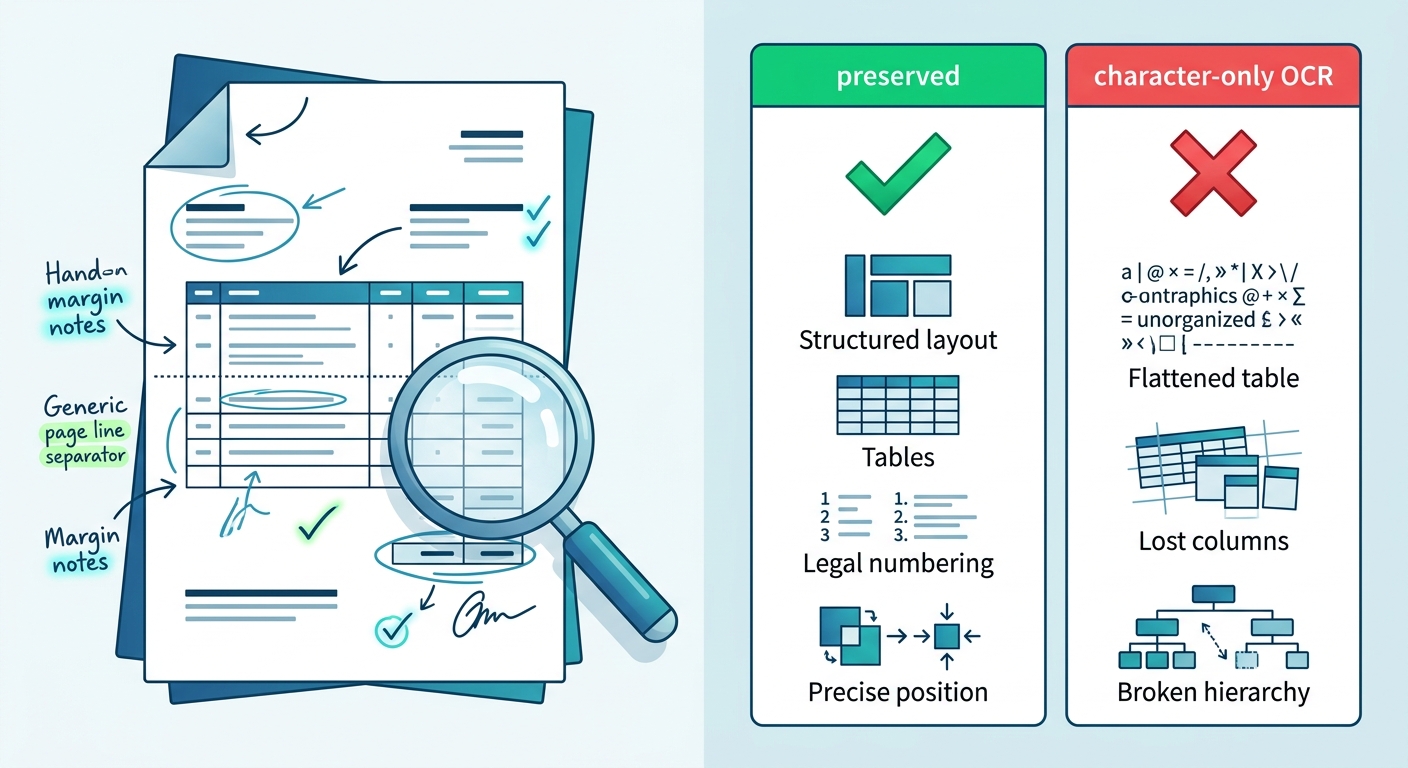
Traditional OCR benchmarks score character accuracy — how many letters came out right. That metric misses the real problem.
Consider a scanned table that spans a page break. The characters may all be correct. But if the model loses the column structure somewhere in the middle, every extracted field is wrong anyway. Or consider a legal document where numbering and indentation carry meaning. Preserve the text but flatten the hierarchy, and the document loses its legal force.
This is why the 2026 benchmark standard is shifting toward "document fidelity." The idea is to evaluate how well a model preserves layout, tables, legal numbering, and positional context — not just characters. Benchmarks such as Omni OCR, DocVQA, and ChartQA are built around this idea. The official OCR evaluation suite now flags that most strong multimodal models still score below half on realistic reproduction tests.
The lesson for buyers is direct. Public benchmarks use clean, curated documents. Your production documents are messy. A model that shines on a neat sample often loses accuracy on a rotated scan with a handwritten margin note. Evaluate on your own messy files, not on the marketing scorecard.
The Hard Part — the Enterprise Data Gap
Here is the uncomfortable truth beneath the capability story. The biggest source of failure on real enterprise documents is not the model. It is the data.
2026 industry reporting is blunt about this. Around 84% of data practitioners encounter conflicting versions of the same metric. About 68% say their data is not clean or reliable enough to trust in AI. Nearly half do not fully trust the data behind decisions. When the input is this fragile, the model inherits the mess.
This reframes hallucination. On simple, well-grounded tasks, error rates are low — under a couple of percent. On complex reasoning or long-context tasks, the picture darkens. Rates climb into the 15–52% range. For open-ended legal research across long documents, some evaluations put fabrication above 50%. A common phrase in the field fits. The hallucination problem is a data problem wearing a model costume.
There is also a trap worth naming. It is called the inverted confidence problem. In 2026 evaluations, models are roughly a third more likely to use confident language when they are wrong than when they are right. A model does not hedge as it should. It states a fabricated answer with full assurance. That makes mistakes harder to catch by ear, and it raises the stakes for verification.
Key insight — Clean up the input before you buy a bigger model. Fix ingestion, OCR, and version conflicts first. It is the single biggest lever on accuracy, and it costs less than upgrading your model tier.
RAG vs. Long Context — the 2026 Decision Framework
Given all this, when should you use a long window, and when should you reach for retrieval?
A practical rule of thumb does most of the work.
- Your question lives inside a bounded set of documents (a contract, a codebase, per-tenant data). Use long context directly.
- Your question spans a dynamic, terabyte-scale corpus. Use retrieval — the data simply will not fit, and it changes constantly.
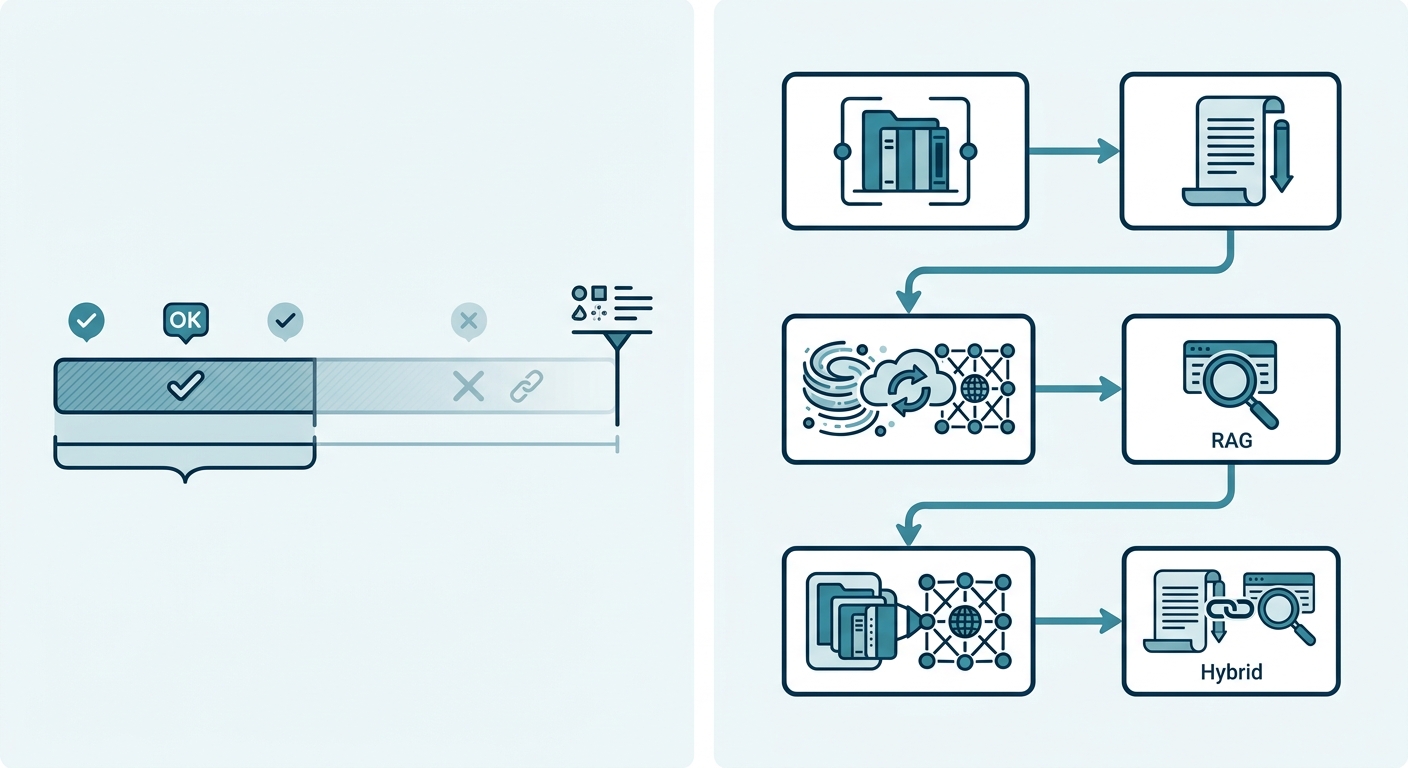
- Most enterprises sit in the third bucket. They have both kinds of questions. Use a hybrid.
Retrieval-augmented generation, or RAG, works by pulling relevant snippets from a knowledge base and feeding them to the model as context. It is excellent for scale, freshness, and cost at high query volume. It has a weakness. It can shift hallucination from the model to the retrieval layer. If the index is built from ungoverned, outdated, or conflicting documents, the model faithfully repeats bad source material. In some enterprise studies, RAG over ungoverned data still produces fabricated answers more than half the time.
RAG handles dynamic and terabyte-scale enterprise corpora; long-context windows replace retrieval only for bounded document domains; hybrid architectures combine retrieval grist with long-context synthesis and citations.
The hybrid pattern is now the common-sense standard. Use retrieval to pull the relevant grist at enterprise scale. Use long-context reasoning to synthesize across it. Require citations on every answer so humans can audit. In our testing, grounding answers with explicit citations and external verification cuts error rates by a wide margin — sometimes by more than 70%.
Tokenomics — the Real Cost of Million-Token Work
There is one more reality to budget for. Capability is not free.
The per-token price has collapsed — down 40–80% year over year, depending on the provider and tier. But the volume you consume has exploded. Feed a model a one-million-token document and you pay for one million tokens of input on every call, whether you rerun the whole thing or not. Total spend can rise even as unit prices fall.
This is why the 2026 discipline is called tokenomics. It is the craft of spending tokens efficiently. Practical levers include quantizing models to smaller numeric precision, using speculative decoding to speed generation, compressing context before it enters the window, and caching repeated prefixes so you are not charged for the same setup twice. Retrieval also helps here. Pulling only relevant chunks instead of the whole corpus cuts the bill dramatically for high-volume querying.
Tokenomics governs whether million-token workloads stay affordable at enterprise scale.
The managerial takeaway is simple. When you pick an architecture, model the token bill as carefully as you model accuracy. A long-context approach that is delightful but expensive per query may lose to a hybrid that pairs a modest window with smart retrieval.
Closing the Gap: A Practical Playbook
So what does a strong 2026 strategy look like? The pieces assemble into a clean playbook.
Start upstream. Fix ingestion, OCR, and version control before you scale the model. Get a single source of truth for your metrics. Standardize how documents are normalized and stored. This is unglamorous work, and it is where the accuracy battles are actually won.
Then choose the right machinery per domain. Bounded documents go to long context. Dynamic, huge corpora go to retrieval. Everything else is hybrid. Enforce citations and grounding everywhere so responses stay auditable.
Finally, keep a human in the loop for high-stakes decisions. Agents can draft, validate, and route. A human should own the final call on money, compliance, and customer records. Add evaluation harnesses that score models on document fidelity and uncertainty, not just clean-benchmark accuracy.
Grounded LLMs cut hallucination sharply — external grounding and citations reduce errors by roughly 70% or more in our testing.
One honest note from our own work. None of this is a one-time decision. The model landscape moves fast, and the correct architecture shifts with it. Build a lightweight evaluation loop that re-runs your own messy documents against new releases, and you will avoid locking in the wrong choice.
If you are building or buying document-heavy AI this year, start with your data. Then benchmark models against your real files before you commit. The million-token era is real. The win comes from using it honestly — where it helps, and knowing where it stops.
Want to keep up as these capabilities and the economics around them keep shifting? Subscribe to Algorithmine for practical, benchmark-backed guidance on enterprise AI — no hype, just what works.