Long-Context LLMs in 2026: How Model Architectures Scale to Millions of Tokens
In 2026 the million-token context window is an infrastructure problem, not a spec sheet feature. Sparse attention, Mixture-of-Experts, KV-cache optimization, positional encodings, and hybrid architectures determine whether long-context models actually scale in production.
Expert validation note: Technical claims reflect 2026 published research, vendor spec sheets, and industry estimates. Forward-looking or extrapolated figures are labeled "estimated" where they could not be independently confirmed.
The Million-Token Window Is Now an Infrastructure Question
For a few years, the conversation about long context LLM capability centered on one dumb number: how many tokens can it digest? In 2026 that framing has finally collapsed. Flagship models ship million token context windows as standard, and some open families advertise as much as ten million. The question is no longer "can the model hold a million tokens." It is "can your infrastructure afford to feed it one."
That shift matters, because long context LLM scale stopped being a marketing bullet point and became a real engineering trade-off. Every token you stuff into a prompt costs compute, memory, latency, and money. A model that holds two million tokens is only useful if the total cost of using it stays inside your budget and your latency budget.
The entire 2026 architecture story is about four forces colliding: attention complexity, KV cache growth, positional encoding, and the serving stack around them. Understand those four and the million-token window stops being magic — it becomes an engineering decision you can reason about.
The framing shift is the real story — long context went from "a spec feature" to "an infrastructure decision" that teams budget for per workload.
Why Pure Attention Hits a Wall at Scale
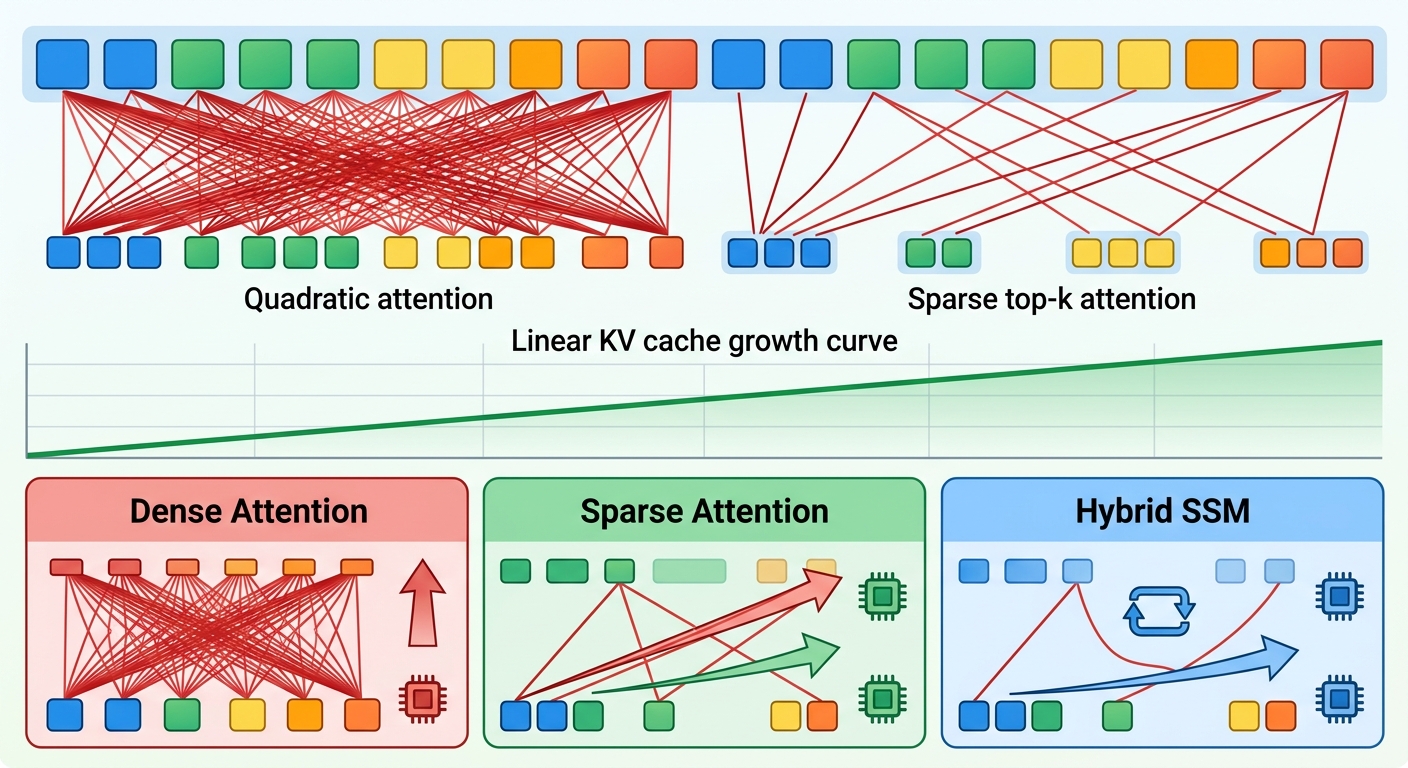
The bottleneck starts in the attention mechanism every Transformer uses. Self-attention exhibits quadratic scaling with sequence length. For a prompt of n tokens, every token compares against every other token. Doubling the window does not double the work — it roughly quadruples it.
That is the compute wall. There is a second, separate wall in memory.
KV cache grows linearly with sequence length. The key-value cache stores the attention keys and values for every token so the model does not recompute them. At a million tokens, that cache per user can reach the tens of gigabytes. What you paid for in compute, you then pay for again in RAM.
Fast kernels like FlashAttention are not a solution to either wall. FlashAttention band-aids the constants. It makes each attention step cheaper, but it does not change the quadratic or linear scaling class. It buys you headroom, not a different curve.
Compute scales quadratically, memory linearly — both hit you at a million tokens, just in different places. Optimizing one without the other fails in production.
Sparse Attention — Attending to the Tokens That Matter
The first serious architectural answer is to stop attending to everything. Sparse attention reduces attention to top-K tokens. Instead of comparing a query against every prior token, the model scores candidates and keeps only the most relevant handful — a few thousand instead of a million.
The 2026 generation of this idea is genuinely practical. Techniques such as DeepSeek Sparse Attention (DSA) use a lightweight scoring pass — sometimes called a lightning indexer — to rank past tokens, then run full attention only on the survivors. Sliding-window attention is the simpler relative: it keeps only the recent tokens in the KV cache and drops everything older.
The trade-off is real and you should not ignore it. Sparse attention reduces compute at the cost of assuming you can predict what matters. For retrieval-heavy and long-document workloads that is a good bet. For general reasoning where a critical fact sits deep in the middle of a huge prompt, aggressive sparsity can silently drop the token you needed.
The practical guidance: use sparse attention where the workload is naturally local or retrieval-shaped, and verify recall on your own data before trusting it on arbitrary prompts.
Mixture of Experts Makes Million-Token Economical
A second answer is architectural in a different sense — it is about model economics. Mixture of experts activates a subset of parameters for each token via a gating network, rather than running the whole model on every input.
This is why so many frontier long context LLM models are MoE. A model can hold a hundred billion or a trillion total parameters and still run cheaply per token, because only a fraction of those parameters do any work at a time. MoE architecture gives you capacity without proportional compute.
MoE matters for long context in a specific way. The compute budget that dense attention would consume on a million tokens is partly freed up because each token routes cheaply to its experts. The model can afford the massive total size that long-range pattern capture seems to need, without making every inference prohibitively expensive.
The catch is routing quality and load balancing. If the gating network sends too many tokens to one expert, the others idle and the speed advantage disappears. Modern MoE training pays close attention to that balance.
Stretching the Window With Positional Encodings
Attention and MoE change how you pay for context. RoPE extrapolation extends context past training length — and it is a large part of how models reach 1M and beyond without training natively at that size.
Rotary position embeddings (RoPE) encode a token's position by rotating its embedding vector. Because the rotation is a smooth function of position, the model can often reason about positions it never saw during training. Interpolation methods like YaRN and LongRoPE2 squeeze the learned positions out to longer windows, which is why open models natively trained at 256K tokens are routinely stretched to 1M.
This is a cost saver. Context extrapolation lets teams extend an existing model rather than retrain from scratch. But it is not free. Extrapolated tokens can have degraded reasoning, and the farther past training length you go, the more you should validate on your own long-context benchmarks.
KV Cache — The Hidden Memory Tax
If attention is the compute problem, KV cache is the memory problem — and at a million tokens it is often the one that breaks your deployment.
A single user holding a million-token context can consume tens of gigabytes of KV cache just for that session. Multiply by concurrent users and you are buying servers for memory, not compute. KV cache quantization is one of the most effective levers: storing keys and values in lower precision roughly halves per-user memory, at a small accuracy cost.
Two more levers live in the serving layer. Context parallelism shards the long sequence across multiple GPUs so no single device holds the whole KV cache. KV offloading moves less-hot cache layers to CPU or storage. Both trade latency and complexity for memory relief.
Prefill latency is the silent third cost. Decoding — generating tokens one at a time — is cheap. But prefilling, processing the entire long prompt before the first token is emitted, scales with the whole context. Prefilling a two-million-token prompt can take minutes. That wall-clock cost is invisible on a spec sheet and decisive in production.
A million-token prompt is mostly a memory and prefill problem, not a generation problem — budget KV cache per user and prefill wall-clock before you commit.
The "Lost in the Middle" Problem and How Benchmarks Measure It
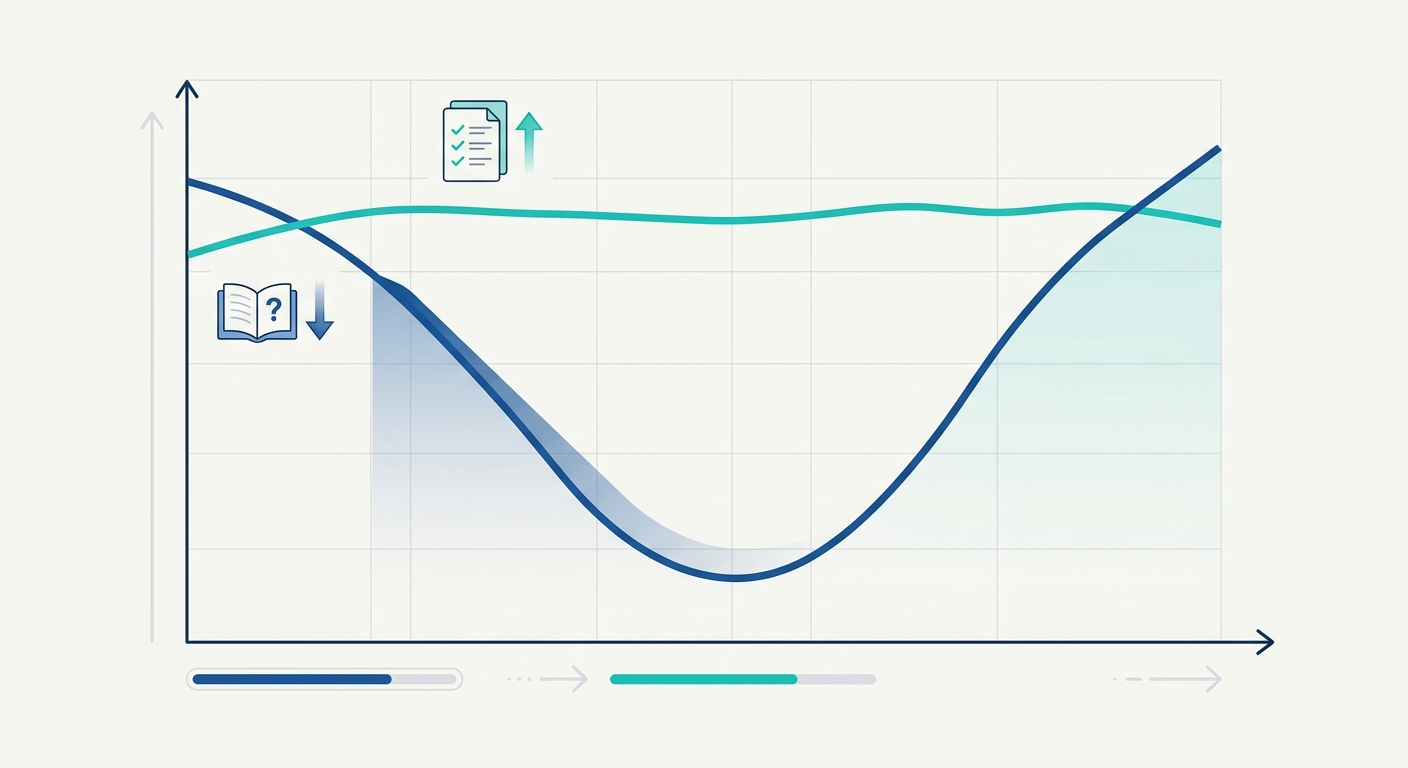
Even when you can afford the memory and latency, the model may not actually use the context well. The "lost in the middle" phenomenon is the well-documented tendency of LLMs to recall information at the start and end of a long prompt far better than information in the middle. It produces a U-shaped performance curve, and at scale the mid-context degradation can be severe.
Naive needle-in-a-haystack tests miss this because they test whether a model can find a single inserted fact. Modern long context benchmark suites are more honest. RULER and similar frameworks layer in multiple retrieval, reasoning, and code-understanding tasks that expose middle-token failure. "Lost in the middle" degrades mid-context recall, and you want benchmarks that catch it.
The mitigation is not exotic. Chunking the input, layering coarse retrieval on top of the long window, and weighting recent tokens all recover recall. The point is that "bigger context" and "usable context" are different claims, measured by different benchmarks.
Hybrid Architectures — State-Space Models Meet Transformers
The most fundamental answer is to change the scaling class of the base layer. State-space models (SSMs) like the Mamba lineage process sequences in nearly linear time, sidestepping the quadratic attention wall entirely.
Pure SSMs trade away some of the precise content-addressing that attention provides. So the 2026 pattern is hybrid: hybrid architectures combine SSMs with transformers, using attention layers where fine-grained retrieval and reasoning matter and SSM layers where linear-time scaling pays off. NVIDIA's Nemotron 3 family and several frontier models follow this playbook.
The trade-offs are real. SSM layers are excellent at long, streaming sequences, but their tooling, quantization support, and eager-decoding behavior are less mature than the battle-tested attention stack. In 2026 you choose a hybrid because you need linear-time inference at extreme length, and you accept some engineering friction.
Native Long Context vs RAG — When to Stop Retrieving
The architecture you pick is only half the decision. The other half is whether you should feed the model everything at all.
Native context vs RAG is the 2026 version of a classic argument. Native long context is simpler and removes a retrieval pipeline that can itself fail. But it charges you full prefill cost for every token, every time — even tokens that carry no useful signal.
RAG, retrieval-augmented generation, is cheaper because it admits only relevant chunks. Its weakness is the retrieval step: if the retriever misses the right chunk, no amount of reasoning recovers it. Retrieval augmented generation trades recall for cost.
The pragmatic pattern in production is hybrid. Use a coarse retrieval pass to narrow a large corpus, then hand a long-context model a sizable window of highly relevant content. That recovers much of the recall a pure retriever loses while keeping prefill cost far below feeding an entire corpus. Decide by measuring recall against prefill cost on your own workload, not by vendor claims.
The Bottom Line
The million-token window is real, and it is not going away. But in 2026 it is best understood as a system-problem category rather than a spec sheet feature. Sparse attention reduces the compute wall. MoE keeps the giant models affordable. Positional encodings stretch context without retraining. KV-cache optimization and prefill management handle the memory and latency. Benchmarks separate "big" from "usable."
The teams that win with long context are the ones that treat it as infrastructure — matching architecture, cost, and evaluation to each workload. If that kind of practical, hard-won engineering knowledge is what you are building toward, subscribing to our portal keeps you one step ahead of the curve.
Expert Q&A
Q: Why can't a 1M-token model just attend to everything cheaply? A: Because self-attention exhibits quadratic scaling. Each query compares against every other token, so the compute grows with the square of the sequence length, and the KV cache grows linearly alongside it. Sparse attention and MoE are how models route around that wall instead of just paying it.
Q: What is the real memory cost of a million-token KV cache? A: It commonly reaches tens of gigabytes per user for a single long session. That is why serving teams rely on KV cache quantization to halve it and context parallelism to shard it across GPUs, rather than trying to fit it in one device.
Q: When should I use native long context instead of RAG? A: Native context vs RAG is a recall-versus-cost decision. Native context is simpler and avoids retrieval failure, but bills full prefill for every token. RAG is cheaper but fragile if the retriever misses. For large corpora, a hybrid — coarse retrieval feeding a long window — usually wins.
Q: Does sparse attention hurt quality on general tasks? A: It can. Sparse attention reduces compute by assuming you can predict which tokens matter. That assumption is safe for retrieval-shaped workloads but risky for general reasoning where a critical fact hides in the middle. Validate on your own data.
Q: What does "prefill latency" mean and why does it matter? A: Prefill is processing the entire prompt before the first output token. Prefill latency scales with the whole context and can take minutes for a multi-million-token prompt. It is the cost that never appears on a spec sheet but dominates user experience and cost.
Q: How do I benchmark long-context recall beyond needle-in-haystack? A: Needle tests only detect a single inserted fact. Use modern suites like RULER that layer retrieval, reasoning, and code-understanding tasks, and track recall by token position to catch the "lost in the middle" U-shaped degradation.