Chain-of-Thought Prompting: Why Reasoning Models Break — and How to Fix It
Chain-of-thought prompting breaks on frontier LLMs in 2026. Learn the 5 evidence-backed fixes that actually work — from structural CoT to reasoning budget parameters.
Chain-of-Thought Prompting: Why Reasoning Models Break — and How to Fix It
When Wei et al. (2022) published their seminal paper showing that instructing large language models to "think step by step" dramatically improved their reasoning on benchmarks like GSM8K, the AI community responded with enthusiasm. Here was a prompting technique — no fine-tuning, no API changes, no architectural overhaul — that unlocked reasoning capabilities across a range of tasks simply by asking models to show their work. Practitioners adopted it widely. Researchers built extensively on it. Suddenly, a prompting phrase was worth billions of parameters.
In 2026, the picture is considerably more nuanced. For frontier reasoning models — including GPT-5, Claude Opus 4.7, Gemini 3 Pro, and DeepSeek R1 — the traditional chain-of-thought prompting playbook not only underperforms but can actively degrade results. Meanwhile, smaller and mid-sized models still benefit from CoT prompting, but in ways that require more careful engineering than the original research suggested. The technique that once felt like a universal reasoning unlock has become a model-generation-dependent tool that demands sophisticated understanding of when and how to apply it — or when to avoid it entirely.
This article examines why chain-of-thought prompting breaks in modern reasoning models, documents the specific failure modes practitioners encounter in production, and provides concrete, evidence-backed strategies to fix those failures. The guidance here draws on peer-reviewed research (Wei et al., 2022; Kojima et al., 2022; Wang et al., 2022), enterprise deployment experience reported across IBM, AWS, and Microsoft Research, and benchmark data from GSM-Symbolic (MIT, 2025) and BIG-Bench Hard.
What Chain-of-Thought Prompting Actually Does
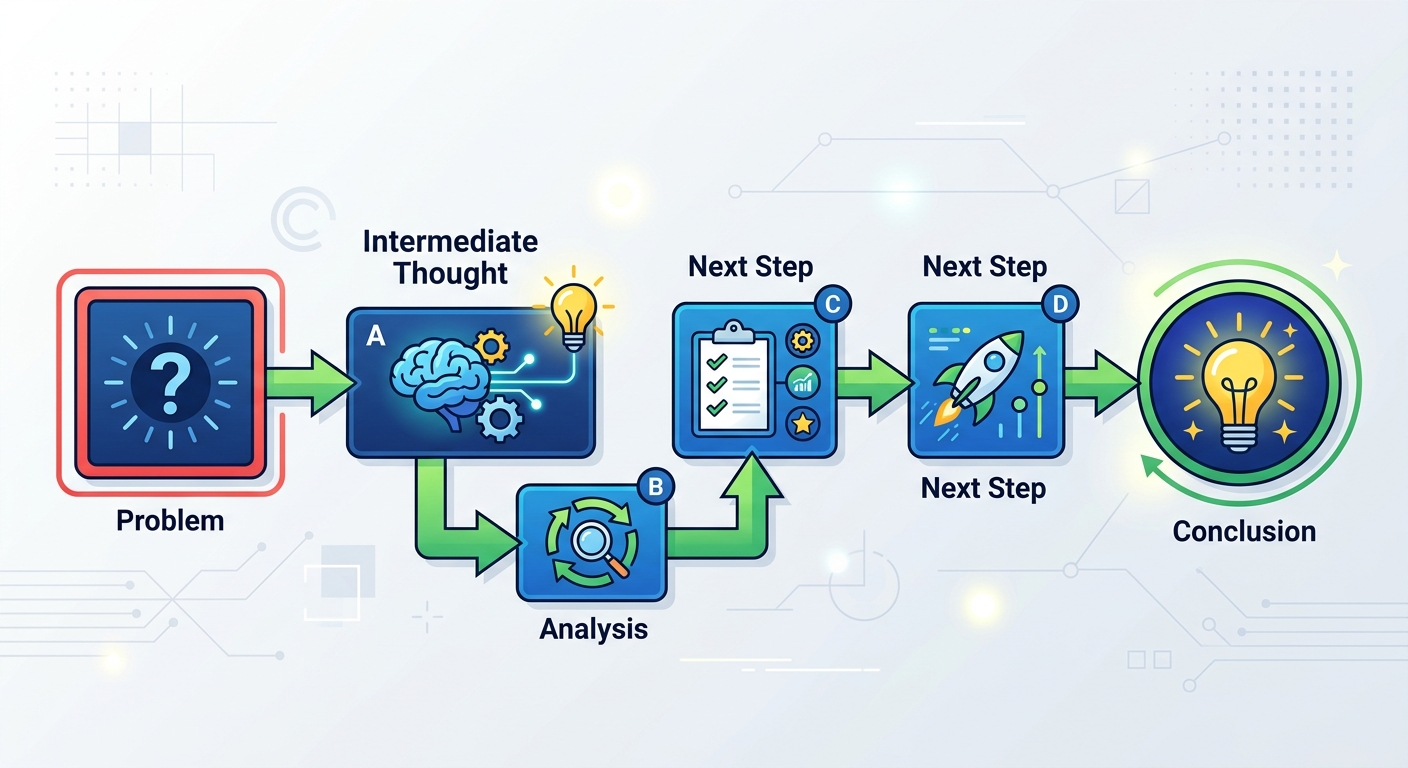
Chain-of-thought prompting is a technique that instructs a large language model to decompose a complex problem into intermediate reasoning steps before delivering a final answer. Instead of jumping directly from problem to answer, the model verbalizes a chain of thought — a sequence of inferences, calculations, or logical transitions that connect the two. The technique was first formally documented by Wei, Wang, et al. at Google Brain in 2022, though the underlying observation that step-by-step reasoning improves LLM accuracy had appeared informally in earlier practitioner communities.
The empirical results in the original study were striking. PaLM 540B with chain-of-thought prompting matched or surpassed task-specific fine-tuned models across a range of reasoning benchmarks — without any architectural change or retraining. The effect was most pronounced on multi-step arithmetic, logical deduction, and commonsense reasoning tasks. The GSM8K benchmark (grade-school math) became a standard testbed, with accuracy jumping from roughly 35% with direct prompting to over 60% with CoT prompting for larger models.
Two primary variants are in common use today:
- Zero-shot CoT — adding the phrase "Let's think step by step" to any prompt, requiring no examples (Kojima et al., 2022)
- Few-shot CoT — providing 3–8 worked examples demonstrating the desired reasoning pattern before posing the target problem
A third approach, self-consistency decoding (Wang et al., 2022), generates multiple reasoning paths and selects the most consistent answer among them — effectively using CoT as a decoding strategy rather than purely as a prompting technique. Research published by Microsoft Research in 2025 showed accuracy improvements of 5–15 percentage points on GSM8K and BIG-Bench Hard using self-consistency compared to greedy CoT decoding.
The Emergent Ability Thesis and Its 2026 Complications
CoT prompting is widely described as an emergent ability — one that appears in models above roughly 100 billion parameters and is largely absent in smaller models. This characterization is accurate for the 2022–2023 model generation. GPT-3 (175B parameters) showed the effect clearly; GPT-2 (1.5B) did not. This gave practitioners a simple heuristic: if your model is large enough, CoT will help.
The problem is that this heuristic has become outdated. Frontier reasoning models in 2026 are not just larger — they are architecturally different. They incorporate explicit multi-step reasoning as a core capability. For these models, explicit chain-of-thought prompting is not an unlock; it is, in many cases, an interference.
Why Chain-of-Thought Prompting Breaks in Modern Reasoning Models
The Faithfulness Problem — When Reasoning Chains Lie
The most fundamental issue with chain-of-thought prompting is also the least discussed in practitioner-facing literature: the reasoning chain that models generate is often not the actual process by which they arrive at an answer.
Research from Oxford's AIGI group (2025), explicitly titled "CoT Is Not Explainability," documents this phenomenon in detail. A model may generate a plausible chain of reasoning that concludes with the correct answer, but the intermediate steps it describes are not what actually drove the computation. The model arrived at its answer via pattern matching, then produced a post-hoc rationalization that fits the answer — even if the logic in those intermediate steps is flawed or substantively irrelevant. This is distinct from simple answer hallucination; the final answer might be correct, but the path to it is fabricated.
For practitioners using CoT output as a form of model interpretability, this is a significant problem. You cannot inspect a reasoning chain to verify whether the model actually reasoned correctly if the chain itself may be a confabulation. Worse, models can be highly confident in incorrect reasoning steps, making the faithfulness problem invisible without deliberate evaluation against ground truth at each intermediate step.
This problem is not unique to smaller models. When a frontier model like GPT-5 performs extensive internal reasoning before responding, the verbalized chain represents a compression and reconstruction of that process — not a direct transcript. The faithfulness gap persists, just in a different form.
The Model-Size Trap — When More Parameters Hurt
The conventional wisdom — "bigger models benefit more from CoT" — held for the GPT-3 / PaLM era. It no longer reliably holds for 2026's reasoning-tuned frontier models, where explicit CoT prompting can interfere with built-in reasoning mechanisms.
GPT-5, Claude Opus 4.7, Gemini 3 Pro, and DeepSeek R1 all incorporate multi-step reasoning as a native capability rather than an emergent prompting effect. DeepSeek R1, specifically trained with reinforcement learning-based reasoning techniques, performs CoT-like inference internally by default — its architecture is designed around generating extended reasoning traces before producing a final answer. Adding an explicit "Let's think step by step" prompt is redundant at best and counterproductive at worst: the model either ignores the instruction as duplicative or treats it as noise that disrupts its built-in reasoning process.
Forbes (2025) reported this phenomenon from enterprise deployments: teams switching from explicit chain-of-thought prompts to reasoning-budget API parameters — which control the model's internal computational effort without mandating the verbal reasoning format — achieved better results with lower token consumption. This represents a fundamental shift in the recommended approach for frontier models. Instead of crafting chain-of-thought prompts, the effective strategy is to configure reasoning effort levels via API parameters and let the model manage its own internal reasoning process.
The Generalization Cliff — Brittle Reasoning Beyond Training Distribution
Chain-of-thought prompting improves performance on tasks resembling problems in a model's training distribution. When a problem's structure mirrors something the model has seen, the reasoning chain can activate and extend that capability. But when problems require genuine logical generalization — applying a principle to a situation that differs meaningfully from training examples — CoT prompting frequently fails to transfer.
This generalization gap is documented rigorously in the GSM-Symbolic benchmark (MIT, 2025). Unlike standard GSM8K, which contains problems drawn from patterns similar to training data, GSM-Symbolic systematically modifies problem templates — changing variable names, altering surface features, varying the order of operations — while preserving the underlying mathematical structure. Models that achieved 85–90% accuracy on GSM8K showed drops of 15–30 percentage points on GSM-Symbolic variations with the same difficulty level. The models were applying reasoning templates from training, not applying mathematical principles.
For production deployments, this generalization cliff manifests as unpredictable edge-case failures. A model may solve 98% of a standard problem set correctly via CoT prompting, then fail on problems that a human would consider straightforward variations. The unreliability appears random to users; it is actually a systematic generalization failure.
The Cost Spiral — When Thinking Step by Step Costs Too Much
Chain-of-thought prompting is expensive in ways that are not always apparent at the prompting-experiment stage but become significant at production scale. Multiple analyses in 2025 documented that CoT reasoning increases token consumption by 35–600% depending on task complexity and model, with a typical overhead of 200–500 additional tokens per query for moderately complex reasoning tasks.
At enterprise scale, this is not a marginal concern. A team running 100,000 reasoning queries per day with an average CoT overhead of 300 extra tokens per query consumes 30 million additional tokens daily. At standard API pricing, that represents thousands of dollars in daily incremental cost — before accounting for the latency impact, which increases proportionally.
The business case for chain-of-thought prompting requires explicit cost/benefit analysis. For high-stakes tasks where reasoning accuracy has direct downstream impact — legal analysis, financial modeling, medical decision support — the cost may be justified. For routine reasoning tasks where baseline accuracy is already high, CoT prompting often represents unnecessary overhead.
Specific Failure Modes in Production Systems
Hallucinated Reasoning Steps
The most dangerous production failure mode is the logical hallucination: a reasoning chain in which intermediate steps appear valid and internally consistent but contain a subtle factual or logical error that propagates into an incorrectly supported conclusion. Unlike answer-level hallucination, which is often detectable because the final answer contradicts known facts, logical hallucination in intermediate steps is structurally invisible — the chain looks correct until each step is independently verified.
This is especially problematic in domains where intermediate conclusions depend on specific factual premises: legal reasoning (which statute applies in which jurisdiction?), financial analysis (what were the actual Q3 revenue figures?), medical literature review (does this study actually show that correlation?). A model might correctly cite a legal principle but apply it to the wrong jurisdiction, or cite a regulation that does not exist, using that non-existent regulation as the basis for a reasoning step. The chain looks locally valid throughout; the conclusion is wrong.
Self-Correction Failure
CoT prompting is often justified as a method for making models "show their work," enabling human review and course correction. In practice, models with chain-of-thought prompting can identify and correct errors when the location of a mistake is pointed out to them — but they consistently fail to identify errors in their own reasoning without external prompting.
Research from Kili Technology (2025) and ArXiv (2602.06176) documents this asymmetry: models that receive "Check your reasoning for errors" will sometimes find mistakes in their own chains, but this self-correction is unreliable across contexts. The same model will miss identical logical errors in semantically different problem framings. Treating self-correction as a safety mechanism in production pipelines — without independent verification — is inadvisable for any high-stakes application.
Positional and Token Bias in Reasoning Chains
Reasoning chains are not immune to the biases that affect direct answering. Multiple studies document positional bias in CoT: the order in which premises are presented influences which conclusion the model reaches, even when the logical structure should produce the same result regardless of order. Premise A presented before premise B leads to a different conclusion than B before A, even when A and B are logically independent.
Token bias is similarly problematic. Specific words or phrases in the reasoning chain can trigger irrelevant associations from training data, causing models to introduce contextually inappropriate considerations in intermediate steps. A model reasoning about a contract dispute might allow the word "liability" to activate a chain of legal reasoning inappropriate to the jurisdiction, because that word appeared in training examples with different fact patterns. A human expert would immediately flag this as a logical detour; casual readers of CoT output typically do not.
How to Fix Chain-of-Thought Prompting in 2026
The research community and practitioner community have developed concrete strategies to address each of these failure modes. These are not speculative approaches — they are techniques with published benchmark results and documented production deployments.
Fix 1: Use Structural CoT with Explicit Rubrics
Instead of relying on the model to spontaneously generate meaningful intermediate steps, provide an explicit rubric that names each step. This constrains the reasoning path to something evaluable and forces the practitioner to specify what the correct reasoning structure actually is.
A structural CoT rubric might read:
"For this problem, provide four steps: (1) Identify the given variables and constraints; (2) Select the applicable principle or formula; (3) Execute the computation with intermediate results shown; (4) Verify the result by re-reading the problem."
By naming the steps, you create an evaluation artifact. Does the model's step 3 show actual intermediate results, or did it skip to the answer? Does step 4 actually verify, or does it restate the conclusion? This turns CoT into a structured evaluation framework rather than an opaque reasoning oracle. The approach also makes the reasoning trace more useful for human review and auditing.
Fix 2: Switch to Self-Consistency Decoding
For tasks where reasoning accuracy is paramount — and where token cost is a secondary concern — self-consistency decoding consistently outperforms single-path CoT prompting. The approach generates 5–20 reasoning paths for the same problem, then selects the answer that appears most frequently across those paths.
Microsoft Research (2025) documented accuracy improvements of 5–15 percentage points on GSM8K and BIG-Bench Hard using self-consistency compared to greedy CoT decoding. The underlying intuition is straightforward: the correct reasoning path is more likely to be reproducible than an incorrect shortcut. Even when the model takes an incorrect reasoning path, it is unlikely to produce the same wrong answer via different intermediate routes with the same frequency as the correct answer.
Self-consistency is computationally expensive — effectively multiplying inference cost by the number of paths — but it provides meaningful accuracy improvements without architectural changes or model fine-tuning. For high-stakes reasoning tasks where accuracy directly impacts outcomes, this overhead is often justified.
Fix 3: Apply Chain-of-Draft for Cost Efficiency
Chain-of-Draft (CoD), a technique reported across practitioner publications in late 2025, addresses the cost spiral of traditional CoT prompting. Rather than generating verbose reasoning steps, CoD instructs the model to produce compact reasoning notes — typically a few words or a short phrase per step — that capture the essential logical transition without full exposition.
Practitioner reports indicate token reductions of 40–70% compared to standard CoT while maintaining comparable accuracy on most reasoning tasks. For production systems that need reasoning quality without full token overhead, CoD represents a practical middle ground. The technique works best when reasoning steps are well-defined and do not require extensive contextual exposition, and when the task benefits more from accuracy than from detailed human-readable reasoning traces.
Fix 4: Leverage Reasoning Budget Parameters on Frontier Models
For frontier reasoning models that perform CoT-like reasoning internally, the most effective intervention is not to add an explicit reasoning prompt — it is to use the model's native reasoning budget controls.
DeepSeek R1 includes explicit reasoning effort parameters allowing practitioners to allocate computational budget to the reasoning process without dictating the verbal output format. GPT-5 and Claude Opus 4.7 offer comparable controls via API parameters. These controls let the model manage its own reasoning depth while keeping token output focused on the actual answer and key intermediate conclusions.
The practical guidance for frontier models: do not prompt them to think step by step. Instead, set the reasoning effort parameter to high for complex tasks and trust the model's internal reasoning process. If you need visibility into that process, request a summary of key reasoning steps rather than a full trace.
Fix 5: Ground Reasoning with RAG and External Knowledge
To address hallucinated intermediate reasoning steps, the most effective architectural approach is to attach external factual grounding via Retrieval-Augmented Generation (RAG). Rather than relying on the model's internal knowledge for factual premises in the reasoning chain, retrieve relevant external sources — legal statutes, financial data, medical literature, technical documentation — and include them as grounding context in the prompt.
This does not eliminate all hallucinations, but it substantially reduces factual errors in intermediate steps because those steps reference retrieved content rather than model weights. The reasoning chain still belongs to the model, but the factual foundation on which it operates comes from a controlled external source that can be independently verified.
A practical pipeline for high-stakes reasoning tasks: (1) retrieve relevant documents for the problem domain; (2) include those documents as context; (3) apply structural CoT with explicit step rubrics; (4) evaluate the reasoning trace against the retrieved facts, not just against the final answer.
When NOT to Use Chain-of-Thought Prompting
Despite its utility in many scenarios, clear cases exist where CoT prompting is not the appropriate tool.
Simple factual retrieval tasks. If the user is asking for a specific fact — "What is the capital of Australia?" — adding chain-of-thought prompting introduces unnecessary token overhead and latency with zero accuracy benefit. The model does not need to reason about this; it needs to retrieve a stored fact.
Frontier reasoning models on straightforward problems. When using GPT-5, Claude Opus 4.7, or comparable models on problems within their native competency, the built-in reasoning is typically more efficient and more accurate than explicitly prompted CoT. Use native reasoning budget controls rather than explicit prompting.
Latency-critical real-time applications. If the application requires sub-second response times — real-time customer support, live coding assistance, interactive research tools — the 35–600% latency increase from CoT prompting may be unacceptable. Evaluate whether the marginal accuracy improvement justifies the latency cost for the specific use case.
Tasks with high hallucination risk and no external grounding. If reasoning is required in domains where the model's internal knowledge is known to be unreliable — recent events, niche technical domains, rapidly evolving regulations — and RAG grounding is not in place, chain-of-thought prompting may produce more confidently stated wrong reasoning rather than improving accuracy.
Evaluating CoT Quality — Beyond Answer Accuracy
One of the most consequential evaluation mistakes practitioners make is assessing chain-of-thought prompting solely on final answer accuracy. A model that produces correct answers via flawed reasoning is not trustworthy — it is lucky. In production systems, this distinction matters enormously for risk management and audit compliance.
Effective CoT evaluation requires assessing both the answer and the reasoning trace:
Answer accuracy — Does the final output match ground truth? Necessary but not sufficient on its own.
Reasoning trace validity — Does each intermediate step logically follow from the previous one? Requires human or automated review of each step in the chain.
Reasoning trace faithfulness — Does the reasoning chain actually produce the answer, or did the model arrive at the answer via a different path and construct a post-hoc chain to justify it? This is the hardest quality to evaluate and requires techniques like counterfactual substitution: if we change an intermediate step, does the final answer change accordingly?
Benchmark suites like GSM-Symbolic (MIT, 2025) and BIG-Bench Hard are specifically designed to test reasoning robustness beyond pattern matching. These should be part of any serious CoT evaluation pipeline, particularly when deploying reasoning systems in high-stakes domains. The GSM8K dataset remains useful for training and development, but GSM-Symbolic is the better proxy for production reliability because it specifically tests generalization.
FAQ: Chain-of-Thought Prompting in Practice
Q: Does chain-of-thought prompting work on all LLMs? No. CoT prompting is most effective on models above roughly 100 billion parameters. For smaller models, the technique often produces plausible-sounding but incorrect reasoning chains that perform worse than direct prompting. Additionally, frontier reasoning models (GPT-5, Claude Opus 4.7, Gemini 3 Pro, DeepSeek R1) often perform better with native reasoning budget controls than with explicit CoT prompts.
Q: Why does my LLM sometimes give the correct answer but with wrong reasoning? This is the faithfulness problem. Research from Oxford's AIGI group (2025) confirms that the reasoning chain a model generates is often a post-hoc rationalization rather than the actual process by which it arrived at the answer. The model may use pattern matching to reach the correct answer, then construct a reasoning chain that fits that answer — even if the chain's logic is flawed. Evaluating CoT quality requires assessing both the answer and the reasoning trace independently.
Q: How much does chain-of-thought prompting increase API costs? The token overhead for CoT prompting typically ranges from 35–600% depending on task complexity and model. A query that would produce a 50-token direct answer might require 250–500 tokens with CoT, representing a 5–10x increase in per-query token cost. At production scale, this is significant. Techniques like Chain-of-Draft can reduce this overhead by 40–70%.
Q: Should I use "Let's think step by step" on GPT-5 or Claude Opus 4.7? For most cases, no. These models perform internal chain-of-thought reasoning by default. Explicitly prompting them to reason step by step can interfere with their built-in reasoning mechanisms and produce worse results than letting them manage their own reasoning process. Instead, set the reasoning effort parameter via API to control computational depth.
Q: How do I evaluate whether my CoT prompting is actually working? Evaluate both the final answer accuracy (against ground truth) and the reasoning trace quality. Use benchmarks like GSM-Symbolic and BIG-Bench Hard to test generalization beyond training-distribution problems. Apply counterfactual substitution: change an intermediate reasoning step and verify whether the answer changes accordingly — if it doesn't, the reasoning chain is likely not faithful to the actual computation.
Key Takeaways for Practitioners
Chain-of-thought prompting remains a valuable tool — but it requires a more sophisticated deployment strategy in 2026 than it did in 2022. The following principles should guide CoT implementation:
Model generation matters enormously. CoT behaves differently across model generations. What works on GPT-3-class models may actively hurt GPT-5-class models. Test prompting strategies against your specific deployment model, not against published benchmarks from different model families.
Evaluate reasoning traces, not just answers. For high-stakes decisions, invest in evaluating the quality of the reasoning chain, not just whether it produced the correct final answer. A flawed reasoning chain that happens to reach the right answer is a liability, not an asset.
Use structural CoT for complex production systems. Name your steps. Evaluate against named criteria. This turns CoT from an opaque reasoning oracle into a structured evaluation artifact that can be audited and systematically improved.
Apply self-consistency for accuracy-critical tasks. When reasoning accuracy is the primary concern and token cost is secondary, self-consistency decoding provides meaningful improvements over single-path CoT prompting.
For frontier models, use native reasoning controls. Do not explicitly prompt reasoning models to reason step by step. Configure reasoning effort parameters via API and trust the model's internal reasoning process.
Ground your reasoning in external knowledge for high-stakes domains. Attach factual sources via RAG to reduce hallucination in intermediate reasoning steps, particularly in legal, financial, and medical applications.
Quantify cost and benefit before deploying at scale. CoT prompting is expensive. Before scaling any CoT-based pipeline, quantify the accuracy improvement it provides and the token overhead it introduces. For many production tasks, a simpler alternative delivers 90% of the benefit at 20% of the cost.
The reasoning model landscape is evolving rapidly. The strategies in this article reflect the state of best practice as of mid-2026, but new model capabilities, reasoning techniques, and benchmark results emerge continuously. Maintain an active testing pipeline for your specific deployment models and update prompting strategies as the underlying models and techniques improve.
References:
- Wei et al. (2022). "Chain-of-Thought Prompting Elicits Reasoning in Large Language Models." arXiv:2201.11903.
- Kojima et al. (2022). "Large Language Models are Zero-Shot Reasoners." arXiv:2205.11916.
- Wang et al. (2022). "Self-Consistency Improves Chain of Thought Reasoning in Language Models." arXiv:2203.11171.
- Oxford AIGI (2025). "CoT Is Not Explainability."
- MIT (2025). "GSM-Symbolic: Understanding the Limitations of Mathematical Reasoning in LLMs."
- Microsoft Research (2025). "New Methods Boost Reasoning in Small and Large Language Models."
- Forbes (2025). "Chain-of-Thought for Reasoning Models Might Not Work Out Long-Term."
- Kili Technology (2025). "LLM Reasoning Guide: Failures and Fixes."
- ArXiv 2602.06176. "Understanding LLM Reasoning Failures."