OpenAI's Latest API Update: What Changed for Enterprise Developers in June 2026
OpenAI's June 2026 API update brings GPT-5.6 Sol, realtime voice APIs, per-minute container billing, enterprise spend controls, and deprecation deadlines. Here's what changes for enterprise developers
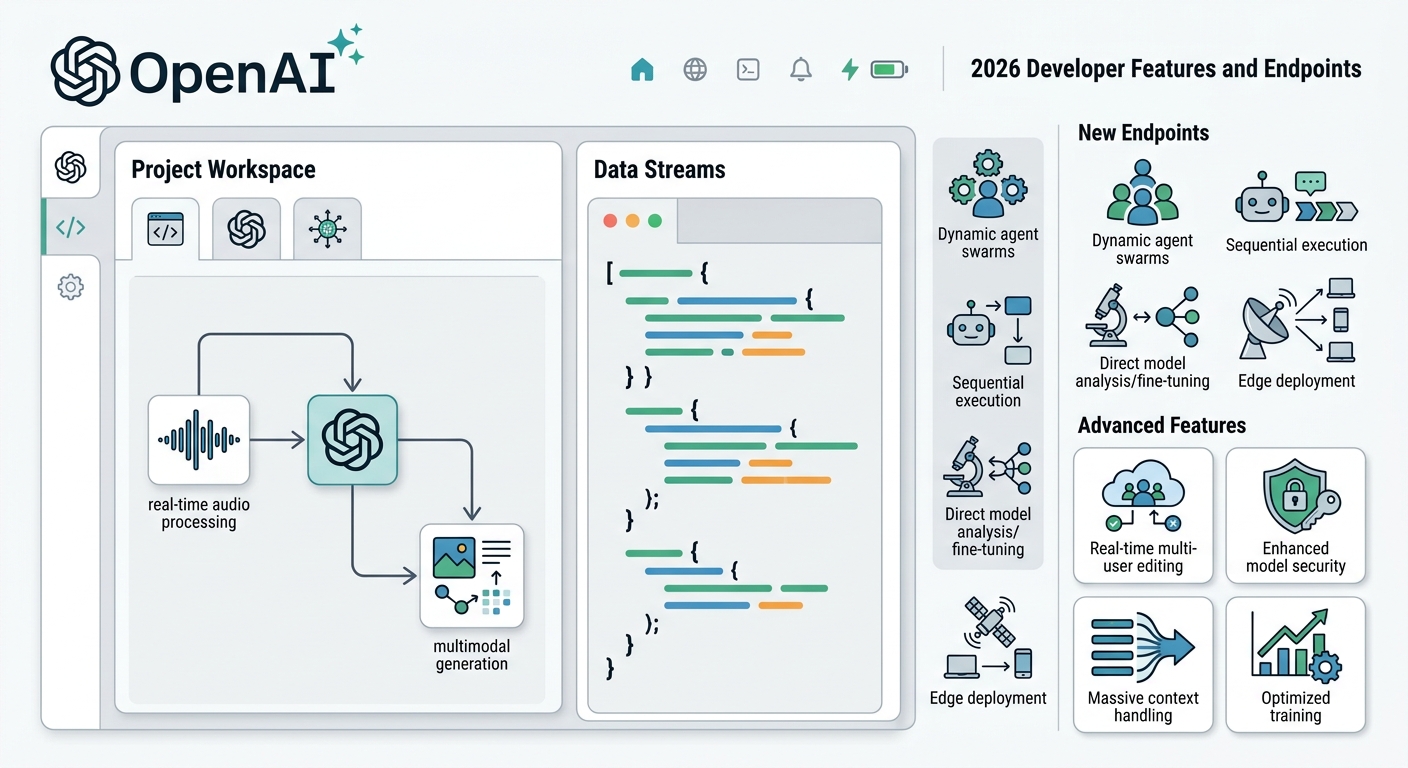
OpenAI's Latest API Update: What Changed for Enterprise Developers in June 2026
June 2026 marks one of the most consequential API release cycles OpenAI has ever shipped for the enterprise developer audience. In the span of a few weeks, OpenAI introduced a new flagship model tier, overhauled its voice and realtime APIs, tightened cost management tooling, launched agent-specific features in Codex, and set concrete deprecation dates that will break production integrations if ignored. Enterprise development teams that rely on the OpenAI API need to understand what changed, what it costs, and what they must do before the end of the year.
This article breaks down the five biggest areas of change and provides a concrete action plan for engineering teams.
The GPT-5.6 Family Arrives — And a New Flag旗舰逻辑
The most watched announcement is the preview rollout of the GPT-5.6 series, anchored by the flagship model GPT-5.6 Sol. This release represents a meaningful step forward in OpenAI's model strategy, introducing what the company calls "max reasoning effort" and "ultra mode" — specialized inference modes designed for tasks requiring extended deliberation: complex coding problems, multi-step scientific reasoning, and long-horizon agentic planning. [1]
Sol's capabilities in coding and scientific reasoning are notably stronger than prior generations. However, access is currently restricted to a limited set of trusted partners. OpenAI cited cybersecurity considerations for the controlled rollout, signaling that broad API availability is likely still months away. The complementary GPT-5.6 Terra and GPT-5.6 Luna variants round out the series. [2]
For developers who don't have trusted-partner access, the more immediately relevant release is the GPT-5.5 Instant update, now the default model in the free ChatGPT tier. This refresh brings meaningful improvements to intent understanding, shopping results, local recommendations, and the handling of complex constraints. [3] Developers can access this updated model via the chat-latest API alias, though OpenAI continues to recommend gpt-5.5 for stable production workloads. [4]
Speaking of stable production, GPT-5.5 for the API remains the recommended workhorse for complex professional tasks. It offers a 1M token context window, image input support, structured outputs, function calling, prompt caching, batch processing, tool search, and web search — a feature set that covers the vast majority of enterprise use cases today. [4]
Realtime Voice APIs Enter Production-Ready Territory
OpenAI has significantly upgraded its voice capabilities with the release of GPT-Realtime-2, a new voice model built for speech-to-speech agent interactions. Unlike earlier voice integrations that relied on chaining separate STT, model, and TTS services, GPT-Realtime-2 is designed as an end-to-end speech-native model with configurable reasoning — meaning developers can tune how much deliberation the model applies before responding in real-time. [4]
Joining it are two specialized derivatives:
- GPT-Realtime-Translate — a streaming speech translation model purpose-built for live interpretation use cases
- GPT-Realtime-Whisper — a streaming speech-to-text model optimized for continuous transcription workflows
For enterprise developers, these releases open new categories of production applications: real-time multilingual customer support agents, accessibility tooling for enterprise products, voice-enabled productivity assistants, and live transcription for meetings and call centers.
Cost Management Gets Serious: Per-Minute Billing and Usage Analytics
Enterprise finance teams have long requested more granular cost controls for OpenAI API usage. June 2026 delivers on multiple fronts.
Container session billing has been overhauled. Eligible container sessions are now billed per minute with a 5-minute minimum, replacing the previous flat 20-minute session rate. For development teams that run hundreds of short container sessions per day — a common pattern in testing, CI/CD, and evaluation pipelines — this change translates to immediate per-session cost reductions. [4]
On the visibility side, credit usage analytics are now available in the Global Admin Console for ChatGPT Enterprise. Administrators get granular breakdowns of credit consumption across users, products, and models — with the ability to set default spend limits, group-specific limits, and individual user overrides. [5]
Additional billing mechanics worth noting [6]:
- Data residency carries a 10% token pricing multiplier for regional processing requirements
- Batch tier offers a 50% discount for asynchronous processing with a 24-hour turnaround window
- Flex tier provides the same 50% discount with variable latency for non-production workloads
- Priority tier bills at 2x the standard rate for guaranteed high-speed processing
For current API pricing context, GPT-5.5 costs $5.00 per million input tokens and $30.00 per million output tokens. The more cost-efficient GPT-5.4 mini runs $0.75 and $4.50 per million tokens respectively, while GPT-5.4 nano — the cheapest production model — is priced at $0.20 per million input tokens and $1.25 per million output tokens. [6] Web search via the API costs $10 per 1,000 calls. Average enterprise spending on OpenAI is estimated at approximately $561,564 per year. [7]
Enterprise Agent Tooling: Codex Plugins, Sites, and Workspace Agents
OpenAI is aggressively targeting the enterprise agentic workflow market, and the June 2026 release includes the most substantial expansion of Codex capabilities to date. [8]
Record & Replay, now available in the Codex app for macOS, lets Enterprise and Edu users demonstrate a workflow once and convert it into a reusable, shareable skill. Instead of writing detailed instructions, users perform the task once and Codex captures it as a reproducible agentic skill.
The rollout of role-specific Codex plugins is equally significant. OpenAI is shipping specialized plugins tailored to specific enterprise functions: Sales, Data Analytics, Product Design, Creative Production, Investment Banking, and Public Equity Investing. [8] Each plugin comes pre-configured with domain-relevant knowledge, tool access patterns, and workflow templates.
Internal Workspace Apps via Sites allow enterprises to build and deploy internal applications without any public distribution — critical for companies that want AI-powered internal tools but cannot expose them externally.
Workspace Agent Controls give enterprise administrators fine-grained governance: agent creators can explicitly choose GPT-5.5 and configure reasoning effort levels, while workspace admins control publishing permissions, model access, and response capabilities. The addition of Workload Identity Federation, expanded Admin APIs, Secure MCP Tunnel, and IP allowlist management rounds out a governance stack designed for organizations running AI agents at scale. [8]
New API Capabilities: Inline Moderation, Image Search Results, and Bedrock Availability
Beyond models and enterprise tooling, the June 2026 release adds several API-level capabilities that developers should be aware of. [4]
Moderation scores have been added to both the Responses API and the Chat Completions API. Previously, running content moderation required a separate API call. Now, moderation results for both input prompts and generated outputs are returned within the same API response — simplifying integration and reducing overhead for applications requiring content safety checks on every turn.
The web search tool now supports returning image results in addition to text. The return_token_budget parameter in the Responses API web search tool lets developers opt into longer GPT-5+ reasoning cycles for high-effort research queries.
A notable infrastructure development: OpenAI models are now accessible via Amazon Bedrock through an OpenAI-compatible Responses API endpoint. For enterprises already committed to AWS infrastructure, this removes a significant barrier to adopting OpenAI models within their existing cloud architecture.
The Deprecation Clock: What Breaks in December 2026
Perhaps the most urgent piece of the June 2026 release is the explicit deprecation timeline OpenAI has set for several older model snapshots and platform features. [9]
The following are scheduled for removal:
- GPT-5 and o3 model snapshots will be removed from the API on December 11, 2026
- Older GPT Image models will be removed on December 1, 2026
- The Agent Builder product and the Evals platform are deprecated immediately
- Reusable Prompt Objects are also deprecated
These deprecations affect any production system still pointing at older model snapshots rather than stable gpt-5.5 or gpt-5.4 production aliases. The December 2026 timeline is approximately six months out, but migration testing, regression runs, and stakeholder approval cycles make starting the audit this quarter essential.
What Enterprise Developers Should Do Right Now
The scope of June 2026's changes is broad, but enterprise development teams can prioritize action using the following checklist:
-
Audit model aliases — Identify every API call pointing at deprecated GPT-5 or o3 snapshot identifiers. Migrate to stable
gpt-5.5orgpt-5.4production aliases. Test thoroughly before the December deadlines. -
Evaluate model tiering — Not every task needs GPT-5.5. Audit your application's request profile and identify paths where GPT-5.4 nano or mini would suffice. A tiered model strategy can reduce API spend by 60–80% on non-complex tasks.
-
Enable usage analytics and set spend controls — If you're on ChatGPT Enterprise, activate the credit usage analytics dashboard and establish spend limits for high-volume teams before a runaway query creates an unexpected bill.
-
Optimize container session patterns — Review workloads that currently run sessions shorter than 15 minutes. Per-minute billing means these can now run at a fraction of the previous cost.
-
Pilot GPT-Realtime-2 for voice use cases — If your roadmap includes real-time voice features, now is the time to begin integration testing with the production-ready model.
-
Explore role-specific Codex plugins — If your enterprise operates in Sales, Data Analytics, Product Design, Creative Production, or Finance, the pre-configured plugins can dramatically reduce time to productive agentic workflows.
-
Review the Bedrock option — If your organization is AWS-centric, evaluate whether routing OpenAI API traffic through Bedrock's compatible endpoint simplifies compliance, billing, or network architecture.
OpenAI's June 2026 release represents a maturation of the platform toward enterprise-grade governance, cost predictability, and agentic workflow support. The new model tiers, voice APIs, and developer tooling are substantial — but the deprecation deadlines are the most immediate action item. Six months passes quickly. Audit your integrations, update your model selection strategy, and take advantage of the new cost management tools before the year closes out.
Frequently Asked Questions
When will GPT-5.6 Sol be available to all API developers? GPT-5.6 Sol is currently in restricted preview with limited access for trusted partners only. OpenAI has not announced a broad availability date. Developers interested in early access should contact their OpenAI account representatives. General API availability is likely still months away.
What is the most cost-effective OpenAI model for simple tasks? GPT-5.4 nano is currently the cheapest production model in the OpenAI API lineup, priced at $0.20 per million input tokens and $1.25 per million output tokens. For many simple, high-volume tasks like classification, extraction, or short-form generation, GPT-5.4 nano can replace GPT-5.5 at a fraction of the cost.
How does the new per-minute container billing work? Container sessions are now billed per minute with a 5-minute minimum, replacing the previous 20-minute session minimum. This benefits development and testing workloads with short average session lengths. Sessions under 15 minutes see the most significant cost reduction compared to the prior billing model.
What happens if I don't migrate from deprecated model snapshots before December 2026? Any API calls pointing to deprecated GPT-5 or o3 model snapshots will stop working after December 11, 2026. Older GPT Image models will be removed on December 1, 2026. Production systems still using these identifiers will experience failures. Enterprises should begin migration planning immediately given testing and approval cycle timelines.
Can I use OpenAI models through Amazon Bedrock? Yes. OpenAI models are now accessible via an OpenAI-compatible Responses API endpoint on Amazon Bedrock. This allows enterprises with existing AWS infrastructure to use OpenAI models within their current cloud architecture, potentially leveraging existing AWS billing, compliance, and networking arrangements.