The State of Generative Video in 2026: What's Production-Ready and What Isn't
Generative video in 2026 is production-ready for short-form volume work, but not autonomous premium storytelling. An honest breakdown of workflows, models, and what still needs a human.
The Short Version — Where AI Video Stood at the Start of 2026
Generative video crossed a real threshold in 2026. It is no longer a demo novelty you get occasional invites to. It is a production tool that shipping teams use every day. But "production-ready" does not mean "autonomous everywhere." The honest headline is this: AI video is mature for high-volume, short-form work, and still far from ready to replace human judgment for premium, brand-defining content.
The numbers back that split. Monthly active users across AI video platforms passed 124 million in January 2026, a figure best treated as an estimated platform-aggregated measure. The overall AI video market sits near $5.5 billion in 2026 and is projected to climb toward $42.3 billion by 2033 — roughly a 33.7% compound annual growth rate. On the efficiency side, AI-driven production is reported to be about three times faster and 40-80% cheaper than comparable traditional methods for volume work. Those are planning ranges, not guarantees.
Yet the same data shows the other edge. Roughly 68% of enterprise AI video deployments still require human intervention to reach publishable quality. That single figure frames the entire state of the technology: what has changed is cost and speed; what has not changed is the need for a human quality gate.
Three Things Everyone Agrees On
Three points cut through the vendor noise. First, the direction of travel is real — the speed and cost gains hold up for volume content. Second, the 5-30 second clip is the native unit of AI video; long-form is assembled from short shots, not generated whole. Third, human review is the default quality gate everywhere in 2026. Nobody serious runs an autonomous, unattended video pipeline today.
Division of Labor: Text-to-Video vs Image-to-Video
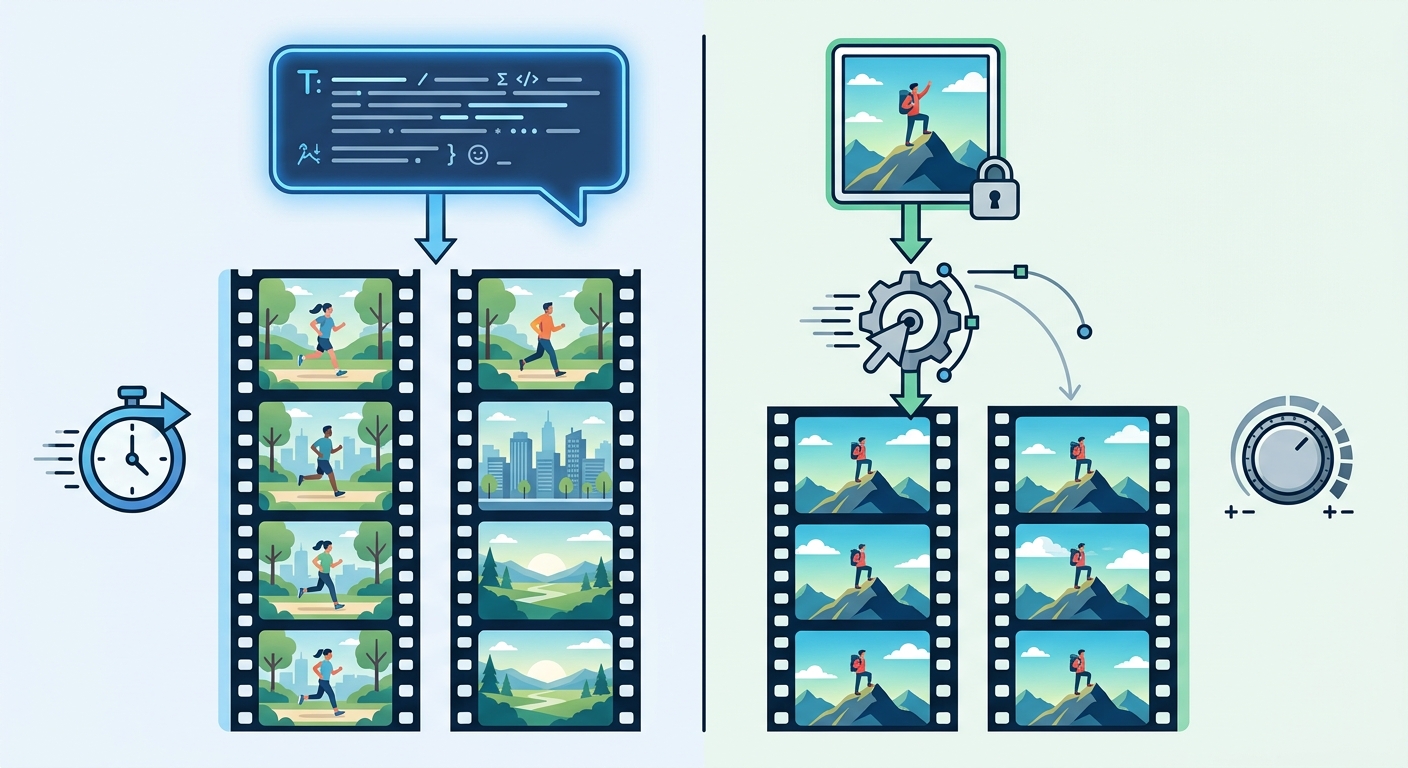
Two generation modes dominate, and they solve different problems. Text-to-video still commands the largest share of the market, holding roughly a 46% share of generation volume. You type a prompt, the model returns frames. It is fast, iterative, and great for exploring ideas quickly.
Image-to-video works differently. You lock a high-quality still first — with precise composition and style control — then animate it. The result is far more controllable and consistently on-brand. For product shots, brand assets, and any work where the subject must not drift, the two-step still-then-motion approach routinely beats direct text-to-video.
The practical rule — use text-to-video when you need speed and ideation. Switch to image-to-video when you need brand and product consistency. Most mature teams use both in one pipeline.
This division is the first thing to understand, because it predicts which workflows feel production-ready and which still fight you.
The Production-Ready Playbook — Where AI Video Earns Its Keep
Calling a tool "production-ready" is only meaningful per use case. In 2026, a clear set of workloads genuinely earns their keep with generative video.
High-volume marketing and social content is the biggest win. Need twenty clip variants for an A/B test by noon? AI video delivers. Explainer and training videos follow close behind, where the format is short, structured, and low-risk. Product demonstrations are a standout — reported uplift on conversion when video is used in e-commerce is strong, though treat specific percentages as estimated. AI avatars for localization, re-voicing, and dubbing have become genuinely usable, including native audio and lip-sync tools. And storyboards and concept pre-visualization let a team show a client a moving concept before spending on a full shoot.
The common thread: these are front-of-funnel tasks where iteration speed and volume matter more than emotional nuance. That is where generative video is unambiguously production-ready.
Where It Still Breaks — The Honest "Not Production-Ready" List
Now the part most marketing avoids. Several failure modes remain genuinely unsolved, and knowing them is how you avoid burning a budget.
Character identity drift is the biggest production blocker. Across shots — and often within a single longer sequence — a character's face, hair, clothing, and body proportions shift. Frames disagree about who is on screen. Short clips hold up; anything with multiple angles exposes the drift fast. Some models improve this with reference images, but it is managed, not solved.
Long-form coherence collapses over time. Beyond a few seconds, lighting, camera logic, and character appearance "drift." A single-pass generation of extended video is unreliable, so teams assemble long-form work shot by shot from shorter, consistent clips.
Physics hallucinations are the uncanny tell. Liquids, cloth, hair, and collisions behave wrong. The human eye is brutally good at spotting impossible physics, which is why fast cuts break the illusion but slow, continuous shots reveal it.
Lip sync has improved a lot — dedicated tools now sync reasonably well on both real footage and avatars. But natural, precise lip movement still needs human review. Native audio reduces post-production work but does not remove it.
Finally, fine emotion and brand-defining storytelling remain human territory. When the creative vision and emotional truth are the product, the model is still the junior assistant, not the lead.
The 68% reality — most enterprise AI video deployments still require human intervention to reach publishable quality. Budget for a review step, not an autonomous pipeline.
The Physics Problem and the World-Model Shift
The physics problem points to the deepest fix. Most current models predict pixels — they learn what frames "usually" look like, which is why physics can break. A structural alternative is emerging: world models simulate the scene rather than guess pixels. These models reason about object interaction, bounce, occlusion, and continuity. Early results show far more physically plausible motion.
This matters for production because physical plausibility is the hardest quality bar to fake. A world-model approach is the structural fix, not a tuning tweak. Expect it to reshape quality baselines through 2026.
The Model Landscape and Capability Tiers in 2026
The model field has settled into capability tiers. At the flagship closed tier, several systems offer realistic output, dialogue, native audio, and in some cases up to 4K generation, with strong creative control. Popular large-creator platforms count their users in tens of millions — one major platform reports over 60 million creators, a figure to treat as estimated.
Across the flagship tier, native audio and reference-image control are now standard rather than exotic. Internal generation routes now competently handle re-voicing, syncing, and editing in one workspace. The open-source tier keeps improving but still trails on control, length, and consistency. The practical takeaway: model choice is a capability decision, not a brand loyalty contest. Match the model's strengths to the shot type you need.
The Mature Workflow: A Three-Layer Production Stack
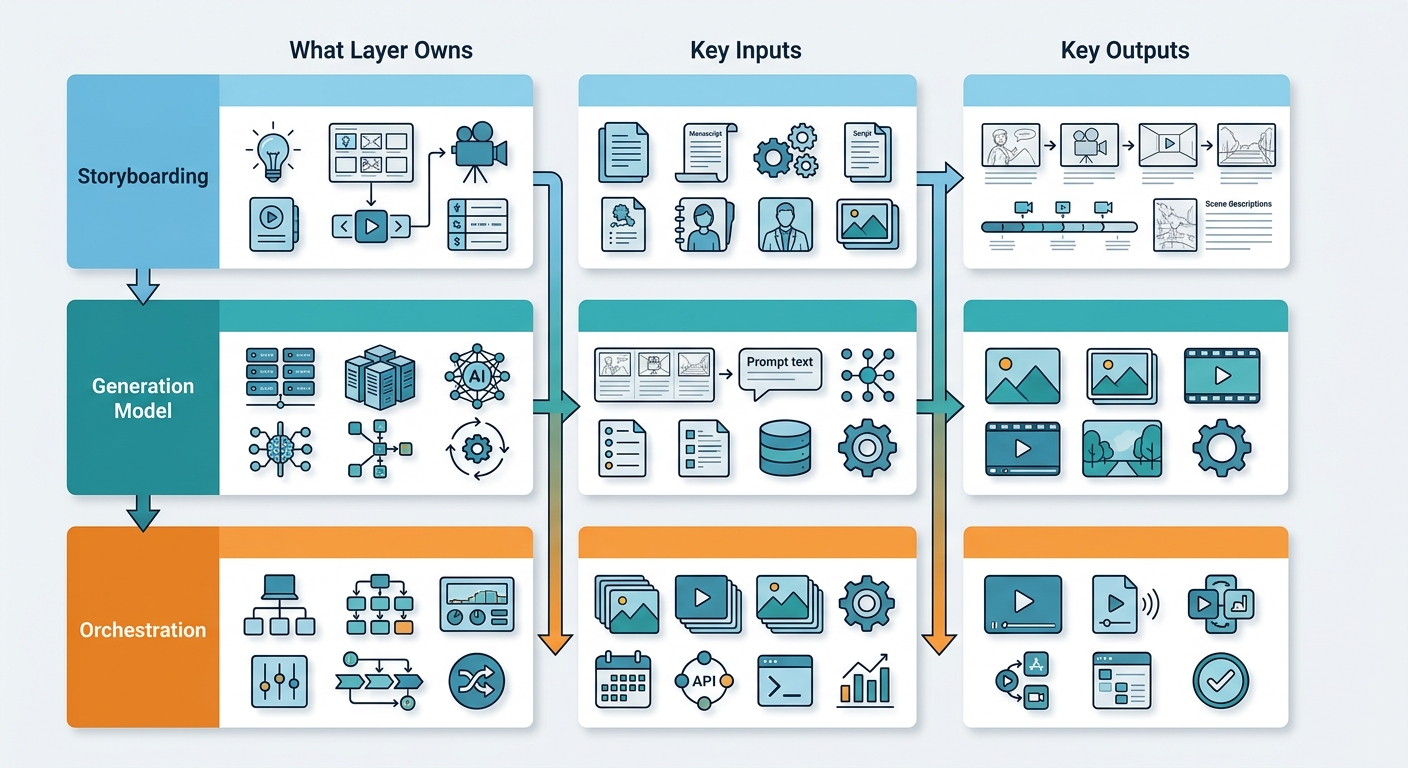
Teams that move past single clips structure work in three layers.
Layer one is storyboarding and concept. You decide the shots, the beats, the transitions before any generation. This is where creative judgment lives and where mediocre work is caught early.
Layer two is the generation model itself. Here you produce clip candidates, iterate on prompts and reference images, and select keepers.
Layer three is orchestration. This layer chains scenes, extends clips, manages references across shots, and keeps characters, voice, and brand assets consistent. It is the layer that makes AI video feel like production instead of one-off generation.
Directed production — prompt control, consistent characters, voice, editing, localization, and brand assets strung together — is what separates a usable tool from a toy. If your team is evaluating AI video, invest in the orchestration layer before you invest in more generation credits.
Toward Real-Time and Interactive Video
The longer-term direction is real-time, interactive generation. As world models mature, generation moves from offline batch rendering toward interactive physics. The implications are significant: dynamic ads that adapt, interactive product configurators, and game-style interactive content. This is a genuine direction of travel — but it is not today's production default. Treat real-time interactive video as the coming wave, not the current standard.
How to Decide What's Production-Ready for You
Use a simple decision filter. If the work is volume-driven, short-form, and low brand-risk — social cuts, A/B variants, explainer drafts — adopt now. The economics already work.
If the work is long-form, character-heavy, or brand-defining — a hero campaign, a feature film, a signature brand spot — run it human-led with AI assist. Use AI for pre-viz, drafts, and options, then let a creative team own the final.
Wherever you adopt, start with the still-to-motion workflow for control. And budget a human review stage with a defined rejection threshold. That review step is not a workaround; it is the production-ready way to use the tool in 2026.
The Bottom Line
Generative video in 2026 is a production amplifier, not a replacement for creative judgment. It cuts cost and time dramatically for volume work and genuinely fails at autonomous premium storytelling. The winning posture is selective: adopt where it is mature, plan a review stage everywhere, and let your creative team stay in the driver's seat.
The field is moving fast enough that the state of the art changes quarterly. If you are building video pipelines on this stack, subscribe to stay current on what is production-ready — and what still needs a human.
Expert Q&A
Q: Can AI video replace a human video editor in 2026? A: Not as a wholesale replacement, and not for premium work. AI video replaces specific, high-volume stages — generation, variation, lip-sync cleanup, localization. It does not yet replace editorial judgment over pacing, emotion, and brand voice. The winning setup is a human editor directing an AI toolset, with AI doing the heavy lifting on volume.
Q: What's the most production-ready use case for AI video right now? A: High-volume, short-form marketing and social content, plus product demonstrations and explainer videos. These are low brand-risk, momentum-driven, and format-constrained — all conditions where AI's speed and cost advantages fully apply. Long-form, character-heavy hero content should still be human-led.
Q: Why do AI videos look "uncanny," and what causes it? A: The uncanny feeling comes mostly from physics hallucinations and identity drift. Models that predict pixels rather than simulate a scene produce subtly wrong liquid, cloth, and collision behavior. Mixed with slight character inconsistencies across shots, the result reads as "almost but not real." Faster cuts hide it; slow continuous shots expose it.
Q: Is text-to-video or image-to-video better for brand consistency? A: Image-to-video, decisively. Locking a controlled still first gives the model a fixed subject to animate, which preserves composition, style, and product fidelity. Text-to-video is faster for ideation but far more prone to drift on brand-critical subjects.
Q: How long can a single AI-generated video clip be? A: The reliable native unit is 5-30 seconds. Some models extend to about two minutes at reduced resolution, and extension chains can reach roughly three minutes — but coherence drifts as length grows. Long-form content is built by assembling shorter consistent clips, not by generating one long take.
Q: Do I need a human review step if I use an AI video API? A: Yes. With roughly 68% of enterprise AI video deployments still needing human intervention to reach publishable quality, the review stage is the default production readiness gate. Encode a rejection threshold and a re-generation loop rather than assuming autonomous output.
Q: What is a world model and why does it matter for video? A: A world model simulates the scene and its physics rather than predicting pixels. This yields physically plausible interactions — correct bounces, occlusion, fluid behavior. It is the structural fix for physics hallucinations and the reason quality baselines are expected to rise through 2026.
Q: How much does production-grade AI video cost per minute? A: Cost varies widely by resolution, length, and model tier, and figures are estimated. The practical planning range is that AI-driven production is roughly three times faster and 40-80% cheaper than comparable traditional work for volume output. Build your budget around per-clip or per-minute API pricing for your specific volume and quality bar.