Edge AI in 2026: On-Device LLMs and the Rise of NPUs in Consumer Hardware
On-device LLMs went mainstream in 2026 as NPUs hit 50–100 TOPS. A practical look at bandwidth, cost, privacy, and what to buy or build.
Why 2026 Is the Year of On-Device AI
For years, "AI" meant sending data to a data center. That assumption is cracking. In 2026, the neural network moves onto the device itself, and the hardware is finally ready for it.
The numbers tell the story. AI Advanced PCs are projected to exceed half of global PC shipments this year, close to 59%. The edge AI market sits in the $30–47 billion range with a reported compound annual growth rate of roughly 22–32%. Those figures are estimates, but the direction is consistent.
The key shift — inference no longer needs to round-trip to the cloud. It happens in the laptop on your desk and the phone in your pocket.
Three forces drive this. Latency drops because data never leaves the machine. Privacy improves because sensitive content stays local. And cost falls because you stop paying per token to a cloud provider. Let's look at what makes all of that possible.
What an NPU Actually Does (and Doesn't)
A Neural Processing Unit (NPU) is a purpose-built accelerator for neural network inference. Unlike a general-purpose CPU, it packs large arrays of multiply-accumulate units tuned for the matrix math inside neural networks. Unlike a discrete GPU, it prioritizes efficiency per watt over raw flexible compute.
Marketing focuses on one number: TOPS, or tera-operations per second. It describes theoretical peak operations. Higher TOPS sounds better, and vendors push it hard. Copilot+ PCs, Microsoft's AI-ready spec, require at least 40 TOPS. Flagship chips now reach 50, 80, even 100 TOPS.
Here's the catch. TOPS measures raw arithmetic capacity, not real-world speed. The practical limit for running a large language model (LLM) locally is usually memory bandwidth, not the arithmetic rate.
The Memory Bandwidth Bottleneck
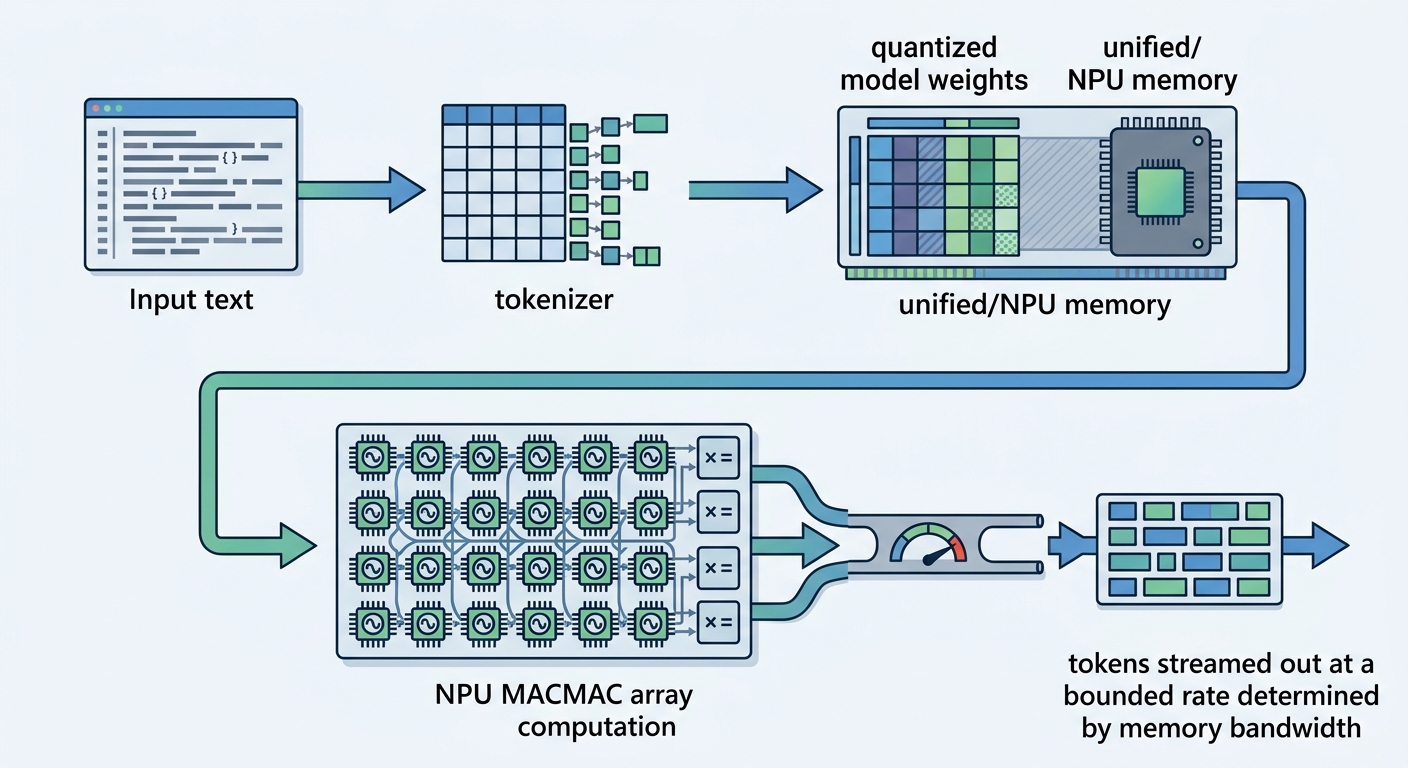
To generate a single token, the device must stream the entire model through the compute unit. A 7-billion-parameter model at 4-bit precision is roughly 3.5 GB. A 4-bit 13B model is about 6.5 GB.
The math is simple:
tokens per second ≈ memory bandwidth ÷ model size
If your chip delivers 100 GB/s of usable bandwidth, a 3.5 GB quantized 7B model streams at roughly 28 tokens per second. If bandwidth is 50 GB/s, you halve that. No amount of TOPS changes this ceiling. This is why a modest-NPU chip with wide memory can beat a high-TOPS chip with narrow memory.
This single insight reframes how you should read every spec sheet. TOPS tells you the ceiling of computation. Bandwidth tells you the real speed of local inference.
The 2026 NPU Landscape — Laptops and Phones
Consumer silicon moved fast in the past year. Here's where the major players landed in 2026.
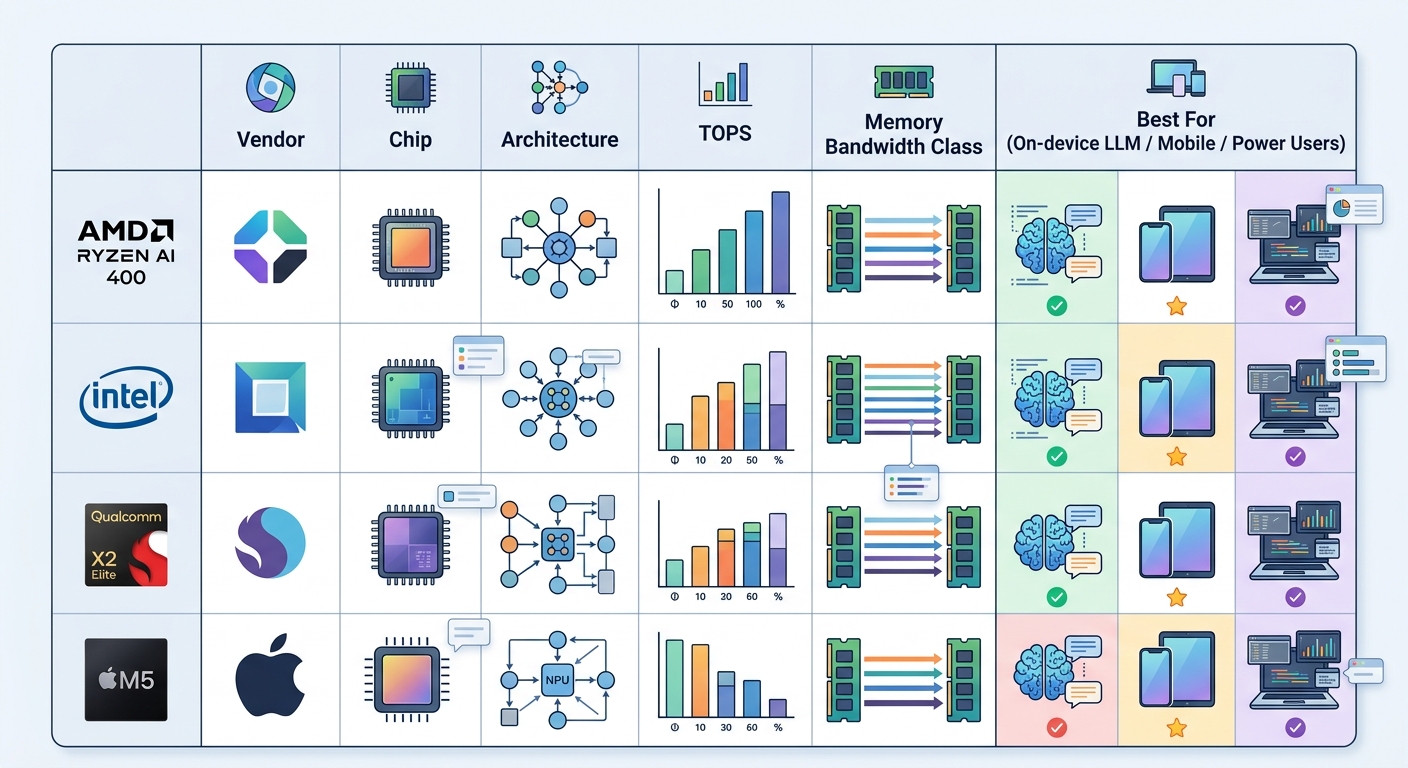
AMD pushed its Ryzen AI 400 series to up to 60 TOPS on the XDNA 2 architecture, with the Ryzen AI 300 line at 50 TOPS (reported). These target laptops and mini PCs with an eye on local inference workloads.
Intel shipped Panther Lake, its mainstream AI-PC platform with the NPU 5 architecture at 50 TOPS. Combined with the integrated Xe3 GPU, total platform AI performance reaches roughly 180 TOPS (reported). Lunar Lake (Core Ultra 200V) sits around 47–48 TOPS.
Qualcomm leads on raw numbers. The Snapdragon X2 Elite NPU reaches 80 TOPS, with up to 85 TOPS on Elite Extreme SKUs. On the phone side, the Snapdragon 8 Elite Gen 5 claims around 100 TOPS. Qualcomm has bet heavily on pervasive on-device AI across PC, mobile, and automotive.
Apple took a different path. The M5 and M6 families no longer publish Neural Engine TOPS figures. Instead, most on-device AI routes through dedicated neural accelerators inside each GPU core. Apple leans on massive unified memory — the M5 Ultra supports up to 512 GB — which lets it run very large local models without worrying about a bandwidth wall.
The takeaway — no single number decides the winner. A high-bandwidth unified-memory machine can run larger local models than a high-TOPS chip with limited memory, even if the TOPS figure reads lower.
How On-Device LLMs Actually Run
Hardware gets the attention, but software made local LLMs practical. Three techniques dominate.
Quantization reduces model precision from 16-bit to 8-bit or 4-bit. This shrinks memory footprint by up to 4x, which directly raises the token rate by cutting how much data must stream per token.
KV cache management optimizes the key-value storage inside the attention mechanism. It keeps memory use manageable for longer contexts, letting useful conversations fit on-device.
Speculative decoding uses a small, fast "draft" model to predict several tokens, which the larger model then verifies in parallel. It accelerates generation without changing output quality.
For smaller models under a billion parameters, deep-thin architectures — more layers, smaller hidden dimensions — beat wide-shallow ones in efficiency.
Realistic Use Cases Today
Be honest about boundaries. On-device LLMs are excellent right now at summarization, text formatting, light Q&A, code assistance, voice command handling, and sentiment analysis. They run offline and respond instantly.
Cloud LLMs still lead at frontier reasoning, very long multi-turn conversations, and tasks needing massive context. The winning pattern in 2026 is hybrid: run fast, private, low-cost utility tasks on-device, and escalate complex reasoning to the cloud only when needed.
Why It Matters for Your Infrastructure Budget
If you pay for API inference at scale, on-device processing changes your cost model. Every task that runs locally removes a cloud call and its recurring fee.
Privacy and compliance compound the benefit. Data that never leaves the device avoids data-residency requirements and reduces breach surface. This matters most in regulated industries like healthcare and finance.
Offline capability is a smaller but real win. Devices keep working in bad connectivity, remote sites, and air-gapped environments.
Security Considerations on the Edge
Shipping models to devices introduces new risks that cloud-only deployments avoid.
Model extraction is the big one — an attacker with physical access can reverse-engineer a shipped model. If your model is proprietary and valuable, weigh local distribution carefully.
Prompt injection applies to any LLM, but local apps that wire model output into actions need extra scrutiny. A corrupted in-device prompt could drive unintended behavior with no server-side guardrail.
Update hygiene matters. Models on devices need a secure delivery and versioning path, or stale, vulnerable weights linger in the field for years.
Treat on-device models as software to secure, not magic to ship and forget.
What to Evaluate Before Buying or Building
Whether you're buying laptops for a team or building a local AI feature, work through this checklist.
Match model size to bandwidth. Pick a device whose memory bandwidth comfortably streams your target model at an acceptable token rate — not one with the flashiest TOPS figure.
Check the software ecosystem. The best NPU is useless without a practical runtime. Evaluate ONNX Runtime, Apple's Core ML, and Qualcomm's AI Engine for platform support and how easily your model converts.
Watch power and thermals. NPUs win on efficiency, but sustained inference still heats up thin devices. Peak TOPS assume ideal cooling.
Plan for tooling debt. Conversion, quantization, and versioning of on-device models add engineering load. Budget for it.
The shift to on-device AI is real, but it rewards people who read past the TOPS sticker. Measure bandwidth, match models to workloads, secure the deployment — and you'll turn 2026's hardware wave into a genuine cost, privacy, and latency advantage.
This is a fast-moving space, and the hardware picture changes quarterly. If you want to stay current on on-device AI, NPUs, and the hardware that powers them, subscribe to the Algorithmine portal for practical, engineer-first briefings as the silicon landscape keeps evolving.
Expert Q&A
Q: Is a higher TOPS number always the right reason to pick an NPU laptop? A: No. TOPS describes peak arithmetic capacity, but real-world local LLM speed is bounded by memory bandwidth. The two NPUs of a given TOPS class can differ hugely in how fast they stream model weights. Match the device's bandwidth to the size of the model you actually intend to run. A 50 TOPS chip with wide memory band is often the more practical buy than an 80 TOPS chip that bottlenecks on narrow, slower memory.
Q: What's the single most common mistake teams make when moving inference to the edge? A: Choosing hardware from a spec sheet and only discovering the real constraint after integration. Teams pick high-TOPS parts, then find their target model doesn't fit in usable memory or streams too slowly for the required token rate. The fix is to benchmark with your own quantized model on the actual target device before committing — measure tokens/sec, peak memory, and sustained thermals under real load, not just vendor numbers.
Q: Apple doesn't publish TOPS anymore. How do you compare its Neural Engine to Intel, AMD, or Qualcomm? A: You compare behavior, not a single metric. Apple routes AI through per-GPU-core neural accelerators and leans on unified memory. For on-device LLM work, the practical effect is that Apple's M-series machines can often host large models (M5 Ultra up to 512 GB) without the same bandwidth wall. Bench on the platform: run your quantized model and measure tokens/sec and memory. Vendor marketing metrics matter less than the measured result on your workload.
Q: When should I deliberately keep a task in the cloud instead of pushing it on-device? A: When the workload needs frontier reasoning, very long context, or frequent model updates you can't safely push to devices. Also keep it in the cloud if your model is proprietary and sensitive to extraction from physical devices. On-device is best for high-frequency, latency-sensitive, private utility tasks; cloud is best for complex one-off reasoning where cost is secondary to quality.
Q: Does quantization meaningfully degrade output quality for real use cases? A: For many utility tasks — summarization, formatting, classification, light Q&A — 4-bit quantization is barely distinguishable from full precision. For tasks pushed near the model's capability boundary, quality drops can surface. The practical approach is to A/B test your specific workload at 8-bit vs 4-bit and measure task-level quality, not just perplexity. Pick the precision that clears your quality bar with the smallest footprint.
Q: Is there a security risk in shipping your model to customer devices at all? A: Yes. A capable attacker with physical access can extract model weights and probe its behavior. If the model embeds proprietary knowledge, that's a real asset-exposure risk. Mitigate with hardened binaries, obfuscation, and frequent version updates — or keep highly proprietary models server-side and ship only thin on-device adapters. Treat on-device distribution as a security decision, not a default.