Edge AI Deployment on ARM-based Hardware: A Practical Guide for 2026
The edge AI market is projected to reach $33.3 billion in 2026, with an estimated 1.6 billion edge AI chip shipments driving a fundamental shift in where intelligence lives. ARM-based hardware has eme
The edge AI market is projected to reach $33.3 billion in 2026, with an estimated 1.6 billion edge AI chip shipments driving a fundamental shift in where intelligence lives. ARM-based hardware has emerged as the dominant platform for this transformation, powering everything from industrial smart cameras to autonomous robots. If you are an ML engineer or systems architect planning your first production edge AI deployment, this guide walks through the complete journey: hardware selection, model optimization, software stack, and operational patterns specific to ARM.
Why ARM Is Winning the Edge AI Race
Cloud AI inference carries inherent costs: latency from round trips to distant data centers, bandwidth expenses for transmitting data, and privacy risks from moving sensitive information off-device. ARM-based edge hardware — provides — heterogeneous compute that addresses all three by bringing inference directly to the data source.
ARM — has spent — decades optimizing for power efficiency, and that philosophy aligns perfectly with edge AI requirements. Where a cloud GPU server might consume 300W for a single inference job, a complete ARM edge system with Cortex-A CPU and Ethos-U NPU delivers 4 TOPS (tera-operations per second) at under 2W total system power — roughly 150x better performance-per-watt.
The ecosystem maturity matters just as much as silicon performance. Developers can choose from hundreds of development boards, established embedded Linux distributions, and a software toolchain spanning everything from bare-metal RTOS to full Kubernetes edge clusters. This breadth reduces integration risk in a way that newer, narrower edge AI platforms cannot match.
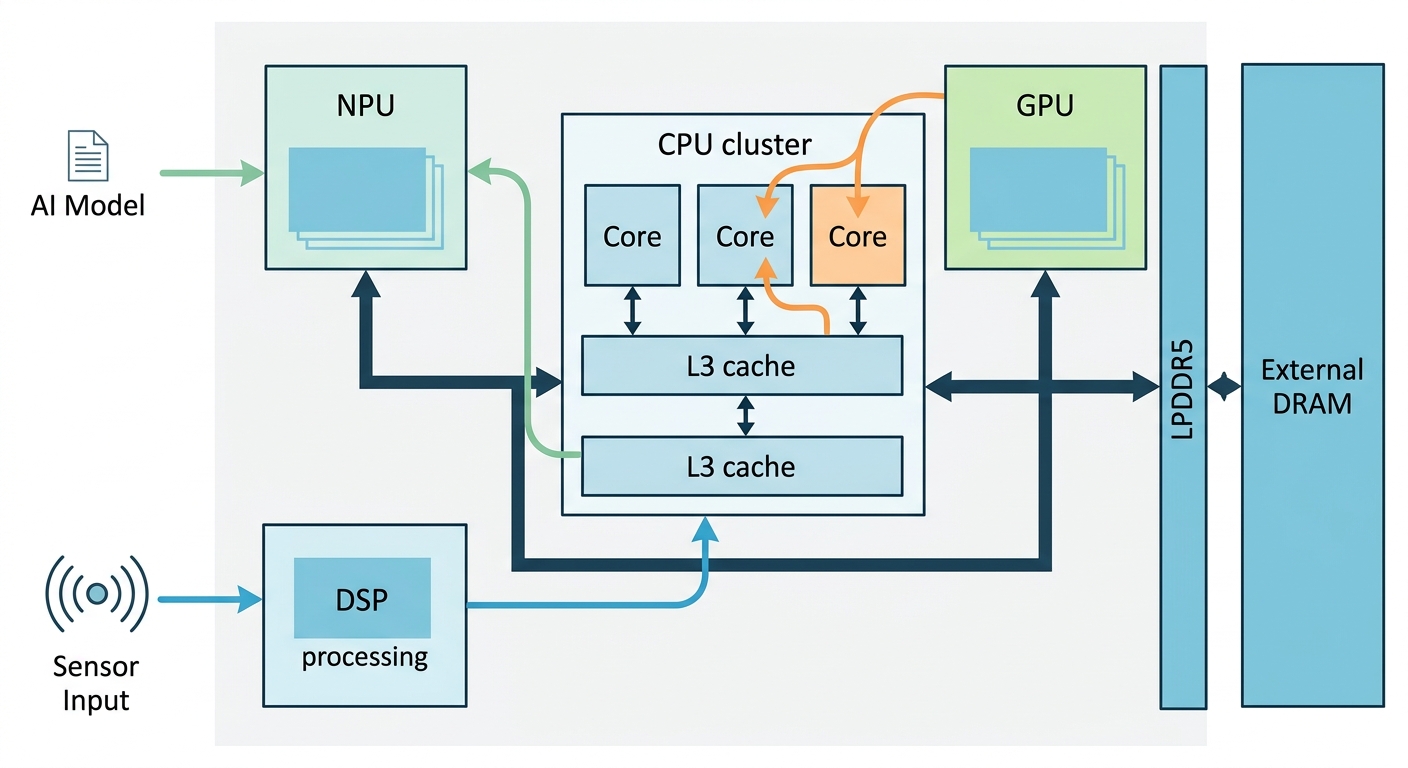
ARM — enables — maximum performance-per-watt through heterogeneous compute. Rather than forcing all AI workloads through a single accelerator, ARM designs let you match each model layer to the optimal execution unit: neural processing units (NPUs) for convolutional vision models, CPU vector extensions for transformer attention, digital signal processors (DSPs) for sensor preprocessing. This flexibility is why ARM — has become — the default architecture for edge AI deployment.
Understanding ARM's Edge AI Hardware Stack
ARM's edge AI hardware portfolio spans a wide performance range, from microcontrollers to high-performance application processors.
Cortex-A application processors target embedded Linux devices running complex AI workloads. The Cortex-A720, ARM's current mainstream offering, delivers strong general-purpose performance with solid machine learning acceleration via Neon SIMD (Single Instruction Multiple Data) instructions. The newer Cortex-A320, announced in early 2025 as part of ARM's edge AI platform, ARM Cortex-A320 — delivers — 10x ML performance uplift over the Cortex-A35 while consuming under 1W. The Cortex-C1 cluster, announced in late 2025, pushes single-thread performance 25% higher than the previous generation with improved power efficiency for sustained workloads.
Ethos-U85 NPU (Neural Processing Unit), introduced in April 2024, is ARM's dedicated AI accelerator for edge devices. It scales from 256 GOPS to 4 TOPS at 1 GHz and adds native support for transformer-based models — a capability its predecessor, the Ethos-U65, lacked. The U85 delivers 4x the performance of the U65 with 20% better power efficiency.
Ethos-U85 delivers 4x inference performance with 20% better power efficiency than its predecessor — the most significant NPU architectural advancement ARM has shipped for edge AI workloads.
It pairs naturally with Cortex-A processors, offloading compute-intensive AI layers while the CPU handles control flow and pre/post-processing. Ethos-U85 NPU — accelerates — transformer inference at the edge for vision models, while SME2 — enables — matrix operations on Cortex-A CPU for language model feed-forward layers.
Cortex-M microcontrollers address ultra-low-power TinyML use cases: keyword spotting, anomaly detection on sensor streams, simple gesture recognition. These parts run on milliwatts and fit in tens of kilobytes of memory, enabling AI in battery-powered devices that cannot tolerate the power budget of a full application processor.
ARMv9 architecture brings specific AI acceleration features that matter for edge deployment. Scalable Matrix Extension 2 (SME2) — adds — matrix compute units directly into the CPU core, enabling efficient execution of matrix multiplications — the core operation in transformer models — without dedicated NPU hardware. This matters for deployments where NPU availability is uncertain or where heterogeneous workload distribution requires CPU-based AI acceleration.
[ILLUSTRATION: Comparison table showing 5 model optimization techniques — Quantization INT8, Structured Pruning, Knowledge Distillation, KV Cache Compression, and Model Compilation — with columns for Memory Reduction (4x, 1.5-3x, 3-10x, 4-8x, 1.5-2x), Latency Improvement (2-4x, 1.3-1.8x, 2-3x, 1.2-1.5x, 2-5x), Accuracy Loss (1-2%, 2-5%, 3-8%, <1%, 0%), and Best Use Case (General purpose, Vision models, LLMs, Long context, Production deployment).]
Model Optimization for ARM Edge Deployment
Deploying AI models on edge hardware requires more than porting a trained PyTorch or TensorFlow checkpoint. Memory constraints, compute limitations, and power budgets demand systematic optimization.
Quantization reduces numerical precision to shrink model size and accelerate inference. Converting weights from 32-bit floating point (FP32) to 8-bit integer (INT8) typically yields 4x memory reduction with 1-2% accuracy loss on image classification tasks — an acceptable trade-off for most production deployments. For extreme constraints, 4-bit integer (INT4) quantization halves memory again, though accuracy degradation becomes more noticeable. Quantization — reduces — model memory footprint on ARM by 4-8x, making previously impossible deployments feasible. KleidiAI — accelerates — CPU-based AI inference through optimized INT8 and FP16 kernels that exploit Neon SIMD instructions on Cortex-A cores.
Pruning removes weights that contribute minimally to model output. Structured pruning removes entire channels or attention heads, creating sparsity patterns that hardware can exploit. Unstructured pruning removes individual weights, achieving higher theoretical compression but requiring sparse matrix representation that most edge hardware cannot accelerate efficiently. For ARM deployment, structured pruning with 30-50% sparsity typically provides the best practical balance.
Knowledge distillation trains a smaller student model to mimic a larger teacher model. The student learns not just from hard labels but from the teacher's probability distribution over classes — a richer training signal that produces a compact model with accuracy closer to the teacher than training from scratch would achieve. For LLMs specifically, distilled small language models (SLMs) in the 1B-7B parameter range can now run interactively on ARM Cortex-A hardware with acceptable latency.
Model compilation translates trained model graphs into optimized machine code for the target hardware. Model optimization — enables — ARM edge deployment by transforming trained model artifacts into hardware-specific executables. ARM's toolchain, combined with runtime environments like TensorFlow Lite and ONNX Runtime, performs operator fusion (combining adjacent operations to reduce memory bandwidth), layer layout optimization (reordering data for cache-friendly access), and hardware-specific scheduling (matching operation scheduling to NPU pipeline characteristics). The result is often 2-5x faster inference compared to naive interpretation of the original model graph.
KV cache compression matters specifically for autoregressive models like LLMs. The key-value cache grows linearly with sequence length, consuming context window memory that ARM edge devices may not have to spare. Techniques like grouped-query attention (GQA) and key-value quantization reduce cache footprint by 4-8x, making longer-context inference feasible on constrained hardware.
ARM's Software Stack for Edge AI Development
ARM's AI software ecosystem has matured significantly, though navigating it requires understanding the layers.
KleidiAI is ARM's CPU-oriented AI acceleration library, providing optimized kernels for common AI operations on Cortex-A cores. Unlike vendor-specific SDKs, KleidiAI targets the ARM architecture generically, making code portable across different Cortex-A implementations from different chip vendors. It handles INT8, FP16, and BF16 (brain float) operations with Neon SIMD acceleration.
CMSIS-NN (Cortex Microcontroller Software Interface Standard — Neural Networks) provides neural network kernels optimized for Cortex-M and Cortex-A processors. It is the standard path for deploying AI on ARM microcontrollers and is tightly integrated with TensorFlow Lite for Microcontrollers.
ARM SME2 (Scalable Matrix Extension 2) instructions enable efficient matrix multiplication directly in the CPU core. KleidiAI includes SME2-optimized kernels that accelerate transformer feed-forward and attention layers without requiring an NPU. On Cortex-A cores with SME2 support, these kernels deliver 2-3x speedup over Neon-only execution for matrix-heavy AI workloads.
Google AI Edge tools work directly with ARM hardware. LiteRT (formerly TensorFlow Lite) generates ARM-optimized inference graphs with NPU delegate support. The AI Edge Quantizer performs post-training quantization with accuracy recovery, minimizing the accuracy loss that naive quantization introduces. Model Explorer visualizes model graphs to identify optimization opportunities before deployment.
Third-party frameworks round out the ecosystem. ONNX Runtime provides hardware-agnostic AI inference with ARM optimization, useful when deploying models trained in various frameworks to heterogeneous ARM fleets. ExecuTorch serves PyTorch teams deploying to edge gateways. XGBoost and scikit-learn models can run on ARM via ONNX conversion for traditional ML workloads at the edge.
Achieving Real-Time Inference on ARM Hardware
Edge AI — requires — real-time low-latency inference for interactive applications, and ARM's heterogeneous architecture provides the building blocks to achieve it. Real-time AI inference — typically defined as sub-100ms response time for interactive applications, or sub-10ms for safety-critical systems — requires deliberate architecture beyond basic model optimization.
Pipeline optimization overlaps stages to reduce effective latency. While the NPU executes inference on frame N, the CPU preprocesses frame N+1 and the DSP post-processes results from frame N-1. This pipelining keeps all execution units active and hides the latency of individual stages behind each other. The critical path becomes the slowest single stage rather than the sum of all stages.
Dynamic batching adapts batch size to incoming traffic. At low request rates, single-stream inference provides minimum latency. When traffic spikes, batching multiple requests amortizes the overhead of memory transfers and NPU kernel launches, improving throughput without proportionally increasing latency for any single request.
NPU offloading strategy matters for achieving consistent low latency. The Ethos-U85 handles vision transformers, object detection models (YOLO variants), and CNNs efficiently. LLM inference, however, presents a challenge: transformer attention layers map well to the NPU, but feed-forward network layers are memory-bandwidth-bound and run faster on CPU cores with SME2 acceleration. The optimal partition places attention on NPU and FFN on CPU, requiring careful implementation.
Memory bandwidth optimization reduces the latency bottleneck that memory access creates. AI model inference spends significant time loading weights from RAM. Techniques like weight quantization (reducing data volume), layer fusion (reducing load operations), and strategic layer ordering (placing memory-heavy operations early when cache is fresh) all contribute. For the most latency-sensitive deployments, profiling with ARM's performance counters to identify memory-bound layers pays dividends.
ARM Cortex-A320 — delivers — 10x ML performance uplift over its predecessor, enabling new latency targets on ultra-compact edge devices. For applications requiring real-time performance on devices previously considered too constrained — smart watches, earbuds, tiny industrial sensors — the A320 changes the feasibility boundary.
Production Deployment Patterns for ARM Edge Devices
Moving from proof-of-concept to production edge AI requires patterns that address scale, security, and reliability.
Over-the-air (OTA) model updates enable fleet-wide model improvements without physical access to devices. Delta updates transmit only changed model weights rather than full model files, reducing bandwidth costs and update duration. Model versioning with automatic rollback ensures that a bad update does not brick a deployed fleet. Healthy deployment pipelines include accuracy validation on a reference dataset before propagating updates across the full fleet. OTA updates — maintain — edge AI model fleet health and security over multi-year deployments.
Headless deployment runs ARM edge AI systems without human interface hardware. Embedded Linux on Cortex-A boards (Raspberry Pi 5, Rockchip RK3588, NXP i.MX series) supports fully automated operation via SSH or management APIs. Container runtimes like Docker and Podman isolate AI workloads from system services, simplifying dependency management and enabling consistent behavior across hardware revisions.
Fleet management at scale requires centralized visibility into device health, model accuracy drift, and inference latency distributions. A practical approach combines lightweight agents on each device reporting metrics to a central dashboard, with alerting configured for anomalies like inference latency spikes or accuracy degradation on validation data. Canary rollouts — updating a small percentage of devices first and monitoring — reduce the blast radius of problematic updates.
Security demands attention at every layer. Secure boot validates the boot chain from ROM through bootloader to OS kernel, preventing tampering before AI inference begins. Model encryption protects intellectual property and prevents reverse engineering of deployed models. Runtime integrity verification periodically checks that model files and inference code have not been modified. For the most sensitive deployments, ARM's Trusted Execution Environment (TEE) provides an isolated enclave where AI inference can run without exposure to the main operating system.
Offline-first design recognizes that edge environments frequently lack reliable connectivity. Edge AI — eliminates — cloud connectivity dependency by performing all critical inference locally. AI inference must function correctly with no network access, making local decision-making autonomous. Optional synchronization, when connectivity exists, uploads telemetry and downloads model updates. This pattern is essential for industrial automation, autonomous vehicles, and remote infrastructure monitoring.
Hybrid cloud-edge architecture combines the strengths of both. Cloud infrastructure handles model training, large-scale analytics, and model registry management. ARM edge devices handle time-sensitive inference, preprocessing to reduce upstream bandwidth, and local response generation. The edge acts as an intelligent filter, transmitting only salient events or anomalies to the cloud rather than raw data streams.
Use Cases: Where ARM Edge AI Is Making an Impact
ARM-based edge AI deployment spans a wide range of industries and applications.
Smart cameras represent one of the largest edge AI market segments. Object detection, people counting, and anomaly detection run directly on camera SoCs embedding Cortex-A cores and Ethos-U NPUs, eliminating the latency and bandwidth cost of transmitting video to cloud servers. Privacy-sensitive applications like occupancy monitoring in offices or patient fall detection in healthcare benefit particularly from on-device inference, as raw video never leaves the premises.
Industrial robotics relies on ARM edge AI for real-time perception. Object detection, pose estimation, and path planning models run on robot controller boards, enabling sub-millisecond response to environmental changes. Robot manufacturers favor ARM for its combination of real-time processing capability, power efficiency in battery-powered mobile robots, and long product lifecycle support that industrial deployments require.
Healthcare monitors deploy continuous patient monitoring AI on wrist-worn or bedside devices. Arrhythmia detection, sleep apnea monitoring, and fall detection run on ultra-low-power ARM Cortex-M systems, providing immediate alerts without cloud latency or dependency. This approach also addresses data privacy requirements in healthcare, where patient data often cannot leave the care facility.
Smart agriculture deploys AI models on drone-edge and tractor-edge hardware for crop health analysis, weed detection, and yield estimation. Processing imagery on the edge reduces the bandwidth required for large agricultural operations covering thousands of acres with intermittent rural connectivity.
Automotive driver monitoring systems and advanced driver-assistance systems (ADAS) run AI inference on ARM-based automotive SoCs. Lane departure warning, attention detection, and traffic sign recognition depend on low-latency edge inference where the consequences of cloud round-trip latency are unacceptable.
Cost Analysis — ARM Edge AI vs Cloud GPU Inference
For high-volume production deployments, the economics of edge AI on ARM often favor on-device inference over cloud GPU processing.
Hardware cost for ARM-based edge AI modules ranges from approximately $20 for a compact Cortex-A system-on-module to $200 for a high-performance module with NPU. A cloud GPU instance capable of comparable inference throughput costs $0.50-3.00 per hour in direct compute charges. At scale, the crossover point — where cumulative cloud inference costs exceed the hardware cost of on-device ARM deployment — arrives within months for many use cases.
Connectivity costs disappear with edge inference. Transmitting video or sensor data to cloud GPU servers costs $0.05-0.50 per GB depending on data volume commitments. A single smart camera transmitting compressed video at 2 Mbps generates roughly 650 GB per month, a significant ongoing cost that edge inference eliminates by transmitting only alerts and metadata.
Latency value is difficult to quantify but real. Applications where 50-100ms additional cloud latency degrades user experience or system responsiveness — interactive AI assistants, real-time video analytics, autonomous systems — justify edge deployment on latency grounds alone.
Power cost compounds the hardware economics. A 2W ARM edge AI system costs approximately $1.75 per year in electricity at typical commercial rates. A cloud GPU instance consuming 300W costs roughly $260 per year for the same inference workload, assuming continuous operation.
Total cost of ownership for edge AI on ARM shows 30-50% lower TCO compared to equivalent cloud GPU inference for production deployments exceeding roughly 50,000 inferences per day, based on estimated 2026 hardware and cloud pricing.
ARM edge AI achieves 30-50% lower total cost of ownership compared to cloud GPU inference for deployments exceeding 50,000 inferences per day — driven by eliminated connectivity costs, dramatically lower power consumption, and hardware amortization over multi-year device lifecycles.
Getting Started — Your First ARM Edge AI Deployment
Beginning your ARM edge AI journey requires practical choices at each layer of the stack.
Hardware selection sets the performance ceiling. For learning and prototyping, a Raspberry Pi 5 with 8GB RAM provides accessible ARM Cortex-A76 cores and reasonable AI inference performance via ONNX Runtime. For more serious development with NPU acceleration, the Rockchip RK3588 development board offers an Ethos-U85 NPU alongside Cortex-A76/A55 cores. NVIDIA Jetson Orin Nano uses ARM Cortex-A78AE cores — an often-overlooked detail that makes it directly comparable to other ARM edge platforms in terms of instruction set architecture.
Framework choice determines portability. TensorFlow Lite provides the broadest optimization path to ARM NPUs, with Google AI Edge tools automating quantization and NPU delegate configuration. ONNX Runtime offers strong ARM support with a hardware abstraction layer that simplifies targeting different ARM boards from the same model artifact.
Profiling before optimization prevents wasted effort. ARM Development Studio includes performance analysis tools that identify whether your model is compute-bound, memory-bandwidth-bound, or memory-capacity-constrained on your target hardware. Optimization efforts directed at the actual bottleneck deliver the highest return.
Iterative optimization follows a predictable sequence: start with INT8 quantization, benchmark accuracy and latency, then apply structured pruning if memory constraints persist, then explore operator-level optimization if latency targets remain unmet. Each step trades development time against incremental gains — stop when the gains no longer justify the effort.
Reference implementations accelerate learning. ARM's official edge AI documentation, KleidiAI code examples, and Google AI Edge tutorials provide working starting points for common model architectures. The partner ecosystem — chip vendors like Rockchip, NXP, and Qualcomm — publishes board-specific optimization guides for their ARM-based products.
The tools and patterns for production ARM edge AI deployment have matured significantly through 2025 and 2026. What once required deep embedded systems expertise now fits within the skillset of ML engineers familiar with Python-based workflows and cloud AI pipelines. The key advantages — power efficiency, predictable latency, data privacy, and operational cost reduction — apply across a wide range of use cases from industrial automation to consumer electronics. Starting with a focused pilot on accessible development hardware lets teams build practical expertise before committing to full-scale production deployment.
Ready to optimize your AI models for ARM edge deployment? Explore our practical tutorials on TensorFlow Lite ARM optimization and edge AI quantization techniques to build hands-on experience with the techniques covered in this guide.
Expert Q&A
Q: Can I run a 7B parameter LLM on an ARM Cortex-A device at the edge, and what performance should I expect? A: Yes, with 4-bit quantization and KV cache compression, a 7B parameter model can run on a Cortex-A720 with 16GB of LPDDR5 RAM at approximately 15-30 tokens per second for interactive use cases. The Ethos-U85 NPU handles transformer attention layers efficiently, while SME2-accelerated CPU cores process feed-forward network layers. For batch processing rather than interactive use, throughput scales roughly 2-3x higher. The key memory constraint is fitting the quantized model weights (roughly 3.5GB for INT4), the KV cache for your context window, and activation tensors simultaneously in RAM. A 4K context window with GQA typically consumes 1-2GB of KV cache, leaving sufficient headroom on a 16GB system.
Q: What is the biggest pitfall engineers encounter when first deploying AI models on ARM edge hardware? A: Memory fit is the most common failure mode. Engineers successfully optimize their model for latency and accuracy, then discover at runtime that the model plus activations do not fit in available RAM, causing page faults that degrade performance by 10-50x. The fix is to profile memory consumption during inference with ARM's performance counters before deployment, not after. A secondary pitfall is neglecting the memory bus: an optimized model that exceeds L2/L3 cache and becomes memory-bandwidth-bound will underperform a less optimized model that stays cache-resident. Always validate that your optimization sequence (quantize, then compile, then prune) actually improves the metric that matters for your use case.
Q: How should I decide between NPU-based and CPU-based AI inference on ARM for my specific model? A: The decision depends on model architecture and batch size. The Ethos-U85 NPU excels at CNNs, vision transformers, object detection models (YOLO family), and any model with regular convolution or matrix multiplication patterns that map to the NPU's systolic array. CPU-based inference with Neon or SME2 is preferable for autoregressive models (LLMs), models with irregular control flow, small batch sizes where NPU kernel launch overhead dominates, and any model that must coexist with other real-time workloads on the same system. In practice, the most effective approach is heterogeneous: partition your model so that NPU handles the layers it executes efficiently while CPU handles the remainder.
Q: What power management techniques are most effective for battery-powered edge AI devices? A: Dynamic voltage and frequency scaling (DVFS) is the primary lever — ARM's big.LITTLE architecture lets you migrate workloads between high-performance Cortex-A cores and efficiency cores based on inference demands. For the Ethos-U85 NPU, clock-gating during idle between inference requests saves significant power since the NPU consumes meaningful leakage even when not executing. A practical power management stack configures the operating system to select the minimum clock frequency that meets your latency target for each inference request, uses idle states aggressively between requests, and implements a simple state machine that transitions between full-power inference, low-power standby, and deep-sleep modes based on traffic patterns. ForAlways-on keyword spotting or similar continuous monitoring tasks, Cortex-M microcontrollers should be used instead of Cortex-A application processors — the power difference is an order of magnitude.
Q: How do OTA model updates work securely on ARM edge devices without risking a bad deployment? A: A secure OTA pipeline requires three elements: signed updates, atomic deployment, and automatic rollback. Each model artifact is signed with a private key whose public counterpart is provisioned in secure storage (e.g., ARM TrustZone) during manufacturing. The device verifies the signature before accepting an update. Atomic deployment ensures that either the full update completes or the previous model remains active — partial updates cannot be loaded. Automatic rollback triggers when post-deployment health checks fail, reverting to the last known-good model within seconds. The update payload itself should use delta compression to minimize bandwidth: transmitting only changed weight tensors rather than full model files, which can be 100MB+ for modern models. Reference implementations from ARM's partners (NXP, STMicroelectronics, Renesas) provide turnkey secure OTA pipelines compatible with their edge AI modules.