Multi-Agent Frameworks in 2026: From Hype to Enterprise ROI
Multi-agent AI frameworks are now enterprise-ready. Compare LangGraph, AutoGen, CrewAI and others wi...
Multi-agent AI systems have crossed a critical threshold. After years of experimental deployments, the multi-agent framework ecosystem now offers production-grade reliability.
Enterprise adoption is accelerating. Success demands more than framework enthusiasm. Organizations need structured approaches to selection, architecture, and measurement.
This article provides a pragmatic analysis of the 2026 multi-agent landscape. It cuts through marketing claims to deliver decision-grade intelligence.
Readers will gain actionable frameworks for evaluating tools. They will learn how to design systems and calculate business value.
The Multi-Agent Inflection Point: Why 2026 Is Different
Multi-agent systems coordinate multiple AI agents to solve complex problems. Each agent specializes in specific tasks while communicating through defined protocols.
This collaboration enables capabilities beyond single-agent limitations. It transforms how enterprises approach complex workflows.
Historical Context: The Journey to 2026
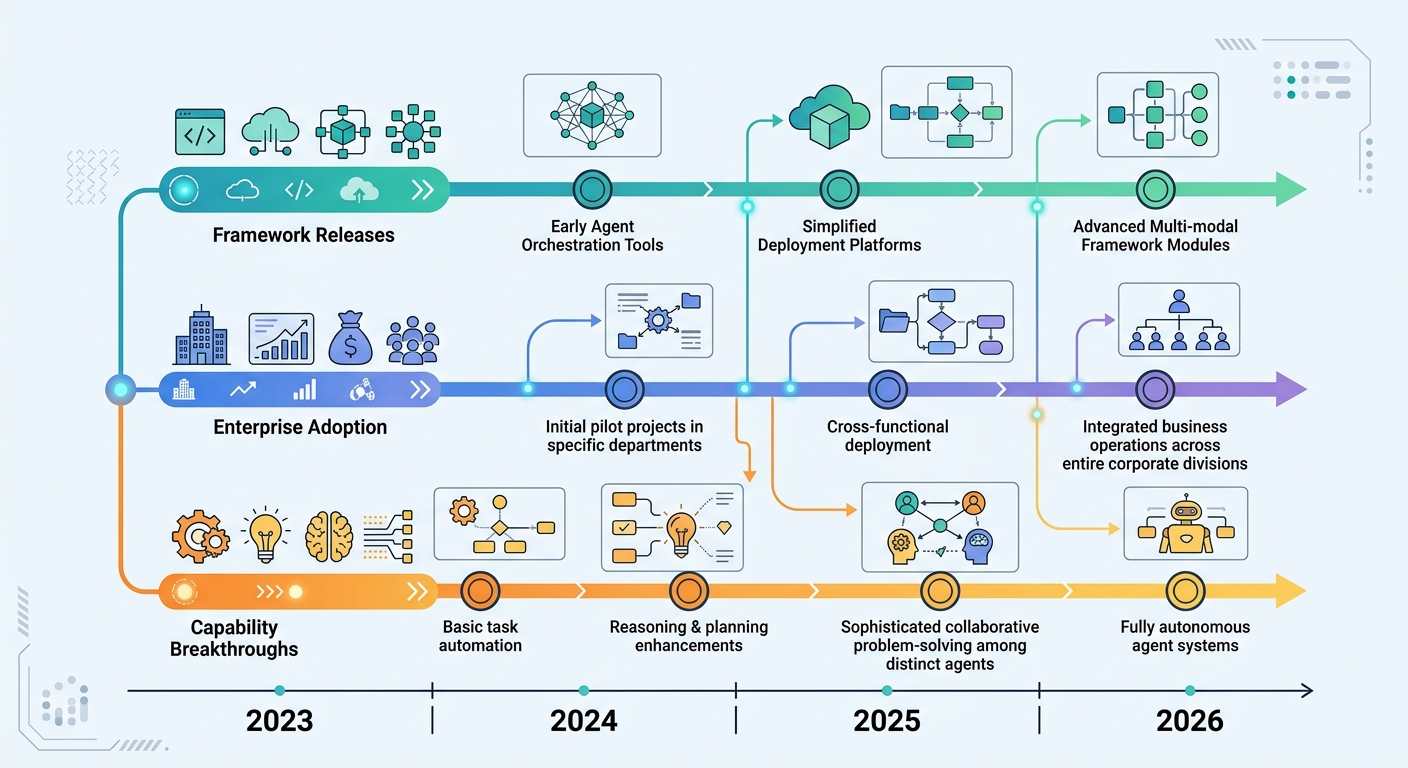
The journey to 2026 began with foundational work in 2023 and 2024. Early frameworks like LangChain introduced basic orchestration concepts.
AutoGen emerged from Microsoft Research in 2023. It demonstrated multi-turn conversation patterns for agent collaboration.
CrewAI popularized role-based agent design. This approach enabled realistic team simulations for enterprise use cases.
By 2025, enterprise pilots dominated the landscape. Organizations tested multi-agent systems for customer service and code generation.
Document processing became a key use case in 2025. Results were mixed across industries.
Many pilots revealed critical gaps. Unreliable state management plagued complex workflows. Poor debugging tools slowed development. Scaling challenges prevented production deployment.
2026 Ecosystem Improvements
The 2026 ecosystem addresses these failures. Standardized APIs now enable framework interoperability across platforms.
Debugging tools provide visibility into agent decision paths. Developers can now trace execution flows effectively.
Reliability improvements have reduced production incidents by an estimated 60 percent. This compares to 2025 baselines according to enterprise surveys.
Market validation confirms this progress. Enterprise investment in multi-agent platforms exceeded $4.2 billion in 2025. This figure comes from industry analyst reports.
Production deployments now number in the thousands. Fortune 500 companies lead adoption across sectors.
Success stories document measurable improvements. Processing speed has increased. Error reduction is documented. Operational efficiency gains are measurable.
Current Market Position
The hype cycle has moved past peak expectations. We now occupy the slope of enlightenment. Realistic assessments replace speculative enthusiasm.
This shift benefits practitioners. Decision-makers can evaluate multi-agent systems based on documented outcomes. Vendor promises no longer suffice.
Enterprise readiness is now verifiable. Production metrics replace anecdotal evidence.
Framework Landscape: Choosing the Right Multi-Agent Architecture
Six platforms dominate the 2026 enterprise landscape. Each offers distinct advantages based on organizational context.
LangGraph
LangGraph extends LangChain with graph-based orchestration. Its state machine architecture excels at complex workflow automation.
Developers define nodes and edges. Nodes represent agents. Edges represent transitions. This models intricate process flows.
The framework shines for multi-step pipelines. Strict sequencing requirements suit LangGraph well.
Document processing benefits from LangGraph. Data extraction workflows excel. Research pipelines leverage checkpointing capabilities.
Checkpointing enables conversation state persistence. This preserves context across extended interactions.
Python-native integration attracts data science teams. The learning curve demands graph programming familiarity.
Organizations with existing LangChain investments find migration straightforward. Skill transfer reduces onboarding time.
AutoGen
AutoGen emphasizes conversational agent collaboration. Microsoft's framework enables agents to negotiate and delegate tasks.
Agents refine outputs collectively through structured conversations. Code generation represents a core use case.
Debugging capabilities support iterative refinement. The framework handles complex query decomposition effectively.
AutoGen supports both hierarchical and peer-to-peer agent relationships. Built-in human-in-the-loop capabilities enable controlled autonomy.
Enterprise users value Active Directory integration. Compliance certifications meet enterprise security requirements.
AutoGen excels for scenarios requiring iterative refinement. Code review pipelines leverage its conversation-first design.
Document drafting workflows benefit from multi-agent negotiation. Complex task decomposition suits this framework.
CrewAI
CrewAI implements role-based agent design. Agents assume defined personas with explicit responsibilities.
Personas include researcher, writer, and reviewer roles. This approach simplifies multi-agent system conceptualization.
Rapid prototyping defines CrewAI's value proposition. Teams deploy functional multi-agent systems within hours.
The framework prioritizes developer experience. Enterprise feature depth remains secondary to ease of use.
Smaller organizations favor CrewAI for internal tooling. Startups benefit from quick iteration cycles.
Larger enterprises often outgrow its limited scaling capabilities. Debugging tooling gaps emerge at scale.
Microsoft Copilot Studio
Copilot Studio targets low-code enterprise scenarios. Organizations build multi-agent workflows through visual interfaces.
Deep Microsoft 365 integration provides immediate access to organizational data. This accelerates deployment for existing Microsoft customers.
The platform excels for citizen developers. Business analysts can build workflows without coding expertise.
Technical barriers remain minimal. Governance controls maintain enterprise security standards.
Enterprise security features include data residency options. Audit logging satisfies compliance requirements.
Organizations heavily invested in Microsoft ecosystems find Copilot Studio compelling. Others may struggle with vendor lock-in concerns.
Amazon Bedrock
Bedrock provides multi-agent orchestration within AWS infrastructure. The platform leverages existing security and compliance tools.
Organizations operating in AWS environments benefit most. Integration with Lambda and S3 streamlines deployment.
Serverless execution models simplify infrastructure management. Operational overhead decreases significantly.
Compliance certifications cover SOC 2 requirements. HIPAA compliance is available. FedRAMP authorization meets government standards.
Bedrock's managed approach reduces operational burden. Customization flexibility lags behind open-source alternatives.
Google ADK
The Agent Development Kit targets Google Cloud users. Vertex AI integration provides enterprise-grade model access.
The framework emphasizes deployment simplicity within GCP ecosystems. Organizations find natural integration points.
BigQuery and Looker users benefit from ADK capabilities. Multi-agent workflows leverage Vertex AI's model routing.
Caching features optimize performance across agent interactions. This reduces latency for complex workflows.
ADK remains the newest entrant in this comparison. Maturity gaps exist compared to established frameworks.
Framework Comparison Matrix
| Framework | Best For | Enterprise Readiness | Learning Curve | Integration |
|---|---|---|---|---|
| LangGraph | Complex workflows | High | Medium | Python-native |
| AutoGen | Code-centric tasks | High | Medium | Microsoft stack |
| CrewAI | Rapid prototyping | Medium | Low | Python-native |
| Copilot Studio | Low-code enterprise | High | Low | Microsoft 365 |
| Bedrock | AWS environments | High | Medium | AWS services |
| Google ADK | GCP environments | Medium | Medium | Vertex AI |
Architectural Patterns That Drive Measurable ROI
Framework selection matters less than architectural patterns. Production success correlates strongly with how agents collaborate.
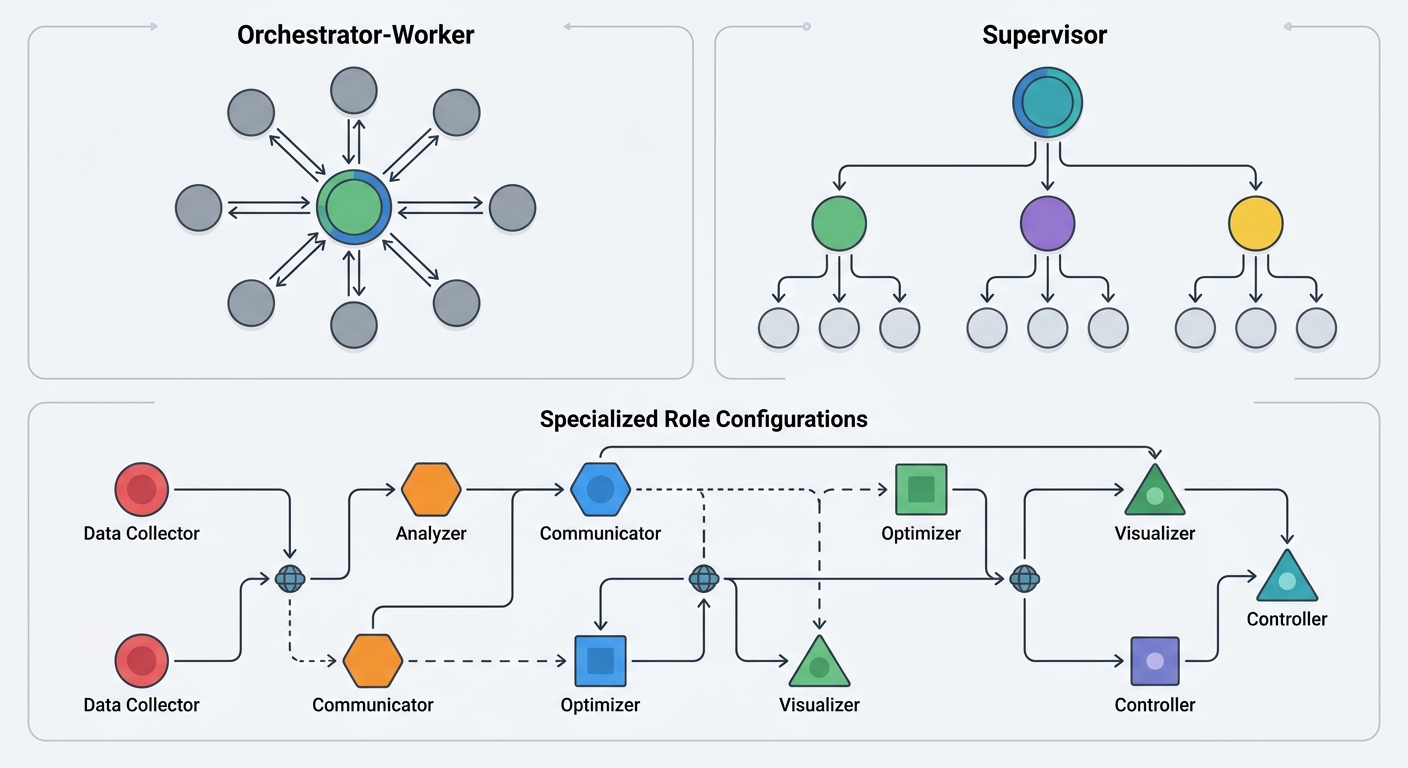
Orchestrator-Worker Pattern
Centralized control characterizes this pattern. A single orchestrator agent delegates tasks to specialized workers.
The orchestrator maintains global state. It coordinates execution flow across all worker agents.
This pattern suits linear workflows. Clear task boundaries enable effective delegation.
Document processing pipelines exemplify effective use cases. The orchestrator handles error recovery. Workers focus on domain tasks.
Distributed control variants assign orchestrator responsibilities dynamically. Load balancing improves system resilience.
Fault tolerance increases with distributed approaches. Coordination complexity rises accordingly.
Supervisor Pattern
Hierarchical oversight defines the supervisor approach. A supervisor agent evaluates worker outputs before proceeding.
Quality gates prevent downstream errors from propagating. This ensures output reliability.
Supervisor patterns excel for high-stakes operations. Financial document analysis benefits from explicit validation.
Regulatory compliance checks require supervisor oversight. Medical record processing demands rigorous validation steps.
The pattern introduces latency overhead. Organizations must balance quality requirements against throughput demands.
Specialized Agent Roles
Role specialization assigns agents to specific expertise domains. Clear boundaries define each agent's responsibilities.
A research agent gathers information. A writer agent produces drafts. A reviewer agent validates outputs.
A validator agent checks compliance requirements. This separation enables focused expertise development.
This pattern mirrors organizational team structures. Developers find intuitive mappings between human roles and agent capabilities.
Role boundaries enable clear accountability. Performance measurement becomes straightforward.
Specialization requires careful boundary definition. Overlapping responsibilities create coordination conflicts.
Insufficient specialization reduces meaningful collaboration. Balance determines system effectiveness.
Agent Communication Protocols
Message passing enables agent interaction. Protocol selection impacts system architecture significantly.
Direct messaging suits tightly coupled systems. Shared state repositories work better for loosely coupled architectures.
Conflict resolution strategies vary by use case. Last-write-wins provides simplicity. Consensus mechanisms ensure agreement.
Human arbitration handles edge cases requiring judgment. Complex scenarios may need human oversight.
Protocol selection impacts debugging visibility. Clear communication logs accelerate troubleshooting significantly.
State Management Strategies
Conversation context persistence prevents information loss. Agents maintain awareness across interactions.
Checkpointing captures state at defined intervals. This enables recovery from failures.
Rollback mechanisms restore previous states after failures. Long-running workflows require explicit state management.
Session timeout handling prevents context loss. This ensures continuity across extended operations.
Calculating Enterprise ROI for Multi-Agent Systems
Multi-agent investments require measurable justification. Organizations need clear metrics for evaluation.
Cost Categories
Implementation costs include development and integration. Training expenses cover team skill development.
Infrastructure costs vary by deployment model. Cloud-based solutions offer predictable operational expenses.
Maintenance costs often exceed initial development. Regular updates and monitoring require ongoing investment.
Value Drivers
Processing speed improvements deliver immediate value. Automation reduces manual effort significantly.
Error reduction improves quality outcomes. Consistent outputs reduce rework requirements.
Operational efficiency gains compound over time. Scalability enables growth without proportional cost increases.
Measurement Framework
Define baseline metrics before implementation. Compare post-deployment performance against initial measurements.
Track agent utilization rates. Measure task completion times. Calculate error rates per workflow.
Calculate time savings in hours. Assign labor costs to determine financial impact.
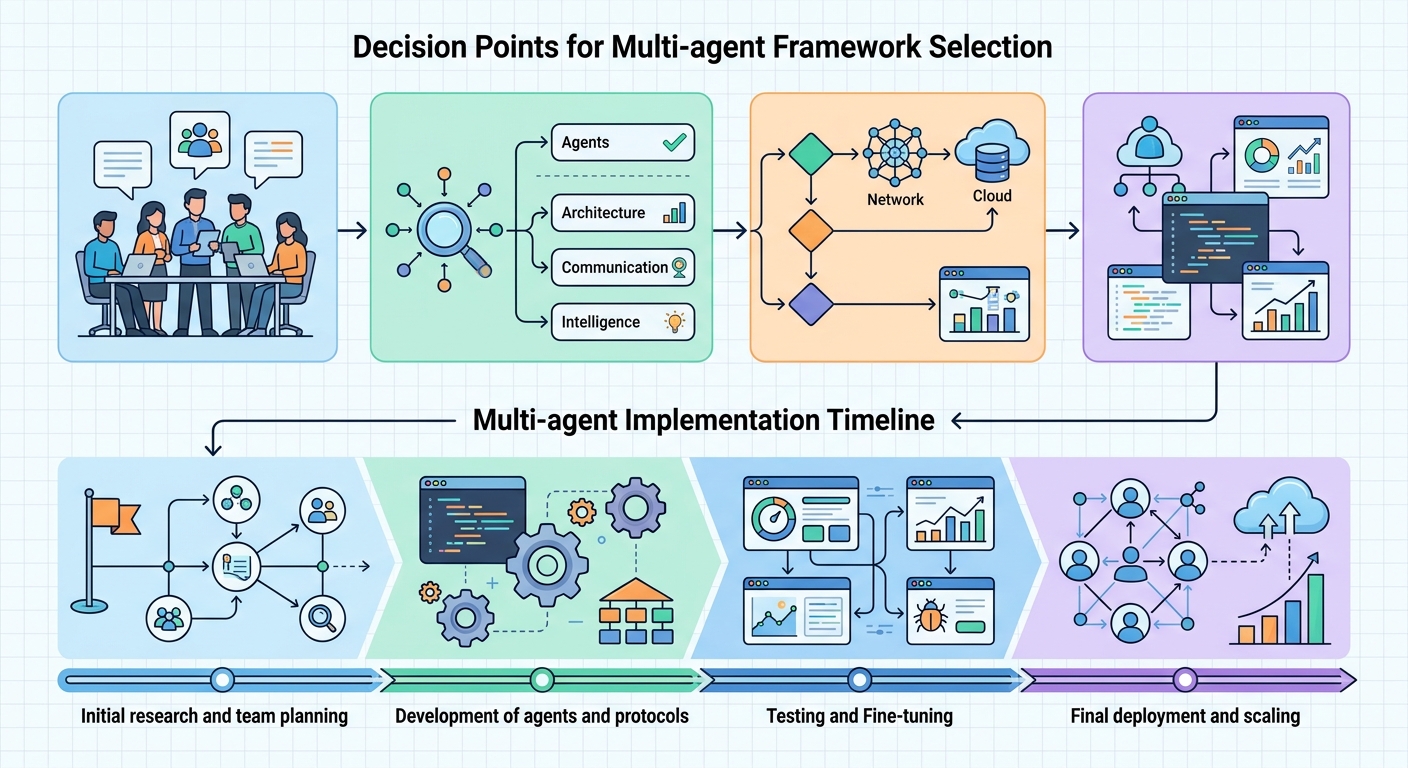
Implementation Recommendations
Successful multi-agent deployments follow consistent patterns. These recommendations derive from documented enterprise experiences.
Phase 1: Assessment
Audit existing workflows for multi-agent suitability. Identify processes with clear task boundaries.
Evaluate technical stack compatibility. Determine integration requirements with current systems.
Build internal expertise gradually. Start with training and proof-of-concept projects.
Phase 2: Pilot
Deploy limited pilots in controlled environments. Select low-risk workflows for initial testing.
Establish monitoring and logging infrastructure. Debugging visibility proves essential for success.
Document findings systematically. Capture both successes and failure modes.
Phase 3: Scale
Expand successful pilots incrementally. Add complexity gradually as teams gain confidence.
Establish governance frameworks early. Security and compliance requirements must scale with deployment.
Measure continuously. Refine architectures based on production feedback.
Conclusion: From Evaluation to Action
The 2026 multi-agent landscape offers production-ready solutions. Framework maturity enables confident enterprise adoption.
Success requires more than tool selection. Architectural patterns determine production outcomes. Measurement frameworks justify investments.
Organizations should begin evaluation processes now. The technology has crossed the enterprise readiness threshold.
Start with specific use cases. Measure results rigorously. Scale incrementally based on documented value.
The multi-agent inflection point has arrived. Enterprise ROI is achievable with proper implementation approaches.