Mamba, RWKV, and the Race to Replace Transformers: A 2026 Architecture Showdown
A technical deep-dive comparing Mamba, RWKV, and Transformer architectures in 2026 — covering performance benchmarks, efficiency trade-offs, hybrid models, and a practical framework for architecture s
The AI industry is in the middle of its most significant architecture shift since 2017. For nearly a decade, the Transformer dominated every frontier model — GPT-4, Claude, Gemini, LLaMA all built on the same core insight: let every token attend to every other token. But in 2026, state space models like Mamba and linear attention variants like RWKV are no longer academic curiosities. They are production contenders that every ML engineer needs to understand.
This article provides a technical deep-dive comparing Mamba, RWKV, and Transformer architectures — how they work under the hood, where each excels, benchmark performance as of 2026, and a practical framework for choosing the right architecture for your use case.
Why the Transformer Empire Is Being Challenged in 2026
The Transformer architecture has dominated natural language processing since 2017, when researchers at Google published "Attention Is All You Need." The architecture succeeded because self-attention is a powerful primitive for capturing long-range token dependencies. But power comes at a cost that has become increasingly difficult to ignore.
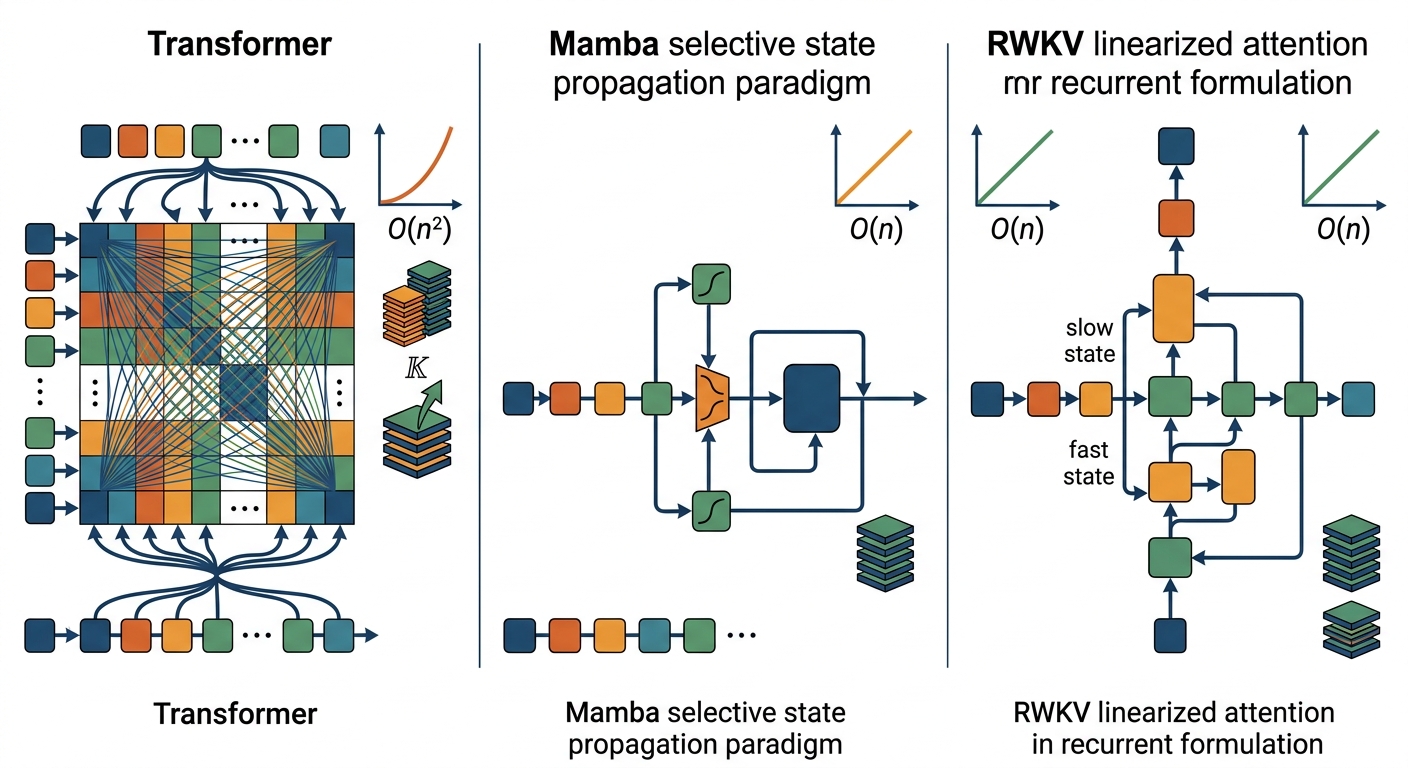
Standard self-attention exhibits quadratic computational complexity — both memory and compute grow with the square of the sequence length. A 2,048-token context costs roughly four times more to process than a 1,024-token context. A 1,048,576-token context — a goal many leading AI labs are actively pursuing — requires compute growing with the square of a million.
This is the quadratic bottleneck, and it is the fundamental limitation driving the race toward alternative architectures in 2026.
In practice, the bottleneck manifests in two concrete ways. First, the key-value (KV) cache — the memory mechanism that allows Transformers to generate tokens autoregressively — grows linearly with context length, consuming gigabytes of GPU memory for long conversations. Second, inference latency scales poorly: generating 10,000 tokens is not 10 times slower than generating 1,000 tokens — it is roughly 100 times slower, assuming a constant batch size.
By 2026, three forces converged to make this problem urgent. Model sizes reached hundreds of billions of parameters, pushing memory bandwidth to its limits. Context window ambitions grew from 32K to over 1M tokens. And inference costs for large-scale production deployments became a significant budget line for every AI team.
The result is a genuine race to find architectures that maintain Transformer-quality reasoning while achieving sub-quadratic scaling.
The Transformer Architecture: Strengths, Limits, and Optimization Efforts
A Transformer processes a sequence by passing it through alternating layers of self-attention and feedforward networks. In self-attention, each token produces a query (Q), key (K), and value (V) vector. The attention score between two tokens is computed by taking the dot product of one token's query with the other token's key, then softmaxing across all tokens.
The result is an attention matrix — a full n × n table of pairwise token relationships. For a sequence of length 1,024, that matrix contains over one million entries. For a sequence of length 65,536, it contains over four billion.
This is simultaneously what makes Transformers so capable and so expensive. Every token has a direct computational pathway to every other token, enabling the complex reasoning and in-context learning that define modern language models. But the attention matrix must be materialized — at least partially — at every layer.
Several significant optimizations have emerged without fundamentally solving the root problem:
- FlashAttention-3: Computes attention in tiles that fit in GPU SRAM rather than slow HBM memory, reducing memory reads by an order of magnitude without changing the algorithmic complexity
- Rotary Positional Embeddings (RoPE): Allows models to extrapolate to context lengths longer than their training context, enabling 1M+ token contexts in leading models
- Mixture-of-Experts (MoE): Decouples parameter count from active computation, allowing trillion-parameter models to run at the cost of tens of billions of active parameters per token
These optimizations are real improvements. But they are architectural optimizations layered on top of the same quadratic core. The attention matrix still exists. The KV cache still grows with context length.
Where Transformers remain dominant — and will likely remain so for the near future — are tasks requiring precise token-level retrieval, complex multi-step reasoning, and high-quality instruction following. The attention mechanism's direct token-to-token access gives Transformers an edge in precision that current state space model and linear attention alternatives approximate but have not fully replicated.
Mamba: Selective State Space Models in Depth
Selective State Space Models (SSMs), most prominently implemented in the Mamba architecture, take a fundamentally different approach to sequence modeling. Rather than computing pairwise token relationships via an attention matrix, SSMs maintain a compressed hidden state that evolves as the model processes each token. The model decides what to keep in that state and what to discard — hence "selective."
How Mamba's Selective Mechanism Works
Mathematically, an SSM processes an input sequence through a continuous-time state equation. The key innovation in Mamba's selective variant is that the transition matrix — which governs how the hidden state evolves over time — and the input-to-state mapping are both input-dependent. For each token, the model learns how much the new information should update the internal state versus being discarded.
This is analogous to the gating decision in a Long Short-Term Memory (LSTM) network, but applied at the architectural level rather than the weight level. The result is a model that can dynamically choose which information to compress and which to propagate.
The scaling advantage is profound. Computational cost grows linearly with sequence length, not quadratically. The hidden state has a fixed size — it does not grow with context. A 1M-token sequence does not require 1,000 times more SSM compute than a 1,000-token sequence; it requires roughly 1,000 times more. Memory usage remains constant regardless of sequence length.
Mamba models also achieve significantly higher inference throughput. Benchmarks comparing Mamba-3B against similarly-sized Transformer models show up to 5x higher tokens per second in generation tasks, with the gap widening substantially for longer outputs.
Mamba-3: The March 2026 Update
Mamba-3, released in March 2026, introduced two notable architectural advances:
- Complex-valued state tracking: Allows the model to maintain richer, phase-encoded representations of information over long distances. This is particularly relevant for genomic sequence classification, protein structure prediction, and audio processing tasks where the relevant information has a natural complex representation.
- Multi-Input Multi-Output (MIMO) formulations: Improve cross-channel information integration, effectively allowing the model to process multiple input streams simultaneously — useful for multimodal applications.
Mamba Performance: Benchmarks and Trade-offs
Mamba-3B matches Transformer models twice its size on language modeling perplexity. On long-context tasks — where the entire sequence must be considered simultaneously — Mamba consistently outperforms same-sized Transformers, often dramatically so.
Where Mamba falls short: Explicit retrieval tasks — such as "find the phone number in this document" — remain a relative weakness. In-context learning on the MMLU benchmark trails Transformers of comparable size. The compressed state, while efficient, necessarily loses some information during compression. For tasks requiring precise token-level recall, the trade-off currently favors Transformer architectures.
Mamba's sweet spot: Genomics and protein sequences, audio processing, time-series forecasting, real-time decision-making with long histories, and edge deployment on constrained hardware.
RWKV: Linear Attention With RNN Roots
RWKV — Receptance Weighted Key Value — approaches the efficiency problem from a different angle. Rather than abandoning attention entirely, RWKV reformulates the attention mechanism so it can be computed as a linear operation rather than a quadratic one.
The Linear Attention Trick
Standard attention computes output = softmax(Q × K^T) × V — an operation that requires materializing the full Q × K^T matrix at every layer. RWKV rewrites this using the associative property of matrix multiplication, transforming the computation into a linear recurrence: the attention output at position t can be computed using only the output at position t-1 and the new token's contribution, without ever materializing the full attention matrix.
This gives RWKV the inference characteristics of a recurrent neural network — constant memory usage during generation, linear scaling with output length — while retaining the pretraining advantages of the attention mechanism. The model trains using standard backpropagation but behaves like an RNN at inference time.
RWKV-7: Dynamic State Evolution
RWKV-7, released in March 2025, introduced a key innovation called Dynamic State Evolution. The model maintains two complementary state pathways:
- A slow state that preserves long-range context with minimal updating
- A fast state that responds rapidly to immediate context
This dual-pathway approach addresses a core weakness of earlier linear attention models: the tendency to either forget long-range information too quickly or be excessively sensitive to recent inputs, making it difficult to maintain both short-term and long-term context simultaneously.
RWKV-7 Benchmarks
As of early 2026, RWKV-7 achieves an average score of 72.8% on standard NLP benchmarks (ARC, BoolQ, COPA, HellaSwag, LAMBADA, OpenBookQA, PIQA, and Winogrande), compared to 69.7% for LLaMA 3.2 at comparable parameter counts — with three times fewer tokens in pretraining.
On the Long Range Arena (LRA) benchmark, which evaluates sequence lengths up to 16,000 tokens across five datasets, RWKV performs second only to the S4 state space model.
RWKV-X: One Million Token Decoding
RWKV-X, proposed in May 2025, pushes the architecture further with a hybrid approach that maintains linear-time training complexity and constant-time inference complexity per token. On the 64K passkey retrieval benchmark — a test that requires locating a specific token hidden in a long context — RWKV-X achieves near-perfect accuracy. The model has demonstrated stable decoding of sequences up to 1 million tokens, with speed and memory usage remaining constant regardless of sequence length.
RWKV efficiency on hardware: On an NVIDIA RTX 4090, the RWKV7-G1 2.9B model runs at over 115 tokens per second with nf4 quantization, using just 2.4GB of VRAM. A Transformer model of similar capability would require substantially more memory as context length grows.
Mamba vs RWKV: Direct Comparison
Mamba and RWKV are both responses to the quadratic bottleneck, but they take meaningfully different paths:
| Dimension | Mamba | RWKV |
|---|---|---|
| Core approach | Compressed state that evolves over time | Linearized attention with RNN inference |
| State management | Input-dependent selective mechanism | Dual-pathway dynamic state evolution |
| Long-range context | Excellent — distributed signal compression | Strong — slow state preserves long context |
| General language modeling | Good — matches 2x size Transformers | Very good — exceeds LLaMA 3.2 at 3x less compute |
| Token retrieval | Weaker | Moderate |
| Hardware efficiency | 5x throughput gain over Transformers | Constant memory, linear generation time |
| Best for | Genomic, audio, time-series, edge | Long-generation language, constant-memory inference |
Neither architecture has displaced Transformers for complex reasoning tasks. The retrieval precision, in-context learning, and multi-step chain-of-thought reasoning that make Transformers the default choice for general-purpose LLMs remain areas where attention's direct token-to-token pathway provides a structural advantage.
Hybrid Architectures: The Winning Pattern of 2026
The clearest architectural trend of 2026 is not that one architecture replaces the others. It is that production models increasingly combine complementary approaches.
The logic is straightforward. Transformers and SSMs have complementary strengths: attention layers handle precise retrieval and complex reasoning; SSM layers handle long-range compression and efficient sequence processing. A model that strategically combines both can achieve both high accuracy and superior throughput.
Key examples from 2026:
- NVIDIA Nemotron 3: Integrates Mamba-2 layers with Transformer layers, achieving competitive reasoning with significantly higher throughput on long-context tasks compared to pure Transformer baselines
- IBM Bamba: Uses a Mamba-2 and Transformer hybrid that matches the performance of Meta LLaMA 3.1 8B while delivering substantially higher throughput and lower latency for longer sequences
- Jamba 1.5 (AI21 Labs): Blends Transformer layers, Mamba layers, and Mixture-of-Experts blocks to enable very long context windows (up to 256K tokens) with strong reasoning and high throughput — a combination neither pure architecture achieves at this scale
- RWKV-X: Implements a hybrid approach combining linear-time training with constant-time inference, enabling stable 1M-token decode without quality degradation
For practitioners, the practical implication is significant: the architecture decision is increasingly not "Transformer vs Mamba" but which layers should use which mechanism — based on where the computational bottlenecks lie for your specific use case.
Architecture Selection: A Practical Decision Framework for ML Engineers
Choosing the right architecture depends on three variables: your sequence length requirements, your inference budget, and the task complexity of your primary workload.
When to Choose Transformers (or MoE Transformers)
Transformers — particularly MoE variants — remain the default choice when:
- Task accuracy and reasoning quality are paramount
- Multi-step chain-of-thought logic is required
- Precise token-level retrieval is part of the workflow
- You need the broadest ecosystem of tooling and pretrained models
When to Choose Mamba SSMs
Mamba is the right fit when:
- Working with very long sequences (genomics, audio, time-series)
- Operating on edge hardware with strict memory constraints
- Throughput at long contexts is more important than retrieval precision
- The signal is distributed across long ranges rather than localized
When to Choose RWKV
RWKV deserves serious consideration when:
- Generating very long outputs (thousands of tokens)
- Constant memory usage during generation is a hard requirement
- Inference cost at scale is the primary optimization target
- General language modeling quality matters, with long-context needs
When to Choose Hybrid Architectures
Hybrid models are the right bet for:
- Production systems with mixed workloads
- Applications requiring both strong reasoning and long-context efficiency
- Teams that want the benefits of both paradigms without committing to one
- Systems targeting 256K+ token context windows
Expert Q&A: State Space Models vs Transformers
Q: If Mamba achieves 5x higher throughput than Transformers at long contexts, why hasn't it replaced Transformers in production LLM systems?
A: Throughput and quality are not the same metric. Mamba's 5x throughput advantage is real for long-sequence generation tasks, but it comes with a trade-off on retrieval precision and in-context learning. Production LLM systems — especially those used for customer support, coding assistants, and complex reasoning — are typically bottlenecked by task accuracy, not raw throughput. Transformers still produce more reliable results on the precise token-level operations that most enterprise applications require. The hybrid approach (Mamba + Transformer layers) is currently the pragmatic solution: use Transformer attention for reasoning-critical layers and Mamba for efficient sequence processing.
Q: RWKV-7 reportedly outperforms LLaMA 3.2 with 3x less pretraining data. Does this mean compute requirements for training are lower, or is it specific to inference efficiency?
A: The benchmark result reflects RWKV's more efficient use of training tokens — the model achieves competitive performance with less data exposure during pretraining. This is partly structural (the linear attention mechanism may generalize more efficiently per token than standard attention) and partly empirical (the RWKV training curriculum has been heavily optimized). However, RWKV's primary advantage is in inference, where constant memory usage and linear generation time create significant cost savings at scale. The training efficiency is a bonus, not the main value proposition.
Q: How should teams think about the architectural decision for a new production system in late 2026?
A: Start with the workload profile, not the architecture. If your application primarily processes short-to-medium length inputs (under 8K tokens) with complex reasoning requirements, a Transformer or MoE is still the safest choice — the ecosystem is mature, and the quality gap on reasoning tasks is real. If your application processes very long sequences (genomics, audio, time-series, long conversations) and can tolerate slightly lower retrieval precision, Mamba is worth serious evaluation. If your primary concern is inference cost at scale and you generate long outputs, RWKV is the most efficient option. For mixed workloads with high stakes, hybrid architectures like Jamba 1.5 or IBM Bamba represent the best current balance.
Q: The article mentions that hybrid models are "the winning pattern of 2026." Does this mean we should expect future frontier models to all be hybrid?
A: The trend toward hybrid architectures is strong, but it is not yet clear whether all future frontier models will be hybrid. The leading AI labs — Anthropic, OpenAI, Google DeepMind — have not publicly committed to hybrid designs. Their next-generation models may achieve similar efficiency gains through other means (e.g., more aggressive KV cache compression, speculative decoding improvements, or entirely new attention approximations). What is clear is that the hybrid approach has crossed the threshold from "interesting research direction" to "production-proven strategy" in 2026. Even if pure architectures make a comeback, the hybrid approach has demonstrated that combining different computational primitives is both possible and beneficial.
Q: For an ML engineer evaluating these architectures for a real-time edge deployment (e.g., on-device inference on mobile or embedded systems), what should be the primary evaluation criteria?
A: For edge deployment, three criteria dominate: memory footprint, inference latency per token, and quality per parameter. Mamba has the strongest story on all three for edge use cases. Its fixed-state memory usage means the model does not require progressively more memory as conversations continue — a critical property for memory-constrained devices. The 5x throughput advantage translates directly to lower latency and lower power consumption. The fact that Mamba-3B can match Transformer models twice its size on language modeling quality means you get more quality per stored parameter. RWKV is also competitive on memory and throughput at small model sizes, particularly the sub-7B range where it has been most extensively optimized. Pure Transformers, even with distillation and quantization, are generally the most memory-hungry option at the edge.
Conclusion: The End of the Single-Architecture Era
The era of a single dominant architecture may be ending. The quadratic bottleneck that has constrained Transformers for years has finally become expensive enough — at scale — to justify serious investment in alternatives.
State space models like Mamba have demonstrated that linear-time inference with competitive quality is achievable. Linear attention variants like RWKV have shown that the attention mechanism itself can be reformulated to escape its quadratic constraint. And hybrid models have proven that the two approaches are complementary rather than competitive.
For ML engineers and technical decision-makers, the practical takeaway is clear: evaluate architectures based on your specific workload profile, not on benchmark averages. The right choice for a genomic research system is different from the right choice for a general-purpose chatbot, which is different from the right choice for a real-time edge deployment.
The architecture wars are real. But the winners will be specialized, not universal.
Tags: state space models, Mamba architecture, RWKV linear attention, Transformer alternatives, linear attention mechanism, SSM vs attention, hybrid LLM architecture, Mamba benchmarks, RWKV performance