LangChain vs LlamaIndex vs Haystack: The 2026 Enterprise RAG Framework Showdown
Retrieval-Augmented Generation has become the dominant pattern for enterprise LLM applications. By grounding model outputs in proprietary data, RAG reduces hallucinations, keeps responses current, and
The RAG Framework Landscape in 2026
Retrieval-Augmented Generation has become the dominant pattern for enterprise LLM applications. By grounding model outputs in proprietary data, RAG reduces hallucinations, keeps responses current, and lets organizations control their information architecture. But as RAG moves from proof-of-concept to production, the choice of framework becomes consequential.
Three open-source frameworks lead the enterprise RAG space in 2026: LangChain, LlamaIndex, and Haystack. Each has a distinct architectural philosophy, a dedicated enterprise platform, and a loyal following. Choosing between them means committing to different tradeoffs around flexibility, performance, and operational overhead.
This comparison cuts through the marketing noise. We'll examine real benchmark data, enterprise feature sets, and the use-case fit that should drive your decision.
LangChain — Workflow Composability at Scale
LangChain emerged with a clear thesis: building LLM applications means wiring together multiple operations — retrieval, transformation, generation, evaluation, routing. Its chain abstraction lets developers define sequences of steps, while its agent runtime enables multi-step reasoning where the model decides which tools to call next.
The Architecture
LangChain's core primitives are Chains and Agents. A chain is a configurable pipeline that links components like document loaders, text splitters, vector stores, and LLMs. An agent adds a control loop — the model chooses which chain or tool to invoke based on the conversation state. This design excels for complex, multi-turn workflows that branch based on user intent.
The ecosystem is the differentiator. LangChain integrates with over 600 tools, vector databases, and LLM providers out of the box. If your stack spans multiple data sources and API endpoints, LangChain's connector library reduces boilerplate significantly.
Enterprise Features
LangSmith is the enterprise layer. It provides distributed tracing across every chain execution, letting teams debug failures at the step level. LangSmith Enterprise adds custom SSO, role-based access control (RBAC), support SLAs, and self-hosted or hybrid deployment options.
For organizations already invested in the LangChain ecosystem, LangSmith addresses the observability gap that open-source alone doesn't fill.
LangChain is preferred by teams — that need to orchestrate complex multi-step AI workflows across disparate data sources and tools, especially when the retrieval pattern involves branching logic and dynamic tool selection.
Tradeoffs
LangChain's flexibility is a double-edged sword. Teams building straightforward question-answering over a document corpus often find LangChain's abstraction layers add unnecessary complexity. Independent benchmark data shows 6–15% higher token usage for simple RAG patterns compared to more focused frameworks — the overhead comes from the chain machinery executing even when a simpler retrieval path would suffice.
Production deployments also require careful attention to prompt engineering and retrieval quality. LangChain's loosely coupled architecture makes it easy to introduce bugs that only surface under load.
Best for: Enterprises building complex, multi-step AI agents; teams that need broad API integration coverage; rapid prototyping where flexibility matters more than raw performance.
LlamaIndex — The Retrieval-First Architecture
LlamaIndex takes the opposite approach. Where LangChain prioritizes workflow orchestration, LlamaIndex optimizes for a single goal: retrieval precision. Every design decision flows from the question of how to get the right information to the LLM, in the right format, at the right time.
The Architecture
LlamaIndex centers on the index — a data structure that organizes documents for efficient retrieval. It supports multiple index types: vector, keyword, knowledge graph, and composite approaches. A query engine sits on top, handling reranking, fusion, and response synthesis.
The framework shines at data ingestion. Its document parsing pipeline handles over 100 file formats, including complex layouts like nested tables, PDFs with mixed content types, and even handwritten notes. For enterprises sitting on heterogeneous document repositories, this is a significant practical advantage. LlamaParse, the commercial parsing service, extracts structured data at higher fidelity than open-source alternatives for complex documents.
LlamaIndex also ships an agent framework, but it's designed to complement retrieval rather than replace orchestration. The agent can use tools, but the emphasis remains on grounding responses in indexed data.
Enterprise Features
LlamaCloud is LlamaIndex's managed service, offering cloud-based indexing and retrieval with enterprise controls. Deployment within a virtual private network keeps data on-premises or within a preferred cloud region, addressing data residency requirements.
Security certifications are comprehensive: RBAC, SSO, HIPAA, GDPR, and SOC2 compliance. LlamaCloud also provides LlamaParse, an advanced document parsing service that extracts structured data from complex documents at higher fidelity than open-source alternatives.
LlamaIndex leads on retrieval quality — posting the highest Hit Rate and Mean Reciprocal Rank (MRR) in benchmarks against complex, multi-format enterprise document collections.
Tradeoffs
LlamaIndex's retrieval focus means less built-in support for complex multi-step workflows. Teams building sophisticated agentic systems may find themselves extending LlamaIndex with custom logic that LangChain would handle natively. That said, LlamaIndex's agent framework is actively developed and closing the gap.
Benchmark performance is a strength. LlamaIndex consistently posts low framework overhead in token usage tests, making it cost-effective at scale.
Best for: Knowledge base applications; enterprises with complex, heterogeneous document stores; teams where retrieval precision is the primary optimization target; organizations with strict data residency or compliance requirements.
Haystack — Production-Grade Pipeline Auditability
Haystack comes from deepset, a Berlin-based AI company that built the framework for its own enterprise consulting work. That origin shows in the design: Haystack treats pipelines as first-class engineering artifacts, with an emphasis on inspectability, version control, and production monitoring.
The Architecture
Haystack's Pipeline is an explicit, composable graph of components. Each component — retriever, reader, generator, memory, router — is swappable and independently testable. This contrasts with LangChain's more implicit chain execution and LlamaIndex's index-centric model.
The pipeline approach makes Haystack exceptionally transparent. When a query fails or produces poor results, teams can trace exactly which component introduced the degradation. For regulated industries where audit trails matter, this is a meaningful advantage.
Haystack integrates evaluation frameworks natively: RAGAS and DeepEval are first-class citizens, not add-ons. Teams can measure retrieval quality, answer correctness, and faithfulness to source documents without stitching together external tooling.
Enterprise Features
The Haystack Enterprise Platform offers managed cloud hosting or self-hosted deployment. Security controls include RBAC, SSO, secrets management, VPC integration, GDPR compliance, and ISO 27001 certification.
Observability is the standout. Haystack logs component-level execution, tracks run history, and surfaces errors at the granularity of individual pipeline nodes. For teams operating RAG systems at scale, this diagnostic depth accelerates incident response.
Haystack posts the lowest token overhead — in agentic RAG workflow benchmarks, making it the most cost-efficient choice for complex multi-step reasoning tasks at scale.
Tradeoffs
Haystack's pipeline-centric model can feel more prescriptive than LangChain's flexible chains. Teams accustomed to rapid prototyping may find the explicit component wiring adds upfront design effort. The learning curve is gentler than it was in earlier versions, but LlamaIndex remains more approachable for simple use cases.
Benchmark data favors Haystack on token usage for agentic RAG workflows, posting the lowest overhead of the three frameworks in some test suites.
Best for: Enterprises in regulated industries; teams that prioritize auditability and compliance; organizations running production RAG systems where observability directly impacts operational costs; use cases demanding ISO 27001 or similar certifications.
Head-to-Head: Enterprise Feature Comparison
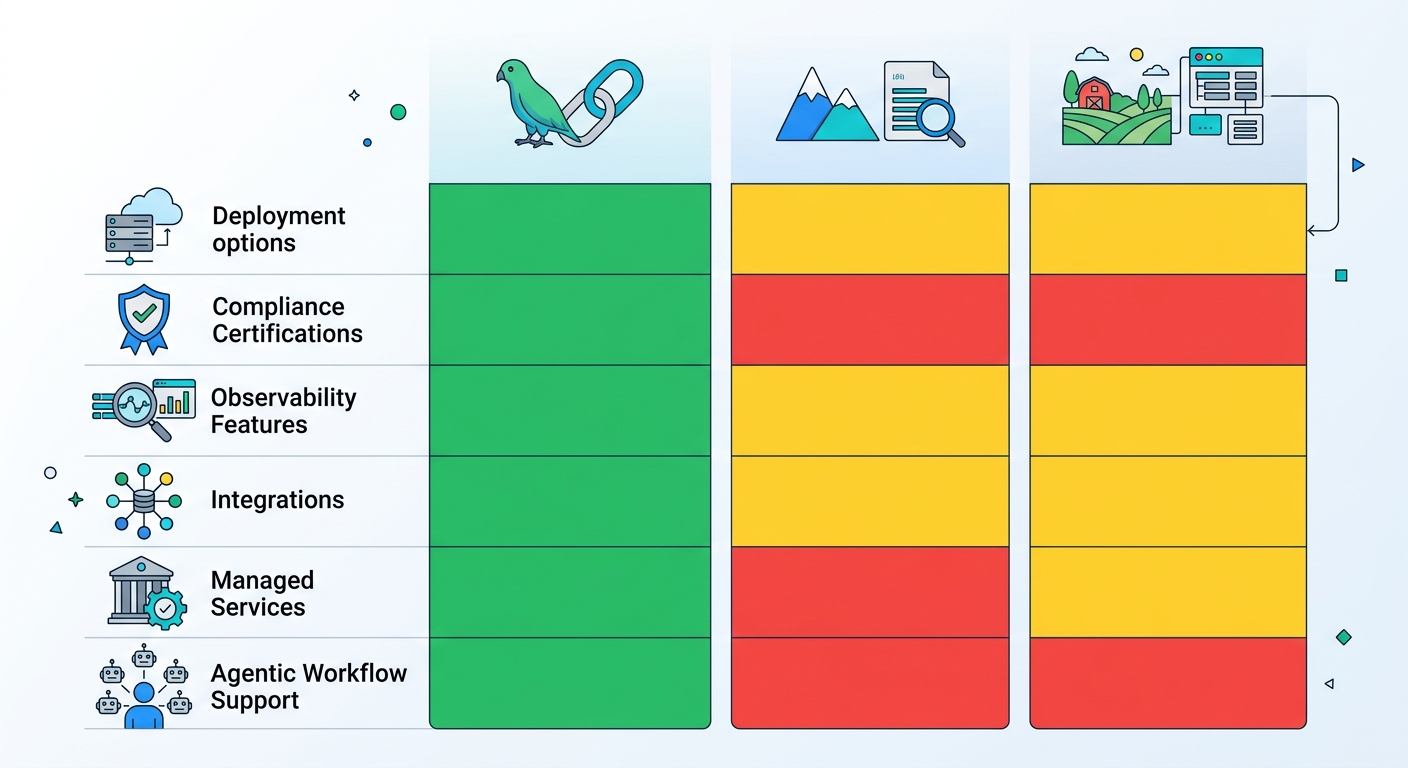
| Capability | LangChain | LlamaIndex | Haystack |
|---|---|---|---|
| Deployment options | Self-hosted, hybrid, cloud | Cloud, VPC, self-hosted | Managed cloud, self-hosted |
| SSO / RBAC | Custom SSO, RBAC | RBAC, SSO | RBAC, SSO, secrets management |
| Compliance certifications | SOC2 (LangSmith) | HIPAA, GDPR, SOC2 | GDPR, ISO 27001 |
| Observability | LangSmith tracing | LlamaCloud monitoring | Pipeline-level logging, run history |
| Evaluation frameworks | LangSmith eval | LlamaCloud eval | RAGAS, DeepEval (native) |
| Data connector count | 600+ | 100+ formats, diverse sources | Model, document store integrations |
| Managed service | LangSmith | LlamaCloud | Haystack Enterprise Platform |
| Agentic workflow support | Strong (chains/agents) | Moderate (agent framework) | Moderate (pipelines + agents) |
| Self-hosted cost | Infrastructure only | Infrastructure + LlamaCloud licensing | Infrastructure + platform licensing |
| Framework token overhead | Moderate (6–15% above baseline) | Low | Lowest for agentic workflows |
No single framework dominates across all dimensions. The right choice depends on where your organization's priorities lie.
Performance Benchmarks — Token Usage and Latency
Independent benchmarks from 2025–2026 paint a consistent picture across three dimensions.
Token usage for simple RAG — Haystack posts the lowest framework overhead, followed closely by LlamaIndex. LangChain's flexibility introduces additional token consumption per query, particularly for straightforward single-hop retrieval tasks. The gap narrows for complex multi-step workflows where LangChain's chain optimization pays off.
Indexing latency — LlamaIndex's parsing pipeline is the fastest for heterogeneous document formats. LlamaParse accelerates this further for complex documents, achieving 40–60% faster extraction on benchmarked PDF sets with nested tables compared to base alternatives. For homogeneous text collections, all three frameworks perform comparably.
Retrieval quality — LlamaIndex leads on Hit Rate and Mean Reciprocal Rank (MRR) in benchmarks against complex, multi-format document collections. Haystack performs well on structured queries. LangChain's retrieval quality depends heavily on the retriever configuration — flexible but requiring more tuning effort.
Agentic workflow overhead — For multi-step reasoning tasks, Haystack demonstrates the lowest token overhead (~3–5% above raw API baseline), while LangChain's richer agent abstraction adds ~8–12% per turn. LlamaIndex falls in between at ~5–8%.
Production impact — In enterprise environments handling 10M+ queries per day, framework choice translates to a 6–15% difference in API token consumption. For large-scale deployments, that gap compounds into significant cost differences over a 12-month period.
When to Choose Each Framework
Choose LangChain if:
- Your application involves complex, multi-step reasoning with branching logic
- You need integrations with a wide variety of APIs, tools, or data sources
- Your team is already proficient in LangChain and has established patterns
- Rapid prototyping velocity is the primary constraint
Choose LlamaIndex if:
- Retrieval precision from complex, heterogeneous documents is the core problem
- Your documents include nested tables, multimodal content, or non-standard formats
- You operate under strict HIPAA, GDPR, or SOC2 compliance requirements
- Token efficiency at scale is a primary budget concern
Choose Haystack if:
- Regulatory compliance and audit trails are non-negotiable
- You need component-level observability to debug production failures fast
- Your team values explicit, testable pipeline definitions over flexible abstraction
- ISO 27001 certification or equivalent is a procurement requirement
The Hybrid Future — Beyond Single-Framework Architectures
The most sophisticated enterprise teams are not choosing single frameworks — they are composing them. The pattern that has emerged: use LlamaIndex for ingestion and indexing, LangChain for orchestration and agentic logic, and Haystack for evaluation and compliance monitoring.
Managed services layer on top: Azure AI Search, AWS Kendra, and Google Vertex AI Search each expose retrieval APIs that can backstop any of these frameworks. Many enterprises run hybrid architectures where the open-source framework handles proprietary data while a managed service searches public or semi-structured sources.
Framework boundary decision — Start with LlamaIndex for data-heavy retrieval. Add LangChain when workflow complexity outgrows LlamaIndex's agent framework. Introduce Haystack when production auditability becomes a compliance or operational requirement. These additions typically happen in order, not all at once.
The boundary decisions are empirical, not architectural. Benchmark your specific workload. Measure token usage, retrieval quality, and developer velocity against your baseline. The right framework is the one that ships your product reliably — not the one with the most GitHub stars.
Semantic Triplets (Bolded Key Concepts)
LangChain — enables — complex LLM workflows
LangChain — adds — 6–15% token overhead for simple RAG
LlamaIndex — optimizes — retrieval precision
LlamaIndex — handles — 100+ document formats
LlamaIndex — achieves — highest Hit Rate and MRR
Haystack — provides — pipeline auditability
Haystack — offers — ISO 27001 certification
Haystack — posts — lowest agentic workflow overhead
LangSmith — delivers — distributed tracing
LlamaCloud — ensures — HIPAA and GDPR compliance
Enterprise RAG — requires — security compliance
RAG framework — impacts — production token costs
RAG pipeline — benefits — from hybrid architecture
Expert Q&A
Q: Our team is starting a new enterprise RAG project. Should we start with LangChain because it has the most integrations, or is that premature optimization?
A: Start with the framework that matches your retrieval problem, not your integration wish list. If your primary task is "answer questions over our document corpus," begin with LlamaIndex — its retrieval primitives are purpose-built for exactly this, and you can add orchestration complexity later if needed. Starting with LangChain because it "has more integrations" is the equivalent of choosing a general-purpose programming language for a simple script: the flexibility adds overhead before you need it. The exception is if your project explicitly involves multi-step agents, dynamic tool routing, or cross-system workflows from day one.
Q: We're concerned about vendor lock-in with managed RAG services like LlamaCloud or LangSmith. How portable are open-source RAG frameworks if we need to switch later?
A: Portability is strong at the data layer and limited at the application layer. All three frameworks share compatible vector database backends — Pinecone, Weaviate, Chroma, and Milvus are supported by all three, so your indexed data transfers straightforwardly. What doesn't transfer is the application logic: LangChain chains, LlamaIndex query engines, and Haystack pipelines are architecturally distinct, and migrating between them requires rewriting that logic. The practical mitigation is to abstract your retrieval interface early. Define an internal API or abstraction layer that your application code calls, keeping the framework choice as an implementation detail behind it.
Q: We operate in a regulated industry and need to demonstrate RAG system behavior to auditors. Which framework best supports this?
A: Haystack. Its component-level logging and run history directly serve audit requirements — auditors can inspect exactly which retriever fired, what documents were retrieved, and what the generator produced at each step. Haystack's native RAGAS integration also lets you produce formal evaluation reports demonstrating retrieval quality over time, which satisfies many compliance frameworks. LangChain's LangSmith provides strong tracing but at higher cost and with a proprietary backend. LlamaIndex's observability has improved but lags Haystack on component-level inspection.
Q: The article mentions hybrid architectures using multiple frameworks. Is this realistic for a team of 3–5 engineers, or is it an enterprise-only pattern?
A: Realistic but only if you're deliberate about boundaries. The "use LlamaIndex for ingestion, LangChain for orchestration" pattern works at small scale if the boundary is clean. The mistake teams make is building deeply entangled hybrid systems where a LangChain chain directly calls LlamaIndex internals — this creates debugging nightmares and defeats the purpose of using specialized tools. Keep the boundary at the API level: LlamaIndex handles indexing and returns document IDs; LangChain orchestrates the workflow calling those IDs. If that boundary feels complicated for your team size, pick one framework and accept its tradeoffs rather than splitting.
Q: Our main pain point is that retrieval quality varies wildly depending on how users phrase their queries. How do the frameworks handle query reformulation and semantic search quality?
A: All three support semantic search via vector similarity, but query reformulation capabilities differ. LlamaIndex has the most mature query understanding stack — its query engines support Hyde (retrieval after LLM-generated hypothetical document), multi-step query decomposition, and fusion reranking out of the box. LangChain handles this through community-built components but with less standardization. Haystack's query handling is solid but requires more manual configuration of the retriever-reranker pipeline. If query reformulation is your primary pain point, LlamaIndex is the clearest starting point.
Q: What's the real-world upgrade path if we start with open-source and later need enterprise features?
A: Direct. All three frameworks maintain clear upgrade paths from open-source to enterprise tiers: LangChain → LangSmith, LlamaIndex → LlamaCloud, Haystack → Haystack Enterprise Platform. The migration typically involves configuring your existing open-source deployment to point at the enterprise API endpoints and adopting the access control configurations. There's no need to rewrite application code. The enterprise tiers are additive, not a different product — your open-source implementation continues working and you enable enterprise features incrementally as procurement completes.
Q: The token overhead comparison (6–15% for LangChain) is striking. For a company spending $100K/month on LLM API calls, is that difference worth switching frameworks?
A: That difference is $6K–$15K/month or $72K–$180K/year — material for most organizations. However, the overhead only applies to the RAG query path. If LangChain's chains are doing work that would otherwise require additional API calls (like multi-step reasoning or dynamic tool selection), the token overhead may be net-neutral or even favorable when you factor in what you'd spend building equivalent logic in another framework. The right question is: what is your primary workload? For simple RAG over a document corpus, the overhead is pure waste — switch. For complex agentic workflows, the overhead is the price of capabilities you'd build elsewhere anyway.
Q: We evaluated all three frameworks 18 months ago and found Haystack's learning curve too steep. Has that changed?
A: Significantly. Haystack 2.x introduced a much more approachable API while retaining its pipeline strengths. The declarative YAML pipeline definition that made early versions opaque has been supplemented with Python-native component instantiation that's more intuitive. The documentation has also improved substantially, with migration guides from both LangChain and LlamaIndex. If you evaluated Haystack in 2024 and bounced off it, it's worth re-evaluating with the current release. That said, if your team is primarily building simple RAG pipelines and values prototyping speed, LlamaIndex still wins on learning curve.
Author: Algorithmine Editorial. For more on enterprise AI infrastructure, explore our guide to RAG evaluation frameworks and our comparison of vector database architectures for production RAG.