LangChain, LlamaIndex, and Haystack in 2026: Choosing the Right Framework for Production LLM Apps
Compare LangChain, LlamaIndex, and Haystack 2.0 for production LLM apps in 2026. Benchmarks, decisio...
ATAlgorithmine Team
··Updated Sep 18, 2026·14 min read·292 views
In 2024 and early 2025, the question "which LLM framework should I use?" felt like a multiple-choice test with one right answer. Teams either picked LangChain, LlamaIndex, or Haystack and built their entire stack around it.
That era is over.
By mid-2026, the three frameworks have carved out distinct specialties. They still compete for mindshare. But the most sophisticated production systems no longer pick one — they layer them together. This article gives you the full picture: what each framework actually excels at, the real benchmark numbers, and a decision framework you can apply tomorrow.
What Changed in the LLM Framework Landscape in 2026
The frameworks started as all-in-one solutions. They tried to own the entire LLM application stack from ingestion to output. That approach created bloat and forced trade-offs no team wanted to make.
The specialization shift happened fast. LangChain leaned into agent orchestration with LangGraph. LlamaIndex doubled down on retrieval depth and data intelligence with LlamaParse and Workflows. Haystack 2.0 rewrote its entire architecture around type safety and enterprise pipeline clarity.
Today, choosing a framework means choosing a primary problem to solve:
LangGraph is for complex multi-step agents with loops and tool calls.
LlamaIndex is for RAG systems where retrieval quality determines everything.
Haystack 2.0 is for teams that need every AI decision to be auditable and compliant.
The hybrid pattern — LlamaIndex for retrieval, LangGraph for orchestration — is now the dominant architecture in serious production deployments. More on that below.
LangChain and LangGraph: The Orchestration Powerhouse
LangChain's core value in 2026 is breadth and the depth of its agent orchestration capabilities through LangGraph.
LangGraph models agent workflows as directed graphs. Each node is a step. Edges define transitions. State flows through the graph and can be persisted, branched, and recovered. This is fundamentally different from the chain-based approach LangChain used before — and it's the right model for production agents.
What LangGraph Does Well
LangGraph handles the complexity that breaks simpler frameworks:
Loops and conditional branching. Real agents don't run in straight lines. They loop, self-correct, and branch based on intermediate results.
Durable execution. If an agent step fails mid-way, LangGraph can recover state from a checkpoint rather than restart the entire workflow.
Human-in-the-loop. Critical decisions can pause for human approval before proceeding.
Memory and conversation state. LangGraph manages long-horizon memory across agent turns.
Observability via LangSmith. Every LLM call, tool invocation, and state transition can be traced, evaluated, and cost-audited.
LangChain's ecosystem is another strength. It integrates with over 1,000 models, vector databases, APIs, and external tools. If your application needs to call a weather API, query a SQL database, and reason over the results in a single agentic flow, LangChain has the integration layer ready.
The Costs: Latency, Tokens, and Image Size
LangChain's breadth comes with measurable overhead. Benchmarks from 2026 production environments show:
Metric
LangChain/LangGraph
LlamaIndex
Haystack 2.0
Framework overhead per query
~10–14 ms
~6 ms
~5.9 ms
Token usage per request
~2.4 k
~1.60 k
~1.57 k
Docker image size delta
+200–400 MB
baseline
baseline
The token overhead is the one that compounds. At 10 million requests per month using GPT-4o-mini pricing, a 800-token difference between LangChain and LlamaIndex translates to roughly $2,400 in additional API costs per month. Not fatal, but meaningful at scale.
LangChain's dependency tree is broad. That means larger Docker images and slower build times. For microservices architectures, this adds deployment friction.
When to Choose LangChain or LangGraph
Pick LangChain when your primary challenge is orchestrating multiple tools, managing multi-step agent reasoning, or integrating a wide variety of external systems. If you're building a customer service agent that queries three different databases, calls a policy engine, and generates a nuanced response — LangGraph is purpose-built for exactly this.
Avoid LangChain when you need simple RAG. For straightforward retrieval over a document corpus, LangChain adds complexity without return. LlamaIndex will get you there faster and leaner.
LlamaIndex: The Retrieval and Data Intelligence Expert
LlamaIndex is purpose-built for one problem: connecting LLMs to your private data with high retrieval accuracy.
It wins on depth. While LangChain cast a wide net, LlamaIndex went deep on data ingestion pipelines, chunking strategies, retrieval abstractions, and document intelligence. In 2026, it is the clear choice for RAG-first applications.
Why Retrieval Quality Matters More Than Framework Overhead
The most common mistake in framework selection is optimizing for the wrong metric. Framework overhead (5–14ms) is negligible compared to LLM inference latency (200–2000ms) and vector search time (1–50ms).
What actually determines RAG accuracy is retrieval quality. If your chunks are the wrong size, your embedding model is suboptimal, or your index structure ignores document hierarchy, no framework will save you. LlamaIndex's entire design philosophy is oriented around this.
In late 2025, LlamaIndex introduced Workflows — an event-driven architecture for multi-step AI pipelines. This is architecturally different from both chain-based approaches and LangGraph's graph-based model.
In a chain, steps execute in a predefined sequence. In a graph, nodes execute based on edges. In an event-driven workflow, steps emit and listen for events. Components react to what happened rather than following a rigid execution path.
This model is cleaner for document-centric pipelines. A document enters the system, gets parsed, chunked, embedded, and indexed — with each step able to trigger downstream processes independently. It composes better and tests more easily than monolithic chains.
LlamaParse: Enterprise Document Intelligence
One of LlamaIndex's most powerful but underappreciated tools is LlamaParse. It converts messy enterprise documents — PDFs with tables and charts, complex spreadsheets with merged cells, scanned documents — into structured, queryable data.
This matters enormously for enterprise RAG. Most real-world document collections are not clean text files. They are the outputs of word processors, spreadsheets, and scanned archives. LlamaParse handles the mess that breaks simpler chunking approaches.
LlamaSheets does the same for Excel and Google Sheets, preserving cell relationships and sheet structure in the index.
The Numbers
For a 10,000-document corpus:
LlamaIndex ingestion: ~4 minutes
LlamaIndex memory overhead: 30% less than LangChain
Framework overhead per query: ~6 ms
Token usage per request: ~1.60 k
LlamaIndex is leaner and more retrieval-focused. Its limitation is agent orchestration. If you need complex multi-step decision-making beyond retrieval, LlamaIndex primitives can feel constraining compared to LangGraph.
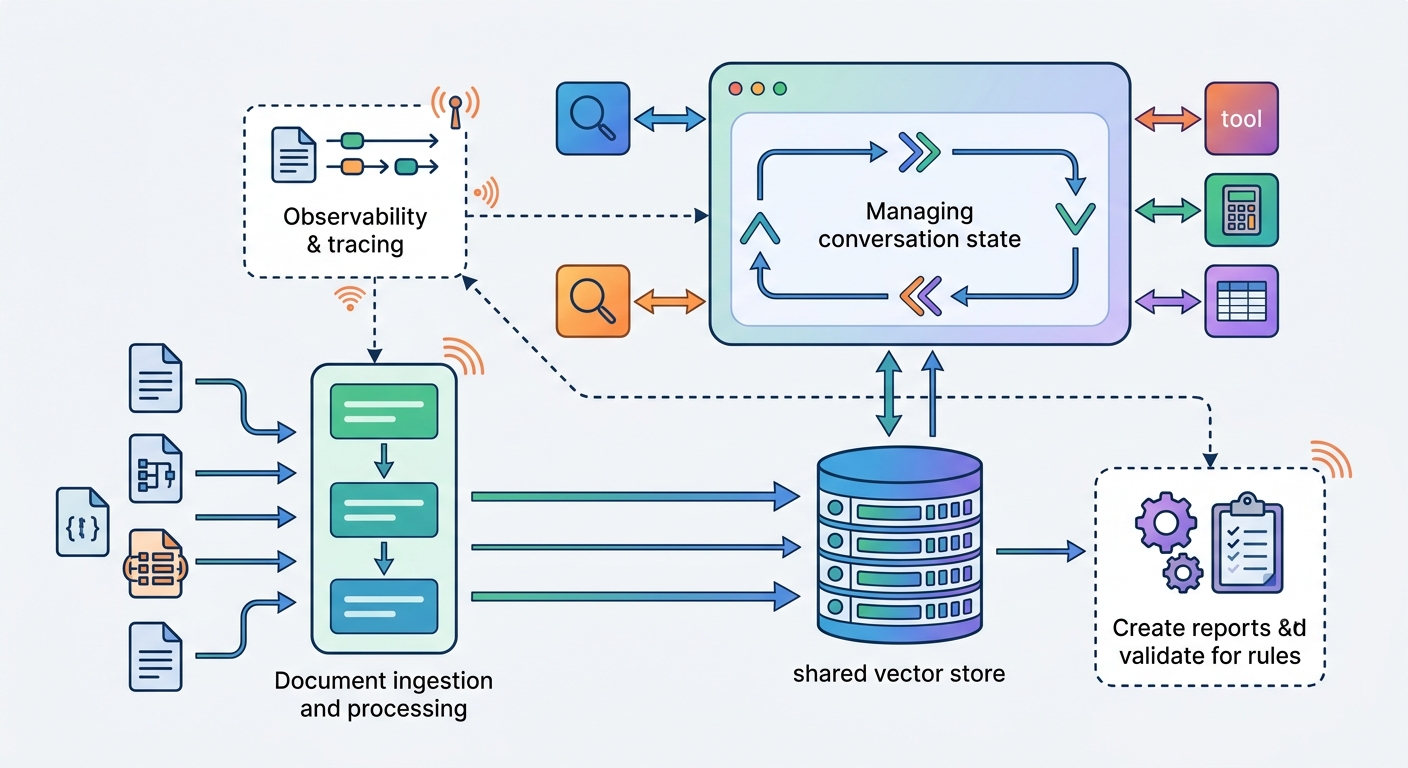
Architecture diagram — hybrid production stack showing LlamaIndex handling document ingestion and vector indexing, feeding into a shared vector store, with LangGraph agent orchestration layer on top calling tools and managing conversation state, LangSmith for observability, and Haystack optionally layering on for compliance reporting
Haystack 2.0: Production Clarity and Enterprise Auditability
Haystack 2.0, released in 2024 as a full rewrite, is the most opinionated of the three frameworks. Where LangChain bets on flexibility and LlamaIndex bets on retrieval depth, Haystack bets on production clarity above all else.
The core abstraction is a typed pipeline. Every component has explicit input and output types. Connections between components are validated at runtime. Configuration errors surface as clear exceptions rather than mysterious runtime failures.
Type Safety Is Not Just a Developer Experience Feature
In production NLP systems, type safety directly reduces operational incidents. When a component expects a list of strings and receives a single string, LangChain may silently coerce it or fail in an opaque way. Haystack 2.0 raises a typed exception with a clear message about the mismatch.
This matters most in regulated industries. If you're building a compliance-relevant NLP system, you need to know exactly how data flows through your pipeline. Haystack's explicit pipeline architecture makes this tractable.
EU AI Act Compliance and Pipeline Auditability
The EU AI Act, fully applicable from 2026, places strict requirements on high-risk AI systems. Traceability is central — operators must document how AI decisions are made and be able to explain them.
Haystack 2.0 pipelines can be serialized to YAML and rendered as visual diagrams. Every component, connection, and data transformation is explicit and inspectable. This is not a feature LlamaIndex or LangChain prioritize in the same way.
For teams building compliance-relevant applications in finance, healthcare, or legal, Haystack's auditability can reduce the compliance engineering burden significantly.
The Trade-Off: Verbosity for Clarity
Haystack's typed pipeline approach requires more explicit code. You declare components, define connections, and specify data flow. This is more verbose than LangChain's flexible chain composition or LlamaIndex's opinionated defaults.
For teams doing rapid prototyping, this verbosity can feel like friction. For teams building production systems that need to be maintained, debugged, and audited over years, the clarity pays dividends.
The Numbers
Haystack 2.0 has the lowest framework overhead (~5.9 ms/query) and the lowest token usage (~1.57 k/request) of the three frameworks. Its Docker image size is lean — baseline, not the +200–400 MB delta LangChain carries.
For teams in regulated industries or with strong typed-language engineering culture, Haystack is the pragmatic choice that reduces long-term maintenance burden.
The 2026 Production Decision Framework
After working through dozens of production deployments and benchmark studies, the framework decision reduces to one question: what is your primary problem?
Use this decision tree:
1. Is your primary challenge complex multi-step agent orchestration with tool calling and long-horizon memory?
→ Choose LangGraph (LangChain ecosystem). This is what it was built for and no other framework matches its agent primitives.
2. Is your primary challenge retrieval accuracy over a large, heterogeneous document corpus?
→ Choose LlamaIndex. Its ingestion pipeline, LlamaParse, hybrid search, and retrieval abstractions are unmatched for RAG quality.
3. Is your primary challenge building auditable, type-safe pipelines with regulatory compliance requirements?
→ Choose Haystack 2.0. Its explicit pipeline model is purpose-built for this.
4. Is your challenge a combination of the above?
→ Use a hybrid stack. The dominant pattern in 2026 production systems:
LlamaIndex for document ingestion, parsing, indexing, and retrieval quality
LangGraph for agent orchestration, tool calling, and conversation management
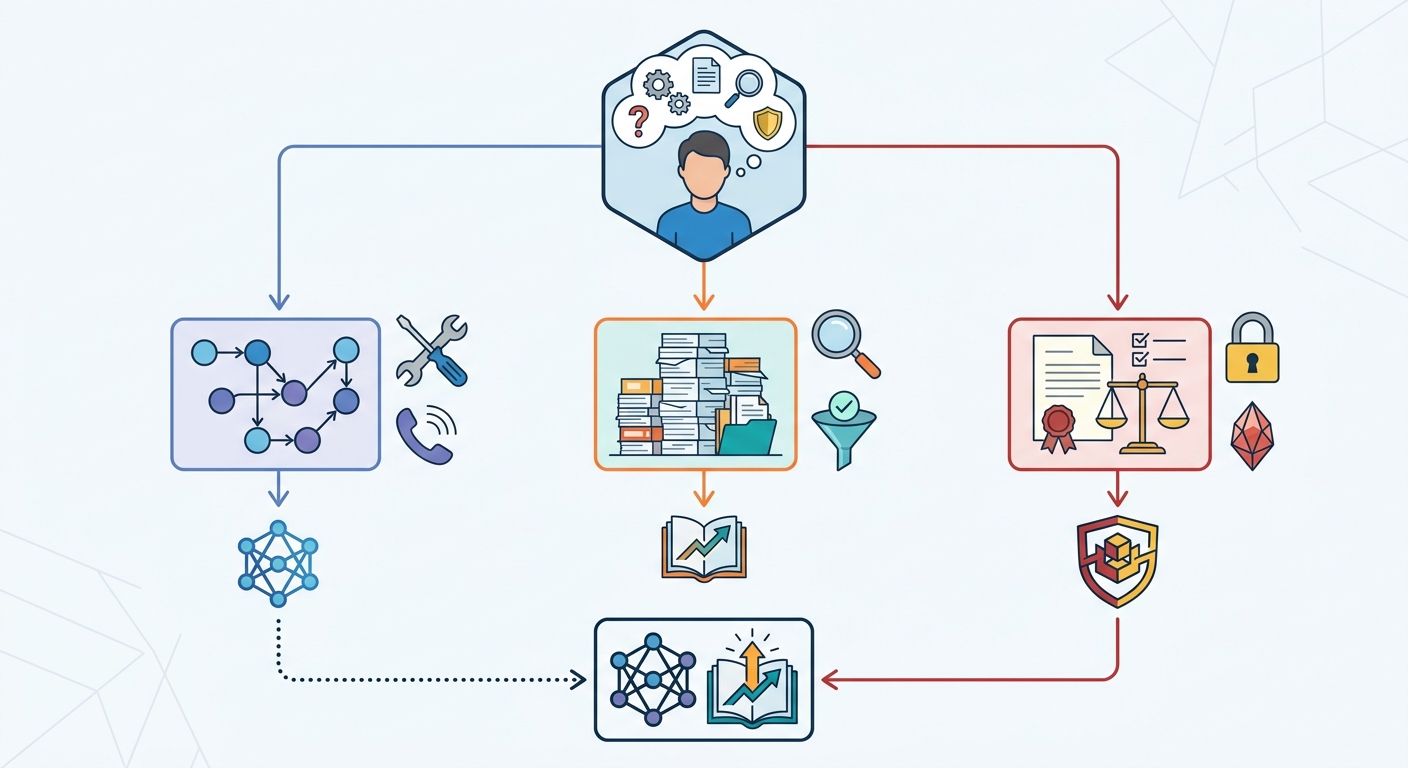
Haystack optionally for compliance-oriented pipeline reDecision flowchart starting with "What is your primary challenge?" with three branches — Agent orchestration + tool calling → LangGraph; Large document corpus + retrieval quality → LlamaIndex; Compliance + auditability + type safety → Haystack 2.0 — ending with "Or consider hybrid: LlamaIndex + LangGraph" hybrid: LlamaIndex + LangGraph"]
Real Cost at Scale
The framework you choose has real dollar implications at production scale:
At 10 million requests per month using GPT-4o-mini pricing:
LlamaIndex (~1.60k tokens/request): ~$2,400 cheaper per month
Haystack (~1.57k tokens/request): ~$2,400 cheaper per month
The latency differences (5.9ms vs 14ms) matter at high-throughput real-time applications. The token differences matter at every scale. Factor both into your decision.
Common Pitfalls and How to Avoid Them
Pitfall: Choosing LangChain for simple RAGLangChain is excellent for agent orchestration. For a basic retrieval pipeline over a document folder, it introduces a complexity tax with no benefit. LlamaIndex with out-of-the-box defaults will get you a working RAG system in a fraction of the code.
Pitfall: Ignoring retrieval quality
Teams spend weeks tuning framework parameters and model settings while serving poorly chunked, semantically mismatched retrieval results to their LLM. Retrieval quality almost always has higher ROI than framework tuning. Invest in chunking strategy, embedding model selection, and hybrid search before optimizing framework overhead.
Pitfall: LangGraph without LangSmithLangGraph's power comes with opacity. Multi-step agent flows generate complex decision trees. Without LangSmith's tracing, debugging production agent failures is archaeological work through logs. If you adopt LangGraph, adopt LangSmith alongside it.
Pitfall: Underestimating LlamaIndex Workflows learning curveLlamaIndex Workflows require a mental model shift. If you approach them thinking "chain with different syntax," you'll fight the event-driven paradigm. Treat it as a new architecture and invest time in understanding events before building complex flows.
Pitfall: Haystack verbosity slowing initial velocityHaystack's typed pipeline model is excellent for production maintainability. It can severely slow initial prototyping velocity if the team is not aligned on the benefits. Set expectations early: Haystack is a long-term investment in clarity, not a fast-to-market framework.
Expert Q&A
Q: Can I combine multiple frameworks in one production system?
Yes. The hybrid approach — LlamaIndex for retrieval and data ingestion, LangGraph for agent orchestration and tool calling, optionally Haystack for compliance pipeline layers — is the most common pattern in sophisticated 2026 production deployments. Each framework does what it's best at, and the integration points are well-established. A common implementation pattern is LlamaIndex producing a retriever that feeds into a LangGraph agent, which manages the orchestration layer.
Q: Which framework has the best documentation and community support in 2026?
LangChain has the largest community by far (92,000+ GitHub stars) and the most tutorials, videos, and Stack Overflow answers. Its documentation for newer features — LangGraph, LCEL — can be inconsistent between versions. LlamaIndex has dramatically improved its documentation with structured learning paths and cookbook examples. Haystack benefits from Deepset's commercial backing, providing enterprise-grade documentation and professional support for Haystack Enterprise customers.
Q: How does EU AI Act compliance affect framework choice?
The EU AI Act requires that high-risk AI systems be traceable and explainable. Teams must document how AI decisions are made. Haystack 2.0's pipelines serialize to YAML, can be rendered as visual diagrams, and every component's behavior is explicit and auditable. This makes Haystack the most compliance-ready framework out of the box. LangChain and LlamaIndex can achieve similar traceability through LangSmith (for LangChain) and additional instrumentation, but this requires explicit engineering effort that Haystack builds in by default.
Q: What are the actual Docker image size differences?
LangChain's broad dependency tree adds 200–400 MB to Docker images compared to LlamaIndex and Haystack. In containerized microservices architectures, this affects cold-start times and deployment costs. For a single-service application, it may be negligible. For a system with 10+ microservices all running LLM framework code, the cumulative image size delta adds up in both storage costs and deployment pipeline duration.
Q: How do I migrate from LangChain to LlamaIndex for the retrieval layer while keeping LangGraph for orchestration?
The migration path is well-trodden. Keep your LangGraph agent code unchanged — it handles orchestration logic. Replace your LangChain retrieval components (document loaders, text splitters, vector store integration) with LlamaIndex equivalents. The key interface is the Retriever object: once your LlamaIndex retriever is returning relevant nodes, feed them to your existing LangGraph agent as context. The two frameworks integrate cleanly at the retriever-to-agent boundary without requiring you to rewrite your agent logic.
Q: What emerging patterns are teams using for framework selection in 2026?
The most significant emerging pattern is stratified architecture: using LlamaIndex as the retrieval foundation, LangGraph as the orchestration brain, and deploying a thin Haystack layer for compliance-critical pipeline segments. This three-layer approach separates concerns cleanly and lets each team own its layer independently. A second pattern gaining traction is evaluative routing — using a lightweight LangGraph agent to evaluate which retrieval strategy to use at query time (keyword vs vector vs hybrid), then dispatching to the appropriate LlamaIndex retriever.
Q: How should startups evaluate framework lock-in risk?
Frameworks abstract LLM APIs, but the abstraction boundaries differ. LlamaIndex's abstractions are closest to the data layer — switching from LlamaIndex to raw vector DB calls is relatively straightforward. LangGraph's abstractions are deeper in the agent orchestration logic, making switching more expensive. Teams should evaluate the cost of replacing their current framework before committing to deep integration patterns. The hybrid approach with clear layer boundaries (retrieval → orchestration → compliance) reduces lock-in at each boundary.
The Bottom Line
LangChain, LlamaIndex, and Haystack have found their sweet spots in 2026. The days of asking "which is best" are over — the question is now "which is right for which layer of my stack."
For complex agentic systems: LangGraph is the clear choice.
For retrieval-first RAG applications: LlamaIndex is the clear choice.
For compliance-oriented production NLP: Haystack 2.0 is the clear choice.
And for sophisticated production systems — which is most of what gets built in 2026 — the answer is usually a hybrid stack that takes the best of each.
Start with your primary problem. Choose accordingly. And if you find yourself building something complex enough that one framework isn't enough, that's not a failure of the frameworks — that's a signal that your system is doing something genuinely sophisticated.
Sources: Gigagpu.com benchmark data, AIMultiple RAG framework analysis, OpenHelm.ai agent framework comparison, Dev.to benchmarking AI agents in 2026, ranksquire.com LangChain vs LlamaIndex analysis (all 2026).