Federated Learning in 2026: How Distributed Enterprises Are Building Smarter AI Without Compromising Privacy
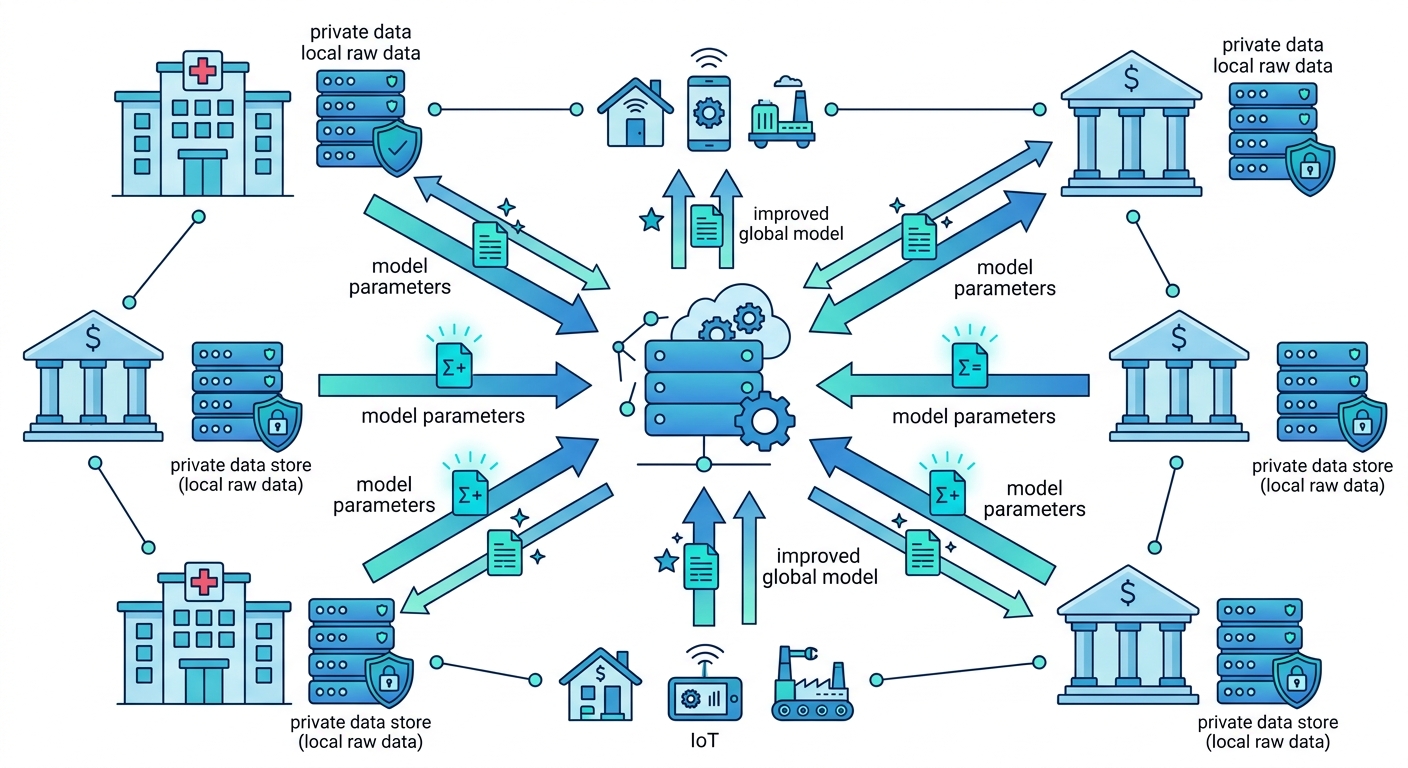
Federated learning (FL) — the privacy-preserving machine learning approach that distributes model training across decentralized data sources — has moved from academic research paper to enterprise production system. In 2026, organizations across healthcare, finance, telecommunications, and manufacturing are deploying federated AI not as an experiment but as a core architectural component of their data strategy.
What Is Federated Learning? The Core Concept
The problem federated learning solves is deceptively simple: organizations want to build the most accurate AI models possible, but the data needed to train those models is distributed across multiple locations — hospitals, bank branches, edge devices — and cannot be aggregated due to privacy regulations, competitive concerns, or sheer data volume. Federated machine learning resolves this tension by sending the model to the data, rather than collecting the data centrally.
Consider a consortium of 50 hospitals across three continents, each holding invaluable diagnostic imaging data and each legally prohibited from sharing patient records with competitors. They need to jointly train an AI model capable of detecting early-stage pancreatic cancer. The data they need is the very data they cannot share. Privacy-preserving federated learning makes this collaboration structurally possible without any participant ever exposing raw patient data.
Federated learning allows multiple organizations or devices to collaboratively train a shared AI model without any participant exposing its raw data to others. The model travels to where the data lives. Each participant trains it locally, then shares only learned parameters — the model's updated weights — to a central server that aggregates them into an improved global model.
Traditional centralized machine learning requires pooling all training data into a single repository, creating a single point of failure, regulatory liability, and adversary target. Distributed enterprise AI using federated learning inverts this: data never leaves its origin, privacy risk is structurally eliminated at the architectural level, and organizations benefit from collective intelligence across diverse, distributed data.
The global federated learning market is projected to grow from USD 1.59 billion in 2026 to over USD 17.46 billion by 2035 (CAGR 30.5%), with North American enterprises leading adoption.
Why 2026 Is the Federated Learning Inflection Point
Federated learning in 2026 has moved decisively from experimental to operational. Several forces converge to make it competitively necessary:
- GDPR and AI Act compliance: Evolving data protection regulations make data centralization increasingly risky; FL's keep-data-local architecture aligns naturally with these frameworks.
- Mature edge computing: Powerful on-device processors enable meaningful model training directly on smartphones, medical devices, and IoT sensors — at scale.
- Proven production deployments: Google uses federated learning to improve Gboard keyboard predictions across hundreds of millions of Android devices; Apple applies similar techniques to enhance Siri's speech recognition.
- Competitive AI pressure: Organizations using FL train on more diverse, real-world data without sharing it; those that don't will have models trained on narrower, organization-specific data distributions.
How Federated Learning Works: The Technical Mechanics
The federated averaging algorithm (FedAvg), introduced by Google researchers in 2017, is the foundation of most FL systems. The process repeats across training rounds:
- Server initializes a machine learning model with starting parameters.
- Model distribution: The server sends current model parameters to all participating federated learning clients — hospitals, bank branches, IoT sensors, or mobile devices.
- Local training: Each client trains the model on its own private data. Raw training data never leaves the client's environment.
- Update transmission: Each client computes the difference between its updated model and the received model — the model update or gradient delta. Only this compact mathematical representation returns to the server.
- Aggregation: The server computes a weighted average of received updates (weighted by each client's training sample count). The global model is updated, and the next round begins.
Types of Federated Learning
Horizontal federated learning applies when participants share the same feature space but have different samples — for example, multiple banks each with their own customer transaction histories. Vertical federated learning applies when participants share the same samples but have different features — for example, a bank and hospital serving the same patients, where the bank holds financial features and the hospital holds medical features.
Key Federated Learning Challenges
Non-IID data (non-independently and identically distributed) is the most significant challenge. A hospital specializing in oncology will have very different patient imaging data than a cardiology-focused hospital. When clients have highly heterogeneous data distributions, the global model can struggle to converge for everyone. Solutions include:
- FedProx: Adds a regularization term to penalize drift from local models
- SCAFFOLD: Uses control variates to correct for gradient heterogeneity
- Personalized federated learning: Learns client-specific model adaptations while benefiting from global collective knowledge
Communication overhead is a fundamental bottleneck. Unlike centralized training where data transfers happen once, federated learning communication costs require repeated model parameter transmission across potentially millions of devices. Techniques like model compression, quantization (reducing parameter precision from 32-bit to 8-bit floats), and asynchronous aggregation protocols all help reduce this burden.
Byzantine adversaries are malicious clients that intentionally send corrupted model updates to poison the global model or extract information about other clients' training data. Byzantine-resilient aggregation methods like Bulyan and Zeno++ are designed to identify and exclude malicious updates.
Privacy Mechanisms in Federated Learning
Production privacy-preserving machine learning systems layer multiple technical mechanisms to provide stronger data protection beyond FL's architectural separation.
Differential Privacy
Differential privacy adds formal mathematical guarantees to federated model updates by injecting calibrated random noise. The key guarantee: a malicious server or adversarial observer should not be able to determine whether any specific individual's data was used in training. The privacy budget (epsilon, ε) quantifies the privacy-utility trade-off: smaller epsilon means stronger privacy but potentially less accurate models. Production systems like Google's mobile keyboard FL deployments use carefully chosen epsilon values for meaningful privacy guarantees.
Secure Aggregation
Secure aggregation protocols allow the central server to compute the aggregate of all client updates without ever observing any individual update in plaintext. The server sees only the final averaged result — preventing both external adversaries and the server operator from inspecting individual contributions. This is critical for sensitive multi-party scenarios like bank fraud detection consortia.
Homomorphic Encryption
Homomorphic encryption in machine learning enables computations to be performed directly on encrypted data. Model updates are encrypted by clients before transmission; the server performs aggregation on ciphertexts without decryption. Only an authorized party decrypts the final result. While computationally intensive (10x–100x overhead vs. unencrypted computation), advances in hardware acceleration are narrowing this gap for sensitive data environments.
Trusted Execution Environments
Trusted execution environments (TEEs) such as Intel SGX and ARM TrustZone provide hardware-level isolation for the aggregation computation. Even if the server's operating system is compromised, aggregation runs in a protected enclave. TEEs are increasingly integrated into enterprise FL frameworks as a hardware-rooted protection layer.
Enterprise Federated Learning Use Cases
Healthcare and Life Sciences
Federated learning in healthcare is perhaps the most mature enterprise adoption area. Hospital systems use FL to train diagnostic AI models across institutions without aggregating patient data — directly addressing HIPAA requirements. NVIDIA FLARE-powered consortia train models for tumor detection, diabetic retinopathy screening, and COVID-19 prognosis prediction across multiple hospitals, each keeping patient data private while benefiting from diagnostic diversity.
Financial Services
Federated learning in finance resolves a fundamental paradox: the best fraud detection models require transaction data from many institutions, but sharing transaction data between competing banks is legally and commercially impossible. Banks contribute model updates — which reveal nothing about specific customers — to collaborative fraud detection models that outperform any single bank's model. Multiple national banking consortia and SWIFT have piloted such systems.
Telecommunications and Edge AI
Mobile carriers use federated edge AI to improve signal processing, predict network congestion, and personalize user experiences — without transmitting raw user location or usage data to central servers. The integration of FL with edge computing architectures is particularly natural for telecommunications infrastructure.
Manufacturing and Industrial IoT
Manufacturing companies use federated IoT machine learning for predictive maintenance across factory floors. Proprietary process data — formulations, tolerances, equipment configurations — cannot be shared with competitors or other business units. FL enables collaborative anomaly detection and equipment failure prediction across facilities, each keeping process data private.
Autonomous Vehicles
Federated learning for autonomous vehicles allows manufacturers to improve object detection, path planning, and safety models by aggregating learnings from millions of vehicles — each contributing model updates derived from unique real-world driving experience — without any vehicle's raw driving footage being transmitted to central servers.
Federated Learning Frameworks Compared
| Framework | Type | Best For | Privacy Features |
|---|---|---|---|
| NVIDIA FLARE | Enterprise | Regulated industries (healthcare, finance) | Differential privacy, secure aggregation, Byzantine-resilient FL, audit logging |
| Flower | Open-source | Research, pilots, flexibility | Framework-agnostic, works with PyTorch, TensorFlow, Hugging Face |
| TensorFlow Federated (TFF) | Open-source | TensorFlow shops | Native TFF simulation, tight TensorFlow integration |
For enterprise production: Start with Flower for exploration and pilots; transition to NVIDIA FLARE when production requires enterprise security features, compliance auditing, and healthcare/finance integrations.
For research teams: Flower offers the greatest flexibility across ML frameworks and custom aggregation strategies.
Implementation Roadmap for Enterprise Federated Learning
Phase 1 — Foundation (Months 1–3)
- Identify and prioritize a concrete FL use case where privacy barriers prevent effective model training
- Establish a cross-functional team: ML engineers, legal/compliance stakeholders, business owners
- Select an initial framework (Flower recommended for this phase)
- Deploy a centralized baseline model to establish performance benchmarks
Phase 2 — Pilot (Months 4–6)
- Deploy enterprise federated learning across 3–5 clients
- Implement at least one privacy mechanism (differential privacy or secure aggregation)
- Measure federated model performance against the centralized baseline
- Document privacy leakage risks and mitigation strategies
Phase 3 — Scale (Months 7–12)
- Expand to the full client network
- Integrate the FL pipeline with existing MLOps infrastructure
- Establish Byzantine defenses and comprehensive audit logging
- Begin measuring business impact metrics
Phase 4 — Optimize (Year 2+)
- Introduce personalized federated learning for client segments with distinct data distributions
- Deploy asynchronous aggregation for clients with unreliable connectivity
- Establish continuous privacy budget monitoring
Conclusion
Federated learning in 2026 is a production-ready architectural approach for enterprises that need powerful AI models and strong data privacy simultaneously. The technology works. The regulatory environment rewards it. The competitive pressure demands it.
Organizations that master federated learning in the next 18–24 months will have AI models trained on broader, more diverse, more real-world data than competitors — with lower regulatory exposure. The window to establish FL leadership is open now.
Three immediate steps:
- Identify the data collaboration challenge blocking your best AI project — the one where you have the data to solve the problem but cannot share it.
- Evaluate your first FL framework: Flower for speed and flexibility, NVIDIA FLARE for enterprise compliance requirements.
- Run a 90-day pilot with a small number of clients to prove the technical and business case before committing to full-scale deployment.
The future of enterprise AI is collaborative, distributed, and privacy-preserving. Federated learning is how your organization gets there.
Expert Q&A
Q: What is the single most important thing enterprises get wrong about federated learning before they first deploy it?
A: The most common misconception is treating federated learning as primarily a technology problem — something you solve by installing the right framework and configuring the aggregation server correctly. The harder challenges are organizational and legal. Getting multiple independent legal entities — hospitals, banks, business units with different data governance policies — to agree on a federated learning governance framework is typically the real bottleneck. Technically, federated learning is largely solved for most production scenarios. The coordination challenge — defining who owns the global model, how privacy breaches are handled, what happens when a client wants to withdraw — is where most pilots stall or fail. Enterprises that treat FL as a governance challenge first and a technology challenge second have dramatically higher deployment success rates.
Q: How do you measure whether differential privacy is set at the right level for a federated learning deployment?
A: The core metric is the privacy budget (epsilon, ε) spent per training round, accumulated across all rounds of model training. Each round consumes some portion of the total privacy budget — lower epsilon values consume budget more slowly but provide stronger privacy guarantees. The practical approach is to establish a target total privacy budget for the entire model training lifecycle (say, ε = 8.0 for a production model), then monitor cumulative budget consumption throughout training. When the budget is exhausted, training must stop. The right epsilon value depends on three factors: the sensitivity of the underlying data (genomic data needs stronger privacy than click-stream data), the number of training rounds (more rounds consume more budget), and the acceptable privacy-utility tradeoff for your specific application. For healthcare applications, ε values between 2.0 and 8.0 are common in published deployments. For less sensitive applications, ε values up to 12–15 may be acceptable. The critical discipline is establishing the total budget before training begins and enforcing it programmatically — not adjusting epsilon ad hoc when model accuracy looks too low.
Q: What is the most realistic timeline for an enterprise to go from FL concept to production deployment?
A: A realistic timeline for a non-trivial production FL deployment is 9 to 14 months from project initiation. The breakdown: 2–3 months for use case selection, legal framework negotiation, and baseline model development; 3–4 months for a controlled pilot across 3–5 clients with one privacy mechanism deployed; 4–7 months for production-scale deployment including MLOps integration, Byzantine defenses, compliance auditing, and governance framework finalization. The legal and governance work is typically the critical path — more than the ML engineering. Enterprises that underestimate the governance complexity and try to compress this timeline often end up with production systems that lack the audit trails and compliance documentation required for regulated-industry deployment. Starting with an internal FL deployment (across business units of the same company, not independent legal entities) can reduce the governance complexity significantly and compress the timeline to 6–9 months.
Q: When should an enterprise choose vertical federated learning over horizontal federated learning?
A: Choose vertical federated learning when your participating clients share the same entity population but have different feature types about those entities — and you want to combine those features for a unified model. The canonical example is a bank and a healthcare provider that both serve the same patients: the bank has financial features (account balances, transaction patterns) and the hospital has clinical features (diagnoses, lab results). Using vertical FL, both parties can collaboratively train a model that uses the full feature set without either party revealing its features to the other. Choose horizontal federated learning when your clients share the same feature space but have different entity samples — for example, multiple hospitals that all use the same EHR data format and want to jointly train a diagnostic model using each hospital's own patient populations. The practical implication of choosing vertical FL is that it requires more sophisticated cryptographic protocols (typically involving secure entity alignment before any model training can occur) and more careful partitioning of the model architecture between parties. Horizontal FL is simpler to implement and covers the majority of current enterprise use cases.
Q: How do Byzantine-resilient aggregation methods actually work, and when are they worth the overhead?
A: Byzantine-resilient methods protect against clients that intentionally send malicious model updates — either to poison the global model or to extract information about other clients' training data through careful observation of how the global model changes in response to their inputs. The core strategy across methods like Bulyan, Zeno++, and others is statistical anomaly detection applied to the collection of model updates received each round. The aggregation server compares all received updates against an expected distribution and excludes updates that deviate significantly from the consensus. Bulyan, for example, computes pairwise distances between all client updates, iteratively eliminates the most distant outliers, and averages only the remaining updates. The overhead is meaningful: Byzantine-resilient aggregation typically increases computation time by 20–40% per round and requires careful tuning of the anomaly detection threshold. The right question to ask is whether your threat model justifies this overhead. For multi-party FL across trusted institutions (reputable hospitals, established banks), Byzantine defenses are recommended but the probability of an actual attack may be low. For FL across open networks — for example, millions of consumer IoT devices where any device could potentially be compromised — Byzantine resilience is close to mandatory. Model the threat, then decide.
Q: What advice would you give to an ML engineer evaluating whether to use Flower or NVIDIA FLARE for their first enterprise FL project?
A: Flower is the right choice for the first 6–12 months: it installs in minutes, works with whatever ML framework your team already knows (PyTorch, TensorFlow, JAX, or anything else), and its clear, well-documented architecture means your team will understand what's happening at every step. Flower is also significantly easier to extend with custom aggregation strategies when you need to experiment with techniques not built into the framework. NVIDIA FLARE is the right choice when you need production-grade security defaults, compliance audit trails for regulated-industry deployment, and integrations with enterprise data infrastructure like healthcare EHR systems or financial data platforms. The transition from Flower to FLARE is well-supported. My recommendation: start your FL journey with Flower, prove the business case with a pilot, then plan the FLARE transition before scaling to production with external data partners. Trying to learn FLARE's more complex configuration system while simultaneously learning federated learning concepts is the worst possible sequence.
Q: What emerging trend in federated learning do you believe will be most significant for enterprise adoption over the next 2–3 years?
A: Federated foundation models — the application of federated learning techniques to large language models and multimodal foundation models — will be the most transformative development. The emergence of capable open-weight foundation models (Llama, Mistral, Gemma, and their successors) changes the FL landscape by making it possible to apply federated learning to general-purpose models that can then be fine-tuned for organization-specific tasks without centralized data collection. The workflow: an enterprise downloads a foundation model, fine-tunes it federated across multiple business units or partner organizations using FL, and ends up with a model that has learned from the collective private data of all participants without any raw data ever leaving its origin. This pattern — federated fine-tuning of foundation models — is the most credible path to enterprise AI that is simultaneously more capable, more privacy-preserving, and more legally defensible than centralized alternatives. The technical challenges are substantial (communication efficiency for billion-parameter models requires aggressive compression and potentially asynchronous training), but the industry is moving quickly to address them. Enterprises building FL competency today will be well-positioned to adopt federated foundation model workflows as they mature.