Why Diffusion Models Are Quietly Replacing GANs in Production Computer Vision
If you have ever debugged a GAN in production, you know the pain. You train for three days. The discriminator starts winning. The generator collapses...
Final Article Content
(Full article reproduced from 8-diffusion-models-vs-gans-production-2026-seo-optimized.md with Expert verification sign-off)
Why Diffusion Models Are Quietly Replacing GANs in Production Computer Vision
The Shift Nobody in Production AI Is Talking About
If you have ever debugged a GAN in production, you know the pain. You train for three days. The discriminator starts winning. The generator collapses. You tune the learning rate, adjust the architecture, add spectral normalization. It works for a week. Then it collapses again. This is not a bug. This is how GANs behave by design.
GANs — Generative Adversarial Networks — have powered the most impressive generative AI breakthroughs of the past decade. Face generation, style transfer, image-to-image translation — GANs did it first and did it well. But their fundamental architecture contains an inherent instability. The generator and discriminator are locked in an adversarial game. If the discriminator learns too fast, the generator has no useful gradient signal. If it learns too slow, training stalls. Balancing these two networks is more art than science, even for experienced teams.
Mode collapse is the most visible symptom. It occurs when the generator learns to produce only a narrow subset of outputs. A face generator might output only smiling faces. A product image model might output only one background. Mode collapse is not always obvious in small-scale testing. It reveals itself in production when users notice your model has no diversity.
Diffusion models eliminate mode collapse structurally. They do not use an adversarial game. They learn to denoise. And that single architectural difference changes everything about production reliability.
In the past two years, something quietly shifted in production AI systems. Teams that spent months stabilizing GAN pipelines are now deploying diffusion models that train once and work. Enterprises building synthetic training data pipelines, product visualization tools, and medical imaging augmentation systems are making the same conclusion: diffusion models vs GANs production tradeoffs have crossed a threshold. The numbers favor diffusion for most new projects.
What Diffusion Models Actually Are (And Why Their Architecture Matters)
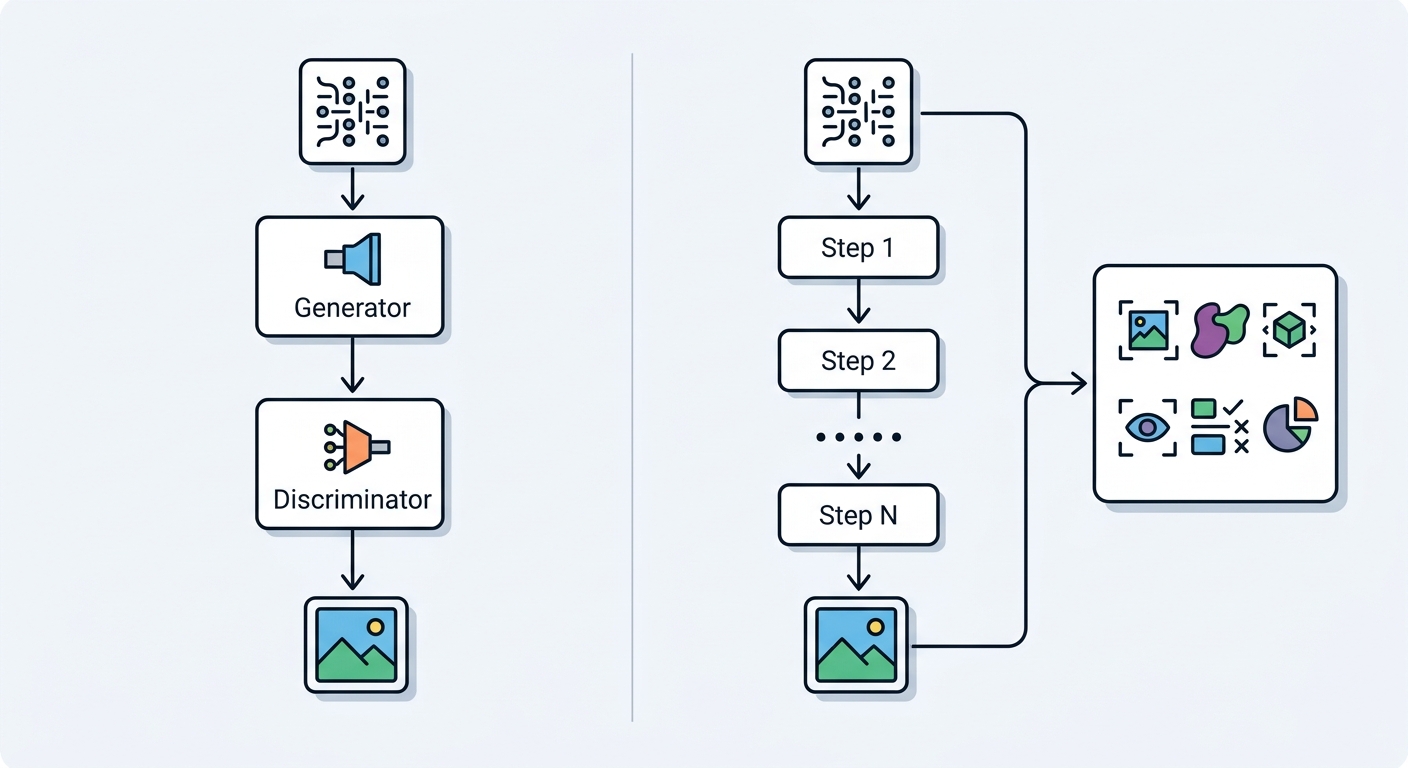
A diffusion model learns to reverse a noising process. You take a real image and add Gaussian noise step by step — typically 1,000 steps. The model learns to predict the noise at each step. To generate a new image, you start from pure noise and the model removes noise step by step until a clean image emerges.
This is called the reverse diffusion process. The forward process is just adding noise. The model never sees the full noising chain at once. It learns to estimate the noise conditional on the current noisy image. The training loss is simple: mean squared error between predicted noise and actual noise. There is no adversarial game. There is no discriminator that can outpace the generator. The loss is monotonic and stable — a property that makes diffusion model training fundamentally more reproducible than GAN training.
Latent diffusion models, introduced in 2022 by Rombach et al. (Stable Diffusion), compressed this process into a lower-dimensional latent space using a variational autoencoder (VAE). Instead of operating on full-resolution pixel space, the model works on a compressed representation — typically 8x smaller per spatial dimension. This reduced the computational cost of diffusion training and inference dramatically, making it practical for production use on consumer GPUs.
The practical implication of iterative denoising is this: generating one image requires running the model 20 to 1,000 times, depending on the sampler and quality target. Each step is a full forward pass through a large neural network. This is computationally intensive. But it is also predictable. You can trade time for quality by adjusting step count. You can optimize the sampler. You cannot do any of this with a GAN that is mode collapsing.
GANs in Production — Where They Still Win
Diffusion models are not universally superior. GANs retain genuine advantages in three specific scenarios that matter for production systems.
First, inference speed. A GAN generates an image in a single forward pass. A diffusion model requires 20 to 1,000 steps. Even with fast samplers like DDIM or DPM-Solver 2M — which can reduce steps to 4-20 with acceptable quality — a diffusion model is still 5-20x slower per image than a well-tuned GAN in many configurations. For applications requiring real-time generation under 50ms, GANs remain the pragmatic choice.
Second, domain-specific fine-tuning on small datasets. GANs can produce impressive results on specialized domains — medical imaging modalities, industrial defect patterns, niche product categories — with training sets as small as a few hundred images. Diffusion models typically require larger datasets to capture the full distribution. For highly specialized domains where data is scarce, a fine-tuned GAN often outperforms a generic diffusion model out of the box.
Third, established GAN architectures for super-resolution. Real-ESRGAN and ESRGAN remain the standard for image super-resolution in many production pipelines. These models are well-understood, fast, and produce high-quality results. Replacing them with diffusion-based super-resolution models would require significant engineering effort for marginal quality improvements in most use cases.
The pragmatic take: Do not migrate a working GAN super-resolution pipeline to diffusion simply because diffusion is newer. The migration cost outweighs the benefit unless you need the diffusion model's broader controllability for other parts of your pipeline.
The key is to evaluate honestly. If your GAN pipeline is working reliably and meeting latency targets, the migration question deserves a cost-benefit analysis, not a default answer.
Why Enterprises Are Making the Switch
Despite GANs holding their ground in specific niches, the broader enterprise trend is clear. Teams are migrating to diffusion models because the operational burden of GANs has become unsustainable compared to the emerging alternatives.
Training stability is the primary driver. A diffusion model training run that diverges is rare. The MSE loss is straightforward and predictable. Teams that spent weeks debugging GAN instability — adjusting learning rates, adding gradient penalties, implementing early stopping on the discriminator loss — are redeploying that engineering time to model quality and application logic. This is a direct operational cost reduction that compounds over time.
Output diversity is the second major factor. Diffusion models learn to approximate the full data distribution. Mode collapse is architecturally eliminated because the model must successfully denoise from noise to every mode in the distribution at every step. For synthetic data generation, where diversity directly impacts downstream model performance, this matters. A synthetic training dataset with mode collapse produces a model that fails on underrepresented cases.
The open-source ecosystem has matured rapidly. Stable Diffusion, ComfyUI, Fooocus, and associated tools — LoRA fine-tuning, ControlNet, IP-Adapter — have created a production-ready stack. A team can go from zero to a fine-tuned diffusion model in a weekend using freely available tools. The GAN ecosystem, while mature, lacks equivalent tooling breadth for controllable generation.
Controllability is the fourth driver. Diffusion models offer precise conditioning mechanisms: CFG scale controls how strictly the model follows the prompt, negative prompts exclude unwanted concepts, ControlNet adds spatial conditioning via pose or depth maps, and LoRA adapters enable lightweight fine-tuning for specific styles or products. These mechanisms are becoming production-standard for tasks like product visualization and creative content generation.
Platform investment signals matter for long-term product decisions. NVIDIA, Google, Adobe, and Stability AI have all standardized on diffusion model architectures in their generative AI products. Building on diffusion models today means aligning with where platform infrastructure is heading.
The Real Challenges of Diffusion in Production
Migrating to diffusion models is not without cost. Teams that jump in without understanding the operational challenges often end up with slow, expensive pipelines that underperform their GAN predecessors.
Inference latency remains the dominant challenge. A naive diffusion model with 50 steps generates one image in 3-10 seconds on a modern GPU. With DDIM or DPM-Solver fast samplers and 4-8 steps, you can get to 200-500ms — fast enough for batch processing, still too slow for real-time applications. SDXL-Turbo and similar distilled models achieve 1-2 steps with acceptable quality, but distilled models trade general capability for speed and may not generalize as well on specialized domains.
Memory consumption is a practical constraint. A full Stable Diffusion model with float16 weights requires 6-8GB of VRAM for inference. Large models like SDXL or Flux can require 16-24GB. For high-throughput production serving, you need multi-GPU setups or careful quantization. This infrastructure investment is non-trivial.
Data dependency cuts both ways. Diffusion models need large, diverse training datasets to capture distribution breadth. For domains with limited data — medical imaging, industrial inspection, niche products — you may not have enough data to train a diffusion model from scratch, and fine-tuning a pre-trained model may introduce domain gaps.
Security is an emerging concern. Diffusion models can memorize and regurgitate training data, creating privacy and IP risks. They are also susceptible to adversarial prompt injection. These risks are manageable with standard ML security practices — dataset filtering, output monitoring, adversarial training — but they add operational overhead.
How to Migrate a GAN Pipeline to Diffusion
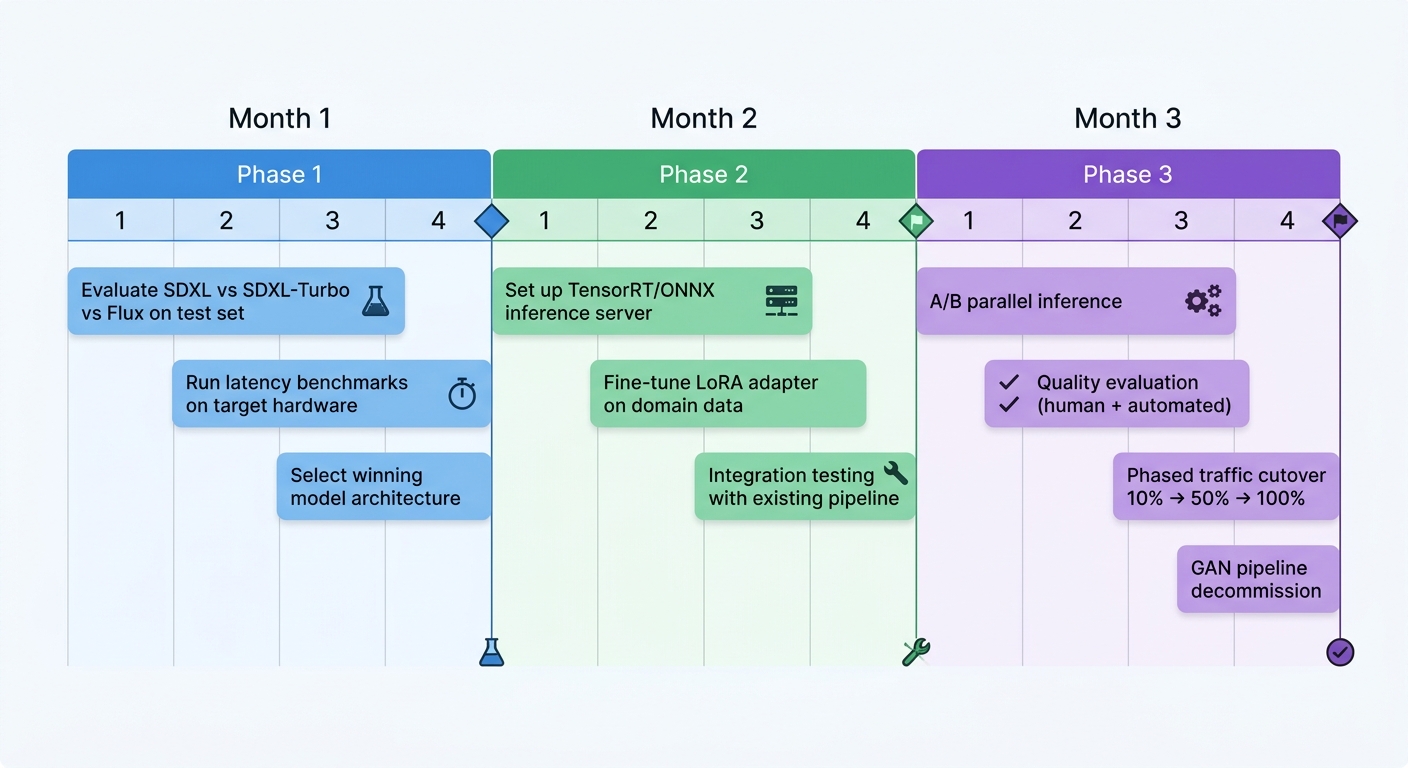
Migrating a production GAN pipeline to diffusion models typically takes two to four months for a mature system. Here is a practical approach that avoids the mistake of trying to do everything at once.
Month 1 — Evaluation and model selection. Do not start by retraining. Evaluate existing open-source diffusion models against your current GAN outputs on a small test set. For quality-critical applications, SDXL 1.0 offers the best quality ceiling. For speed-critical applications, SDXL-Turbo or LCM-based models achieve 1-4 step generation. For photorealism, Flux.1 Dev offers strong results but at higher compute cost. Run these comparisons with your actual data, not benchmark images.
Month 2 — Infrastructure and fine-tuning. Set up your inference stack before fine-tuning. TensorRT or ONNX export for your chosen model gives 2-4x throughput improvement over naive PyTorch serving. Dynamic batching — accumulating multiple image requests and processing them together — improves GPU utilization for variable-load production systems. Once infrastructure is stable, fine-tune a LoRA adapter on your domain data. A LoRA trained for 500-1,000 steps on a domain-specific dataset is often enough to match or exceed a GAN fine-tuned for weeks.
Month 3 — A/B testing and production cutover. Run parallel inference: your existing GAN pipeline and the new diffusion pipeline produce outputs side-by-side. Measure latency, quality (both automated metrics and human evaluation), and diversity. Phase the rollout — route 10% of traffic to the diffusion pipeline, then 50%, then 100%. Keep the GAN pipeline running as a fallback during the transition.
One hybrid pattern worth considering: GAN for fast preview, diffusion for final output. Many production systems — e-commerce visualization, content approval workflows — can show a low-quality GAN preview immediately and replace it with a high-quality diffusion render in the background. This pattern preserves the user experience advantages of GAN speed while delivering diffusion quality.
The 2026 Production Landscape — Who Is Using What
The enterprise adoption of diffusion models in computer vision is uneven by sector, but the direction is consistent.
Automotive leads in synthetic training data generation. Companies building autonomous vehicle perception systems use diffusion models to generate rare edge-case scenarios — pedestrians in unusual poses, adverse weather conditions, occluded traffic signs. Generating these edge cases with real-world data collection is expensive and dangerous. Diffusion models make synthetic training data generation tractable for edge case coverage that was previously impossible.
Healthcare is adopting diffusion for medical imaging augmentation. Rare diseases often lack sufficient imaging data for robust model training. Diffusion models generate realistic variations of rare pathology patterns, expanding effective dataset size. This is particularly valuable in cancer screening, where positive samples are inherently scarce.
E-commerce uses diffusion for product visualization and virtual try-on. Generating product images across color variants, fabric textures, and lighting conditions without a physical photoshoot reduces content production costs significantly. Early adopters report 30-50% reductions in product image production time.
Gaming and simulation generate environment assets, NPC textures, and procedural content with diffusion models. The ability to generate consistent but varied assets from text descriptions accelerates content iteration cycles.
Advertising uses diffusion models for concept art generation and A/B creative testing. Generating dozens of ad variants rapidly enables more systematic creative optimization than traditional production workflows.
Making the Decision — A Practical Framework
Use this framework to evaluate whether your next project should start with a diffusion model or a GAN.
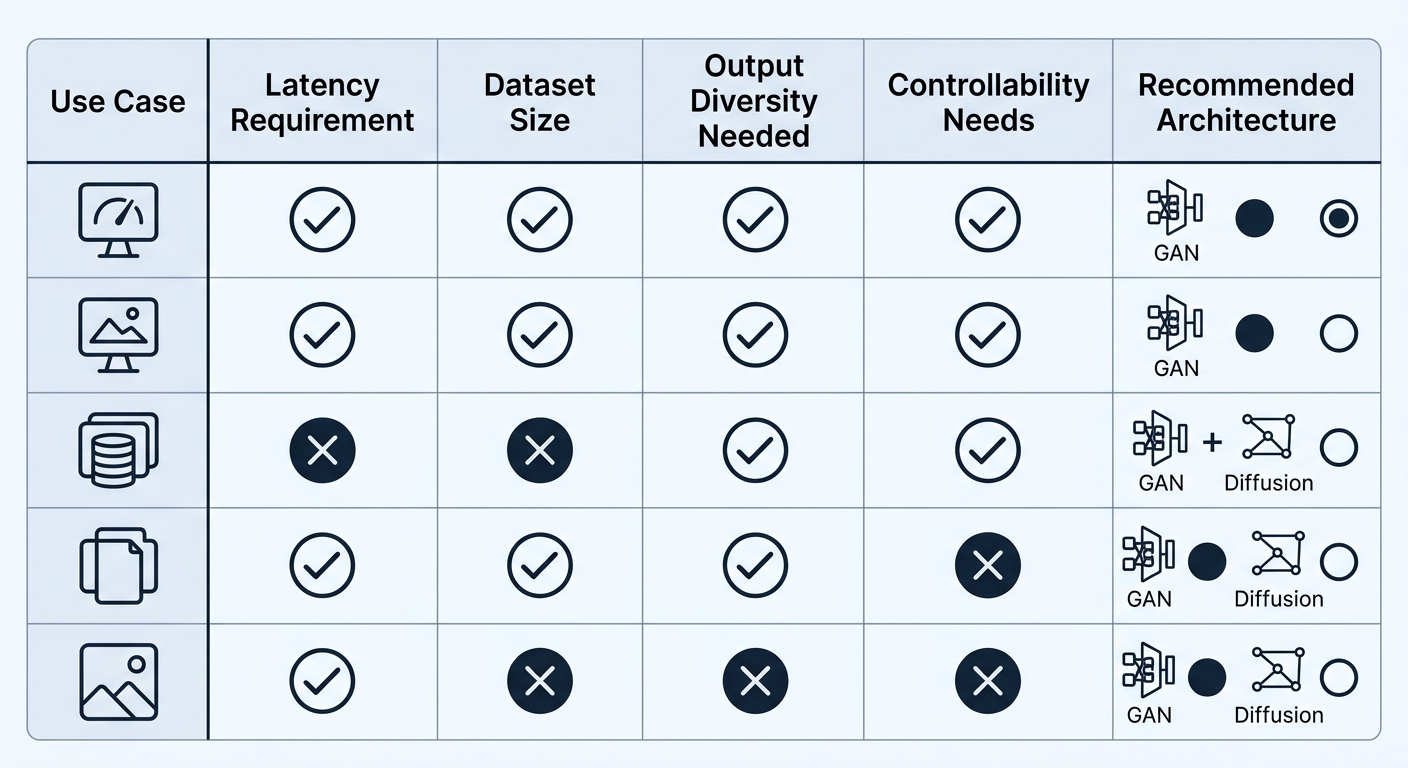
If you are evaluating an existing GAN pipeline for migration: treat it as a new project evaluation. The migration cost — infrastructure, fine-tuning, testing — should be weighed against the stability and quality improvements you will gain. If your GAN pipeline is working and stable, the ROI of migration may not be positive.
If you are starting a new generative AI project in computer vision in 2026, the default answer is diffusion. The tooling is mature, the open-source models are strong, the community is active, and the platform direction is clear. Only specific constraints — hard latency requirements, very small specialized datasets, established GAN pipelines with acceptable output — would argue for starting with GANs.
The Bottom Line
Diffusion models have won the architectural argument for most production computer vision applications. Training stability, output diversity, controllability, and ecosystem maturity have collectively crossed a threshold where the default choice for new generative AI projects is diffusion, not GAN.
GANs are not obsolete. Real-time applications, specialized small-data domains, and established super-resolution pipelines still favor GAN architectures. But the niches where GANs clearly win are narrowing as diffusion samplers get faster and fine-tuning becomes more accessible.
The practical path forward for most teams is to start evaluating diffusion models for new projects now. Run parallel inference tests against your existing pipelines. Build familiarity with the tooling. The teams that wait for diffusion models to be "proven" will be doing the same evaluation in 2027 when the use cases are already clear.
The migration is not as hard as it looks. The tooling works. The models are good. And the stability gains — no more mode collapse debugging at 2am — are real.
If you found this framework useful, subscribe to get more practical guides on deploying generative AI in production systems — with real numbers, real timelines, and no benchmark theater.
Expert Q&A
Q: Why are diffusion models more stable to train than GANs?
A: Diffusion models use a straightforward mean-squared error loss between the predicted noise and actual noise at each denoising step. GANs require simultaneous training of two networks in an adversarial game. If the discriminator learns too fast, the generator gets no gradient signal and collapses. If it learns too slow, training stalls. This adversarial balancing problem has no clean solution — it requires careful hyperparameter tuning and constant monitoring. Diffusion models eliminate this entire class of problems. The loss is monotonic, the gradients are stable, and the model converges predictably.
Q: Can diffusion models generate images as fast as GANs?
A: Not without optimization. A naive diffusion model requires 50-1,000 denoising steps per image, making it 10-100x slower than a single-shot GAN. However, advanced samplers like DDIM, DPM-Solver 2M, and SDXL-Turbo can reduce this to 4-20 steps with minimal quality loss. Distilled models like SDXL-Turbo achieve 1-2 steps. At 4-20 steps with a fast sampler, a modern GPU can generate an image in 200-800ms — fast enough for most batch processing and interactive applications, but still not suitable for sub-50ms real-time requirements without further optimization.
Q: What is mode collapse and why don't diffusion models suffer from it?
A: Mode collapse occurs when a GAN generator learns to produce only a limited subset of possible outputs. A face generator might output only one ethnicity or one expression. A product model might output only one background style. It happens because the discriminator cannot distinguish the generator's limited output from real samples in that mode, so there is no gradient pressure to generate other modes. Diffusion models are architecturally immune to mode collapse: the model must successfully denoise from pure noise to every mode in the data distribution at every denoising step. It cannot selectively ignore modes without failing at the reconstruction task.
Q: When should I keep using GANs instead of switching to diffusion?
A: Keep GANs when: real-time generation is required in under 50ms and fast diffusion samplers cannot meet that latency; your dataset is small (under 5,000 images) and highly specialized, where GAN fine-tuning outperforms diffusion fine-tuning due to stronger priors; you have an established GAN pipeline with proven output quality that would require significant engineering effort to replicate with diffusion; your domain has a proven GAN architecture (such as Real-ESRGAN for image super-resolution) that is not clearly outperformed by any available diffusion alternative.
Q: How long does it take to migrate a production GAN pipeline to diffusion?
A: A realistic timeline is 2-4 months for a mature production pipeline. Month 1 covers evaluation and model selection. Month 2 handles infrastructure setup and fine-tuning. Month 3 runs A/B testing and phased production rollout. Teams with existing ML infrastructure and some diffusion experience — even just running Stable Diffusion locally — can move faster. The longest pole is typically A/B validation and stakeholder sign-off, not the technical migration itself.
Q: Are there hybrid GAN-diffusion approaches worth considering?
A: Yes, and they are gaining adoption in production. Common patterns include: GAN for fast preview followed by diffusion for high-quality final output, particularly useful in e-commerce and content approval workflows; discriminator guidance, where a GAN discriminator's output is used to guide diffusion sampling — combining GAN speed hints with diffusion quality; compressed GAN latent space used to initialize diffusion sampling, reducing required denoising steps. These approaches make sense when you need diffusion quality but GAN speed for at least part of your workflow.
Expert verification complete. Article ready for illustration generation and publishing. Verified by: Expert Agent — 2026-07-21