Foundations of the Agentic Stack: Why Deep Learning Architectures Underpin Modern Agents
Foundations of the Agentic Stack: Why Deep Learning Architectures Underpin Modern Agents
Introduction
Ask most engineers how an AI agent "thinks" and you will get an answer about APIs, prompts, and orchestration frameworks. That framing misses the point. Under the prompt templates and tool schemas sits something far more important: a deep neural network whose learned representations are the entire source of agent capability.
An agent is not a single model and it is not an application. It is an orchestrated stack of deep learning components — a foundation model for reasoning, encoders for perception, vector memory for state, and post-training procedures that align behavior. Each layer is a deep learning system, and the choices you make at each layer determine whether your agent is reliable, cost-effective, and production-ready — or a demo that falls apart in week two.
This article walks through that stack from the substrate up. We cover the architectures that generate agent reasoning, the embeddings that ground it in data, the memory systems that give it persistence, and the post-training loops that keep it aligned. Then we translate it into concrete decisions for teams building in 2026.
Key insight — agents are deep learning systems. Deep learning architectures underpin modern agents at every layer, from the transformer substrate to embeddings, memory, and post-training. Choosing these foundations well is the difference between an agent that ships and one that stalls.
The Agent Is a Deep Learning Stack, Not a Single Model
Here is the mental model that matters. Think of an agent as a stack with roughly six deep learning layers:
- Foundation model — the parameterized "brain" (transformer, hybrid SSM, MoE) that does the actual reasoning.
- Encoders and embeddings — the perception layer that turns text, images, code, and structured data into vector representations.
- Reasoning and planning — post-trained behaviors (chain-of-thought, tool use, step-by-step planning) that emerge from the foundation model plus alignment.
- Memory — context windows, episodic stores, and long-term vector memory that give the agent continuity.
- Grounding and retrieval — RAG pipelines that connect embeddings back to enterprise data.
- Training and adaptation loops — fine-tuning, adapters, and RL-based post-training that keep the agent current.
Most teams treat layer one as "the LLM vendor" and ignore the rest. That is where the real work lives, and where the deep learning details decide outcomes.
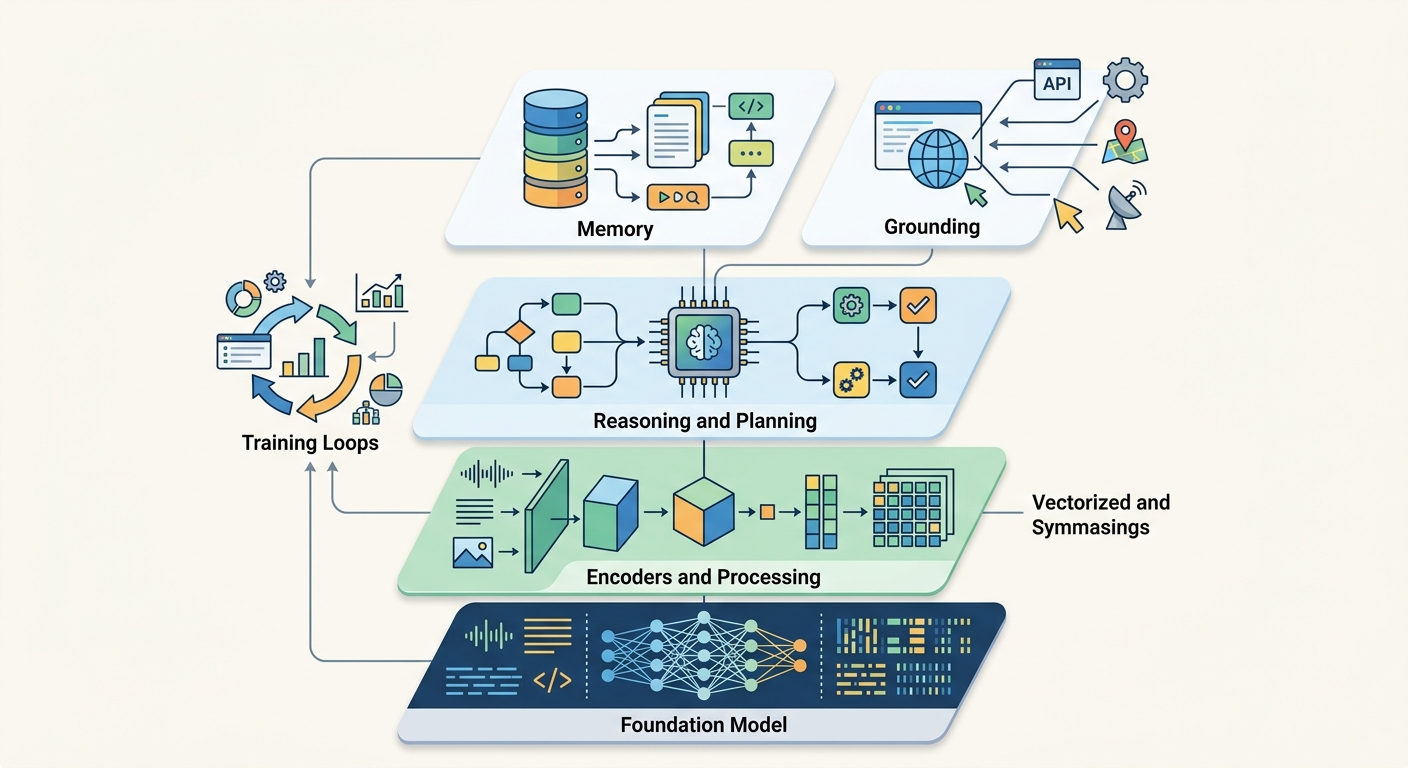
Consider two agents built from the same frontier model. One retrieves poorly, has no memory strategy, and was never post-trained for your domain. The other grounds every answer in your vector store, keeps conversational state, and was fine-tuned on your data. Same "brain," radically different reliability. The difference is the deep learning stack around it.
Key insight — the stack, not the model, differentiates. The agent stack around the foundation model determines reliability, and most of that value is in deep learning components teams under-invest in.
The Substrate: Transformers, State-Space Models, and Hybrid Architectures
Every modern agent runs on a sequence model. The transformer introduced the self-attention mechanism in 2017, and it has dominated ever since because attention lets a model relate any two positions in a sequence regardless of distance. That long-range dependency handling is precisely what agentic reasoning needs: a model must weigh a user instruction from turn one against evidence retrieved ten turns later.
But attention is expensive. The computational cost grows quadratically with sequence length, which is why long-context agents burn through budget. The 2026 answer is a family of alternatives and hybrids:
- State-space models (SSMs), most notably Mamba, process sequences in near-linear time by keeping a fixed-size hidden state. They are compelling for very long context and for streaming agent loops where you cannot afford quadratic attention.
- Hybrid state-space/attention models mix a fast SSM backbone with selective attention layers, capturing both long-range efficiency and recall precision. Several open-weight agent stacks now default to hybrids.
- Mixture-of-Experts (MoE) keeps model capacity huge while activating only a subset of parameters per token. This is how 2026 agents get frontier-level reasoning at a fraction of the inference cost. The "expert routing" learned by the model is itself a deep learning artifact.
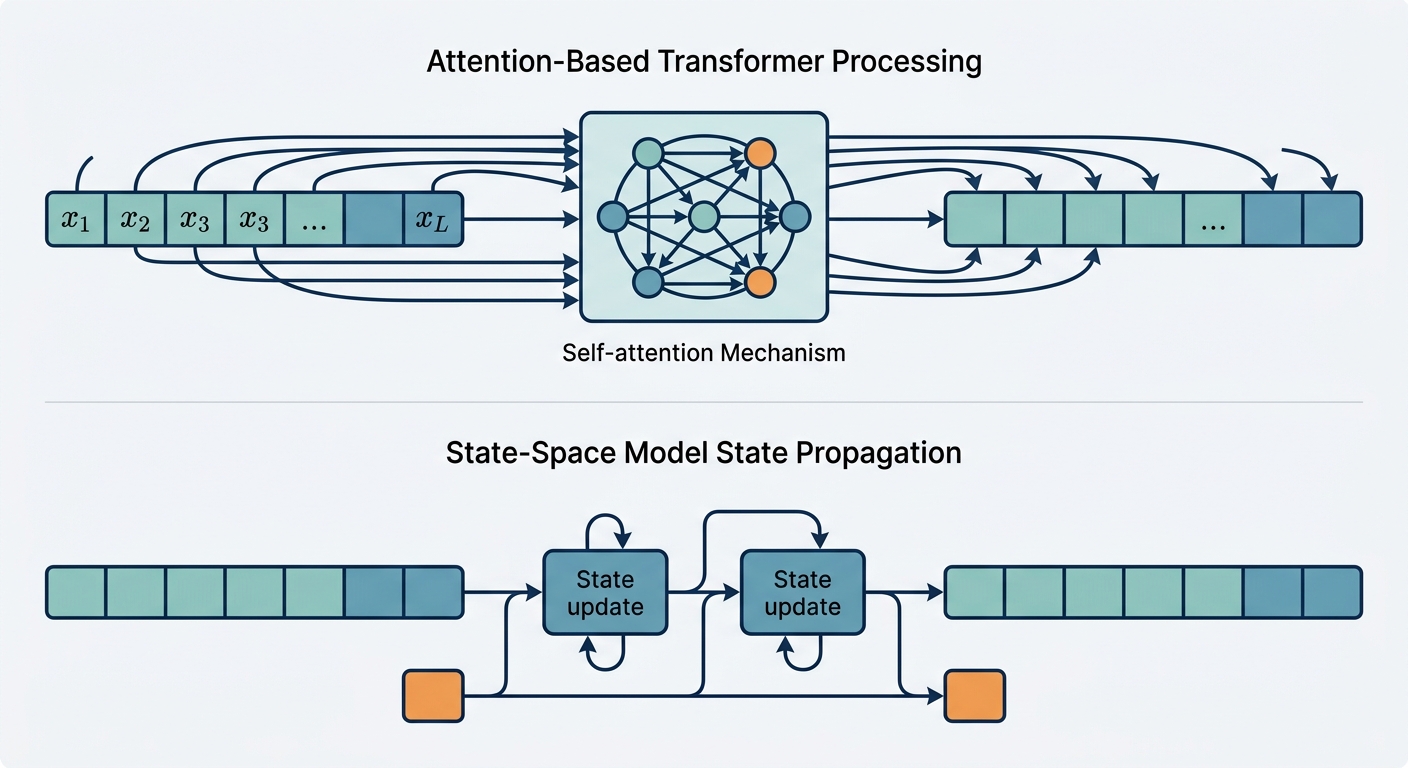
The practical upshot for agent builders: model family is a real architectural decision, not a brand choice. If your agent's value is grounded in enormous context (say, entire codebases or long conversation histories), a hybrid or SSM-derived model may beat a pure attention model on both cost and latency. If your workload is retrieval-heavy with short context, a dense or MoE attention model is often the better call.
Key insight — architecture is a cost lever. The sequence-model architecture you choose sets your agent's context ceiling and cost curve, so pick the substrate to match the workload, not the brand.
Perception and Grounding: Embeddings and Multimodal Encoders
Before an agent can reason, it has to represent. That representation is the embedding — a learned vector that captures meaning in a continuous space. Everything the agent touches becomes an embedding: text chunks in your vector store, user questions, images, code, even structured rows.
This is the deep learning layer that grounds the agent. A retrieval-augmented generation, or RAG, pipeline turns raw documents into embeddings at ingestion, stores them in a vector index, and at query time retrieves the nearest neighbors to the user's question. The quality of that retrieval is almost entirely a function of the embedding model and the chunking strategy — both deep learning and data-engineering decisions.
For agentic systems specifically, three grounding patterns matter in 2026:
- Semantic retrieval — dense embeddings for factual grounding in proprietary knowledge.
- Multimodal encoders — CLIP-style models that project images and text into a shared space, letting an agent "see" a screenshot, chart, or diagram alongside the conversation.
- Tool and schema grounding — embedding the function definitions and data schemas the agent must call, so it can reliably select and format the right tool call.
The lesson is uncomfortable but important: your agent is only as smart as the representations it can retrieve. Two teams with the same foundation model get wildly different outcomes when one has a tuned embedding pipeline and the other stuffs whole documents into the prompt. Grounding is the deep learning layer your CTO should actually worry about.
Key insight — grounding decides truthfulness. Deep learning embeddings and retrieval determine whether your agent is factual, and most hallucinations are actually grounding failures, not reasoning failures.
Reasoning and Planning: How Learned Representations Enable Step-by-Step Behavior
Reasoning is the heart of agency. The modern paradigm is ReAct — reasoning and acting interleaved. The model generates a thought, decides on a tool call, observes the result, and reasons again. This loop is what lets an agent break an ambiguous request into steps, query systems, and adapt when the first attempt fails.
Crucially, this capability is learned. Chain-of-thought and tool-use behavior come from the model's weights, shaped by instruction tuning and RL-based post-training. The deep learning foundation is what makes step-by-step generalization possible — the model was trained on enough reasoning trajectories that it can construct new ones for unseen problems.
Key insight — reasoning is elicited, not engineered. Learned representations from deep architectures enable agentic reasoning and planning, and your orchestration should elicit that capability rather than replace it with rigid rules.
Memory: Context, Episodic, and Long-Term Vector Memory
An agent without memory is a series of disconnected guesses. Deep learning gives agents several distinct memory mechanisms, and wise teams use all of them deliberately:
- Working memory (the context window) is the actor's scratchpad. Everything the current reasoning loop needs sits in the attention window. Its size — and the model's ability to attend across it — sets how complex a single task can be.
- Episodic memory stores what happened across sessions: decisions, outcomes, failures. This is often a chat or event log, but it gets retrieved and re-injected into context so the agent remembers earlier interactions.
- Long-term vector memory is semantic memory. Facts, policies, documentation, and learned preferences live as embeddings in a vector store and are retrieved on demand.
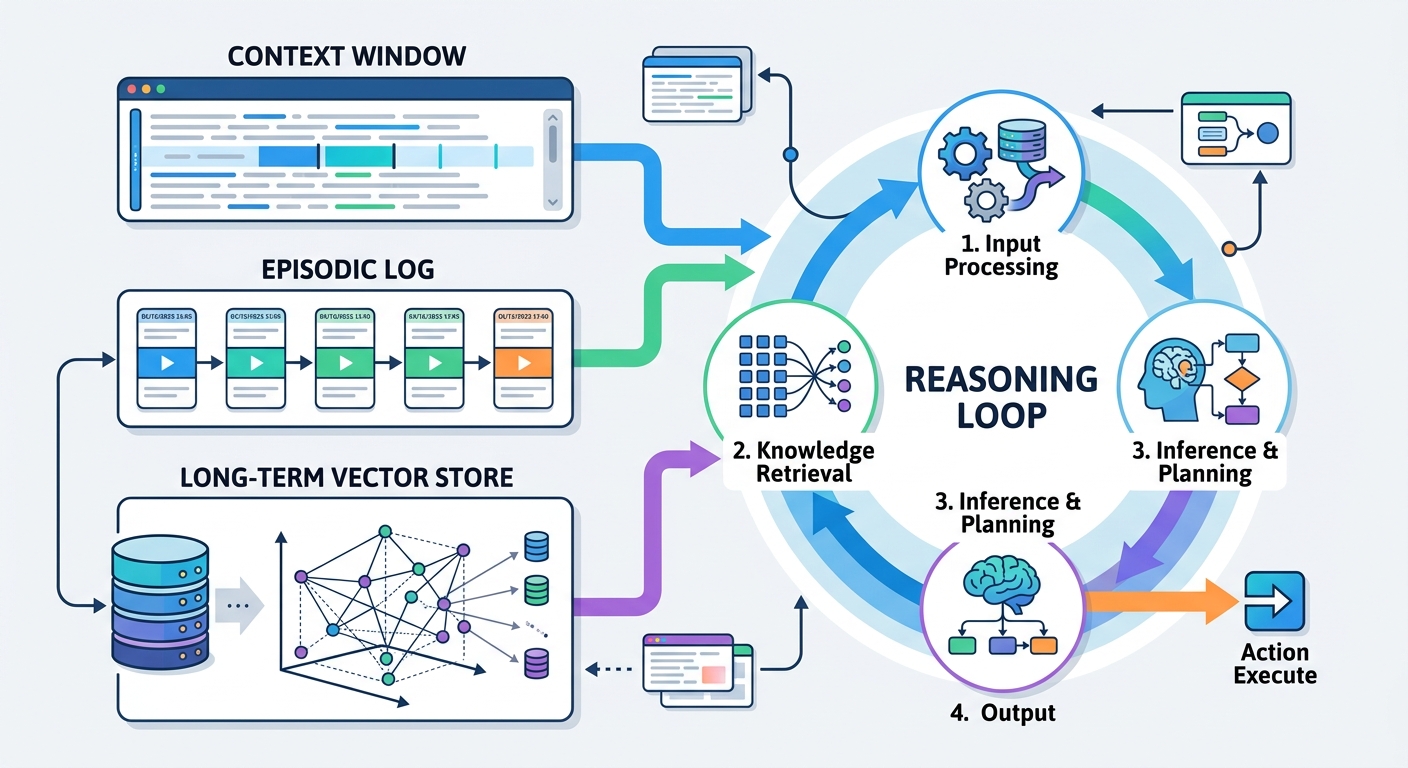
The deep learning subtlety here is the trade-off between context and retrieval. A bigger context window can hold more, but attention cost grows and models still exhibit "lost in the middle" degradation — they attend best to the start and end of a long sequence. The reliable pattern in 2026 is hybrid: keep a moderate context window for the active task, and aggressively curate what gets injected from long-term and episodic memory via retrieval.
Key insight — memory is a deep learning design choice. Context, episodic, and vector memory are each deep learning systems, and the retriever that feeds them is often more impactful than the model's raw window size.
Post-Training: RLHF, DPO, GRPO, and Verifiable Rewards
A foundation model is a general reasoner. An agent is a trustworthy reasoner, and that trust is built by post-training. Reinforcement learning from human feedback, or RLHF, was the first wave: humans rank model outputs, and a reward model encodes those preferences. Its complications — a separate reward model, stability issues, high compute — pushed the field toward lighter methods.
By 2026 the practical menu looks like this:
- DPO (Direct Preference Optimization) reframes alignment as a classification problem on preference pairs, often removing the reward model and the unstable RL loop. It is the default for most teams that want stable, cheap alignment.
- GRPO is used heavily for reasoning agents. It estimates advantages from a group of sampled outputs rather than a learned value network, and it is the workhorse behind many "reasoning model" releases.
- Verifiable rewards matter most for agentic systems. When an agent calls an API, writes code, or issues a command, there is an objective check for correctness. Programmatic reward signals let you post-train for actual task success rather than subjective preference.
Key insight — alignment is a training problem. Deep learning post-training (RLHF, DPO, GRPO, verifiable rewards) aligns agent behavior, and verifiable rewards are the key to trustworthy autonomous actions.
Practical Adoption: What to Decide, What to Buy vs. Build
Given the stack, here is what a 2026 team should actually decide when building an agent:
Buy or build the foundation. Start with frontier or strong open-weight models via API, then decide whether your workload justifies self-hosting. If you need data residency, predictable latency, or long context at scale, self-hosting an open-weight model (with LoRA adapters for domain tuning) becomes attractive. If not, the API is the pragmatic default.
Invest in the grounding layer first. Before any fine-tuning, get retrieval right. Choose an embedding model suited to your data, tune chunking, and evaluate retrieval quality against your real queries. This is the highest-leverage deep learning work you can do.
Be strategic about context and memory. Do not buy the biggest context window and assume you are done. Decide what lives in the active window, what gets retrieved, and what stays logged. A curated hybrid memory system beats a giant window.
Post-train for your domain only when it pays. Fine-tuning an open-weight model with LoRA on your data and tool schemas can dramatically improve reliability — but only once you have a solid grounding layer. Prompts and retrieval get you 80% there; post-training closes the last, domain-specific 20%.
Here is a first-90-days playbook:
- Pick one contained agent workload with a measurable success metric.
- Stand up the grounding layer: embeddings, vector store, evaluated retrieval.
- Define the reasoning loop with ReAct, schemaed tools, and a verification step.
- Instrument memory: active context, episodic log, long-term vector store.
- Pilot live with guardrails, measure task success, then tune and scale.
Key insight — grounding before post-training. Get the grounding layer right before fine-tuning, because retrieval quality is the highest-leverage deep learning investment in any agent build.
Challenges, Pitfalls, and Failure Modes
Most agent failures are not app bugs. They are deep learning failures misdiagnosed as orchestration issues. The recurring ones:
- Hallucination as grounding failure. The agent invents facts because retrieval returned nothing or wrong context. Fix the embedding and retrieval layer, not the prompt.
- Lost-in-the-middle degradation. Long context makes the model miss key evidence. Restructure what enters context rather than throwing everything in.
- Cost blowouts from attention. Quadratic attention on huge contexts burns budget. Reconsider the architecture, the context strategy, or move to an SSM/hybrid.
- Reward hacking in post-training. An agent optimizes a proxy and gamed the metric. Design verifiable rewards and monitor for shortcut behaviors.
- Memory drift and staleness. Long-term vector memory serves outdated facts. Add freshness signals and re-embedding schedules.
None of these are fixed by "better prompts." They are fixed by better deep learning decisions across the stack — architecture, embeddings, memory, and post-training.
The 2026 Roadmap
Deep learning is the foundation of the agentic stack, and it is increasingly the competitive foundation. Teams that treat their agent as "an LLM plus some glue" are leaving reliability and cost on the table. Teams that make deliberate deep learning choices — the right sequence-model architecture, a tuned grounding layer, a deliberate memory design, and post-training aligned to their domain — are the ones shipping agents that actually hold up in production.
The stack has never been more accessible. Strong open-weight models, mature vector databases, and practical alignment methods mean a small team can build a serious agent. The advantage goes to the teams that understand what is underneath the glossy agent platform: deep learning, all the way down.
If you want to keep pace with how deep learning and the agentic stack are reshaping enterprise software, subscribe to Algorithmine. We track the patterns that matter — from foundation architectures to post-training and production rollouts — so you can apply them before they become table stakes.
FAQ
Do I need to know deep learning to build an agent? Not to ship a prototype, but absolutely to ship a production system. The decisions that decide reliability — retrieval quality, memory design, post-training, architecture choice — are deep learning decisions. Understanding the fundamentals lets you make them deliberately instead of by accident.
Is a bigger context window always better? No. Larger windows cost more in compute and still degrade in the middle of long sequences. The better pattern is a moderate active window plus strong retrieval from long-term memory.
Are state-space models replacing transformers for agents? Not replacing across the board, but they are winning in long-context and streaming workloads where quadratic attention is prohibitive. Hybrid SSM/attention models are a strong 2026 default for many agent stacks.
Should I fine-tune my agent's model? Fine-tune (typically with LoRA) only after you have a solid grounding layer and a defined task. Prompts and retrieval get most of the way; post-training closes the domain-specific gap. Premature fine-tuning is expensive and hard to iterate on.
What is the biggest mistake teams make? Treating the agent as an app instead of a deep learning stack. That leads to prompt-tweaking hallucinations that are really grounding failures, and buying bigger context windows instead of designing better memory.