Picking an Agent Framework in 2026: LangGraph, CrewAI, and the Open-Source Landscape
Picking an Agent Framework in 2026: LangGraph, CrewAI, and the Open-Source Landscape — A neutral scoring rubric and the 2026 open-source landscape for choosing an agent framework.
The Framework Problem in 2026
The agent framework market has exploded. A year ago, a handful of tools dominated. Today, every team building agentic systems faces a confusing array of options. Choosing one is now a production decision, not a weekend experiment.
Frameworks save you from reinventing orchestration plumbing. They manage loops, state, tool calls, and retries. But they also lock you into an architecture. The wrong pick costs months of rework.
What an agent framework actually does matters. At its core, a framework coordinates how an AI model reasons, calls tools, and remembers context across steps. Without one, you hand-wire these mechanics yourself. With one, you inherit its opinions.
This guide gives you a neutral method. You will learn the 2026 landscape, a scoring rubric, and the production criteria most teams skip. No declared winner — just a reproducible way to decide. Agent framework selection shapes your architecture and your LLM workflows.
The 2026 Open-Source Landscape
The open-source ecosystem splits into four broad approaches. Understanding them beats memorizing tool names.
Graph-Based Orchestration
Graph-based orchestration models work as a graph. A graph is a structure of nodes and edges. Nodes are steps. Edges define how control flows between them. Graph-based orchestration models state transitions across agent nodes.
LangGraph is the flagship example. It models an agent as a state machine. A state machine tracks the current condition of a run. Each step reads and updates that state. This gives fine-grained control over branching, loops, and recovery.
The strength here is control. You decide exactly how your agent behaves at every step. The cost is complexity. You write more structure up front.
Task-Pipeline Multi-Agent
The task-pipeline approach decomposes work into discrete tasks. Each task is handled by a specialized agent. A coordinator assigns tasks and merges results. Task-pipeline orchestration decomposes work into specialized agents within assignable crews.
CrewAI is the best-known example. You define "crews" of role-based agents. Each agent has a goal and a focus. The framework sequences their work into a pipeline. A pipeline is a linear chain of processing steps.
This approach is fast to prototype. Teams ship quickly with clear roles. The tradeoff is flexibility. Complex branching logic fights the linear model.
The Protocol-Driven Middle Ground
A growing middle path is protocol-driven. Protocols are standard interfaces that decouple agents from tools and each other. The Model Context Protocol standardizes how agents connect to external tools.
The Model Context Protocol (MCP) is the leading example. MCP standardizes how agents connect to external tools and data. It lets one agent reuse tools across frameworks. This reduces vendor lock-in.
Related proposals standardize agent-to-agent communication. These protocols make frameworks more replaceable. You can swap orchestration without rewriting your tooling layer.
The "No Framework" Path
Some teams skip frameworks entirely. They build a custom runtime on raw model calls. This offers maximum control and minimum dependencies.
It makes sense for simple workloads or hard real-time constraints. It also means you own retries, state, and observability yourself. For most teams, that is a lot of undifferentiated work.
A Scoring Rubric for Choosing
Stop looking for the "best" framework. Define your weights and score candidates. Weighted scoring beats intuition and vendor claims.
Control and Flexibility
Rate how precisely you can shape agent behavior. Control matters for complex, unpredictable workflows. It costs complexity. Give it weight proportional to your workflow's difficulty.
Learning Curve and Velocity
Measure how fast your team ships value. A framework that spreads adoption is worth more than raw power. Prototype with each candidate before scoring.
Production Readiness
Assess reliability under real load. Look for retries, checkpoints, and stability. A great demo framework can be a poor production citizen.
Ecosystem and Integrations
Count the tools, providers, and observability hooks available. A rich ecosystem shortens your build time. Weak integrations become hidden tax.
Team Fit and Longevity
Consider your team's skills and the project's lifespan. A framework your team cannot maintain is a liability. Prefer active projects with clear roadmaps.
Create a table. Score each candidate 1-5 per criterion. Multiply by your weight. Sum the results. The highest total wins for your context.
Production Criteria Most People Skip
Two teams can pick the "same" framework and have opposite experiences. The difference is operational planning. These criteria rarely appear in marketing.
Cost per Task
Launch costs money. Each step consumes tokens. Cost per task combines token usage with a latency budget. Token usage is the number of model tokens spent. A latency budget is your acceptable response time.
Estimate tokens per run across your workflows. Multiply by model pricing. Add infrastructure and call costs. This number should shape your framework choice.
Observability and Debugging
Agents fail in ways plain code does not. A wrong tool call cascades silently. Observability surfaces tracing, logs, and metrics for agent debugging.
Tracing shows the path a request took. Logs record step by step. Metrics track failure rates and latency. Choose a framework with solid tracing support built in.
Failure Recovery and Human-in-the-Loop
Production agents will fail. Plan recovery before you deploy. Human-in-the-loop inserts approval checkpoints into automated pipelines.
An approval checkpoint pauses the run for a person. This matters in regulated industries and high-stakes actions. Prefer frameworks that make checkpoints easy.
Recipe: A Framework-Agnostic Architecture
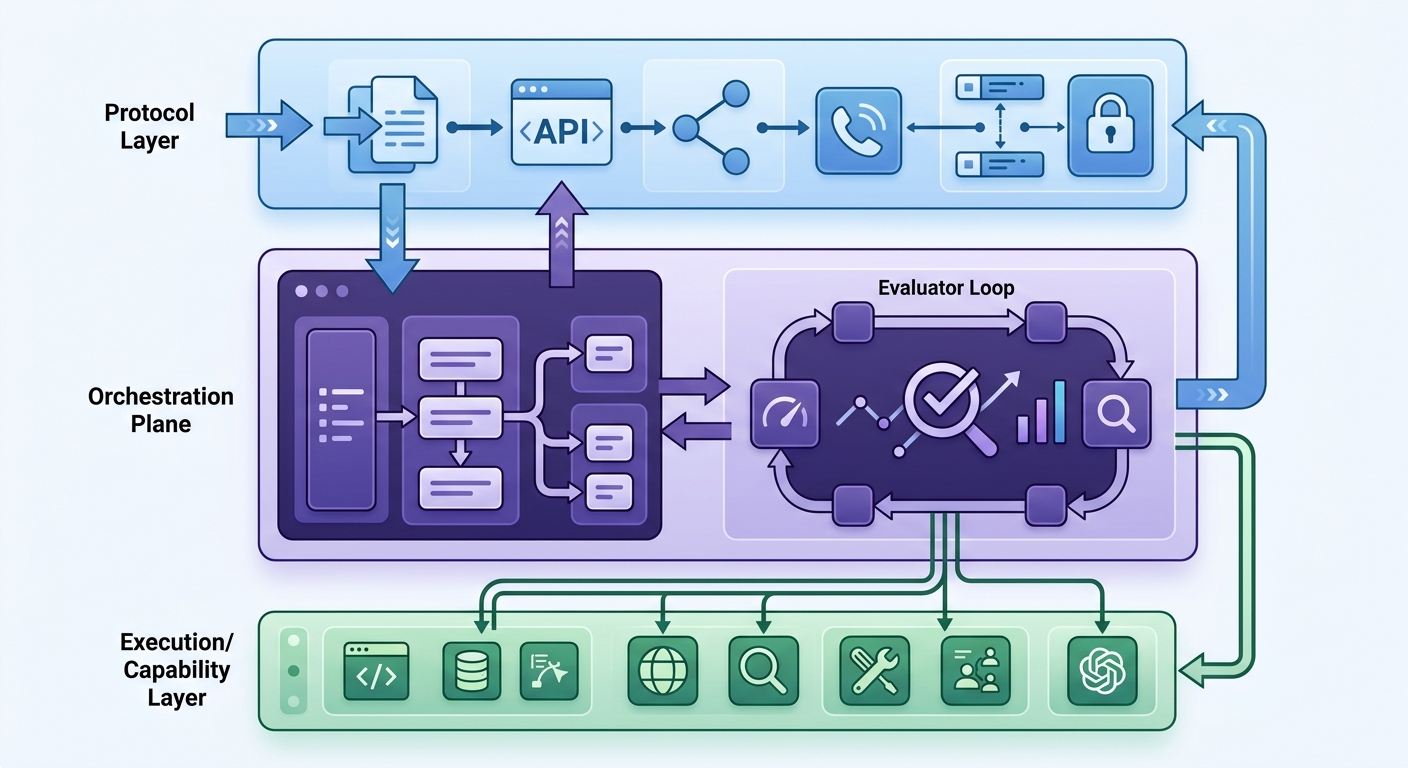
Do not tie your business logic to orchestration details. Layer your system so a framework swap stays cheap. A framework-agnostic architecture decouples business logic from orchestration dependencies.
Start with a protocol layer. Put your tool calls behind MCP or similar standards. Tools become interchangeable. Your agents keep working if orchestration changes.
Next, keep an orchestration plane thin. Treat the framework as an executor, not a design religion. Define your steps in your own terms. Map them to the framework only at the boundary.
Finally, add an evaluator loop. An evaluator checks each output against a goal. It triggers retries or handoff to a human. This loop is framework-independent. It protects quality regardless of the underlying tool.
This design keeps a migration path open. You can switch orchestration without rewriting your agents.
When NOT to Use a Framework
Frameworks add value, not always. Recognize when to skip them.
For a single-step task, a direct model call is simpler. A framework would add overhead with no payoff. For tiny workloads, the cost of learning outweighs the benefit. For hard real-time constraints, a custom runtime gives tighter control.
Rule of thumb: add a framework when coordination cost exceeds its overhead. If your agent is one call, skip it. If it juggles many steps, a framework earns its keep.
How to Decide in One Afternoon
You can make a solid choice quickly. Time-box the process to one afternoon.
- Write two real workflows you must support. Pick one simple and one complex. This grounds your evaluation in reality.
- Prototype each candidate on both. A quick proof of concept reveals the learning curve fast. Note where each framework fights you.
- Run your weighted rubric. Score each candidate on your criteria. Compare totals honestly.
- Check the operational side. Verify tracing, cost controls, and checkpoints. A framework that fails here fails in production.
You will leave with a candidate ranked for your context. Pair it with the framework-agnostic architecture above.
Frequently Asked Questions
Is LangGraph or CrewAI better for production?
Neither is universally better. LangGraph offers more control for complex, stateful flows. CrewAI ships faster for clear, task-based workflows. Score both against your workloads.
Do I need a framework at all?
Only for complex multi-step agents. For single-step tasks, a direct model call is simpler. Add a framework when coordination costs exceed its overhead.
What does MCP do for framework portability?
MCP standardizes how agents connect to tools. By using it, you decouple tools from orchestration. This makes switching frameworks less painful.
How do I estimate an agent's cost per task?
Count tokens per run across your workflows. Multiply by model pricing. Add infrastructure and tool-call costs. This gives a per-task figure for planning.
How hard is it to switch frameworks later?
It depends on your architecture. If your business logic is decoupled, a swap is contained. If logic is tangled with the framework, a rewrite awaits. Design for portability now.
Should my whole team standardize on one framework?
Standardize on a default, but allow exceptions. One default reduces training and review costs. Allow alternatives where the default clearly does not fit.
Conclusion
Choosing an agent framework in 2026 is a production decision. The landscape offers graphs, task pipelines, protocols, and custom runtimes. None is universally best.
Use the weighted rubric against your real workloads. Account for cost, observability, and recovery. Keep an architecture that stays portable.
The right choice is the one that fits your context. Score it, prototype it, and plan for operations. That is the durable way to pick.
If you want more practical guidance like this, subscribe to the Algorithmine portal. You will get implementation-focused analysis on agent systems and production AI, delivered to your inbox. It is the simplest way to keep your toolbox current.
