Inside a 40-Agent Design Studio: What Breaks When AI Handoffs Hit Production
A 40-agent design studio's production failures—context loss, silent errors, and orchestration drift—plus the fixes that held up under real load.
The 40-Agent Studio That Almost Shipped Garbage
When a mid-sized brand and product design studio rebuilt its production pipeline around 40 specialized AI agents, the prototype looked flawless. Work that once took a week moved through the system in hours. Then they turned it on for real client deliverables, and things started breaking in ways nobody had modeled.
I spent several sessions with the studio's operations lead and two senior designers who owned the rollout. Their conclusion was blunt: in their accounting, almost none of the failures were model failures. The models did what they were told. What failed was everything around the models — how context moved between agents, how errors compounded invisibly, how routing logic quietly drifted, and how human review collapsed into a rubber stamp under volume.
This is a first-hand account of that transition from demo to production. It's a single case study, not a benchmark — but the failure modes are common enough that most teams running multi-agent systems will recognize them. We'll walk through the studio's setup, then the four breakpoints that surfaced under real load: context loss at handoffs, silent failures, orchestration drift and ownership gaps, and human review bottlenecks. Each one has a fix that held up — and a lesson any team running multi-agent systems in production should steal before they hit the same wall.
The Studio Setup: How 40 Agents Actually Fit Together
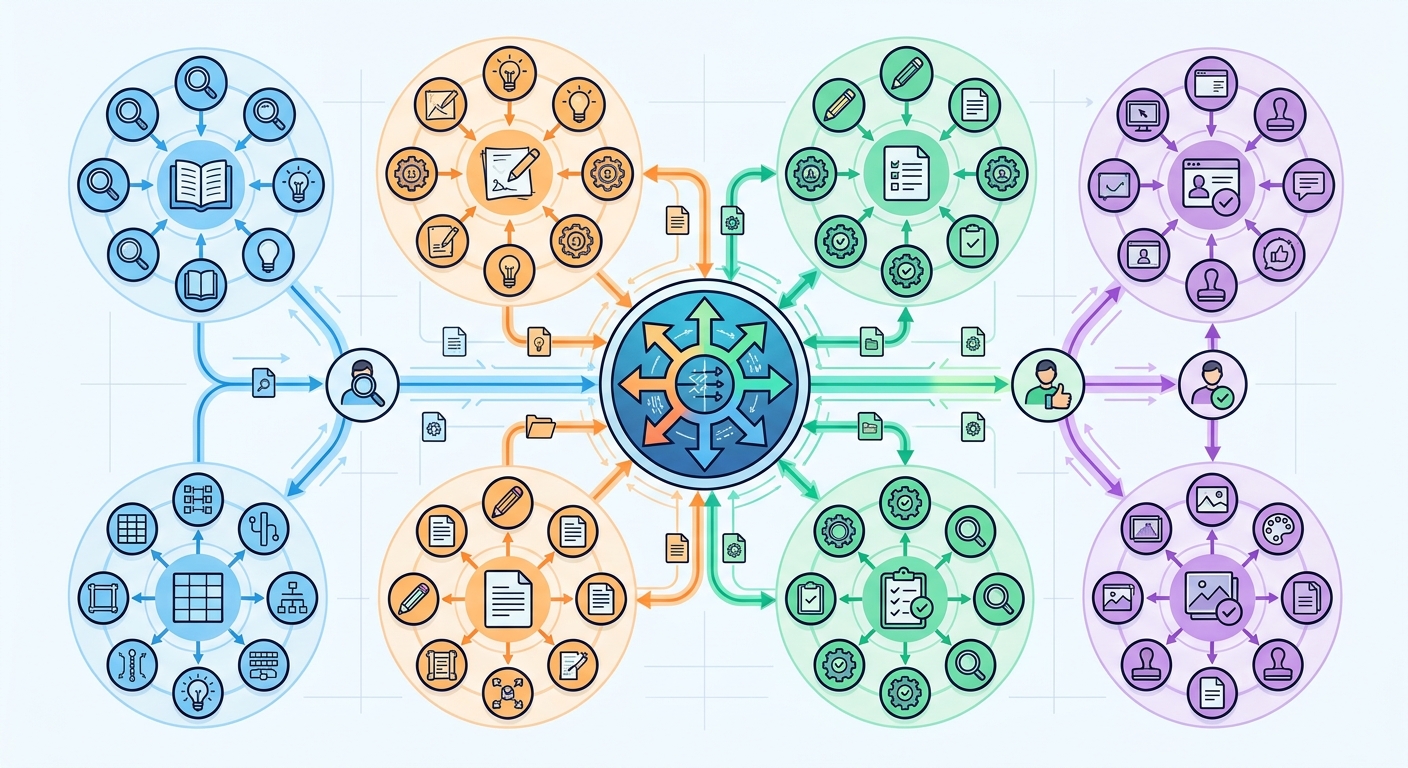
The roster wasn't 40 generalists. It was a set of narrow specialists organized into functional clusters: research agents (audience, competitive, and trend scanning), concepting agents (moodboards, directions, narrative angles), layout and composition agents, copy agents, asset-generation agents, QA agents, and a final review cluster. Each agent had a defined input schema, a defined output, and a narrow job.
Roles, Boundaries, and the Orchestration Layer
Above the agents sat an orchestration layer — a routing and sequencing service that decided which agent ran when, passed artifacts downstream, handled retries, and logged state. When a research agent finished an audience brief, the orchestrator routed it to the concepting cluster, fanned work out to parallel layout and copy agents, then reassembled outputs for QA.
The design principle was clean: agents don't talk to each other directly. They hand artifacts to the orchestrator, which hands them to the next agent. That centralization made the system debuggable — and it's also where two of the four breaks originated. The catch is that a centralized router is only as good as the payload it forwards; if it passes the artifact but drops the reasoning, the centralization hides the loss rather than preventing it. (See our guide to designing reliable multi-agent orchestration layers.)
Where the Human in the Loop Sits
Humans sat at three points: brief intake (a designer translates the client ask into structured inputs), mid-pipeline checkpoints (concept direction approval before layout and copy commit), and final approval before anything left the studio. On paper, that's a healthy human-in-the-loop design. In practice, the middle checkpoint became the pressure point once volume scaled. (Related: human-in-the-loop review patterns for AI workflows.)
"We built the agents to be autonomous and the humans to be the safety net. We didn't build the humans to actually catch things at the speed the system produced them." — Studio operations lead
Break #1 — Context Loss at Agent Handoffs
The first break was the most predictable and the most damaging: handoffs stripped context. A downstream agent received the artifact — the brief, the concept, the layout — but not the reasoning behind it. It didn't know which constraints were hard, which alternatives had been rejected, or why a decision was made.
What the Studio Observed
The mechanism is mundane, and that's what makes it dangerous. Most orchestration setups pass only the latest message or the latest artifact between steps. The receiving agent then reconstructs intent from a lossy summary — and reconstruction is where drift enters. The system was preserving artifact state (what was produced) while silently discarding decision state (why, under what constraints, and against what alternatives).
Symptoms showed up as rework loops and brand drift. A copy agent would write against a concept the layout agent had already abandoned. A layout agent would violate a client constraint that lived only in a research agent's notes. Outputs contradicted each other across stages, and nobody could trace where the divergence started. The team was re-running stages constantly, burning tokens and time to recover information that had existed upstream but never traveled.
The Fix That Held Up Under Load
The studio replaced raw-output handoffs with structured handoff payloads — an explicit schema carrying not just the artifact but the decisions, constraints, provenance, and rejected alternatives. Every handoff now includes:
- The artifact itself, versioned
- Hard constraints the downstream agent must not violate
- Key decisions and rationale made upstream
- Rejected alternatives, so agents don't re-propose dead ends
- Provenance links back to the source request and prior stages
The tradeoff is real: carrying rationale inflates every payload and adds tokens and latency to each hop. The studio accepted that cost because re-running a stage after a drift incident was more expensive still. The lesson is simple and portable: an agent handoff is a contract, not a file transfer. If downstream agents can't see why, they will confidently undo your work. (More on this: context engineering for multi-agent systems.)
Break #2 — Silent Failures and Confident Wrong Output
The second break is the one that scares production teams most. Multi-agent systems don't usually crash. They compound small errors and present them fluently. A slightly off research summary becomes a slightly off concept, which becomes a confidently wrong deliverable that reads perfectly.
Why Multi-Agent Systems Fail Quietly
Loud failures — timeouts, exceptions, malformed outputs — are easy. They trip alarms. Silent failures are plausible-but-wrong: a layout that technically renders but violates a brand rule, a copy block that's on-voice but factually off. Each agent inherits a small upstream error and builds on it, and by the final stage the error is buried under layers of fluent output. Failures surfaced late, at final review, when fixing them was most expensive.
Part of the problem is that "looks good" and "is correct" are different properties, and language models are far better at the first. A reviewer — human or model — reading a polished deliverable is primed to approve it. The fluency that makes the output shippable is the same fluency that hides the defect.
Verification Gates Before Handoff
The fix was to stop relying on downstream review to catch upstream errors. The studio inserted verification gates at each cluster boundary — deterministic checks that run before an artifact is allowed to move on:
- Constraint validation against the hard-constraint list carried in the handoff payload, checked programmatically where possible rather than by another model's judgment
- Schema and completeness checks that reject malformed or partial artifacts at the gate, not at final review
- Cross-stage consistency checks that flag when a downstream artifact contradicts an upstream decision or a rejected alternative
- A gate log that records what was checked, what passed, and what was overridden — so a late failure has a traceable origin instead of an unknown one
The principle: make errors loud as early as possible. A defect caught at the gate after a research agent is cheap; the same defect caught at final approval has already been amplified through concept, layout, and copy. Gates don't eliminate silent failures — they convert most of them into loud ones at the cheapest point to fix them.
Break #3 — Orchestration Drift and Ownership Gaps
The third break was the slowest to notice and the hardest to pin on anyone: the routing logic drifted, and nobody owned it.
What Drifted
The orchestration layer wasn't static. Retry logic, fan-out rules, and fallback paths were adjusted over time — small, reasonable tweaks made under deadline pressure. A retry that was supposed to re-run one agent started re-running a cluster. A fallback path that was meant to be rare became the default whenever an upstream agent ran slow. Individually, each change was defensible. Cumulatively, the pipeline no longer matched the diagram everyone was reasoning about.
The deeper issue was ownership. The orchestration layer sat between functional clusters, so no single designer or engineer was accountable for its behavior end to end. Each team owned its agents; nobody owned the seams. When something went wrong at a seam, the default was to blame the adjacent agent — which is exactly why the studio initially concluded the models were fine and the problem was elsewhere.
The Fix That Held Up Under Load
Two changes held up:
- Treat the orchestration layer as a versioned product, not plumbing. Routing rules, retry policies, and fallback behavior live in version control with review and a changelog, the same as any agent prompt. Drift becomes a diff you can read.
- Assign explicit seam ownership. One named owner is accountable for each handoff boundary and its gate, not just for the agents on either side. When a seam fails, there is a person to route it to, and the "blame the neighbor" reflex has somewhere to land.
The lesson: in a multi-agent system, the most dangerous code is the code nobody owns. The agents get all the attention; the router between them gets none, and that's where the system quietly stops doing what you think it does.
Break #4 — Human Review Collapsing Under Volume
The fourth break was the one the studio expected least, because the humans were supposed to be the safety net. Under volume, the safety net became a rubber stamp.
Why Review Broke
The middle checkpoint — concept direction approval before layout and copy commit — was designed for a human who had time to think. At production volume, that human faced a queue of artifacts produced faster than they could be meaningfully reviewed. Reviewers did what anyone does under a backlog: they skimmed, approved the plausible, and deferred the hard calls. The checkpoint stayed green while catching less and less. The humans weren't failing; the review design was — it assumed unlimited reviewer attention and gave them no way to spend it where it mattered.
The Fix That Held Up Under Load
The studio stopped treating human review as a uniform gate and started treating it as a budgeted, risk-weighted resource:
- Route by risk, not by queue order. Artifacts flagged by a verification gate, or touching a hard constraint, jump the line for real human attention. Routine, gate-clean artifacts get a lighter-touch check.
- Time-box and sample explicitly. Rather than pretending every artifact gets equal scrutiny, the studio defined which categories get full review and which get sampled — and made that policy visible so nobody assumed coverage that didn't exist.
- Give reviewers the decision state, not just the artifact. Because handoff payloads now carry rationale, constraints, and rejected alternatives, a reviewer can check a decision against its reasoning in seconds instead of reconstructing intent from scratch.
This is where the four fixes reinforce each other. Structured payloads make gates possible; gates make risk-routing possible; risk-routing is what lets human review stay meaningful at volume. Fix any one in isolation and the others still break.
What to Steal Before You Hit the Same Wall
The studio's system didn't fail because the models were weak. It failed because the connective tissue — handoffs, gates, routing ownership, and review design — was built for a demo and run in production. Four lessons travel:
- An agent handoff is a contract, not a file transfer. Carry decision state, not just artifact state, or downstream agents will confidently undo upstream work.
- Make errors loud early. Verification gates at cluster boundaries convert silent, compounding failures into cheap, traceable ones.
- Own the seams. Version the orchestration layer and name an owner for every handoff boundary; the router is where systems quietly drift.
- Budget human attention by risk. A safety net that catches everything in theory catches nothing at volume — route scrutiny to where it changes the outcome.
None of these are model problems, which means none of them are solved by a better model. They're systems problems, and they're yours to design — ideally before a client deliverable is the thing that surfaces them.