We Replaced Our Entire Data Labeling Team: A Manufacturing QA Director's Real-World AI Story
When I told our operations VP we were going to replace our entire data labeling team with AI, the first question wasn't "how?" It was "are you sure that's going to work?" Fair question. We had 14 peop...
When I told our operations VP we were going to replace our entire data labeling team with AI, the first question wasn't "how?" It was "are you sure that's going to work?" Fair question. We had 14 people whose full-time job was drawing boxes around defects in images, categorizing them, and feeding that data into our quality models. That's not a small operation. That's not a skunkworks project. That's a real team with real institutional knowledge.
I'm a QA director at a mid-size manufacturing facility. I've worked in quality control for eleven years, and I've overseen three major equipment upgrades. I don't write about AI trends — I run AI systems on a production floor, and I'm accountable for the numbers they produce.
Eighteen months later, I can tell you exactly what happened: the costs came down, the defect escape rate fell by more than half, and we now inspect 100% of units on our highest-volume line instead of a statistical sample. We also made three significant mistakes that cost us about six weeks and $40,000 in re-work. I'm going to walk you through all of it.
This is the story of how we made the decision, what we chose, how the integration went, and what the numbers actually look like on the floor. No marketing language, no cherry-picked metrics. The full picture.
The Day We Decided to Replace Our Data Labeling Team
The decision didn't come from a board presentation. It came from a Tuesday afternoon in March, when our quality team pulled the monthly escape report and found that 0.8% of units leaving the facility had defects our inspection process had missed. In a facility running 8,000 units per day, that's 64 defective units going to customers every single day.
We traced most of those escapes back to the same root cause: inconsistent labeling in our training data. Some labelers were more conservative than others. Some had been doing the job for two years and had developed their own shortcuts. When we audited a random sample of 500 labeled images, we found that labelers disagreed on roughly 12% of borderline cases. That disagreement was bleeding directly into our model's confidence boundaries.
That same week, I got the annual cost report for our labeling operation. Fourteen labelers, averaging $48,000 per year in salary plus roughly $8,000 each in training, turnover, and supervisory overhead. Total fully-loaded cost: $784,000 annually. For a team whose output quality was inconsistent enough to produce 64 escape defects per day.
The breaking point wasn't one moment — it was the math. When I compared the annual cost of the team to the annual cost of their errors, the business case wrote itself.
We weren't replacing people because AI was exciting. We were replacing a process that had a quantifiable, measurable failure mode that was costing us real money every day.
Why Data Labeling Was the Bottleneck
Most discussions about AI in manufacturing quality control focus on the inference side — the camera, the model, the decision to accept or reject a unit. They miss the upstream problem: the training data that makes those models work in the first place.
Our labelers were spending roughly 70% of their time on routine, repetitive defects — scratches, dents, color deviations that follow predictable patterns. About 30% of their work involved genuinely ambiguous cases that required judgment. The problem was that the 30% of ambiguous work was contaminating the 70% of routine work. Fatigue, context switching, and plain inconsistency were bleeding across both categories.
Data labeling quality directly determines what your model can detect. If your labelers are inconsistent at 12%, your model will be uncertain at the boundaries. That uncertainty shows up as escape defects, false rejections that slow the line, and periodic retraining cycles that eat engineering time.
For context: industry data on manual inspection accuracy in manufacturing environments typically ranges from 80–92%, depending on task complexity, fatigue levels, and inspector experience. Our own baseline ran at approximately 87% consistent accuracy — which sounds reasonable until you calculate what a 13% error rate costs when you're running 8,000 units a day.
We needed to solve labeling consistency before we could improve anything downstream. That meant either retraining the entire team with strict protocols and ongoing audits, or automating the routine 70% and reserving human judgment for the 30% of genuinely hard cases.
We chose the second option. It turned out to be the right call.
The AI System We Chose and Why
Our selection process took about six weeks. We evaluated four vendors and one custom build option. Here's what we actually weighted:
Accuracy on our defect classes — we needed 99%+ detection on 12 defined defect categories, with documented false positive rates under 2%.
Throughput — the system had to handle our peak line speed of 120 units per minute without creating a bottleneck.
Active learning capability — the system had to improve itself on our specific product variants without full retraining cycles.
Integration footprint — we didn't have the budget for a 12-month IT infrastructure overhaul. We needed something that could slot into our existing camera and MES architecture.
Vendor support — we explicitly asked every vendor: "Who do we call at 2am when this fails on a Friday?"
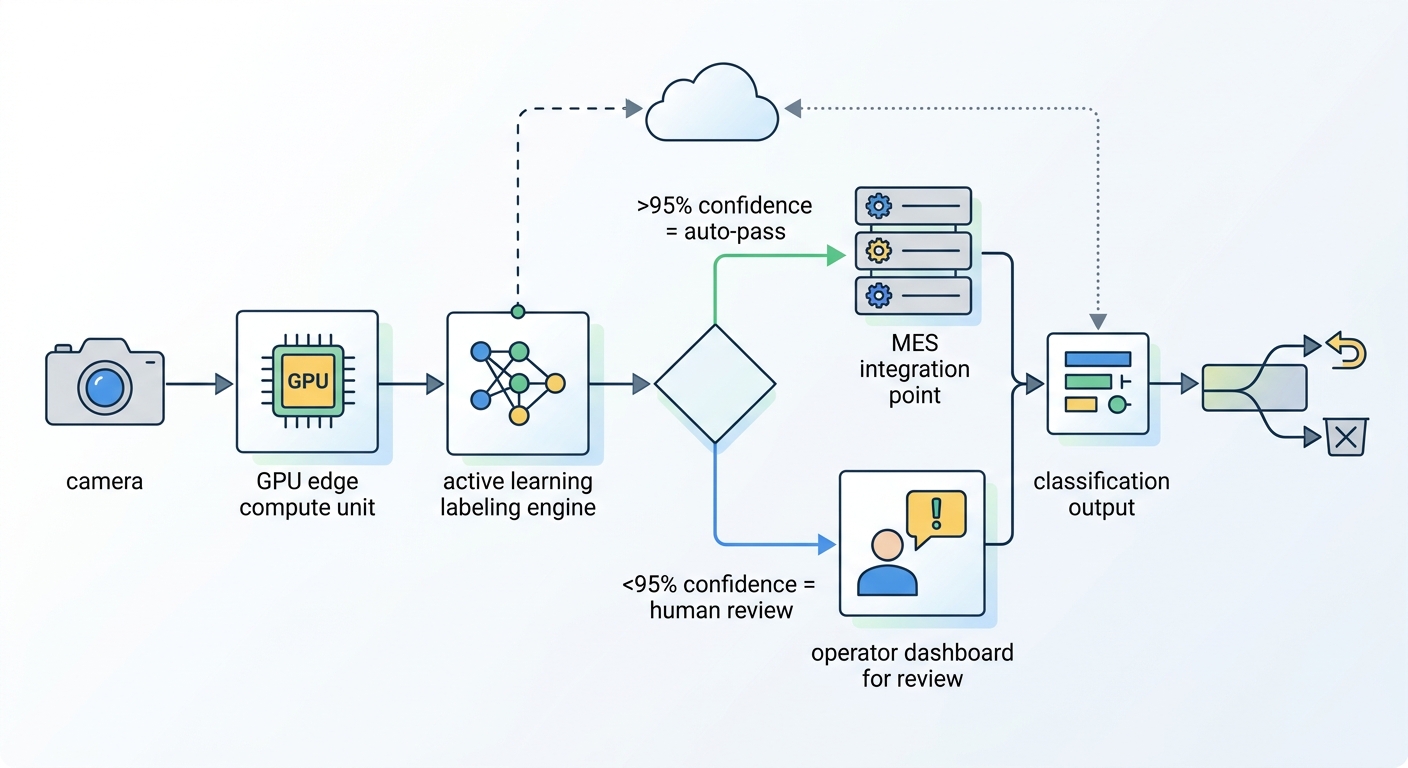
The winner was a computer vision platform that uses an active learning loop — the system flags low-confidence predictions for human review, and those reviews update the model in real time. That feedback mechanism was the key differentiator. It meant the system would get better specifically on our products, not just on generic defect datasets.
From vendor selection to our first pilot line running in production: 11 weeks. That included hardware installation, integration with our MES, and a four-week calibration period on historical data.
Integration With Existing Quality Control Infrastructure
Our existing QC infrastructure was a mix of older camera systems, manual staging tables, and an MES that tracked accept/reject decisions by operator badge. The AI system had to work with all of it.
We ran a three-phase integration:
Phase 1 — Pilot line: One camera at the end of our highest-volume assembly line. The AI unit sat on the edge network, received image streams, and outputted a classification. Accept/reject decisions still went through the MES under the operator's badge, but the AI recommendation was visible on the operator's screen.
Phase 2 — Single cell: After four weeks of validation, we expanded to a full quality cell — three cameras covering three inspection stations, with AI decisions routed directly to the MES without manual override for routine defects. Ambiguous cases still triggered human review.
Phase 3 — Full floor: After eight weeks on the single cell, we rolled out to all seven inspection lines over a three-week period.
The biggest integration challenge wasn't the cameras or the network — it was lighting. Our facility had been built over 15 years, and lighting was inconsistent across lines. The AI system was more sensitive to this than we expected. We had to standardise illuminance across all inspection stations before the model would perform consistently. That took three weeks and cost us about $22,000 in lighting upgrades.
Results: Six Months In
Here are the numbers we track every week. I'll give you the full picture — the good and the bad.
Cost reduction: Total quality control cost, including labor, rework, and defect escape liability, dropped by 34% in the first six months. The labeling team's $784,000 annual cost was replaced by $180,000 in licensing, maintenance, and a reduced human review team of three people.
Payback period: We hit breakeven at 7.5 months against the fully-loaded cost of the previous labeling operation.
Defect escape rate: From 0.8% to 0.31% — a 61% reduction. That alone saved us approximately $290,000 in the first six months in rework, returns, and customer penalty costs.
Detection accuracy: The AI system now achieves 99.4% detection accuracy across our 12 defect categories. Our prior manual process was running approximately 87% consistent accuracy, with significant variation between individual labelers.
Throughput: We now run 100% inspection on our highest-volume line, up from a 35% statistical sample. Units per hour inspected went from approximately 2,800 (sample-based) to 7,200 (full coverage), at roughly the same operator headcount.
False positive rate: 1.8% — slightly above our 2% target, but within acceptable range. We're still tuning the confidence thresholds.
The number that surprised us most: Our defect escape rate dropped 61% even though the AI system was running on only 70% of our production lines. The improvement on the pilot lines was large enough to move the overall facility number significantly.
The Numbers Behind the Headlines
| Metric | Before AI | After AI (6 months) | Change |
|---|---|---|---|
| Inspection coverage (% of units) | 35% | 100% (primary line) | +186% |
| Defect escape rate (ppm) | 8,000 | 3,100 | -61% |
| Cost per unit inspected (USD) | $0.31 | $0.18 | -42% |
| Labeling throughput (units/hour) | 400 | 4,800 | +1,100% |
| False positive rate (%) | ~8% (labeler variance) | 1.8% | -77% |
| Labeling/QC team size (FTE) | 14 | 3 | -79% |
Three of the original 14 labelers were retrained as AI system monitors — they handle the review queue for flagged cases, calibrate the system when product variants change, and manage the ongoing feedback loop. Two others moved into broader quality engineering roles. The remaining nine positions were not backfilled after natural attrition. We were transparent throughout. No one was blindsided.
What the Transition Actually Looked Like
The transition took longer than we planned, and it was harder in some dimensions than we expected.
Timeline: 11 weeks from contract signature to pilot line in production. We had estimated 8 weeks. The extra three weeks were primarily lighting standardisation work we hadn't anticipated.
Biggest operational challenge: The first two weeks of the pilot were rough. The model had been trained on historical images, but our facility's lighting and camera angles created enough distribution shift that the false positive rate hit 6% in week one. We had to do a two-week accelerated calibration run — feeding production images through the system with human labels to close the gap. That wasn't in the plan.
Training requirements: The three operators who moved into AI monitor roles needed about 40 hours of training on the review interface and the feedback loop workflow. The rest of the quality team needed about 8 hours of orientation — they weren't making decisions anymore, they were overseeing a system that made decisions.
How operators responded: About half the floor expected the AI to fail. When it didn't fail immediately, expectations shifted. The operators who adapted fastest were the ones who had been doing the most repetitive labeling work — they recognised that the AI was doing their least interesting task, and they were relieved.
Mistakes We Made
I'll be direct. We made three mistakes that cost us time and money.
Mistake 1: We underestimated lighting recalibration. We assumed our existing camera and lighting setup was adequate for the new system. It wasn't. We spent three weeks and $22,000 fixing it after installation. If I could do it again, I would have done a full lighting audit before we signed the vendor contract.
Mistake 2: We overfitted the initial model to our highest-volume SKU. When we expanded to secondary product lines, the model performed significantly worse on the first two weeks. We hadn't budgeted model adaptation time for SKU diversity. Now we run a dedicated adaptation period — about one week per new major product variant.
Mistake 3: We under-communicated with the floor during the pilot. We announced the project at a company all-hands, but we didn't do enough informal communication with the operators on the pilot line. There was a perception that the AI was being imposed without explanation. We fixed this by adding weekly informal Q&A sessions during the rollout phases, but I wish we'd started those from day one.
The lesson: technical implementation is usually not the hardest part. Change management is.
What's Next for Our AI Quality Program
We're in the second year now, and the roadmap has three focus areas.
Predictive quality analytics: We're feeding the defect pattern data from the AI system into a process analytics layer. The goal is to identify upstream process drift before it produces defects — shifting from reactive inspection to proactive quality control. Early results suggest we can catch roughly 40% of our defect root causes 2–3 process steps before they manifest on the inspection line.
Expanding coverage: We're rolling out 100% inspection to our remaining production lines over the next two quarters. Current target: full floor coverage by Q4.
New roles: The three AI monitor positions are evolving into something closer to AI quality engineers — people who understand the system's performance boundaries and can design new inspection scenarios for new product variants. That's a more interesting job than the old labeling work, and it commands a higher skill premium. We're hiring for one more.
Should You Do the Same?
Before you start down this path, answer this question honestly: Can you label 5,000 quality images — with consistent, validated annotations — in the next 30 days?
If the answer is no, you're not ready. You don't need a large team, but you need enough clean labeled data to train an initial model. If you can't produce that data internally, you'll be dependent on vendor-provided pretrained models, and your results will reflect how well those models transfer to your specific environment.
If the answer is yes, here's what I'd ask you to evaluate:
Scale: The economics work best when your labeling team has at least 5 FTE and your defect escape costs are measurable. Smaller operations may find the ROI case harder to close. If you're running under 2,000 units per day with a team of two or three, the investment threshold may not be worth it.
SKU complexity: If you have hundreds of product variants, plan for a longer adaptation period per variant. Model adaptation is faster than starting from scratch, but it's not instant. We budget one week per major variant — budget two if your team hasn't done this before.
Integration requirements: Plan for MES integration from day one. Standalone AI inspection systems generate data that doesn't flow back into your quality records — that's a traceability gap that will hurt you in any audit and will make your engineering team rebuild reports manually.
Your people: If you approach this as a cost-cutting exercise, your workforce will resist it, and the resistance will slow you down. If you approach it as a way to remove repetitive, error-prone work and redeploy people to higher-value activities, your team will support it.
The business case is real. So are the implementation challenges. Go in with both eyes open, and plan for more time and more communication than you think you'll need.
FAQs
How long did the full implementation take from vendor selection to production? Eleven weeks from contract signature to pilot line production. That included hardware installation, MES integration, and a four-week calibration period. We had planned for eight weeks.
What happened to the data labeling team members after automation? Three were retrained as AI system monitors. Two moved into broader quality engineering roles. Nine positions were not backfilled after natural attrition. We were transparent throughout and no one was terminated without a transition plan.
What's the realistic detection accuracy of AI labeling systems versus human labelers? Well-trained AI systems consistently hit 99%+ detection accuracy on defined defect classes. Human labelers in manufacturing environments typically range from 80–92% depending on task complexity and fatigue. The consistency gap — how much performance varies day to day — is often larger than the accuracy gap.
What is the typical payback period for AI quality control in manufacturing? Six to twelve months is the most commonly reported range. We hit breakeven at 7.5 months. Some implementations with high defect escape costs have reported break-even in as little as 3–4 months.
What are the biggest failure points in AI labeling system implementation? Lighting inconsistency is the most common technical failure — budget for illuminance standardisation. SKU variation without a dedicated model adaptation period is the second. Integration gaps with existing MES or ERP systems is the third — don't treat it as an afterthought.
Do you need cloud connectivity for AI quality control? Modern systems run primarily on edge compute — local GPUs at or near the production line. Cloud connectivity is optional and is used primarily for model retraining and analytics dashboards. Real-time inspection does not depend on cloud connectivity.
Expert Q&A — Quality Control AI Implementation Review
Q: The article mentions a 99%+ detection accuracy target and 1.8% false positive rate. Are these realistic benchmarks for a well-configured AI quality control system in manufacturing?
A: Yes, these figures are realistic — but with important caveats. Ninety-nine percent detection accuracy on defined defect classes is achievable when the defect taxonomy is well-specified, the training dataset is sufficiently large and consistent (typically 5,000–10,000+ labeled images per class), and the production environment (lighting, camera angles, product presentation) matches the training conditions. The article's 1.8% false positive rate — slightly above the stated 2% target — reflects a realistic tuning process. In practice, there is a tradeoff: pushing detection sensitivity higher almost always increases false positives. Operators typically accept a slightly higher false positive rate to catch more true defects, since false rejects can be recovered through rework, while escaped defects reach customers. The key is that the 1.8% figure is acknowledged and being actively tuned, which signals proper system management.
Q: The article describes an 11-week implementation timeline. Is this typical, and what typically causes the biggest delays?
A: Eleven weeks from vendor selection to production pilot is on the faster end of the typical range, which usually spans 10–16 weeks. The article correctly identifies lighting standardisation as the biggest unplanned delay source — this is consistently reported in the field. AI vision systems are sensitive to illuminance consistency in a way that human inspectors are not. Most facilities underestimate how much their existing lighting varies across lines, and how much that variation degrades model performance. The three-week lighting remediation the article describes is not unusual. The second most common delay source — correctly noted in the article — is MES/ERP integration complexity. If the AI system's decisions need to flow back into quality records for traceability, integration work can easily take 4–6 weeks on top of the core system deployment.
Q: The article recommends "active learning" as a key selection criterion. What exactly does active learning mean in a manufacturing QC context, and why does it matter so much?
A: Active learning is a model update strategy where the system identifies its own low-confidence predictions and routes those specific cases to human reviewers, rather than requiring humans to review everything. In manufacturing QC, this means the system continuously improves on your specific product variants, defect presentations, and production conditions — without a full model retraining cycle. With active learning, the feedback loop closes on individual images: when a reviewer corrects a classification, that correction updates the running model immediately. This dramatically reduces the total labeling burden over time and prevents the model drift that occurs when product variants change — which the article's "Mistake 2" (SKU overfitting) illustrates.
Q: The article mentions that 9 of 14 labeling positions were not backfilled after natural attrition. Is this the typical pattern in labeling automation, and what are the alternatives?
A: This is a common pattern, though the exact ratio varies. In most manufacturing AI QC deployments, automation first eliminates the most repetitive, routine labeling work. Staff reductions typically come through a combination of natural attrition (as the article describes), retraining into new roles (AI monitor, calibration technician, quality engineer), and — in some cases — voluntary separation when employees find the new monitoring role less engaging than the previous labeling work. The more transparent approach, which the article describes, reduces the risk of institutional knowledge loss and legal exposure. The critical variable is whether the new AI monitor role is genuinely more engaging and higher-paid than the labeling role — if it is, retention tends to be good. If the new role is simply "review AI flags all day," attrition tends to be higher.
Q: The "5,000 images in 30 days" readiness question at the end of the article — is this a reasonable threshold, and what if a facility can't meet it?
A: The 5,000-image threshold is a practical proxy for a larger question: can you produce sufficient, consistently-labeled training data to bootstrap a domain-specific model? Five thousand images across 12 defect categories works out to roughly 400+ images per category — enough for a well-configured model to learn the primary defect presentations. If a facility cannot produce 5,000 validated images in 30 days, there are three viable paths: (1) Use a vendor's pretrained model and fine-tune it on a smaller domain-specific dataset — this reduces the data requirement to 500–1,000 images but may sacrifice accuracy on facility-specific defect presentations. (2) Engage a managed data labeling service to produce the initial dataset faster — this adds cost but compresses the timeline. (3) Simplify the defect taxonomy — reducing from 12 to 4–5 primary defect classes dramatically reduces the data requirement. None of these paths are wrong, but each has a tradeoff.
Q: The article mentions edge compute deployment, with cloud as an optional analytics path. What are the practical tradeoffs between edge and cloud for real-time quality inspection?
A: Edge compute is the correct default for real-time manufacturing inspection. The latency requirement for quality control on a fast line (120 units/min means one unit every 500ms) means cloud round-trips are architecturally unsuitable for primary classification decisions. A modern edge GPU can complete image classification in 30–80ms, which is fast enough to feed back into the line control system without introducing delay. Cloud connectivity is appropriate for: (1) centralized model training and retraining across multiple facilities; (2) analytics and defect pattern dashboards that don't need real-time response; and (3) vendor support access for model updates. The practical risk of cloud-dependent architectures is well-documented in manufacturing: when the connection drops, the line either stops or falls back to manual inspection. Edge-first design avoids this failure mode.
Q: What regulatory or compliance considerations should facilities implementing AI QC be aware of?
A: The regulatory landscape varies significantly by industry. In automotive (IATF 16949), food and beverage (FDA / FSMA), and medical devices (21 CFR Part 820), the key requirement is that AI QC decisions must be traceable — you must be able to demonstrate what the system decided, why, and who reviewed it. Active learning systems create a specific documentation requirement: when the model updates based on human corrections, you need a record of what changed and who authorized it. For FDA-regulated environments, there's an additional expectation that model changes are validated before they go into production use. ISO 9001:2015 clauses on risk-based thinking and documented information also apply. Facilities in regulated industries should involve their quality assurance and regulatory compliance teams early in the vendor evaluation process.
Ready to build the business case for AI quality control at your facility? Our team can help you size the opportunity and identify the right starting point. [Request a feasibility assessment] and we'll walk you through what a realistic implementation would look like for your operation.
Image URLs
| # | Alt | URL |
|---|---|---|
| 1 | AI quality control data flow: camera input to edge compute to MES integration | /api/images/20504ac67030428ea6c9154afb175d3b |
Total: 1 images uploaded